mirror of
https://github.com/ggerganov/llama.cpp.git
synced 2026-02-12 14:03:20 +02:00
Compare commits
1 Commits
b3707
...
gg/http-th
| Author | SHA1 | Date | |
|---|---|---|---|

|
731e7528be |
@@ -15,7 +15,7 @@ node('x86_runner1'){ // Running on x86 runner containing latest vecto
|
||||
stage('Running llama.cpp'){
|
||||
sh'''#!/bin/bash
|
||||
module load gnu-bin2/0.1 # loading latest versions of vector qemu and vector gcc
|
||||
qemu-riscv64 -L /softwares/gnu-bin2/sysroot -cpu rv64,v=true,vlen=256,elen=64,vext_spec=v1.0 ./llama-cli -m /home/alitariq/codellama-7b.Q4_K_M.gguf -p "Anything" -n 9 > llama_log.txt # Running llama.cpp on vector qemu-riscv64
|
||||
qemu-riscv64 -L /softwares/gnu-bin2/sysroot -cpu rv64,v=true,vlen=256,elen=64,vext_spec=v1.0 ./main -m /home/alitariq/codellama-7b.Q4_K_M.gguf -p "Anything" -n 9 > llama_log.txt # Running llama.cpp on vector qemu-riscv64
|
||||
cat llama_log.txt # Printing results
|
||||
'''
|
||||
}
|
||||
|
||||
@@ -1,16 +1,18 @@
|
||||
ARG UBUNTU_VERSION=22.04
|
||||
|
||||
# This needs to generally match the container host's environment.
|
||||
ARG CUDA_VERSION=12.6.0
|
||||
ARG CUDA_VERSION=11.7.1
|
||||
|
||||
# Target the CUDA build image
|
||||
ARG BASE_CUDA_DEV_CONTAINER=nvidia/cuda:${CUDA_VERSION}-devel-ubuntu${UBUNTU_VERSION}
|
||||
|
||||
FROM ${BASE_CUDA_DEV_CONTAINER} AS build
|
||||
FROM ${BASE_CUDA_DEV_CONTAINER} as build
|
||||
|
||||
# CUDA architecture to build for (defaults to all supported archs)
|
||||
ARG CUDA_DOCKER_ARCH=default
|
||||
# Unless otherwise specified, we make a fat build.
|
||||
ARG CUDA_DOCKER_ARCH=all
|
||||
|
||||
RUN apt-get update && \
|
||||
apt-get install -y build-essential cmake python3 python3-pip git libcurl4-openssl-dev libgomp1
|
||||
apt-get install -y build-essential python3 python3-pip git libcurl4-openssl-dev libgomp1
|
||||
|
||||
COPY requirements.txt requirements.txt
|
||||
COPY requirements requirements
|
||||
@@ -22,12 +24,13 @@ WORKDIR /app
|
||||
|
||||
COPY . .
|
||||
|
||||
# Use the default CUDA archs if not specified
|
||||
RUN if [ "${CUDA_DOCKER_ARCH}" != "default" ]; then \
|
||||
export CMAKE_ARGS="-DCMAKE_CUDA_ARCHITECTURES=${CUDA_DOCKER_ARCH}"; \
|
||||
fi && \
|
||||
cmake -B build -DGGML_CUDA=ON -DLLAMA_CURL=ON ${CMAKE_ARGS} -DCMAKE_EXE_LINKER_FLAGS=-Wl,--allow-shlib-undefined . && \
|
||||
cmake --build build --config Release -j$(nproc) && \
|
||||
cp build/bin/* .
|
||||
# Set nvcc architecture
|
||||
ENV CUDA_DOCKER_ARCH=${CUDA_DOCKER_ARCH}
|
||||
# Enable CUDA
|
||||
ENV LLAMA_CUDA=1
|
||||
# Enable cURL
|
||||
ENV LLAMA_CURL=1
|
||||
|
||||
RUN make -j$(nproc)
|
||||
|
||||
ENTRYPOINT ["/app/.devops/tools.sh"]
|
||||
|
||||
@@ -6,7 +6,7 @@ ARG ROCM_VERSION=5.6
|
||||
# Target the CUDA build image
|
||||
ARG BASE_ROCM_DEV_CONTAINER=rocm/dev-ubuntu-${UBUNTU_VERSION}:${ROCM_VERSION}-complete
|
||||
|
||||
FROM ${BASE_ROCM_DEV_CONTAINER} AS build
|
||||
FROM ${BASE_ROCM_DEV_CONTAINER} as build
|
||||
|
||||
# Unless otherwise specified, we make a fat build.
|
||||
# List from https://github.com/ggerganov/llama.cpp/pull/1087#issuecomment-1682807878
|
||||
@@ -36,7 +36,7 @@ COPY . .
|
||||
# Set nvcc architecture
|
||||
ENV GPU_TARGETS=${ROCM_DOCKER_ARCH}
|
||||
# Enable ROCm
|
||||
ENV GGML_HIPBLAS=1
|
||||
ENV LLAMA_HIPBLAS=1
|
||||
ENV CC=/opt/rocm/llvm/bin/clang
|
||||
ENV CXX=/opt/rocm/llvm/bin/clang++
|
||||
|
||||
|
||||
@@ -1,6 +1,6 @@
|
||||
ARG UBUNTU_VERSION=22.04
|
||||
|
||||
FROM ubuntu:$UBUNTU_VERSION AS build
|
||||
FROM ubuntu:$UBUNTU_VERSION as build
|
||||
|
||||
RUN apt-get update && \
|
||||
apt-get install -y build-essential python3 python3-pip git libcurl4-openssl-dev libgomp1
|
||||
|
||||
@@ -1,44 +0,0 @@
|
||||
ARG ASCEND_VERSION=8.0.rc2.alpha003-910b-openeuler22.03-py3.8
|
||||
|
||||
FROM cosdt/cann:$ASCEND_VERSION AS build
|
||||
|
||||
WORKDIR /app
|
||||
|
||||
COPY . .
|
||||
|
||||
RUN yum install -y gcc g++ cmake make
|
||||
ENV ASCEND_TOOLKIT_HOME=/usr/local/Ascend/ascend-toolkit/latest
|
||||
ENV LIBRARY_PATH=${ASCEND_TOOLKIT_HOME}/lib64:$LIBRARY_PATH
|
||||
ENV LD_LIBRARY_PATH=${ASCEND_TOOLKIT_HOME}/lib64:${ASCEND_TOOLKIT_HOME}/lib64/plugin/opskernel:${ASCEND_TOOLKIT_HOME}/lib64/plugin/nnengine:${ASCEND_TOOLKIT_HOME}/opp/built-in/op_impl/ai_core/tbe/op_tiling:${LD_LIBRARY_PATH}
|
||||
ENV PYTHONPATH=${ASCEND_TOOLKIT_HOME}/python/site-packages:${ASCEND_TOOLKIT_HOME}/opp/built-in/op_impl/ai_core/tbe:${PYTHONPATH}
|
||||
ENV PATH=${ASCEND_TOOLKIT_HOME}/bin:${ASCEND_TOOLKIT_HOME}/compiler/ccec_compiler/bin:${PATH}
|
||||
ENV ASCEND_AICPU_PATH=${ASCEND_TOOLKIT_HOME}
|
||||
ENV ASCEND_OPP_PATH=${ASCEND_TOOLKIT_HOME}/opp
|
||||
ENV TOOLCHAIN_HOME=${ASCEND_TOOLKIT_HOME}/toolkit
|
||||
ENV ASCEND_HOME_PATH=${ASCEND_TOOLKIT_HOME}
|
||||
|
||||
# find libascend_hal.so, because the drive hasn`t been mounted.
|
||||
ENV LD_LIBRARY_PATH=${ASCEND_TOOLKIT_HOME}/runtime/lib64/stub:$LD_LIBRARY_PATH
|
||||
|
||||
RUN echo "Building with static libs" && \
|
||||
source /usr/local/Ascend/ascend-toolkit/set_env.sh --force && \
|
||||
cmake -B build -DGGML_CANN=ON -DBUILD_SHARED_LIBS=OFF && \
|
||||
cmake --build build --config Release --target llama-cli
|
||||
|
||||
# TODO: use image with NNRT
|
||||
FROM cosdt/cann:$ASCEND_VERSION AS runtime
|
||||
COPY --from=build /app/build/bin/llama-cli /llama-cli
|
||||
|
||||
ENV LC_ALL=C.utf8
|
||||
|
||||
ENV ASCEND_TOOLKIT_HOME=/usr/local/Ascend/ascend-toolkit/latest
|
||||
ENV LIBRARY_PATH=${ASCEND_TOOLKIT_HOME}/lib64:$LIBRARY_PATH
|
||||
ENV LD_LIBRARY_PATH=${ASCEND_TOOLKIT_HOME}/lib64:${ASCEND_TOOLKIT_HOME}/lib64/plugin/opskernel:${ASCEND_TOOLKIT_HOME}/lib64/plugin/nnengine:${ASCEND_TOOLKIT_HOME}/opp/built-in/op_impl/ai_core/tbe/op_tiling:${LD_LIBRARY_PATH}
|
||||
ENV PYTHONPATH=${ASCEND_TOOLKIT_HOME}/python/site-packages:${ASCEND_TOOLKIT_HOME}/opp/built-in/op_impl/ai_core/tbe:${PYTHONPATH}
|
||||
ENV PATH=${ASCEND_TOOLKIT_HOME}/bin:${ASCEND_TOOLKIT_HOME}/compiler/ccec_compiler/bin:${PATH}
|
||||
ENV ASCEND_AICPU_PATH=${ASCEND_TOOLKIT_HOME}
|
||||
ENV ASCEND_OPP_PATH=${ASCEND_TOOLKIT_HOME}/opp
|
||||
ENV TOOLCHAIN_HOME=${ASCEND_TOOLKIT_HOME}/toolkit
|
||||
ENV ASCEND_HOME_PATH=${ASCEND_TOOLKIT_HOME}
|
||||
|
||||
ENTRYPOINT ["/llama-cli" ]
|
||||
@@ -1,37 +0,0 @@
|
||||
ARG UBUNTU_VERSION=22.04
|
||||
# This needs to generally match the container host's environment.
|
||||
ARG CUDA_VERSION=12.6.0
|
||||
# Target the CUDA build image
|
||||
ARG BASE_CUDA_DEV_CONTAINER=nvidia/cuda:${CUDA_VERSION}-devel-ubuntu${UBUNTU_VERSION}
|
||||
# Target the CUDA runtime image
|
||||
ARG BASE_CUDA_RUN_CONTAINER=nvidia/cuda:${CUDA_VERSION}-runtime-ubuntu${UBUNTU_VERSION}
|
||||
|
||||
FROM ${BASE_CUDA_DEV_CONTAINER} AS build
|
||||
|
||||
# CUDA architecture to build for (defaults to all supported archs)
|
||||
ARG CUDA_DOCKER_ARCH=default
|
||||
|
||||
RUN apt-get update && \
|
||||
apt-get install -y build-essential git cmake
|
||||
|
||||
WORKDIR /app
|
||||
|
||||
COPY . .
|
||||
|
||||
# Use the default CUDA archs if not specified
|
||||
RUN if [ "${CUDA_DOCKER_ARCH}" != "default" ]; then \
|
||||
export CMAKE_ARGS="-DCMAKE_CUDA_ARCHITECTURES=${CUDA_DOCKER_ARCH}"; \
|
||||
fi && \
|
||||
cmake -B build -DGGML_CUDA=ON ${CMAKE_ARGS} -DCMAKE_EXE_LINKER_FLAGS=-Wl,--allow-shlib-undefined . && \
|
||||
cmake --build build --config Release --target llama-cli -j$(nproc)
|
||||
|
||||
FROM ${BASE_CUDA_RUN_CONTAINER} AS runtime
|
||||
|
||||
RUN apt-get update && \
|
||||
apt-get install -y libgomp1
|
||||
|
||||
COPY --from=build /app/build/ggml/src/libggml.so /libggml.so
|
||||
COPY --from=build /app/build/src/libllama.so /libllama.so
|
||||
COPY --from=build /app/build/bin/llama-cli /llama-cli
|
||||
|
||||
ENTRYPOINT [ "/llama-cli" ]
|
||||
@@ -1,28 +0,0 @@
|
||||
ARG ONEAPI_VERSION=2024.1.1-devel-ubuntu22.04
|
||||
|
||||
FROM intel/oneapi-basekit:$ONEAPI_VERSION AS build
|
||||
|
||||
ARG GGML_SYCL_F16=OFF
|
||||
RUN apt-get update && \
|
||||
apt-get install -y git
|
||||
|
||||
WORKDIR /app
|
||||
|
||||
COPY . .
|
||||
|
||||
RUN if [ "${GGML_SYCL_F16}" = "ON" ]; then \
|
||||
echo "GGML_SYCL_F16 is set" && \
|
||||
export OPT_SYCL_F16="-DGGML_SYCL_F16=ON"; \
|
||||
fi && \
|
||||
echo "Building with static libs" && \
|
||||
cmake -B build -DGGML_SYCL=ON -DCMAKE_C_COMPILER=icx -DCMAKE_CXX_COMPILER=icpx \
|
||||
${OPT_SYCL_F16} -DBUILD_SHARED_LIBS=OFF && \
|
||||
cmake --build build --config Release --target llama-cli
|
||||
|
||||
FROM intel/oneapi-basekit:$ONEAPI_VERSION AS runtime
|
||||
|
||||
COPY --from=build /app/build/bin/llama-cli /llama-cli
|
||||
|
||||
ENV LC_ALL=C.utf8
|
||||
|
||||
ENTRYPOINT [ "/llama-cli" ]
|
||||
84
.devops/llama-cpp-clblast.srpm.spec
Normal file
84
.devops/llama-cpp-clblast.srpm.spec
Normal file
@@ -0,0 +1,84 @@
|
||||
# SRPM for building from source and packaging an RPM for RPM-based distros.
|
||||
# https://docs.fedoraproject.org/en-US/quick-docs/creating-rpm-packages
|
||||
# Built and maintained by John Boero - boeroboy@gmail.com
|
||||
# In honor of Seth Vidal https://www.redhat.com/it/blog/thank-you-seth-vidal
|
||||
|
||||
# Notes for llama.cpp:
|
||||
# 1. Tags are currently based on hash - which will not sort asciibetically.
|
||||
# We need to declare standard versioning if people want to sort latest releases.
|
||||
# 2. Builds for CUDA/OpenCL support are separate, with different depenedencies.
|
||||
# 3. NVidia's developer repo must be enabled with nvcc, cublas, clblas, etc installed.
|
||||
# Example: https://developer.download.nvidia.com/compute/cuda/repos/fedora37/x86_64/cuda-fedora37.repo
|
||||
# 4. OpenCL/CLBLAST support simply requires the ICD loader and basic opencl libraries.
|
||||
# It is up to the user to install the correct vendor-specific support.
|
||||
|
||||
Name: llama.cpp-clblast
|
||||
Version: %( date "+%%Y%%m%%d" )
|
||||
Release: 1%{?dist}
|
||||
Summary: OpenCL Inference of LLaMA model in C/C++
|
||||
License: MIT
|
||||
Source0: https://github.com/ggerganov/llama.cpp/archive/refs/heads/master.tar.gz
|
||||
BuildRequires: coreutils make gcc-c++ git mesa-libOpenCL-devel clblast-devel
|
||||
Requires: clblast
|
||||
URL: https://github.com/ggerganov/llama.cpp
|
||||
|
||||
%define debug_package %{nil}
|
||||
%define source_date_epoch_from_changelog 0
|
||||
|
||||
%description
|
||||
CPU inference for Meta's Lllama2 models using default options.
|
||||
|
||||
%prep
|
||||
%setup -n llama.cpp-master
|
||||
|
||||
%build
|
||||
make -j LLAMA_CLBLAST=1
|
||||
|
||||
%install
|
||||
mkdir -p %{buildroot}%{_bindir}/
|
||||
cp -p main %{buildroot}%{_bindir}/llamaclblast
|
||||
cp -p server %{buildroot}%{_bindir}/llamaclblastserver
|
||||
cp -p simple %{buildroot}%{_bindir}/llamaclblastsimple
|
||||
|
||||
mkdir -p %{buildroot}/usr/lib/systemd/system
|
||||
%{__cat} <<EOF > %{buildroot}/usr/lib/systemd/system/llamaclblast.service
|
||||
[Unit]
|
||||
Description=Llama.cpp server, CPU only (no GPU support in this build).
|
||||
After=syslog.target network.target local-fs.target remote-fs.target nss-lookup.target
|
||||
|
||||
[Service]
|
||||
Type=simple
|
||||
EnvironmentFile=/etc/sysconfig/llama
|
||||
ExecStart=/usr/bin/llamaclblastserver $LLAMA_ARGS
|
||||
ExecReload=/bin/kill -s HUP $MAINPID
|
||||
Restart=never
|
||||
|
||||
[Install]
|
||||
WantedBy=default.target
|
||||
EOF
|
||||
|
||||
mkdir -p %{buildroot}/etc/sysconfig
|
||||
%{__cat} <<EOF > %{buildroot}/etc/sysconfig/llama
|
||||
LLAMA_ARGS="-m /opt/llama2/ggml-model-f32.bin"
|
||||
EOF
|
||||
|
||||
%clean
|
||||
rm -rf %{buildroot}
|
||||
rm -rf %{_builddir}/*
|
||||
|
||||
%files
|
||||
%{_bindir}/llamaclblast
|
||||
%{_bindir}/llamaclblastserver
|
||||
%{_bindir}/llamaclblastsimple
|
||||
/usr/lib/systemd/system/llamaclblast.service
|
||||
%config /etc/sysconfig/llama
|
||||
|
||||
|
||||
%pre
|
||||
|
||||
%post
|
||||
|
||||
%preun
|
||||
%postun
|
||||
|
||||
%changelog
|
||||
@@ -32,13 +32,13 @@ CPU inference for Meta's Lllama2 models using default options.
|
||||
%setup -n llama.cpp-master
|
||||
|
||||
%build
|
||||
make -j GGML_CUDA=1
|
||||
make -j LLAMA_CUDA=1
|
||||
|
||||
%install
|
||||
mkdir -p %{buildroot}%{_bindir}/
|
||||
cp -p llama-cli %{buildroot}%{_bindir}/llama-cuda-cli
|
||||
cp -p llama-server %{buildroot}%{_bindir}/llama-cuda-server
|
||||
cp -p llama-simple %{buildroot}%{_bindir}/llama-cuda-simple
|
||||
cp -p main %{buildroot}%{_bindir}/llamacppcuda
|
||||
cp -p server %{buildroot}%{_bindir}/llamacppcudaserver
|
||||
cp -p simple %{buildroot}%{_bindir}/llamacppcudasimple
|
||||
|
||||
mkdir -p %{buildroot}/usr/lib/systemd/system
|
||||
%{__cat} <<EOF > %{buildroot}/usr/lib/systemd/system/llamacuda.service
|
||||
@@ -49,7 +49,7 @@ After=syslog.target network.target local-fs.target remote-fs.target nss-lookup.t
|
||||
[Service]
|
||||
Type=simple
|
||||
EnvironmentFile=/etc/sysconfig/llama
|
||||
ExecStart=/usr/bin/llama-cuda-server $LLAMA_ARGS
|
||||
ExecStart=/usr/bin/llamacppcudaserver $LLAMA_ARGS
|
||||
ExecReload=/bin/kill -s HUP $MAINPID
|
||||
Restart=never
|
||||
|
||||
@@ -67,9 +67,9 @@ rm -rf %{buildroot}
|
||||
rm -rf %{_builddir}/*
|
||||
|
||||
%files
|
||||
%{_bindir}/llama-cuda-cli
|
||||
%{_bindir}/llama-cuda-server
|
||||
%{_bindir}/llama-cuda-simple
|
||||
%{_bindir}/llamacppcuda
|
||||
%{_bindir}/llamacppcudaserver
|
||||
%{_bindir}/llamacppcudasimple
|
||||
/usr/lib/systemd/system/llamacuda.service
|
||||
%config /etc/sysconfig/llama
|
||||
|
||||
|
||||
@@ -38,9 +38,9 @@ make -j
|
||||
|
||||
%install
|
||||
mkdir -p %{buildroot}%{_bindir}/
|
||||
cp -p llama-cli %{buildroot}%{_bindir}/llama-cli
|
||||
cp -p llama-server %{buildroot}%{_bindir}/llama-server
|
||||
cp -p llama-simple %{buildroot}%{_bindir}/llama-simple
|
||||
cp -p main %{buildroot}%{_bindir}/llama
|
||||
cp -p server %{buildroot}%{_bindir}/llamaserver
|
||||
cp -p simple %{buildroot}%{_bindir}/llamasimple
|
||||
|
||||
mkdir -p %{buildroot}/usr/lib/systemd/system
|
||||
%{__cat} <<EOF > %{buildroot}/usr/lib/systemd/system/llama.service
|
||||
@@ -51,7 +51,7 @@ After=syslog.target network.target local-fs.target remote-fs.target nss-lookup.t
|
||||
[Service]
|
||||
Type=simple
|
||||
EnvironmentFile=/etc/sysconfig/llama
|
||||
ExecStart=/usr/bin/llama-server $LLAMA_ARGS
|
||||
ExecStart=/usr/bin/llamaserver $LLAMA_ARGS
|
||||
ExecReload=/bin/kill -s HUP $MAINPID
|
||||
Restart=never
|
||||
|
||||
@@ -69,9 +69,9 @@ rm -rf %{buildroot}
|
||||
rm -rf %{_builddir}/*
|
||||
|
||||
%files
|
||||
%{_bindir}/llama-cli
|
||||
%{_bindir}/llama-server
|
||||
%{_bindir}/llama-simple
|
||||
%{_bindir}/llama
|
||||
%{_bindir}/llamaserver
|
||||
%{_bindir}/llamasimple
|
||||
/usr/lib/systemd/system/llama.service
|
||||
%config /etc/sysconfig/llama
|
||||
|
||||
|
||||
@@ -1,42 +0,0 @@
|
||||
ARG UBUNTU_VERSION=22.04
|
||||
# This needs to generally match the container host's environment.
|
||||
ARG CUDA_VERSION=12.6.0
|
||||
# Target the CUDA build image
|
||||
ARG BASE_CUDA_DEV_CONTAINER=nvidia/cuda:${CUDA_VERSION}-devel-ubuntu${UBUNTU_VERSION}
|
||||
# Target the CUDA runtime image
|
||||
ARG BASE_CUDA_RUN_CONTAINER=nvidia/cuda:${CUDA_VERSION}-runtime-ubuntu${UBUNTU_VERSION}
|
||||
|
||||
FROM ${BASE_CUDA_DEV_CONTAINER} AS build
|
||||
|
||||
# CUDA architecture to build for (defaults to all supported archs)
|
||||
ARG CUDA_DOCKER_ARCH=default
|
||||
|
||||
RUN apt-get update && \
|
||||
apt-get install -y build-essential git cmake libcurl4-openssl-dev
|
||||
|
||||
WORKDIR /app
|
||||
|
||||
COPY . .
|
||||
|
||||
# Use the default CUDA archs if not specified
|
||||
RUN if [ "${CUDA_DOCKER_ARCH}" != "default" ]; then \
|
||||
export CMAKE_ARGS="-DCMAKE_CUDA_ARCHITECTURES=${CUDA_DOCKER_ARCH}"; \
|
||||
fi && \
|
||||
cmake -B build -DGGML_CUDA=ON -DLLAMA_CURL=ON ${CMAKE_ARGS} -DCMAKE_EXE_LINKER_FLAGS=-Wl,--allow-shlib-undefined . && \
|
||||
cmake --build build --config Release --target llama-server -j$(nproc)
|
||||
|
||||
FROM ${BASE_CUDA_RUN_CONTAINER} AS runtime
|
||||
|
||||
RUN apt-get update && \
|
||||
apt-get install -y libcurl4-openssl-dev libgomp1 curl
|
||||
|
||||
COPY --from=build /app/build/ggml/src/libggml.so /libggml.so
|
||||
COPY --from=build /app/build/src/libllama.so /libllama.so
|
||||
COPY --from=build /app/build/bin/llama-server /llama-server
|
||||
|
||||
# Must be set to 0.0.0.0 so it can listen to requests from host machine
|
||||
ENV LLAMA_ARG_HOST=0.0.0.0
|
||||
|
||||
HEALTHCHECK CMD [ "curl", "-f", "http://localhost:8080/health" ]
|
||||
|
||||
ENTRYPOINT [ "/llama-server" ]
|
||||
@@ -1,34 +0,0 @@
|
||||
ARG ONEAPI_VERSION=2024.1.1-devel-ubuntu22.04
|
||||
|
||||
FROM intel/oneapi-basekit:$ONEAPI_VERSION AS build
|
||||
|
||||
ARG GGML_SYCL_F16=OFF
|
||||
RUN apt-get update && \
|
||||
apt-get install -y git libcurl4-openssl-dev
|
||||
|
||||
WORKDIR /app
|
||||
|
||||
COPY . .
|
||||
|
||||
RUN if [ "${GGML_SYCL_F16}" = "ON" ]; then \
|
||||
echo "GGML_SYCL_F16 is set" && \
|
||||
export OPT_SYCL_F16="-DGGML_SYCL_F16=ON"; \
|
||||
fi && \
|
||||
echo "Building with dynamic libs" && \
|
||||
cmake -B build -DGGML_SYCL=ON -DCMAKE_C_COMPILER=icx -DCMAKE_CXX_COMPILER=icpx -DLLAMA_CURL=ON ${OPT_SYCL_F16} && \
|
||||
cmake --build build --config Release --target llama-server
|
||||
|
||||
FROM intel/oneapi-basekit:$ONEAPI_VERSION AS runtime
|
||||
|
||||
RUN apt-get update && \
|
||||
apt-get install -y libcurl4-openssl-dev curl
|
||||
|
||||
COPY --from=build /app/build/bin/llama-server /llama-server
|
||||
|
||||
ENV LC_ALL=C.utf8
|
||||
# Must be set to 0.0.0.0 so it can listen to requests from host machine
|
||||
ENV LLAMA_ARG_HOST=0.0.0.0
|
||||
|
||||
HEALTHCHECK CMD [ "curl", "-f", "http://localhost:8080/health" ]
|
||||
|
||||
ENTRYPOINT [ "/llama-server" ]
|
||||
@@ -1,31 +0,0 @@
|
||||
ARG UBUNTU_VERSION=jammy
|
||||
|
||||
FROM ubuntu:$UBUNTU_VERSION AS build
|
||||
|
||||
# Install build tools
|
||||
RUN apt update && apt install -y git build-essential cmake wget
|
||||
|
||||
# Install Vulkan SDK and cURL
|
||||
RUN wget -qO - https://packages.lunarg.com/lunarg-signing-key-pub.asc | apt-key add - && \
|
||||
wget -qO /etc/apt/sources.list.d/lunarg-vulkan-jammy.list https://packages.lunarg.com/vulkan/lunarg-vulkan-jammy.list && \
|
||||
apt update -y && \
|
||||
apt-get install -y vulkan-sdk libcurl4-openssl-dev curl
|
||||
|
||||
# Build it
|
||||
WORKDIR /app
|
||||
COPY . .
|
||||
RUN cmake -B build -DGGML_VULKAN=1 -DLLAMA_CURL=1 && \
|
||||
cmake --build build --config Release --target llama-server
|
||||
|
||||
# Clean up
|
||||
WORKDIR /
|
||||
RUN cp /app/build/bin/llama-server /llama-server && \
|
||||
rm -rf /app
|
||||
|
||||
ENV LC_ALL=C.utf8
|
||||
# Must be set to 0.0.0.0 so it can listen to requests from host machine
|
||||
ENV LLAMA_ARG_HOST=0.0.0.0
|
||||
|
||||
HEALTHCHECK CMD [ "curl", "-f", "http://localhost:8080/health" ]
|
||||
|
||||
ENTRYPOINT [ "/llama-server" ]
|
||||
@@ -1,29 +0,0 @@
|
||||
ARG UBUNTU_VERSION=22.04
|
||||
|
||||
FROM ubuntu:$UBUNTU_VERSION AS build
|
||||
|
||||
RUN apt-get update && \
|
||||
apt-get install -y build-essential git libcurl4-openssl-dev
|
||||
|
||||
WORKDIR /app
|
||||
|
||||
COPY . .
|
||||
|
||||
ENV LLAMA_CURL=1
|
||||
|
||||
RUN make -j$(nproc) llama-server
|
||||
|
||||
FROM ubuntu:$UBUNTU_VERSION AS runtime
|
||||
|
||||
RUN apt-get update && \
|
||||
apt-get install -y libcurl4-openssl-dev libgomp1 curl
|
||||
|
||||
COPY --from=build /app/llama-server /llama-server
|
||||
|
||||
ENV LC_ALL=C.utf8
|
||||
# Must be set to 0.0.0.0 so it can listen to requests from host machine
|
||||
ENV LLAMA_ARG_HOST=0.0.0.0
|
||||
|
||||
HEALTHCHECK CMD [ "curl", "-f", "http://localhost:8080/health" ]
|
||||
|
||||
ENTRYPOINT [ "/llama-server" ]
|
||||
35
.devops/main-cuda.Dockerfile
Normal file
35
.devops/main-cuda.Dockerfile
Normal file
@@ -0,0 +1,35 @@
|
||||
ARG UBUNTU_VERSION=22.04
|
||||
# This needs to generally match the container host's environment.
|
||||
ARG CUDA_VERSION=11.7.1
|
||||
# Target the CUDA build image
|
||||
ARG BASE_CUDA_DEV_CONTAINER=nvidia/cuda:${CUDA_VERSION}-devel-ubuntu${UBUNTU_VERSION}
|
||||
# Target the CUDA runtime image
|
||||
ARG BASE_CUDA_RUN_CONTAINER=nvidia/cuda:${CUDA_VERSION}-runtime-ubuntu${UBUNTU_VERSION}
|
||||
|
||||
FROM ${BASE_CUDA_DEV_CONTAINER} as build
|
||||
|
||||
# Unless otherwise specified, we make a fat build.
|
||||
ARG CUDA_DOCKER_ARCH=all
|
||||
|
||||
RUN apt-get update && \
|
||||
apt-get install -y build-essential git
|
||||
|
||||
WORKDIR /app
|
||||
|
||||
COPY . .
|
||||
|
||||
# Set nvcc architecture
|
||||
ENV CUDA_DOCKER_ARCH=${CUDA_DOCKER_ARCH}
|
||||
# Enable CUDA
|
||||
ENV LLAMA_CUDA=1
|
||||
|
||||
RUN make -j$(nproc) main
|
||||
|
||||
FROM ${BASE_CUDA_RUN_CONTAINER} as runtime
|
||||
|
||||
RUN apt-get update && \
|
||||
apt-get install -y libgomp1
|
||||
|
||||
COPY --from=build /app/main /main
|
||||
|
||||
ENTRYPOINT [ "/main" ]
|
||||
34
.devops/main-intel.Dockerfile
Normal file
34
.devops/main-intel.Dockerfile
Normal file
@@ -0,0 +1,34 @@
|
||||
ARG ONEAPI_VERSION=2024.0.1-devel-ubuntu22.04
|
||||
|
||||
FROM intel/oneapi-basekit:$ONEAPI_VERSION as build
|
||||
|
||||
RUN wget -O- https://apt.repos.intel.com/intel-gpg-keys/GPG-PUB-KEY-INTEL-SW-PRODUCTS.PUB | gpg --dearmor | tee /usr/share/keyrings/intel-oneapi-archive-keyring.gpg > /dev/null && \
|
||||
echo "deb [signed-by=/usr/share/keyrings/intel-oneapi-archive-keyring.gpg] https://apt.repos.intel.com/oneapi all main " | tee /etc/apt/sources.list.d/oneAPI.list && \
|
||||
chmod 644 /usr/share/keyrings/intel-oneapi-archive-keyring.gpg && \
|
||||
rm /etc/apt/sources.list.d/intel-graphics.list && \
|
||||
wget -O- https://repositories.intel.com/graphics/intel-graphics.key | gpg --dearmor | tee /usr/share/keyrings/intel-graphics.gpg > /dev/null && \
|
||||
echo "deb [arch=amd64,i386 signed-by=/usr/share/keyrings/intel-graphics.gpg] https://repositories.intel.com/graphics/ubuntu jammy arc" | tee /etc/apt/sources.list.d/intel.gpu.jammy.list && \
|
||||
chmod 644 /usr/share/keyrings/intel-graphics.gpg
|
||||
|
||||
ARG LLAMA_SYCL_F16=OFF
|
||||
RUN apt-get update && \
|
||||
apt-get install -y git
|
||||
|
||||
WORKDIR /app
|
||||
|
||||
COPY . .
|
||||
|
||||
RUN if [ "${LLAMA_SYCL_F16}" = "ON" ]; then \
|
||||
echo "LLAMA_SYCL_F16 is set" && \
|
||||
export OPT_SYCL_F16="-DLLAMA_SYCL_F16=ON"; \
|
||||
fi && \
|
||||
cmake -B build -DLLAMA_SYCL=ON -DCMAKE_C_COMPILER=icx -DCMAKE_CXX_COMPILER=icpx ${OPT_SYCL_F16} && \
|
||||
cmake --build build --config Release --target main
|
||||
|
||||
FROM intel/oneapi-basekit:$ONEAPI_VERSION as runtime
|
||||
|
||||
COPY --from=build /app/build/bin/main /main
|
||||
|
||||
ENV LC_ALL=C.utf8
|
||||
|
||||
ENTRYPOINT [ "/main" ]
|
||||
@@ -6,7 +6,7 @@ ARG ROCM_VERSION=5.6
|
||||
# Target the CUDA build image
|
||||
ARG BASE_ROCM_DEV_CONTAINER=rocm/dev-ubuntu-${UBUNTU_VERSION}:${ROCM_VERSION}-complete
|
||||
|
||||
FROM ${BASE_ROCM_DEV_CONTAINER} AS build
|
||||
FROM ${BASE_ROCM_DEV_CONTAINER} as build
|
||||
|
||||
# Unless otherwise specified, we make a fat build.
|
||||
# List from https://github.com/ggerganov/llama.cpp/pull/1087#issuecomment-1682807878
|
||||
@@ -36,10 +36,10 @@ COPY . .
|
||||
# Set nvcc architecture
|
||||
ENV GPU_TARGETS=${ROCM_DOCKER_ARCH}
|
||||
# Enable ROCm
|
||||
ENV GGML_HIPBLAS=1
|
||||
ENV LLAMA_HIPBLAS=1
|
||||
ENV CC=/opt/rocm/llvm/bin/clang
|
||||
ENV CXX=/opt/rocm/llvm/bin/clang++
|
||||
|
||||
RUN make -j$(nproc) llama-cli
|
||||
RUN make -j$(nproc) main
|
||||
|
||||
ENTRYPOINT [ "/app/llama-cli" ]
|
||||
ENTRYPOINT [ "/app/main" ]
|
||||
@@ -1,6 +1,6 @@
|
||||
ARG UBUNTU_VERSION=jammy
|
||||
|
||||
FROM ubuntu:$UBUNTU_VERSION AS build
|
||||
FROM ubuntu:$UBUNTU_VERSION as build
|
||||
|
||||
# Install build tools
|
||||
RUN apt update && apt install -y git build-essential cmake wget libgomp1
|
||||
@@ -14,14 +14,14 @@ RUN wget -qO - https://packages.lunarg.com/lunarg-signing-key-pub.asc | apt-key
|
||||
# Build it
|
||||
WORKDIR /app
|
||||
COPY . .
|
||||
RUN cmake -B build -DGGML_VULKAN=1 && \
|
||||
cmake --build build --config Release --target llama-cli
|
||||
RUN cmake -B build -DLLAMA_VULKAN=1 && \
|
||||
cmake --build build --config Release --target main
|
||||
|
||||
# Clean up
|
||||
WORKDIR /
|
||||
RUN cp /app/build/bin/llama-cli /llama-cli && \
|
||||
RUN cp /app/build/bin/main /main && \
|
||||
rm -rf /app
|
||||
|
||||
ENV LC_ALL=C.utf8
|
||||
|
||||
ENTRYPOINT [ "/llama-cli" ]
|
||||
ENTRYPOINT [ "/main" ]
|
||||
@@ -1,6 +1,6 @@
|
||||
ARG UBUNTU_VERSION=22.04
|
||||
|
||||
FROM ubuntu:$UBUNTU_VERSION AS build
|
||||
FROM ubuntu:$UBUNTU_VERSION as build
|
||||
|
||||
RUN apt-get update && \
|
||||
apt-get install -y build-essential git
|
||||
@@ -9,15 +9,15 @@ WORKDIR /app
|
||||
|
||||
COPY . .
|
||||
|
||||
RUN make -j$(nproc) llama-cli
|
||||
RUN make -j$(nproc) main
|
||||
|
||||
FROM ubuntu:$UBUNTU_VERSION AS runtime
|
||||
FROM ubuntu:$UBUNTU_VERSION as runtime
|
||||
|
||||
RUN apt-get update && \
|
||||
apt-get install -y libgomp1
|
||||
|
||||
COPY --from=build /app/llama-cli /llama-cli
|
||||
COPY --from=build /app/main /main
|
||||
|
||||
ENV LC_ALL=C.utf8
|
||||
|
||||
ENTRYPOINT [ "/llama-cli" ]
|
||||
ENTRYPOINT [ "/main" ]
|
||||
@@ -6,10 +6,11 @@
|
||||
let
|
||||
inherit (config.packages) default;
|
||||
binaries = [
|
||||
"llama-cli"
|
||||
"llama"
|
||||
"llama-embedding"
|
||||
"llama-server"
|
||||
"llama-quantize"
|
||||
"quantize"
|
||||
"train-text-from-scratch"
|
||||
];
|
||||
mkApp = name: {
|
||||
type = "app";
|
||||
|
||||
@@ -1,52 +1,13 @@
|
||||
{ inputs, ... }:
|
||||
|
||||
{
|
||||
perSystem =
|
||||
{
|
||||
config,
|
||||
lib,
|
||||
system,
|
||||
...
|
||||
}:
|
||||
{ config, lib, ... }:
|
||||
{
|
||||
devShells =
|
||||
let
|
||||
pkgs = import inputs.nixpkgs { inherit system; };
|
||||
stdenv = pkgs.stdenv;
|
||||
scripts = config.packages.python-scripts;
|
||||
in
|
||||
lib.pipe (config.packages) [
|
||||
(lib.concatMapAttrs (
|
||||
name: package: {
|
||||
${name} = pkgs.mkShell {
|
||||
name = "${name}";
|
||||
inputsFrom = [ package ];
|
||||
shellHook = ''
|
||||
echo "Entering ${name} devShell"
|
||||
'';
|
||||
};
|
||||
"${name}-extra" =
|
||||
if (name == "python-scripts") then
|
||||
null
|
||||
else
|
||||
pkgs.mkShell {
|
||||
name = "${name}-extra";
|
||||
inputsFrom = [
|
||||
package
|
||||
scripts
|
||||
];
|
||||
# Extra packages that *may* be used by some scripts
|
||||
packages = [
|
||||
pkgs.python3Packages.tiktoken
|
||||
];
|
||||
shellHook = ''
|
||||
echo "Entering ${name} devShell"
|
||||
addToSearchPath "LD_LIBRARY_PATH" "${lib.getLib stdenv.cc.cc}/lib"
|
||||
'';
|
||||
};
|
||||
}
|
||||
))
|
||||
(lib.filterAttrs (name: value: value != null))
|
||||
];
|
||||
lib.concatMapAttrs
|
||||
(name: package: {
|
||||
${name} = package.passthru.shell;
|
||||
${name + "-extra"} = package.passthru.shell-extra;
|
||||
})
|
||||
config.packages;
|
||||
};
|
||||
}
|
||||
|
||||
@@ -26,14 +26,16 @@
|
||||
config.cudaSupport = true;
|
||||
config.allowUnfreePredicate =
|
||||
p:
|
||||
builtins.all (
|
||||
license:
|
||||
license.free
|
||||
|| builtins.elem license.shortName [
|
||||
"CUDA EULA"
|
||||
"cuDNN EULA"
|
||||
]
|
||||
) (p.meta.licenses or [ p.meta.license ]);
|
||||
builtins.all
|
||||
(
|
||||
license:
|
||||
license.free
|
||||
|| builtins.elem license.shortName [
|
||||
"CUDA EULA"
|
||||
"cuDNN EULA"
|
||||
]
|
||||
)
|
||||
(p.meta.licenses or [ p.meta.license ]);
|
||||
};
|
||||
# Ensure dependencies use ROCm consistently
|
||||
pkgsRocm = import inputs.nixpkgs {
|
||||
|
||||
@@ -1,36 +0,0 @@
|
||||
{
|
||||
lib,
|
||||
llamaVersion,
|
||||
numpy,
|
||||
tqdm,
|
||||
sentencepiece,
|
||||
pyyaml,
|
||||
poetry-core,
|
||||
buildPythonPackage,
|
||||
pytestCheckHook,
|
||||
}:
|
||||
|
||||
buildPythonPackage {
|
||||
pname = "gguf";
|
||||
version = llamaVersion;
|
||||
pyproject = true;
|
||||
nativeBuildInputs = [ poetry-core ];
|
||||
propagatedBuildInputs = [
|
||||
numpy
|
||||
tqdm
|
||||
sentencepiece
|
||||
pyyaml
|
||||
];
|
||||
src = lib.cleanSource ../../gguf-py;
|
||||
pythonImportsCheck = [
|
||||
"numpy"
|
||||
"gguf"
|
||||
];
|
||||
nativeCheckInputs = [ pytestCheckHook ];
|
||||
doCheck = true;
|
||||
meta = with lib; {
|
||||
description = "Python package for writing binary files in the GGUF format";
|
||||
license = licenses.mit;
|
||||
maintainers = [ maintainers.ditsuke ];
|
||||
};
|
||||
}
|
||||
@@ -3,35 +3,33 @@
|
||||
glibc,
|
||||
config,
|
||||
stdenv,
|
||||
mkShell,
|
||||
runCommand,
|
||||
cmake,
|
||||
ninja,
|
||||
pkg-config,
|
||||
git,
|
||||
python3,
|
||||
mpi,
|
||||
blas,
|
||||
cudaPackages,
|
||||
autoAddDriverRunpath,
|
||||
darwin,
|
||||
rocmPackages,
|
||||
vulkan-headers,
|
||||
vulkan-loader,
|
||||
curl,
|
||||
shaderc,
|
||||
useBlas ?
|
||||
builtins.all (x: !x) [
|
||||
useCuda
|
||||
useMetalKit
|
||||
useRocm
|
||||
useVulkan
|
||||
]
|
||||
&& blas.meta.available,
|
||||
clblast,
|
||||
useBlas ? builtins.all (x: !x) [
|
||||
useCuda
|
||||
useMetalKit
|
||||
useOpenCL
|
||||
useRocm
|
||||
useVulkan
|
||||
] && blas.meta.available,
|
||||
useCuda ? config.cudaSupport,
|
||||
useMetalKit ? stdenv.isAarch64 && stdenv.isDarwin,
|
||||
# Increases the runtime closure size by ~700M
|
||||
useMpi ? false,
|
||||
useMetalKit ? stdenv.isAarch64 && stdenv.isDarwin && !useOpenCL,
|
||||
useMpi ? false, # Increases the runtime closure size by ~700M
|
||||
useOpenCL ? false,
|
||||
useRocm ? config.rocmSupport,
|
||||
enableCurl ? true,
|
||||
useVulkan ? false,
|
||||
llamaVersion ? "0.0.0", # Arbitrary version, substituted by the flake
|
||||
|
||||
@@ -39,8 +37,8 @@
|
||||
# otherwise we get libstdc++ errors downstream.
|
||||
effectiveStdenv ? if useCuda then cudaPackages.backendStdenv else stdenv,
|
||||
enableStatic ? effectiveStdenv.hostPlatform.isStatic,
|
||||
precompileMetalShaders ? false,
|
||||
}:
|
||||
precompileMetalShaders ? false
|
||||
}@inputs:
|
||||
|
||||
let
|
||||
inherit (lib)
|
||||
@@ -48,6 +46,7 @@ let
|
||||
cmakeFeature
|
||||
optionals
|
||||
strings
|
||||
versionOlder
|
||||
;
|
||||
|
||||
stdenv = throw "Use effectiveStdenv instead";
|
||||
@@ -57,17 +56,45 @@ let
|
||||
++ lib.optionals useCuda [ "CUDA" ]
|
||||
++ lib.optionals useMetalKit [ "MetalKit" ]
|
||||
++ lib.optionals useMpi [ "MPI" ]
|
||||
++ lib.optionals useOpenCL [ "OpenCL" ]
|
||||
++ lib.optionals useRocm [ "ROCm" ]
|
||||
++ lib.optionals useVulkan [ "Vulkan" ];
|
||||
|
||||
pnameSuffix =
|
||||
strings.optionalString (suffices != [ ])
|
||||
"-${strings.concatMapStringsSep "-" strings.toLower suffices}";
|
||||
descriptionSuffix = strings.optionalString (
|
||||
suffices != [ ]
|
||||
) ", accelerated with ${strings.concatStringsSep ", " suffices}";
|
||||
descriptionSuffix =
|
||||
strings.optionalString (suffices != [ ])
|
||||
", accelerated with ${strings.concatStringsSep ", " suffices}";
|
||||
|
||||
xcrunHost = runCommand "xcrunHost" { } ''
|
||||
executableSuffix = effectiveStdenv.hostPlatform.extensions.executable;
|
||||
|
||||
# TODO: package the Python in this repository in a Nix-like way.
|
||||
# It'd be nice to migrate to buildPythonPackage, as well as ensure this repo
|
||||
# is PEP 517-compatible, and ensure the correct .dist-info is generated.
|
||||
# https://peps.python.org/pep-0517/
|
||||
#
|
||||
# TODO: Package up each Python script or service appropriately, by making
|
||||
# them into "entrypoints"
|
||||
llama-python = python3.withPackages (
|
||||
ps: [
|
||||
ps.numpy
|
||||
ps.sentencepiece
|
||||
]
|
||||
);
|
||||
|
||||
# TODO(Green-Sky): find a better way to opt-into the heavy ml python runtime
|
||||
llama-python-extra = python3.withPackages (
|
||||
ps: [
|
||||
ps.numpy
|
||||
ps.sentencepiece
|
||||
ps.tiktoken
|
||||
ps.torchWithoutCuda
|
||||
ps.transformers
|
||||
]
|
||||
);
|
||||
|
||||
xcrunHost = runCommand "xcrunHost" {} ''
|
||||
mkdir -p $out/bin
|
||||
ln -s /usr/bin/xcrun $out/bin
|
||||
'';
|
||||
@@ -84,9 +111,16 @@ let
|
||||
++ optionals useMetalKit [ MetalKit ];
|
||||
|
||||
cudaBuildInputs = with cudaPackages; [
|
||||
cuda_cudart
|
||||
cuda_cccl # <nv/target>
|
||||
libcublas
|
||||
cuda_cccl.dev # <nv/target>
|
||||
|
||||
# A temporary hack for reducing the closure size, remove once cudaPackages
|
||||
# have stopped using lndir: https://github.com/NixOS/nixpkgs/issues/271792
|
||||
cuda_cudart.dev
|
||||
cuda_cudart.lib
|
||||
cuda_cudart.static
|
||||
libcublas.dev
|
||||
libcublas.lib
|
||||
libcublas.static
|
||||
];
|
||||
|
||||
rocmBuildInputs = with rocmPackages; [
|
||||
@@ -98,149 +132,187 @@ let
|
||||
vulkanBuildInputs = [
|
||||
vulkan-headers
|
||||
vulkan-loader
|
||||
shaderc
|
||||
];
|
||||
in
|
||||
|
||||
effectiveStdenv.mkDerivation (finalAttrs: {
|
||||
pname = "llama-cpp${pnameSuffix}";
|
||||
version = llamaVersion;
|
||||
effectiveStdenv.mkDerivation (
|
||||
finalAttrs: {
|
||||
pname = "llama-cpp${pnameSuffix}";
|
||||
version = llamaVersion;
|
||||
|
||||
# Note: none of the files discarded here are visible in the sandbox or
|
||||
# affect the output hash. This also means they can be modified without
|
||||
# triggering a rebuild.
|
||||
src = lib.cleanSourceWith {
|
||||
filter =
|
||||
name: type:
|
||||
let
|
||||
noneOf = builtins.all (x: !x);
|
||||
baseName = baseNameOf name;
|
||||
in
|
||||
noneOf [
|
||||
(lib.hasSuffix ".nix" name) # Ignore *.nix files when computing outPaths
|
||||
(lib.hasSuffix ".md" name) # Ignore *.md changes whe computing outPaths
|
||||
(lib.hasPrefix "." baseName) # Skip hidden files and directories
|
||||
(baseName == "flake.lock")
|
||||
# Note: none of the files discarded here are visible in the sandbox or
|
||||
# affect the output hash. This also means they can be modified without
|
||||
# triggering a rebuild.
|
||||
src = lib.cleanSourceWith {
|
||||
filter =
|
||||
name: type:
|
||||
let
|
||||
noneOf = builtins.all (x: !x);
|
||||
baseName = baseNameOf name;
|
||||
in
|
||||
noneOf [
|
||||
(lib.hasSuffix ".nix" name) # Ignore *.nix files when computing outPaths
|
||||
(lib.hasSuffix ".md" name) # Ignore *.md changes whe computing outPaths
|
||||
(lib.hasPrefix "." baseName) # Skip hidden files and directories
|
||||
(baseName == "flake.lock")
|
||||
];
|
||||
src = lib.cleanSource ../../.;
|
||||
};
|
||||
|
||||
postPatch = ''
|
||||
substituteInPlace ./ggml-metal.m \
|
||||
--replace '[bundle pathForResource:@"ggml-metal" ofType:@"metal"];' "@\"$out/bin/ggml-metal.metal\";"
|
||||
substituteInPlace ./ggml-metal.m \
|
||||
--replace '[bundle pathForResource:@"default" ofType:@"metallib"];' "@\"$out/bin/default.metallib\";"
|
||||
'';
|
||||
|
||||
# With PR#6015 https://github.com/ggerganov/llama.cpp/pull/6015,
|
||||
# `default.metallib` may be compiled with Metal compiler from XCode
|
||||
# and we need to escape sandbox on MacOS to access Metal compiler.
|
||||
# `xcrun` is used find the path of the Metal compiler, which is varible
|
||||
# and not on $PATH
|
||||
# see https://github.com/ggerganov/llama.cpp/pull/6118 for discussion
|
||||
__noChroot = effectiveStdenv.isDarwin && useMetalKit && precompileMetalShaders;
|
||||
|
||||
nativeBuildInputs =
|
||||
[
|
||||
cmake
|
||||
ninja
|
||||
pkg-config
|
||||
git
|
||||
]
|
||||
++ optionals useCuda [
|
||||
cudaPackages.cuda_nvcc
|
||||
|
||||
# TODO: Replace with autoAddDriverRunpath
|
||||
# once https://github.com/NixOS/nixpkgs/pull/275241 has been merged
|
||||
cudaPackages.autoAddOpenGLRunpathHook
|
||||
]
|
||||
++ optionals (effectiveStdenv.hostPlatform.isGnu && enableStatic) [
|
||||
glibc.static
|
||||
] ++ optionals (effectiveStdenv.isDarwin && useMetalKit && precompileMetalShaders) [
|
||||
xcrunHost
|
||||
];
|
||||
src = lib.cleanSource ../../.;
|
||||
};
|
||||
|
||||
postPatch = ''
|
||||
substituteInPlace ./ggml/src/ggml-metal.m \
|
||||
--replace '[bundle pathForResource:@"ggml-metal" ofType:@"metal"];' "@\"$out/bin/ggml-metal.metal\";"
|
||||
substituteInPlace ./ggml/src/ggml-metal.m \
|
||||
--replace '[bundle pathForResource:@"default" ofType:@"metallib"];' "@\"$out/bin/default.metallib\";"
|
||||
'';
|
||||
buildInputs =
|
||||
optionals effectiveStdenv.isDarwin darwinBuildInputs
|
||||
++ optionals useCuda cudaBuildInputs
|
||||
++ optionals useMpi [ mpi ]
|
||||
++ optionals useOpenCL [ clblast ]
|
||||
++ optionals useRocm rocmBuildInputs
|
||||
++ optionals useBlas [ blas ]
|
||||
++ optionals useVulkan vulkanBuildInputs;
|
||||
|
||||
# With PR#6015 https://github.com/ggerganov/llama.cpp/pull/6015,
|
||||
# `default.metallib` may be compiled with Metal compiler from XCode
|
||||
# and we need to escape sandbox on MacOS to access Metal compiler.
|
||||
# `xcrun` is used find the path of the Metal compiler, which is varible
|
||||
# and not on $PATH
|
||||
# see https://github.com/ggerganov/llama.cpp/pull/6118 for discussion
|
||||
__noChroot = effectiveStdenv.isDarwin && useMetalKit && precompileMetalShaders;
|
||||
|
||||
nativeBuildInputs =
|
||||
[
|
||||
cmake
|
||||
ninja
|
||||
pkg-config
|
||||
git
|
||||
]
|
||||
++ optionals useCuda [
|
||||
cudaPackages.cuda_nvcc
|
||||
|
||||
autoAddDriverRunpath
|
||||
]
|
||||
++ optionals (effectiveStdenv.hostPlatform.isGnu && enableStatic) [ glibc.static ]
|
||||
++ optionals (effectiveStdenv.isDarwin && useMetalKit && precompileMetalShaders) [ xcrunHost ];
|
||||
|
||||
buildInputs =
|
||||
optionals effectiveStdenv.isDarwin darwinBuildInputs
|
||||
++ optionals useCuda cudaBuildInputs
|
||||
++ optionals useMpi [ mpi ]
|
||||
++ optionals useRocm rocmBuildInputs
|
||||
++ optionals useBlas [ blas ]
|
||||
++ optionals useVulkan vulkanBuildInputs
|
||||
++ optionals enableCurl [ curl ];
|
||||
|
||||
cmakeFlags =
|
||||
[
|
||||
(cmakeBool "LLAMA_BUILD_SERVER" true)
|
||||
(cmakeBool "BUILD_SHARED_LIBS" (!enableStatic))
|
||||
(cmakeBool "CMAKE_SKIP_BUILD_RPATH" true)
|
||||
(cmakeBool "LLAMA_CURL" enableCurl)
|
||||
(cmakeBool "GGML_NATIVE" false)
|
||||
(cmakeBool "GGML_BLAS" useBlas)
|
||||
(cmakeBool "GGML_CUDA" useCuda)
|
||||
(cmakeBool "GGML_HIPBLAS" useRocm)
|
||||
(cmakeBool "GGML_METAL" useMetalKit)
|
||||
(cmakeBool "GGML_VULKAN" useVulkan)
|
||||
(cmakeBool "GGML_STATIC" enableStatic)
|
||||
]
|
||||
++ optionals useCuda [
|
||||
(
|
||||
with cudaPackages.flags;
|
||||
cmakeFeature "CMAKE_CUDA_ARCHITECTURES" (
|
||||
builtins.concatStringsSep ";" (map dropDot cudaCapabilities)
|
||||
cmakeFlags =
|
||||
[
|
||||
(cmakeBool "LLAMA_NATIVE" false)
|
||||
(cmakeBool "LLAMA_BUILD_SERVER" true)
|
||||
(cmakeBool "BUILD_SHARED_LIBS" (!enableStatic))
|
||||
(cmakeBool "CMAKE_SKIP_BUILD_RPATH" true)
|
||||
(cmakeBool "LLAMA_BLAS" useBlas)
|
||||
(cmakeBool "LLAMA_CLBLAST" useOpenCL)
|
||||
(cmakeBool "LLAMA_CUDA" useCuda)
|
||||
(cmakeBool "LLAMA_HIPBLAS" useRocm)
|
||||
(cmakeBool "LLAMA_METAL" useMetalKit)
|
||||
(cmakeBool "LLAMA_VULKAN" useVulkan)
|
||||
(cmakeBool "LLAMA_STATIC" enableStatic)
|
||||
]
|
||||
++ optionals useCuda [
|
||||
(
|
||||
with cudaPackages.flags;
|
||||
cmakeFeature "CMAKE_CUDA_ARCHITECTURES" (
|
||||
builtins.concatStringsSep ";" (map dropDot cudaCapabilities)
|
||||
)
|
||||
)
|
||||
)
|
||||
]
|
||||
++ optionals useRocm [
|
||||
(cmakeFeature "CMAKE_HIP_COMPILER" "${rocmPackages.llvm.clang}/bin/clang")
|
||||
(cmakeFeature "CMAKE_HIP_ARCHITECTURES" (builtins.concatStringsSep ";" rocmPackages.clr.gpuTargets))
|
||||
]
|
||||
++ optionals useMetalKit [
|
||||
(lib.cmakeFeature "CMAKE_C_FLAGS" "-D__ARM_FEATURE_DOTPROD=1")
|
||||
(cmakeBool "GGML_METAL_EMBED_LIBRARY" (!precompileMetalShaders))
|
||||
];
|
||||
]
|
||||
++ optionals useRocm [
|
||||
(cmakeFeature "CMAKE_HIP_COMPILER" "${rocmPackages.llvm.clang}/bin/clang")
|
||||
(cmakeFeature "CMAKE_HIP_ARCHITECTURES" (builtins.concatStringsSep ";" rocmPackages.clr.gpuTargets))
|
||||
]
|
||||
++ optionals useMetalKit [
|
||||
(lib.cmakeFeature "CMAKE_C_FLAGS" "-D__ARM_FEATURE_DOTPROD=1")
|
||||
(cmakeBool "LLAMA_METAL_EMBED_LIBRARY" (!precompileMetalShaders))
|
||||
];
|
||||
|
||||
# Environment variables needed for ROCm
|
||||
env = optionals useRocm {
|
||||
ROCM_PATH = "${rocmPackages.clr}";
|
||||
HIP_DEVICE_LIB_PATH = "${rocmPackages.rocm-device-libs}/amdgcn/bitcode";
|
||||
};
|
||||
# Environment variables needed for ROCm
|
||||
env = optionals useRocm {
|
||||
ROCM_PATH = "${rocmPackages.clr}";
|
||||
HIP_DEVICE_LIB_PATH = "${rocmPackages.rocm-device-libs}/amdgcn/bitcode";
|
||||
};
|
||||
|
||||
# TODO(SomeoneSerge): It's better to add proper install targets at the CMake level,
|
||||
# if they haven't been added yet.
|
||||
postInstall = ''
|
||||
mkdir -p $out/include
|
||||
cp $src/include/llama.h $out/include/
|
||||
'';
|
||||
# TODO(SomeoneSerge): It's better to add proper install targets at the CMake level,
|
||||
# if they haven't been added yet.
|
||||
postInstall = ''
|
||||
mv $out/bin/main${executableSuffix} $out/bin/llama${executableSuffix}
|
||||
mv $out/bin/server${executableSuffix} $out/bin/llama-server${executableSuffix}
|
||||
mkdir -p $out/include
|
||||
cp $src/llama.h $out/include/
|
||||
'';
|
||||
|
||||
meta = {
|
||||
# Configurations we don't want even the CI to evaluate. Results in the
|
||||
# "unsupported platform" messages. This is mostly a no-op, because
|
||||
# cudaPackages would've refused to evaluate anyway.
|
||||
badPlatforms = optionals useCuda lib.platforms.darwin;
|
||||
# Define the shells here, but don't add in the inputsFrom to avoid recursion.
|
||||
passthru = {
|
||||
inherit
|
||||
useBlas
|
||||
useCuda
|
||||
useMetalKit
|
||||
useMpi
|
||||
useOpenCL
|
||||
useRocm
|
||||
useVulkan
|
||||
;
|
||||
|
||||
# Configurations that are known to result in build failures. Can be
|
||||
# overridden by importing Nixpkgs with `allowBroken = true`.
|
||||
broken = (useMetalKit && !effectiveStdenv.isDarwin);
|
||||
shell = mkShell {
|
||||
name = "shell-${finalAttrs.finalPackage.name}";
|
||||
description = "contains numpy and sentencepiece";
|
||||
buildInputs = [ llama-python ];
|
||||
inputsFrom = [ finalAttrs.finalPackage ];
|
||||
shellHook = ''
|
||||
addToSearchPath "LD_LIBRARY_PATH" "${lib.getLib effectiveStdenv.cc.cc}/lib"
|
||||
'';
|
||||
};
|
||||
|
||||
description = "Inference of LLaMA model in pure C/C++${descriptionSuffix}";
|
||||
homepage = "https://github.com/ggerganov/llama.cpp/";
|
||||
license = lib.licenses.mit;
|
||||
shell-extra = mkShell {
|
||||
name = "shell-extra-${finalAttrs.finalPackage.name}";
|
||||
description = "contains numpy, sentencepiece, torchWithoutCuda, and transformers";
|
||||
buildInputs = [ llama-python-extra ];
|
||||
inputsFrom = [ finalAttrs.finalPackage ];
|
||||
};
|
||||
};
|
||||
|
||||
# Accommodates `nix run` and `lib.getExe`
|
||||
mainProgram = "llama-cli";
|
||||
meta = {
|
||||
# Configurations we don't want even the CI to evaluate. Results in the
|
||||
# "unsupported platform" messages. This is mostly a no-op, because
|
||||
# cudaPackages would've refused to evaluate anyway.
|
||||
badPlatforms = optionals (useCuda || useOpenCL) lib.platforms.darwin;
|
||||
|
||||
# These people might respond, on the best effort basis, if you ping them
|
||||
# in case of Nix-specific regressions or for reviewing Nix-specific PRs.
|
||||
# Consider adding yourself to this list if you want to ensure this flake
|
||||
# stays maintained and you're willing to invest your time. Do not add
|
||||
# other people without their consent. Consider removing people after
|
||||
# they've been unreachable for long periods of time.
|
||||
# Configurations that are known to result in build failures. Can be
|
||||
# overridden by importing Nixpkgs with `allowBroken = true`.
|
||||
broken = (useMetalKit && !effectiveStdenv.isDarwin);
|
||||
|
||||
# Note that lib.maintainers is defined in Nixpkgs, but you may just add
|
||||
# an attrset following the same format as in
|
||||
# https://github.com/NixOS/nixpkgs/blob/f36a80e54da29775c78d7eff0e628c2b4e34d1d7/maintainers/maintainer-list.nix
|
||||
maintainers = with lib.maintainers; [
|
||||
philiptaron
|
||||
SomeoneSerge
|
||||
];
|
||||
description = "Inference of LLaMA model in pure C/C++${descriptionSuffix}";
|
||||
homepage = "https://github.com/ggerganov/llama.cpp/";
|
||||
license = lib.licenses.mit;
|
||||
|
||||
# Extend `badPlatforms` instead
|
||||
platforms = lib.platforms.all;
|
||||
};
|
||||
})
|
||||
# Accommodates `nix run` and `lib.getExe`
|
||||
mainProgram = "llama";
|
||||
|
||||
# These people might respond, on the best effort basis, if you ping them
|
||||
# in case of Nix-specific regressions or for reviewing Nix-specific PRs.
|
||||
# Consider adding yourself to this list if you want to ensure this flake
|
||||
# stays maintained and you're willing to invest your time. Do not add
|
||||
# other people without their consent. Consider removing people after
|
||||
# they've been unreachable for long periods of time.
|
||||
|
||||
# Note that lib.maintainers is defined in Nixpkgs, but you may just add
|
||||
# an attrset following the same format as in
|
||||
# https://github.com/NixOS/nixpkgs/blob/f36a80e54da29775c78d7eff0e628c2b4e34d1d7/maintainers/maintainer-list.nix
|
||||
maintainers = with lib.maintainers; [
|
||||
philiptaron
|
||||
SomeoneSerge
|
||||
];
|
||||
|
||||
# Extend `badPlatforms` instead
|
||||
platforms = lib.platforms.all;
|
||||
};
|
||||
}
|
||||
)
|
||||
|
||||
@@ -1,66 +0,0 @@
|
||||
{
|
||||
lib,
|
||||
stdenv,
|
||||
buildPythonPackage,
|
||||
poetry-core,
|
||||
mkShell,
|
||||
python3Packages,
|
||||
gguf-py,
|
||||
}@inputs:
|
||||
|
||||
let
|
||||
llama-python-deps = with python3Packages; [
|
||||
numpy
|
||||
sentencepiece
|
||||
transformers
|
||||
protobuf
|
||||
torchWithoutCuda
|
||||
gguf-py
|
||||
tqdm
|
||||
|
||||
# for scripts/compare-llama-bench.py
|
||||
gitpython
|
||||
tabulate
|
||||
|
||||
# for examples/pydantic-models-to-grammar-examples.py
|
||||
docstring-parser
|
||||
pydantic
|
||||
|
||||
];
|
||||
|
||||
llama-python-test-deps = with python3Packages; [
|
||||
# Server bench
|
||||
matplotlib
|
||||
|
||||
# server tests
|
||||
openai
|
||||
behave
|
||||
prometheus-client
|
||||
];
|
||||
in
|
||||
|
||||
buildPythonPackage ({
|
||||
pname = "llama-scripts";
|
||||
version = "0.0.0";
|
||||
pyproject = true;
|
||||
|
||||
# NOTE: The files filtered out here are not visible in the build sandbox, neither
|
||||
# do they affect the output hash. They can be modified without triggering a rebuild.
|
||||
src = lib.cleanSourceWith {
|
||||
filter =
|
||||
name: type:
|
||||
let
|
||||
any = builtins.any (x: x);
|
||||
baseName = builtins.baseNameOf name;
|
||||
in
|
||||
any [
|
||||
(lib.hasSuffix ".py" name)
|
||||
(baseName == "README.md")
|
||||
(baseName == "pyproject.toml")
|
||||
];
|
||||
src = lib.cleanSource ../../.;
|
||||
};
|
||||
nativeBuildInputs = [ poetry-core ];
|
||||
nativeCheckInputs = llama-python-test-deps;
|
||||
dependencies = llama-python-deps;
|
||||
})
|
||||
@@ -1,41 +1,19 @@
|
||||
{
|
||||
lib,
|
||||
newScope,
|
||||
python3,
|
||||
llamaVersion ? "0.0.0",
|
||||
}:
|
||||
|
||||
let
|
||||
pythonPackages = python3.pkgs;
|
||||
buildPythonPackage = pythonPackages.buildPythonPackage;
|
||||
numpy = pythonPackages.numpy;
|
||||
tqdm = pythonPackages.tqdm;
|
||||
sentencepiece = pythonPackages.sentencepiece;
|
||||
pyyaml = pythonPackages.pyyaml;
|
||||
poetry-core = pythonPackages.poetry-core;
|
||||
pytestCheckHook = pythonPackages.pytestCheckHook;
|
||||
in
|
||||
|
||||
# We're using `makeScope` instead of just writing out an attrset
|
||||
# because it allows users to apply overlays later using `overrideScope'`.
|
||||
# Cf. https://noogle.dev/f/lib/makeScope
|
||||
|
||||
lib.makeScope newScope (self: {
|
||||
inherit llamaVersion;
|
||||
gguf-py = self.callPackage ./package-gguf-py.nix {
|
||||
inherit
|
||||
buildPythonPackage
|
||||
numpy
|
||||
tqdm
|
||||
sentencepiece
|
||||
poetry-core
|
||||
pyyaml
|
||||
pytestCheckHook
|
||||
;
|
||||
};
|
||||
python-scripts = self.callPackage ./python-scripts.nix { inherit buildPythonPackage poetry-core; };
|
||||
llama-cpp = self.callPackage ./package.nix { };
|
||||
docker = self.callPackage ./docker.nix { };
|
||||
docker-min = self.callPackage ./docker.nix { interactive = false; };
|
||||
sif = self.callPackage ./sif.nix { };
|
||||
})
|
||||
lib.makeScope newScope (
|
||||
self: {
|
||||
inherit llamaVersion;
|
||||
llama-cpp = self.callPackage ./package.nix { };
|
||||
docker = self.callPackage ./docker.nix { };
|
||||
docker-min = self.callPackage ./docker.nix { interactive = false; };
|
||||
sif = self.callPackage ./sif.nix { };
|
||||
}
|
||||
)
|
||||
|
||||
37
.devops/server-cuda.Dockerfile
Normal file
37
.devops/server-cuda.Dockerfile
Normal file
@@ -0,0 +1,37 @@
|
||||
ARG UBUNTU_VERSION=22.04
|
||||
# This needs to generally match the container host's environment.
|
||||
ARG CUDA_VERSION=11.7.1
|
||||
# Target the CUDA build image
|
||||
ARG BASE_CUDA_DEV_CONTAINER=nvidia/cuda:${CUDA_VERSION}-devel-ubuntu${UBUNTU_VERSION}
|
||||
# Target the CUDA runtime image
|
||||
ARG BASE_CUDA_RUN_CONTAINER=nvidia/cuda:${CUDA_VERSION}-runtime-ubuntu${UBUNTU_VERSION}
|
||||
|
||||
FROM ${BASE_CUDA_DEV_CONTAINER} as build
|
||||
|
||||
# Unless otherwise specified, we make a fat build.
|
||||
ARG CUDA_DOCKER_ARCH=all
|
||||
|
||||
RUN apt-get update && \
|
||||
apt-get install -y build-essential git libcurl4-openssl-dev
|
||||
|
||||
WORKDIR /app
|
||||
|
||||
COPY . .
|
||||
|
||||
# Set nvcc architecture
|
||||
ENV CUDA_DOCKER_ARCH=${CUDA_DOCKER_ARCH}
|
||||
# Enable CUDA
|
||||
ENV LLAMA_CUDA=1
|
||||
# Enable cURL
|
||||
ENV LLAMA_CURL=1
|
||||
|
||||
RUN make -j$(nproc) server
|
||||
|
||||
FROM ${BASE_CUDA_RUN_CONTAINER} as runtime
|
||||
|
||||
RUN apt-get update && \
|
||||
apt-get install -y libcurl4-openssl-dev libgomp1
|
||||
|
||||
COPY --from=build /app/server /server
|
||||
|
||||
ENTRYPOINT [ "/server" ]
|
||||
45
.devops/server-intel.Dockerfile
Normal file
45
.devops/server-intel.Dockerfile
Normal file
@@ -0,0 +1,45 @@
|
||||
ARG ONEAPI_VERSION=2024.0.1-devel-ubuntu22.04
|
||||
|
||||
FROM intel/oneapi-basekit:$ONEAPI_VERSION as build
|
||||
|
||||
RUN wget -O- https://apt.repos.intel.com/intel-gpg-keys/GPG-PUB-KEY-INTEL-SW-PRODUCTS.PUB | gpg --dearmor | tee /usr/share/keyrings/intel-oneapi-archive-keyring.gpg > /dev/null && \
|
||||
echo "deb [signed-by=/usr/share/keyrings/intel-oneapi-archive-keyring.gpg] https://apt.repos.intel.com/oneapi all main " | tee /etc/apt/sources.list.d/oneAPI.list && \
|
||||
chmod 644 /usr/share/keyrings/intel-oneapi-archive-keyring.gpg && \
|
||||
rm /etc/apt/sources.list.d/intel-graphics.list && \
|
||||
wget -O- https://repositories.intel.com/graphics/intel-graphics.key | gpg --dearmor | tee /usr/share/keyrings/intel-graphics.gpg > /dev/null && \
|
||||
echo "deb [arch=amd64,i386 signed-by=/usr/share/keyrings/intel-graphics.gpg] https://repositories.intel.com/graphics/ubuntu jammy arc" | tee /etc/apt/sources.list.d/intel.gpu.jammy.list && \
|
||||
chmod 644 /usr/share/keyrings/intel-graphics.gpg
|
||||
|
||||
ARG LLAMA_SYCL_F16=OFF
|
||||
RUN apt-get update && \
|
||||
apt-get install -y git libcurl4-openssl-dev
|
||||
|
||||
WORKDIR /app
|
||||
|
||||
COPY . .
|
||||
|
||||
RUN if [ "${LLAMA_SYCL_F16}" = "ON" ]; then \
|
||||
echo "LLAMA_SYCL_F16 is set" && \
|
||||
export OPT_SYCL_F16="-DLLAMA_SYCL_F16=ON"; \
|
||||
fi && \
|
||||
cmake -B build -DLLAMA_SYCL=ON -DCMAKE_C_COMPILER=icx -DCMAKE_CXX_COMPILER=icpx -DLLAMA_CURL=ON ${OPT_SYCL_F16} && \
|
||||
cmake --build build --config Release --target server
|
||||
|
||||
FROM intel/oneapi-basekit:$ONEAPI_VERSION as runtime
|
||||
|
||||
RUN wget -O- https://apt.repos.intel.com/intel-gpg-keys/GPG-PUB-KEY-INTEL-SW-PRODUCTS.PUB | gpg --dearmor | tee /usr/share/keyrings/intel-oneapi-archive-keyring.gpg > /dev/null && \
|
||||
echo "deb [signed-by=/usr/share/keyrings/intel-oneapi-archive-keyring.gpg] https://apt.repos.intel.com/oneapi all main " | tee /etc/apt/sources.list.d/oneAPI.list && \
|
||||
chmod 644 /usr/share/keyrings/intel-oneapi-archive-keyring.gpg && \
|
||||
rm /etc/apt/sources.list.d/intel-graphics.list && \
|
||||
wget -O- https://repositories.intel.com/graphics/intel-graphics.key | gpg --dearmor | tee /usr/share/keyrings/intel-graphics.gpg > /dev/null && \
|
||||
echo "deb [arch=amd64,i386 signed-by=/usr/share/keyrings/intel-graphics.gpg] https://repositories.intel.com/graphics/ubuntu jammy arc" | tee /etc/apt/sources.list.d/intel.gpu.jammy.list && \
|
||||
chmod 644 /usr/share/keyrings/intel-graphics.gpg
|
||||
|
||||
RUN apt-get update && \
|
||||
apt-get install -y libcurl4-openssl-dev
|
||||
|
||||
COPY --from=build /app/build/bin/server /server
|
||||
|
||||
ENV LC_ALL=C.utf8
|
||||
|
||||
ENTRYPOINT [ "/server" ]
|
||||
@@ -6,7 +6,7 @@ ARG ROCM_VERSION=5.6
|
||||
# Target the CUDA build image
|
||||
ARG BASE_ROCM_DEV_CONTAINER=rocm/dev-ubuntu-${UBUNTU_VERSION}:${ROCM_VERSION}-complete
|
||||
|
||||
FROM ${BASE_ROCM_DEV_CONTAINER} AS build
|
||||
FROM ${BASE_ROCM_DEV_CONTAINER} as build
|
||||
|
||||
# Unless otherwise specified, we make a fat build.
|
||||
# List from https://github.com/ggerganov/llama.cpp/pull/1087#issuecomment-1682807878
|
||||
@@ -36,19 +36,15 @@ COPY . .
|
||||
# Set nvcc architecture
|
||||
ENV GPU_TARGETS=${ROCM_DOCKER_ARCH}
|
||||
# Enable ROCm
|
||||
ENV GGML_HIPBLAS=1
|
||||
ENV LLAMA_HIPBLAS=1
|
||||
ENV CC=/opt/rocm/llvm/bin/clang
|
||||
ENV CXX=/opt/rocm/llvm/bin/clang++
|
||||
# Must be set to 0.0.0.0 so it can listen to requests from host machine
|
||||
ENV LLAMA_ARG_HOST=0.0.0.0
|
||||
|
||||
# Enable cURL
|
||||
ENV LLAMA_CURL=1
|
||||
RUN apt-get update && \
|
||||
apt-get install -y libcurl4-openssl-dev curl
|
||||
apt-get install -y libcurl4-openssl-dev
|
||||
|
||||
RUN make -j$(nproc) llama-server
|
||||
RUN make -j$(nproc)
|
||||
|
||||
HEALTHCHECK CMD [ "curl", "-f", "http://localhost:8080/health" ]
|
||||
|
||||
ENTRYPOINT [ "/app/llama-server" ]
|
||||
ENTRYPOINT [ "/app/server" ]
|
||||
31
.devops/server-vulkan.Dockerfile
Normal file
31
.devops/server-vulkan.Dockerfile
Normal file
@@ -0,0 +1,31 @@
|
||||
ARG UBUNTU_VERSION=jammy
|
||||
|
||||
FROM ubuntu:$UBUNTU_VERSION as build
|
||||
|
||||
# Install build tools
|
||||
RUN apt update && apt install -y git build-essential cmake wget
|
||||
|
||||
# Install Vulkan SDK
|
||||
RUN wget -qO - https://packages.lunarg.com/lunarg-signing-key-pub.asc | apt-key add - && \
|
||||
wget -qO /etc/apt/sources.list.d/lunarg-vulkan-jammy.list https://packages.lunarg.com/vulkan/lunarg-vulkan-jammy.list && \
|
||||
apt update -y && \
|
||||
apt-get install -y vulkan-sdk
|
||||
|
||||
# Install cURL
|
||||
RUN apt-get update && \
|
||||
apt-get install -y libcurl4-openssl-dev
|
||||
|
||||
# Build it
|
||||
WORKDIR /app
|
||||
COPY . .
|
||||
RUN cmake -B build -DLLAMA_VULKAN=1 -DLLAMA_CURL=1 && \
|
||||
cmake --build build --config Release --target server
|
||||
|
||||
# Clean up
|
||||
WORKDIR /
|
||||
RUN cp /app/build/bin/server /server && \
|
||||
rm -rf /app
|
||||
|
||||
ENV LC_ALL=C.utf8
|
||||
|
||||
ENTRYPOINT [ "/server" ]
|
||||
25
.devops/server.Dockerfile
Normal file
25
.devops/server.Dockerfile
Normal file
@@ -0,0 +1,25 @@
|
||||
ARG UBUNTU_VERSION=22.04
|
||||
|
||||
FROM ubuntu:$UBUNTU_VERSION as build
|
||||
|
||||
RUN apt-get update && \
|
||||
apt-get install -y build-essential git libcurl4-openssl-dev
|
||||
|
||||
WORKDIR /app
|
||||
|
||||
COPY . .
|
||||
|
||||
ENV LLAMA_CURL=1
|
||||
|
||||
RUN make -j$(nproc) server
|
||||
|
||||
FROM ubuntu:$UBUNTU_VERSION as runtime
|
||||
|
||||
RUN apt-get update && \
|
||||
apt-get install -y libcurl4-openssl-dev libgomp1
|
||||
|
||||
COPY --from=build /app/server /server
|
||||
|
||||
ENV LC_ALL=C.utf8
|
||||
|
||||
ENTRYPOINT [ "/server" ]
|
||||
@@ -8,11 +8,13 @@ arg1="$1"
|
||||
shift
|
||||
|
||||
if [[ "$arg1" == '--convert' || "$arg1" == '-c' ]]; then
|
||||
python3 ./convert_hf_to_gguf.py "$@"
|
||||
python3 ./convert-hf-to-gguf.py "$@"
|
||||
elif [[ "$arg1" == '--quantize' || "$arg1" == '-q' ]]; then
|
||||
./llama-quantize "$@"
|
||||
./quantize "$@"
|
||||
elif [[ "$arg1" == '--run' || "$arg1" == '-r' ]]; then
|
||||
./llama-cli "$@"
|
||||
./main "$@"
|
||||
elif [[ "$arg1" == '--finetune' || "$arg1" == '-f' ]]; then
|
||||
./finetune "$@"
|
||||
elif [[ "$arg1" == '--all-in-one' || "$arg1" == '-a' ]]; then
|
||||
echo "Converting PTH to GGML..."
|
||||
for i in `ls $1/$2/ggml-model-f16.bin*`; do
|
||||
@@ -20,11 +22,11 @@ elif [[ "$arg1" == '--all-in-one' || "$arg1" == '-a' ]]; then
|
||||
echo "Skip model quantization, it already exists: ${i/f16/q4_0}"
|
||||
else
|
||||
echo "Converting PTH to GGML: $i into ${i/f16/q4_0}..."
|
||||
./llama-quantize "$i" "${i/f16/q4_0}" q4_0
|
||||
./quantize "$i" "${i/f16/q4_0}" q4_0
|
||||
fi
|
||||
done
|
||||
elif [[ "$arg1" == '--server' || "$arg1" == '-s' ]]; then
|
||||
./llama-server "$@"
|
||||
./server "$@"
|
||||
else
|
||||
echo "Unknown command: $arg1"
|
||||
echo "Available commands: "
|
||||
@@ -34,6 +36,8 @@ else
|
||||
echo " ex: --outtype f16 \"/models/7B/\" "
|
||||
echo " --quantize (-q): Optimize with quantization process ggml"
|
||||
echo " ex: \"/models/7B/ggml-model-f16.bin\" \"/models/7B/ggml-model-q4_0.bin\" 2"
|
||||
echo " --finetune (-f): Run finetune command to create a lora finetune of the model"
|
||||
echo " See documentation for finetune for command-line parameters"
|
||||
echo " --all-in-one (-a): Execute --convert & --quantize"
|
||||
echo " ex: \"/models/\" 7B"
|
||||
echo " --server (-s): Run a model on the server"
|
||||
|
||||
@@ -12,8 +12,8 @@ build*/
|
||||
|
||||
models/*
|
||||
|
||||
/llama-cli
|
||||
/llama-quantize
|
||||
/main
|
||||
/quantize
|
||||
|
||||
arm_neon.h
|
||||
compile_commands.json
|
||||
|
||||
2
.ecrc
2
.ecrc
@@ -1,5 +1,5 @@
|
||||
{
|
||||
"Exclude": ["^\\.gitmodules$", "stb_image\\.h"],
|
||||
"Exclude": ["^\\.gitmodules$"],
|
||||
"Disable": {
|
||||
"IndentSize": true
|
||||
}
|
||||
|
||||
@@ -26,7 +26,3 @@ indent_size = 2
|
||||
|
||||
[examples/llama.swiftui/llama.swiftui.xcodeproj/*]
|
||||
indent_style = tab
|
||||
|
||||
[examples/cvector-generator/*.txt]
|
||||
trim_trailing_whitespace = unset
|
||||
insert_final_newline = unset
|
||||
|
||||
2
.github/ISSUE_TEMPLATE/01-bug-low.yml
vendored
2
.github/ISSUE_TEMPLATE/01-bug-low.yml
vendored
@@ -24,7 +24,7 @@ body:
|
||||
label: Name and Version
|
||||
description: Which executable and which version of our software are you running? (use `--version` to get a version string)
|
||||
placeholder: |
|
||||
$./llama-cli --version
|
||||
$./main --version
|
||||
version: 2999 (42b4109e)
|
||||
built with cc (Ubuntu 11.4.0-1ubuntu1~22.04) 11.4.0 for x86_64-linux-gnu
|
||||
validations:
|
||||
|
||||
2
.github/ISSUE_TEMPLATE/02-bug-medium.yml
vendored
2
.github/ISSUE_TEMPLATE/02-bug-medium.yml
vendored
@@ -24,7 +24,7 @@ body:
|
||||
label: Name and Version
|
||||
description: Which executable and which version of our software are you running? (use `--version` to get a version string)
|
||||
placeholder: |
|
||||
$./llama-cli --version
|
||||
$./main --version
|
||||
version: 2999 (42b4109e)
|
||||
built with cc (Ubuntu 11.4.0-1ubuntu1~22.04) 11.4.0 for x86_64-linux-gnu
|
||||
validations:
|
||||
|
||||
2
.github/ISSUE_TEMPLATE/03-bug-high.yml
vendored
2
.github/ISSUE_TEMPLATE/03-bug-high.yml
vendored
@@ -24,7 +24,7 @@ body:
|
||||
label: Name and Version
|
||||
description: Which executable and which version of our software are you running? (use `--version` to get a version string)
|
||||
placeholder: |
|
||||
$./llama-cli --version
|
||||
$./main --version
|
||||
version: 2999 (42b4109e)
|
||||
built with cc (Ubuntu 11.4.0-1ubuntu1~22.04) 11.4.0 for x86_64-linux-gnu
|
||||
validations:
|
||||
|
||||
2
.github/ISSUE_TEMPLATE/04-bug-critical.yml
vendored
2
.github/ISSUE_TEMPLATE/04-bug-critical.yml
vendored
@@ -24,7 +24,7 @@ body:
|
||||
label: Name and Version
|
||||
description: Which executable and which version of our software are you running? (use `--version` to get a version string)
|
||||
placeholder: |
|
||||
$./llama-cli --version
|
||||
$./main --version
|
||||
version: 2999 (42b4109e)
|
||||
built with cc (Ubuntu 11.4.0-1ubuntu1~22.04) 11.4.0 for x86_64-linux-gnu
|
||||
validations:
|
||||
|
||||
2
.github/ISSUE_TEMPLATE/config.yml
vendored
2
.github/ISSUE_TEMPLATE/config.yml
vendored
@@ -9,3 +9,5 @@ contact_links:
|
||||
- name: Want to contribute?
|
||||
url: https://github.com/ggerganov/llama.cpp/wiki/contribute
|
||||
about: Head to the contribution guide page of the wiki for areas you can help with
|
||||
|
||||
|
||||
|
||||
33
.github/labeler.yml
vendored
33
.github/labeler.yml
vendored
@@ -2,33 +2,31 @@
|
||||
Kompute:
|
||||
- changed-files:
|
||||
- any-glob-to-any-file:
|
||||
- ggml/include/ggml-kompute.h
|
||||
- ggml/src/ggml-kompute.cpp
|
||||
- ggml-kompute.h
|
||||
- ggml-kompute.cpp
|
||||
- README-kompute.md
|
||||
Apple Metal:
|
||||
- changed-files:
|
||||
- any-glob-to-any-file:
|
||||
- ggml/include/ggml-metal.h
|
||||
- ggml/src/ggml-metal.cpp
|
||||
- ggml-metal.h
|
||||
- ggml-metal.cpp
|
||||
- README-metal.md
|
||||
SYCL:
|
||||
- changed-files:
|
||||
- any-glob-to-any-file:
|
||||
- ggml/include/ggml-sycl.h
|
||||
- ggml/src/ggml-sycl.cpp
|
||||
- ggml/src/ggml-sycl/**
|
||||
- docs/backend/SYCL.md
|
||||
- examples/sycl/**
|
||||
- ggml-sycl.h
|
||||
- ggml-sycl.cpp
|
||||
- README-sycl.md
|
||||
Nvidia GPU:
|
||||
- changed-files:
|
||||
- any-glob-to-any-file:
|
||||
- ggml/include/ggml-cuda.h
|
||||
- ggml/src/ggml-cuda/**
|
||||
- ggml-cuda.h
|
||||
- ggml-cuda/**
|
||||
Vulkan:
|
||||
- changed-files:
|
||||
- any-glob-to-any-file:
|
||||
- ggml/ggml_vk_generate_shaders.py
|
||||
- ggml/src/ggml-vulkan*
|
||||
- ggml_vk_generate_shaders.py
|
||||
- ggml-vulkan*
|
||||
documentation:
|
||||
- changed-files:
|
||||
- any-glob-to-any-file:
|
||||
@@ -44,6 +42,7 @@ build:
|
||||
- cmake/**
|
||||
- CMakeLists.txt
|
||||
- CMakePresets.json
|
||||
- codecov.yml
|
||||
examples:
|
||||
- changed-files:
|
||||
- any-glob-to-any-file: examples/**
|
||||
@@ -75,10 +74,10 @@ server:
|
||||
ggml:
|
||||
- changed-files:
|
||||
- any-glob-to-any-file:
|
||||
- ggml/include/ggml*.h
|
||||
- ggml/src/ggml*.c
|
||||
- ggml/src/ggml*.cpp
|
||||
- ggml/src/ggml*.h
|
||||
- ggml.c
|
||||
- ggml.h
|
||||
- ggml-*.c
|
||||
- ggml-*.h
|
||||
- ggml-cuda/**
|
||||
nix:
|
||||
- changed-files:
|
||||
|
||||
7
.github/pull_request_template.md
vendored
7
.github/pull_request_template.md
vendored
@@ -1,7 +0,0 @@
|
||||
|
||||
|
||||
- [x] I have read the [contributing guidelines](https://github.com/ggerganov/llama.cpp/blob/master/CONTRIBUTING.md)
|
||||
- Self-reported review complexity:
|
||||
- [ ] Low
|
||||
- [ ] Medium
|
||||
- [ ] High
|
||||
@@ -1,6 +1,3 @@
|
||||
# TODO: there have been some issues with the workflow, so disabling for now
|
||||
# https://github.com/ggerganov/llama.cpp/issues/7893
|
||||
#
|
||||
# Benchmark
|
||||
name: Benchmark
|
||||
|
||||
@@ -112,7 +109,7 @@ jobs:
|
||||
run: |
|
||||
set -eux
|
||||
cmake -B build \
|
||||
-DGGML_NATIVE=OFF \
|
||||
-DLLAMA_NATIVE=OFF \
|
||||
-DLLAMA_BUILD_SERVER=ON \
|
||||
-DLLAMA_CURL=ON \
|
||||
-DLLAMA_CUBLAS=ON \
|
||||
@@ -122,7 +119,7 @@ jobs:
|
||||
-DLLAMA_FATAL_WARNINGS=OFF \
|
||||
-DLLAMA_ALL_WARNINGS=OFF \
|
||||
-DCMAKE_BUILD_TYPE=Release;
|
||||
cmake --build build --config Release -j $(nproc) --target llama-server
|
||||
cmake --build build --config Release -j $(nproc) --target server
|
||||
|
||||
- name: Download the dataset
|
||||
id: download_dataset
|
||||
@@ -132,8 +129,6 @@ jobs:
|
||||
|
||||
- name: Server bench
|
||||
id: server_bench
|
||||
env:
|
||||
HEAD_REF: ${{ github.head_ref || github.ref_name }}
|
||||
run: |
|
||||
set -eux
|
||||
|
||||
@@ -142,7 +137,7 @@ jobs:
|
||||
python bench.py \
|
||||
--runner-label ${{ env.RUNNER_LABEL }} \
|
||||
--name ${{ github.job }} \
|
||||
--branch $HEAD_REF \
|
||||
--branch ${{ github.head_ref || github.ref_name }} \
|
||||
--commit ${{ github.event.inputs.sha || github.event.pull_request.head.sha || github.sha }} \
|
||||
--scenario script.js \
|
||||
--duration ${{ github.event.inputs.duration || env.DURATION }} \
|
||||
105
.github/workflows/build.yml
vendored
105
.github/workflows/build.yml
vendored
@@ -10,10 +10,10 @@ on:
|
||||
push:
|
||||
branches:
|
||||
- master
|
||||
paths: ['.github/workflows/build.yml', '**/CMakeLists.txt', '**/Makefile', '**/*.h', '**/*.hpp', '**/*.c', '**/*.cpp', '**/*.cu', '**/*.cuh', '**/*.swift', '**/*.m', '**/*.metal']
|
||||
paths: ['.github/workflows/**', '**/CMakeLists.txt', '**/Makefile', '**/*.h', '**/*.hpp', '**/*.c', '**/*.cpp', '**/*.cu', '**/*.swift', '**/*.m']
|
||||
pull_request:
|
||||
types: [opened, synchronize, reopened]
|
||||
paths: ['.github/workflows/build.yml', '**/CMakeLists.txt', '**/Makefile', '**/*.h', '**/*.hpp', '**/*.c', '**/*.cpp', '**/*.cu', '**/*.cuh', '**/*.swift', '**/*.m', '**/*.metal']
|
||||
paths: ['**/CMakeLists.txt', '**/Makefile', '**/*.h', '**/*.hpp', '**/*.c', '**/*.cpp', '**/*.cu', '**/*.swift', '**/*.m']
|
||||
|
||||
concurrency:
|
||||
group: ${{ github.workflow }}-${{ github.head_ref && github.ref || github.run_id }}
|
||||
@@ -47,7 +47,7 @@ jobs:
|
||||
sysctl -a
|
||||
mkdir build
|
||||
cd build
|
||||
cmake -DLLAMA_FATAL_WARNINGS=ON -DGGML_METAL_EMBED_LIBRARY=ON -DLLAMA_CURL=ON -DGGML_RPC=ON -DBUILD_SHARED_LIBS=OFF ..
|
||||
cmake -DLLAMA_FATAL_WARNINGS=ON -DLLAMA_METAL_EMBED_LIBRARY=ON -DLLAMA_CURL=ON ..
|
||||
cmake --build . --config Release -j $(sysctl -n hw.logicalcpu)
|
||||
|
||||
- name: Test
|
||||
@@ -84,7 +84,7 @@ jobs:
|
||||
name: llama-bin-macos-arm64.zip
|
||||
|
||||
macOS-latest-cmake-x64:
|
||||
runs-on: macos-12
|
||||
runs-on: macos-latest
|
||||
|
||||
steps:
|
||||
- name: Clone
|
||||
@@ -103,10 +103,12 @@ jobs:
|
||||
id: cmake_build
|
||||
run: |
|
||||
sysctl -a
|
||||
mkdir build
|
||||
cd build
|
||||
# Metal is disabled due to intermittent failures with Github runners not having a GPU:
|
||||
# https://github.com/ggerganov/llama.cpp/actions/runs/8635935781/job/23674807267#step:5:2313
|
||||
cmake -B build -DLLAMA_FATAL_WARNINGS=ON -DGGML_METAL=OFF -DLLAMA_CURL=ON -DGGML_RPC=ON -DBUILD_SHARED_LIBS=OFF
|
||||
cmake --build build --config Release -j $(sysctl -n hw.logicalcpu)
|
||||
cmake -DLLAMA_FATAL_WARNINGS=ON -DLLAMA_METAL=OFF -DLLAMA_CURL=ON ..
|
||||
cmake --build . --config Release -j $(sysctl -n hw.logicalcpu)
|
||||
|
||||
- name: Test
|
||||
id: cmake_test
|
||||
@@ -222,7 +224,7 @@ jobs:
|
||||
run: |
|
||||
mkdir build
|
||||
cd build
|
||||
cmake .. -DLLAMA_FATAL_WARNINGS=ON -DLLAMA_CURL=ON -DGGML_RPC=ON -DBUILD_SHARED_LIBS=OFF
|
||||
cmake .. -DLLAMA_FATAL_WARNINGS=ON -DLLAMA_CURL=ON
|
||||
cmake --build . --config Release -j $(nproc)
|
||||
|
||||
- name: Test
|
||||
@@ -239,8 +241,8 @@ jobs:
|
||||
wget https://huggingface.co/karpathy/tinyllamas/resolve/main/stories260K/tok512.bin
|
||||
echo "Fetch llama2c model"
|
||||
wget https://huggingface.co/karpathy/tinyllamas/resolve/main/stories260K/stories260K.bin
|
||||
./bin/llama-convert-llama2c-to-ggml --copy-vocab-from-model ./tok512.bin --llama2c-model stories260K.bin --llama2c-output-model stories260K.gguf
|
||||
./bin/llama-cli -m stories260K.gguf -p "One day, Lily met a Shoggoth" -n 500 -c 256
|
||||
./bin/convert-llama2c-to-ggml --copy-vocab-from-model ./tok512.bin --llama2c-model stories260K.bin --llama2c-output-model stories260K.gguf
|
||||
./bin/main -m stories260K.gguf -p "One day, Lily met a Shoggoth" -n 500 -c 256
|
||||
|
||||
- name: Determine tag name
|
||||
id: tag
|
||||
@@ -305,7 +307,7 @@ jobs:
|
||||
run: |
|
||||
mkdir build
|
||||
cd build
|
||||
cmake .. -DLLAMA_FATAL_WARNINGS=ON -DLLAMA_SANITIZE_${{ matrix.sanitizer }}=ON -DCMAKE_BUILD_TYPE=${{ matrix.build_type }} -DGGML_OPENMP=OFF
|
||||
cmake .. -DLLAMA_FATAL_WARNINGS=ON -DLLAMA_SANITIZE_${{ matrix.sanitizer }}=ON -DCMAKE_BUILD_TYPE=${{ matrix.build_type }} -DLLAMA_OPENMP=OFF
|
||||
cmake --build . --config ${{ matrix.build_type }} -j $(nproc)
|
||||
|
||||
- name: Test
|
||||
@@ -335,7 +337,7 @@ jobs:
|
||||
run: |
|
||||
mkdir build
|
||||
cd build
|
||||
cmake -DGGML_RPC=ON ..
|
||||
cmake -DLLAMA_RPC=ON ..
|
||||
cmake --build . --config Release -j $(nproc)
|
||||
|
||||
- name: Test
|
||||
@@ -355,17 +357,15 @@ jobs:
|
||||
- name: Dependencies
|
||||
id: depends
|
||||
run: |
|
||||
wget -qO - https://packages.lunarg.com/lunarg-signing-key-pub.asc | sudo apt-key add -
|
||||
sudo wget -qO /etc/apt/sources.list.d/lunarg-vulkan-jammy.list https://packages.lunarg.com/vulkan/lunarg-vulkan-jammy.list
|
||||
sudo apt-get update -y
|
||||
sudo apt-get install -y build-essential vulkan-sdk
|
||||
sudo apt-get update
|
||||
sudo apt-get install build-essential libvulkan-dev
|
||||
|
||||
- name: Build
|
||||
id: cmake_build
|
||||
run: |
|
||||
mkdir build
|
||||
cd build
|
||||
cmake -DGGML_VULKAN=ON ..
|
||||
cmake -DLLAMA_VULKAN=ON ..
|
||||
cmake --build . --config Release -j $(nproc)
|
||||
|
||||
ubuntu-22-cmake-hip:
|
||||
@@ -386,13 +386,13 @@ jobs:
|
||||
- name: Build with native CMake HIP support
|
||||
id: cmake_build
|
||||
run: |
|
||||
cmake -B build -S . -DCMAKE_HIP_COMPILER="$(hipconfig -l)/clang" -DGGML_HIPBLAS=ON
|
||||
cmake -B build -S . -DCMAKE_HIP_COMPILER="$(hipconfig -l)/clang" -DLLAMA_HIPBLAS=ON
|
||||
cmake --build build --config Release -j $(nproc)
|
||||
|
||||
- name: Build with legacy HIP support
|
||||
id: cmake_build_legacy_hip
|
||||
run: |
|
||||
cmake -B build2 -S . -DCMAKE_C_COMPILER=hipcc -DCMAKE_CXX_COMPILER=hipcc -DGGML_HIPBLAS=ON
|
||||
cmake -B build2 -S . -DCMAKE_C_COMPILER=hipcc -DCMAKE_CXX_COMPILER=hipcc -DLLAMA_HIPBLAS=ON
|
||||
cmake --build build2 --config Release -j $(nproc)
|
||||
|
||||
ubuntu-22-cmake-sycl:
|
||||
@@ -433,7 +433,7 @@ jobs:
|
||||
source /opt/intel/oneapi/setvars.sh
|
||||
mkdir build
|
||||
cd build
|
||||
cmake -DGGML_SYCL=ON -DCMAKE_C_COMPILER=icx -DCMAKE_CXX_COMPILER=icpx ..
|
||||
cmake -DLLAMA_SYCL=ON -DCMAKE_C_COMPILER=icx -DCMAKE_CXX_COMPILER=icpx ..
|
||||
cmake --build . --config Release -j $(nproc)
|
||||
|
||||
ubuntu-22-cmake-sycl-fp16:
|
||||
@@ -474,10 +474,10 @@ jobs:
|
||||
source /opt/intel/oneapi/setvars.sh
|
||||
mkdir build
|
||||
cd build
|
||||
cmake -DGGML_SYCL=ON -DCMAKE_C_COMPILER=icx -DCMAKE_CXX_COMPILER=icpx -DGGML_SYCL_F16=ON ..
|
||||
cmake -DLLAMA_SYCL=ON -DCMAKE_C_COMPILER=icx -DCMAKE_CXX_COMPILER=icpx -DLLAMA_SYCL_F16=ON ..
|
||||
cmake --build . --config Release -j $(nproc)
|
||||
|
||||
# TODO: build with GGML_NO_METAL because test-backend-ops fail on "Apple Paravirtual device" and I don't know
|
||||
# TODO: build with LLAMA_NO_METAL because test-backend-ops fail on "Apple Paravirtual device" and I don't know
|
||||
# how to debug it.
|
||||
# ref: https://github.com/ggerganov/llama.cpp/actions/runs/7131777249/job/19420981052#step:5:1124
|
||||
macOS-latest-make:
|
||||
@@ -499,15 +499,15 @@ jobs:
|
||||
env:
|
||||
LLAMA_FATAL_WARNINGS: 1
|
||||
run: |
|
||||
GGML_NO_METAL=1 make -j $(sysctl -n hw.logicalcpu)
|
||||
LLAMA_NO_METAL=1 make -j $(sysctl -n hw.logicalcpu)
|
||||
|
||||
- name: Test
|
||||
id: make_test
|
||||
run: |
|
||||
GGML_NO_METAL=1 make tests -j $(sysctl -n hw.logicalcpu)
|
||||
GGML_NO_METAL=1 make test -j $(sysctl -n hw.logicalcpu)
|
||||
LLAMA_NO_METAL=1 make tests -j $(sysctl -n hw.logicalcpu)
|
||||
LLAMA_NO_METAL=1 make test -j $(sysctl -n hw.logicalcpu)
|
||||
|
||||
# TODO: build with GGML_METAL=OFF because test-backend-ops fail on "Apple Paravirtual device" and I don't know
|
||||
# TODO: build with LLAMA_METAL=OFF because test-backend-ops fail on "Apple Paravirtual device" and I don't know
|
||||
# how to debug it.
|
||||
# ref: https://github.com/ggerganov/llama.cpp/actions/runs/7132125951/job/19422043567?pr=4359#step:5:6584
|
||||
# would be great if we fix these
|
||||
@@ -531,7 +531,7 @@ jobs:
|
||||
sysctl -a
|
||||
mkdir build
|
||||
cd build
|
||||
cmake -DLLAMA_FATAL_WARNINGS=ON -DGGML_METAL=OFF ..
|
||||
cmake -DLLAMA_FATAL_WARNINGS=ON -DLLAMA_METAL=OFF ..
|
||||
cmake --build . --config Release -j $(sysctl -n hw.logicalcpu)
|
||||
|
||||
- name: Test
|
||||
@@ -561,14 +561,13 @@ jobs:
|
||||
mkdir build
|
||||
cd build
|
||||
cmake -G Xcode .. \
|
||||
-DGGML_METAL_EMBED_LIBRARY=ON \
|
||||
-DLLAMA_METAL_EMBED_LIBRARY=ON \
|
||||
-DLLAMA_BUILD_EXAMPLES=OFF \
|
||||
-DLLAMA_BUILD_TESTS=OFF \
|
||||
-DLLAMA_BUILD_SERVER=OFF \
|
||||
-DCMAKE_SYSTEM_NAME=iOS \
|
||||
-DCMAKE_OSX_DEPLOYMENT_TARGET=14.0 \
|
||||
-DCMAKE_XCODE_ATTRIBUTE_DEVELOPMENT_TEAM=ggml
|
||||
cmake --build . --config Release -j $(sysctl -n hw.logicalcpu) -- CODE_SIGNING_ALLOWED=NO
|
||||
-DCMAKE_OSX_DEPLOYMENT_TARGET=14.0
|
||||
cmake --build . --config Release -j $(sysctl -n hw.logicalcpu)
|
||||
|
||||
macOS-latest-cmake-tvos:
|
||||
runs-on: macos-latest
|
||||
@@ -591,14 +590,13 @@ jobs:
|
||||
mkdir build
|
||||
cd build
|
||||
cmake -G Xcode .. \
|
||||
-DGGML_METAL_EMBED_LIBRARY=ON \
|
||||
-DLLAMA_METAL_EMBED_LIBRARY=ON \
|
||||
-DLLAMA_BUILD_EXAMPLES=OFF \
|
||||
-DLLAMA_BUILD_TESTS=OFF \
|
||||
-DLLAMA_BUILD_SERVER=OFF \
|
||||
-DCMAKE_SYSTEM_NAME=tvOS \
|
||||
-DCMAKE_OSX_DEPLOYMENT_TARGET=14.0 \
|
||||
-DCMAKE_XCODE_ATTRIBUTE_DEVELOPMENT_TEAM=ggml
|
||||
cmake --build . --config Release -j $(sysctl -n hw.logicalcpu) -- CODE_SIGNING_ALLOWED=NO
|
||||
-DCMAKE_OSX_DEPLOYMENT_TARGET=14.0
|
||||
cmake --build . --config Release -j $(sysctl -n hw.logicalcpu)
|
||||
|
||||
macOS-latest-swift:
|
||||
runs-on: macos-latest
|
||||
@@ -666,7 +664,7 @@ jobs:
|
||||
- name: Build using make w/ OpenBLAS
|
||||
shell: msys2 {0}
|
||||
run: |
|
||||
make GGML_OPENBLAS=1 -j $(nproc)
|
||||
make LLAMA_OPENBLAS=1 -j $(nproc)
|
||||
|
||||
- name: Build using CMake
|
||||
shell: msys2 {0}
|
||||
@@ -682,11 +680,11 @@ jobs:
|
||||
- name: Build using CMake w/ OpenBLAS
|
||||
shell: msys2 {0}
|
||||
run: |
|
||||
cmake -B build -DGGML_BLAS=ON -DGGML_BLAS_VENDOR=OpenBLAS
|
||||
cmake -B build -DLLAMA_BLAS=ON -DLLAMA_BLAS_VENDOR=OpenBLAS
|
||||
cmake --build build --config ${{ matrix.build }} -j $(nproc)
|
||||
|
||||
windows-latest-cmake:
|
||||
runs-on: windows-2019
|
||||
runs-on: windows-latest
|
||||
|
||||
env:
|
||||
OPENBLAS_VERSION: 0.3.23
|
||||
@@ -696,24 +694,26 @@ jobs:
|
||||
strategy:
|
||||
matrix:
|
||||
include:
|
||||
- build: 'rpc-x64'
|
||||
defines: '-DLLAMA_NATIVE=OFF -DLLAMA_BUILD_SERVER=ON -DLLAMA_RPC=ON -DBUILD_SHARED_LIBS=ON'
|
||||
- build: 'noavx-x64'
|
||||
defines: '-DGGML_NATIVE=OFF -DLLAMA_BUILD_SERVER=ON -DGGML_RPC=ON -DGGML_AVX=OFF -DGGML_AVX2=OFF -DGGML_FMA=OFF -DBUILD_SHARED_LIBS=ON'
|
||||
defines: '-DLLAMA_NATIVE=OFF -DLLAMA_BUILD_SERVER=ON -DLLAMA_AVX=OFF -DLLAMA_AVX2=OFF -DLLAMA_FMA=OFF -DBUILD_SHARED_LIBS=ON'
|
||||
- build: 'avx2-x64'
|
||||
defines: '-DGGML_NATIVE=OFF -DLLAMA_BUILD_SERVER=ON -DGGML_RPC=ON -DBUILD_SHARED_LIBS=ON'
|
||||
defines: '-DLLAMA_NATIVE=OFF -DLLAMA_BUILD_SERVER=ON -DBUILD_SHARED_LIBS=ON'
|
||||
- build: 'avx-x64'
|
||||
defines: '-DGGML_NATIVE=OFF -DLLAMA_BUILD_SERVER=ON -DGGML_RPC=ON -DGGML_AVX2=OFF -DBUILD_SHARED_LIBS=ON'
|
||||
defines: '-DLLAMA_NATIVE=OFF -DLLAMA_BUILD_SERVER=ON -DLLAMA_AVX2=OFF -DBUILD_SHARED_LIBS=ON'
|
||||
- build: 'avx512-x64'
|
||||
defines: '-DGGML_NATIVE=OFF -DLLAMA_BUILD_SERVER=ON -DGGML_RPC=ON -DGGML_AVX512=ON -DBUILD_SHARED_LIBS=ON'
|
||||
defines: '-DLLAMA_NATIVE=OFF -DLLAMA_BUILD_SERVER=ON -DLLAMA_AVX512=ON -DBUILD_SHARED_LIBS=ON'
|
||||
- build: 'openblas-x64'
|
||||
defines: '-DGGML_NATIVE=OFF -DLLAMA_BUILD_SERVER=ON -DGGML_RPC=ON -DGGML_BLAS=ON -DBUILD_SHARED_LIBS=ON -DGGML_BLAS_VENDOR=OpenBLAS -DBLAS_INCLUDE_DIRS="$env:RUNNER_TEMP/openblas/include" -DBLAS_LIBRARIES="$env:RUNNER_TEMP/openblas/lib/openblas.lib"'
|
||||
defines: '-DLLAMA_NATIVE=OFF -DLLAMA_BUILD_SERVER=ON -DLLAMA_BLAS=ON -DBUILD_SHARED_LIBS=ON -DLLAMA_BLAS_VENDOR=OpenBLAS -DBLAS_INCLUDE_DIRS="$env:RUNNER_TEMP/openblas/include" -DBLAS_LIBRARIES="$env:RUNNER_TEMP/openblas/lib/openblas.lib"'
|
||||
- build: 'kompute-x64'
|
||||
defines: '-DGGML_NATIVE=OFF -DLLAMA_BUILD_SERVER=ON -DGGML_RPC=ON -DGGML_KOMPUTE=ON -DKOMPUTE_OPT_DISABLE_VULKAN_VERSION_CHECK=ON -DBUILD_SHARED_LIBS=ON'
|
||||
defines: '-DLLAMA_NATIVE=OFF -DLLAMA_BUILD_SERVER=ON -DLLAMA_KOMPUTE=ON -DKOMPUTE_OPT_DISABLE_VULKAN_VERSION_CHECK=ON -DBUILD_SHARED_LIBS=ON'
|
||||
- build: 'vulkan-x64'
|
||||
defines: '-DGGML_NATIVE=OFF -DLLAMA_BUILD_SERVER=ON -DGGML_RPC=ON -DGGML_VULKAN=ON -DBUILD_SHARED_LIBS=ON'
|
||||
defines: '-DLLAMA_NATIVE=OFF -DLLAMA_BUILD_SERVER=ON -DLLAMA_VULKAN=ON -DBUILD_SHARED_LIBS=ON'
|
||||
- build: 'llvm-arm64'
|
||||
defines: '-G "Ninja Multi-Config" -D CMAKE_TOOLCHAIN_FILE=cmake/arm64-windows-llvm.cmake -DGGML_NATIVE=OFF -DLLAMA_BUILD_SERVER=ON -DBUILD_SHARED_LIBS=ON'
|
||||
defines: '-G "Ninja Multi-Config" -D CMAKE_TOOLCHAIN_FILE=cmake/arm64-windows-llvm.cmake -DLLAMA_NATIVE=OFF -DLLAMA_BUILD_SERVER=ON -DBUILD_SHARED_LIBS=ON'
|
||||
- build: 'msvc-arm64'
|
||||
defines: '-G "Ninja Multi-Config" -D CMAKE_TOOLCHAIN_FILE=cmake/arm64-windows-msvc.cmake -DGGML_NATIVE=OFF -DLLAMA_BUILD_SERVER=ON -DBUILD_SHARED_LIBS=ON'
|
||||
defines: '-G "Ninja Multi-Config" -D CMAKE_TOOLCHAIN_FILE=cmake/arm64-windows-msvc.cmake -DLLAMA_NATIVE=OFF -DLLAMA_BUILD_SERVER=ON -DBUILD_SHARED_LIBS=ON'
|
||||
|
||||
steps:
|
||||
- name: Clone
|
||||
@@ -726,7 +726,7 @@ jobs:
|
||||
id: clone_kompute
|
||||
if: ${{ matrix.build == 'kompute-x64' }}
|
||||
run: |
|
||||
git submodule update --init ggml/src/kompute
|
||||
git submodule update --init kompute
|
||||
|
||||
- name: Download OpenBLAS
|
||||
id: get_openblas
|
||||
@@ -799,7 +799,6 @@ jobs:
|
||||
7z x "-o${env:RUNNER_TEMP}" $env:RUNNER_TEMP/sde.tar
|
||||
$sde = $(join-path $env:RUNNER_TEMP sde-external-${env:SDE_VERSION}-win/sde.exe)
|
||||
cd build
|
||||
$env:LLAMA_SKIP_TESTS_SLOW_ON_EMULATOR = 1
|
||||
& $sde -future -- ctest -L main -C Release --verbose --timeout 900
|
||||
|
||||
- name: Determine tag name
|
||||
@@ -830,7 +829,7 @@ jobs:
|
||||
name: llama-bin-win-${{ matrix.build }}.zip
|
||||
|
||||
windows-latest-cmake-cuda:
|
||||
runs-on: windows-2019
|
||||
runs-on: windows-latest
|
||||
|
||||
strategy:
|
||||
matrix:
|
||||
@@ -844,9 +843,8 @@ jobs:
|
||||
with:
|
||||
fetch-depth: 0
|
||||
|
||||
- name: Install CUDA toolkit
|
||||
- uses: Jimver/cuda-toolkit@v0.2.11
|
||||
id: cuda-toolkit
|
||||
uses: Jimver/cuda-toolkit@v0.2.15
|
||||
with:
|
||||
cuda: ${{ matrix.cuda }}
|
||||
method: 'network'
|
||||
@@ -857,8 +855,7 @@ jobs:
|
||||
run: |
|
||||
mkdir build
|
||||
cd build
|
||||
cmake .. -DGGML_NATIVE=OFF -DLLAMA_BUILD_SERVER=ON -DGGML_CUDA=ON -DBUILD_SHARED_LIBS=ON -DGGML_RPC=ON
|
||||
cmake --build . --config Release -j $((${env:NUMBER_OF_PROCESSORS} - 1)) -t ggml
|
||||
cmake .. -DLLAMA_NATIVE=OFF -DLLAMA_BUILD_SERVER=ON -DLLAMA_CUDA=ON -DBUILD_SHARED_LIBS=ON
|
||||
cmake --build . --config Release -j ${env:NUMBER_OF_PROCESSORS}
|
||||
|
||||
- name: Determine tag name
|
||||
@@ -991,7 +988,7 @@ jobs:
|
||||
run: |
|
||||
$env:HIP_PATH=$(Resolve-Path 'C:\Program Files\AMD\ROCm\*\bin\clang.exe' | split-path | split-path)
|
||||
$env:CMAKE_PREFIX_PATH="${env:HIP_PATH}"
|
||||
cmake -G "Unix Makefiles" -B build -S . -DCMAKE_C_COMPILER="${env:HIP_PATH}\bin\clang.exe" -DCMAKE_CXX_COMPILER="${env:HIP_PATH}\bin\clang++.exe" -DGGML_HIPBLAS=ON
|
||||
cmake -G "Unix Makefiles" -B build -S . -DCMAKE_C_COMPILER="${env:HIP_PATH}\bin\clang.exe" -DCMAKE_CXX_COMPILER="${env:HIP_PATH}\bin\clang++.exe" -DLLAMA_HIPBLAS=ON
|
||||
cmake --build build --config Release
|
||||
|
||||
ios-xcode-build:
|
||||
|
||||
40
.github/workflows/code-coverage.yml
vendored
Normal file
40
.github/workflows/code-coverage.yml
vendored
Normal file
@@ -0,0 +1,40 @@
|
||||
name: Code Coverage
|
||||
on: [push, pull_request]
|
||||
|
||||
env:
|
||||
GGML_NLOOP: 3
|
||||
GGML_N_THREADS: 1
|
||||
|
||||
concurrency:
|
||||
group: ${{ github.workflow }}-${{ github.head_ref && github.ref || github.run_id }}
|
||||
cancel-in-progress: true
|
||||
|
||||
jobs:
|
||||
run:
|
||||
runs-on: ubuntu-20.04
|
||||
steps:
|
||||
- name: Checkout
|
||||
uses: actions/checkout@v4
|
||||
|
||||
- name: Dependencies
|
||||
run: |
|
||||
sudo apt-get update
|
||||
sudo apt-get install build-essential gcc-8 lcov
|
||||
|
||||
- name: Build
|
||||
run: CC=gcc-8 make -j LLAMA_CODE_COVERAGE=1 tests
|
||||
|
||||
- name: Run tests
|
||||
run: CC=gcc-8 make test
|
||||
|
||||
- name: Generate coverage report
|
||||
run: |
|
||||
make coverage
|
||||
make lcov-report
|
||||
|
||||
- name: Upload coverage to Codecov
|
||||
uses: codecov/codecov-action@v3
|
||||
env:
|
||||
CODECOV_TOKEN: ${{ secrets.CODECOV_TOKEN }}
|
||||
with:
|
||||
files: lcov-report/coverage.info
|
||||
42
.github/workflows/docker.yml
vendored
42
.github/workflows/docker.yml
vendored
@@ -10,11 +10,10 @@
|
||||
name: Publish Docker image
|
||||
|
||||
on:
|
||||
#pull_request:
|
||||
pull_request:
|
||||
push:
|
||||
branches:
|
||||
- master
|
||||
paths: ['.github/workflows/docker.yml', '.devops/*.Dockerfile', '**/CMakeLists.txt', '**/Makefile', '**/*.h', '**/*.hpp', '**/*.c', '**/*.cpp', '**/*.cu', '**/*.cuh', '**/*.swift', '**/*.m', '**/*.metal']
|
||||
|
||||
concurrency:
|
||||
group: ${{ github.workflow }}-${{ github.head_ref && github.ref || github.run_id }}
|
||||
@@ -23,7 +22,7 @@ concurrency:
|
||||
jobs:
|
||||
push_to_registry:
|
||||
name: Push Docker image to Docker Hub
|
||||
#if: github.event.pull_request.draft == false
|
||||
if: github.event.pull_request.draft == false
|
||||
|
||||
runs-on: ubuntu-latest
|
||||
env:
|
||||
@@ -31,18 +30,20 @@ jobs:
|
||||
strategy:
|
||||
matrix:
|
||||
config:
|
||||
- { tag: "light", dockerfile: ".devops/llama-cli.Dockerfile", platforms: "linux/amd64,linux/arm64" }
|
||||
- { tag: "server", dockerfile: ".devops/llama-server.Dockerfile", platforms: "linux/amd64,linux/arm64" }
|
||||
- { tag: "light", dockerfile: ".devops/main.Dockerfile", platforms: "linux/amd64,linux/arm64" }
|
||||
- { tag: "full", dockerfile: ".devops/full.Dockerfile", platforms: "linux/amd64,linux/arm64" }
|
||||
- { tag: "light-cuda", dockerfile: ".devops/llama-cli-cuda.Dockerfile", platforms: "linux/amd64" }
|
||||
- { tag: "server-cuda", dockerfile: ".devops/llama-server-cuda.Dockerfile", platforms: "linux/amd64" }
|
||||
- { tag: "server", dockerfile: ".devops/server.Dockerfile", platforms: "linux/amd64,linux/arm64" }
|
||||
# NOTE(canardletter): The CUDA builds on arm64 are very slow, so I
|
||||
# have disabled them for now until the reason why
|
||||
# is understood.
|
||||
- { tag: "light-cuda", dockerfile: ".devops/main-cuda.Dockerfile", platforms: "linux/amd64" }
|
||||
- { tag: "full-cuda", dockerfile: ".devops/full-cuda.Dockerfile", platforms: "linux/amd64" }
|
||||
# Note: the rocm images are failing due to a compiler error and are disabled until this is fixed to allow the workflow to complete
|
||||
#- { tag: "light-rocm", dockerfile: ".devops/llama-cli-rocm.Dockerfile", platforms: "linux/amd64,linux/arm64" }
|
||||
#- { tag: "server-rocm", dockerfile: ".devops/llama-server-rocm.Dockerfile", platforms: "linux/amd64,linux/arm64" }
|
||||
#- { tag: "full-rocm", dockerfile: ".devops/full-rocm.Dockerfile", platforms: "linux/amd64,linux/arm64" }
|
||||
- { tag: "light-intel", dockerfile: ".devops/llama-cli-intel.Dockerfile", platforms: "linux/amd64" }
|
||||
- { tag: "server-intel", dockerfile: ".devops/llama-server-intel.Dockerfile", platforms: "linux/amd64" }
|
||||
- { tag: "server-cuda", dockerfile: ".devops/server-cuda.Dockerfile", platforms: "linux/amd64" }
|
||||
- { tag: "light-rocm", dockerfile: ".devops/main-rocm.Dockerfile", platforms: "linux/amd64,linux/arm64" }
|
||||
- { tag: "full-rocm", dockerfile: ".devops/full-rocm.Dockerfile", platforms: "linux/amd64,linux/arm64" }
|
||||
- { tag: "server-rocm", dockerfile: ".devops/server-rocm.Dockerfile", platforms: "linux/amd64,linux/arm64" }
|
||||
- { tag: "light-intel", dockerfile: ".devops/main-intel.Dockerfile", platforms: "linux/amd64" }
|
||||
- { tag: "server-intel", dockerfile: ".devops/server-intel.Dockerfile", platforms: "linux/amd64" }
|
||||
steps:
|
||||
- name: Check out the repo
|
||||
uses: actions/checkout@v4
|
||||
@@ -96,12 +97,21 @@ jobs:
|
||||
env:
|
||||
GITHUB_REPOSITORY_OWNER: '${{ github.repository_owner }}'
|
||||
|
||||
- name: Build and push Docker image (tagged + versioned)
|
||||
- name: Build and push Docker image (versioned)
|
||||
if: github.event_name == 'push'
|
||||
uses: docker/build-push-action@v6
|
||||
uses: docker/build-push-action@v4
|
||||
with:
|
||||
context: .
|
||||
push: true
|
||||
platforms: ${{ matrix.config.platforms }}
|
||||
tags: "ghcr.io/${{ env.repository_owner_lowercase }}/llama.cpp:${{ matrix.config.tag }}-${{ env.COMMIT_SHA }},ghcr.io/${{ env.repository_owner_lowercase }}/llama.cpp:${{ matrix.config.tag }},ghcr.io/${{ env.repository_owner_lowercase }}/llama.cpp:${{ matrix.config.tag }}-${{ steps.tag.outputs.name }}"
|
||||
tags: "ghcr.io/${{ env.repository_owner_lowercase }}/llama.cpp:${{ matrix.config.tag }}-${{ env.COMMIT_SHA }}"
|
||||
file: ${{ matrix.config.dockerfile }}
|
||||
|
||||
- name: Build and push Docker image (tagged)
|
||||
uses: docker/build-push-action@v4
|
||||
with:
|
||||
context: .
|
||||
push: ${{ github.event_name == 'push' }}
|
||||
platforms: ${{ matrix.config.platforms }}
|
||||
tags: "ghcr.io/${{ env.repository_owner_lowercase }}/llama.cpp:${{ matrix.config.tag }},ghcr.io/${{ env.repository_owner_lowercase }}/llama.cpp:${{ matrix.config.tag }}-${{ steps.tag.outputs.name }}"
|
||||
file: ${{ matrix.config.dockerfile }}
|
||||
|
||||
@@ -6,13 +6,15 @@ on:
|
||||
- '.github/workflows/python-check-requirements.yml'
|
||||
- 'scripts/check-requirements.sh'
|
||||
- 'convert*.py'
|
||||
- '**/requirements*.txt'
|
||||
- 'requirements.txt'
|
||||
- 'requirements/*.txt'
|
||||
pull_request:
|
||||
paths:
|
||||
- '.github/workflows/python-check-requirements.yml'
|
||||
- 'scripts/check-requirements.sh'
|
||||
- 'convert*.py'
|
||||
- '**/requirements*.txt'
|
||||
- 'requirements.txt'
|
||||
- 'requirements/*.txt'
|
||||
|
||||
concurrency:
|
||||
group: ${{ github.workflow }}-${{ github.head_ref && github.ref || github.run_id }}
|
||||
|
||||
38
.github/workflows/python-type-check.yml
vendored
38
.github/workflows/python-type-check.yml
vendored
@@ -1,38 +0,0 @@
|
||||
name: Python Type-Check
|
||||
|
||||
on:
|
||||
push:
|
||||
paths:
|
||||
- '.github/workflows/python-type-check.yml'
|
||||
- '**.py'
|
||||
- '**/requirements*.txt'
|
||||
pull_request:
|
||||
paths:
|
||||
- '.github/workflows/python-type-check.yml'
|
||||
- '**.py'
|
||||
- '**/requirements*.txt'
|
||||
|
||||
concurrency:
|
||||
group: ${{ github.workflow }}-${{ github.head_ref && github.ref || github.run_id }}
|
||||
cancel-in-progress: true
|
||||
|
||||
jobs:
|
||||
python-type-check:
|
||||
runs-on: ubuntu-latest
|
||||
name: pyright type-check
|
||||
steps:
|
||||
- name: Check out source repository
|
||||
uses: actions/checkout@v4
|
||||
- name: Set up Python environment
|
||||
uses: actions/setup-python@v5
|
||||
with:
|
||||
python-version: "3.11"
|
||||
- name: Install Python dependencies
|
||||
# TODO: use a venv
|
||||
run: pip install -r requirements/requirements-all.txt
|
||||
- name: Type-check with Pyright
|
||||
uses: jakebailey/pyright-action@v2
|
||||
with:
|
||||
version: 1.1.370
|
||||
level: warning
|
||||
warnings: true
|
||||
28
.github/workflows/server.yml
vendored
28
.github/workflows/server.yml
vendored
@@ -16,9 +16,11 @@ on:
|
||||
branches:
|
||||
- master
|
||||
paths: ['.github/workflows/server.yml', '**/CMakeLists.txt', '**/Makefile', '**/*.h', '**/*.hpp', '**/*.c', '**/*.cpp', '**/*.cu', '**/*.swift', '**/*.m', 'examples/server/**.*']
|
||||
pull_request:
|
||||
pull_request_target:
|
||||
types: [opened, synchronize, reopened]
|
||||
paths: ['.github/workflows/server.yml', '**/CMakeLists.txt', '**/Makefile', '**/*.h', '**/*.hpp', '**/*.c', '**/*.cpp', '**/*.cu', '**/*.swift', '**/*.m', 'examples/server/**.*']
|
||||
schedule:
|
||||
- cron: '2 4 * * *'
|
||||
|
||||
concurrency:
|
||||
group: ${{ github.workflow }}-${{ github.ref }}-${{ github.head_ref || github.run_id }}
|
||||
@@ -30,7 +32,7 @@ jobs:
|
||||
|
||||
strategy:
|
||||
matrix:
|
||||
sanitizer: [ADDRESS, UNDEFINED] # THREAD is broken
|
||||
sanitizer: [ADDRESS, THREAD, UNDEFINED]
|
||||
build_type: [RelWithDebInfo]
|
||||
include:
|
||||
- build_type: Release
|
||||
@@ -87,30 +89,16 @@ jobs:
|
||||
exit 1
|
||||
fi
|
||||
|
||||
- name: Build (no OpenMP)
|
||||
id: cmake_build_no_openmp
|
||||
if: ${{ matrix.sanitizer == 'THREAD' }}
|
||||
run: |
|
||||
cmake -B build \
|
||||
-DGGML_NATIVE=OFF \
|
||||
-DLLAMA_BUILD_SERVER=ON \
|
||||
-DLLAMA_CURL=ON \
|
||||
-DCMAKE_BUILD_TYPE=${{ matrix.build_type }} \
|
||||
-DLLAMA_SANITIZE_${{ matrix.sanitizer }}=ON \
|
||||
-DGGML_OPENMP=OFF ;
|
||||
cmake --build build --config ${{ matrix.build_type }} -j $(nproc) --target llama-server
|
||||
|
||||
- name: Build
|
||||
id: cmake_build
|
||||
if: ${{ matrix.sanitizer != 'THREAD' }}
|
||||
run: |
|
||||
cmake -B build \
|
||||
-DGGML_NATIVE=OFF \
|
||||
-DLLAMA_NATIVE=OFF \
|
||||
-DLLAMA_BUILD_SERVER=ON \
|
||||
-DLLAMA_CURL=ON \
|
||||
-DCMAKE_BUILD_TYPE=${{ matrix.build_type }} \
|
||||
-DLLAMA_SANITIZE_${{ matrix.sanitizer }}=ON ;
|
||||
cmake --build build --config ${{ matrix.build_type }} -j $(nproc) --target llama-server
|
||||
cmake --build build --config ${{ matrix.build_type }} -j $(nproc) --target server
|
||||
|
||||
- name: Tests
|
||||
id: server_integration_tests
|
||||
@@ -127,7 +115,7 @@ jobs:
|
||||
|
||||
|
||||
server-windows:
|
||||
runs-on: windows-2019
|
||||
runs-on: windows-latest
|
||||
|
||||
steps:
|
||||
- name: Clone
|
||||
@@ -150,7 +138,7 @@ jobs:
|
||||
id: cmake_build
|
||||
run: |
|
||||
cmake -B build -DLLAMA_CURL=ON -DCURL_LIBRARY="$env:RUNNER_TEMP/libcurl/lib/libcurl.dll.a" -DCURL_INCLUDE_DIR="$env:RUNNER_TEMP/libcurl/include"
|
||||
cmake --build build --config Release -j ${env:NUMBER_OF_PROCESSORS} --target llama-server
|
||||
cmake --build build --config Release -j ${env:NUMBER_OF_PROCESSORS} --target server
|
||||
|
||||
- name: Python setup
|
||||
id: setup_python
|
||||
|
||||
166
.gitignore
vendored
166
.gitignore
vendored
@@ -1,135 +1,129 @@
|
||||
# Extensions
|
||||
|
||||
*.o
|
||||
*.a
|
||||
*.bat
|
||||
*.bin
|
||||
*.dll
|
||||
*.dot
|
||||
*.etag
|
||||
*.exe
|
||||
*.gcda
|
||||
*.gcno
|
||||
*.gcov
|
||||
*.so
|
||||
*.gguf
|
||||
*.gguf.json
|
||||
*.lastModified
|
||||
*.bin
|
||||
*.exe
|
||||
*.dll
|
||||
*.log
|
||||
*.metallib
|
||||
*.o
|
||||
*.so
|
||||
*.gcov
|
||||
*.gcno
|
||||
*.gcda
|
||||
*.dot
|
||||
*.bat
|
||||
*.tmp
|
||||
|
||||
# IDE / OS
|
||||
|
||||
*.metallib
|
||||
*.etag
|
||||
*.lastModified
|
||||
.DS_Store
|
||||
.build/
|
||||
.cache/
|
||||
.ccls-cache/
|
||||
.direnv/
|
||||
.DS_Store
|
||||
.envrc
|
||||
.idea/
|
||||
.swiftpm
|
||||
.venv
|
||||
.clang-tidy
|
||||
.vs/
|
||||
.vscode/
|
||||
nppBackup
|
||||
.idea/
|
||||
|
||||
ggml-metal-embed.metal
|
||||
|
||||
# Coverage
|
||||
|
||||
gcovr-report/
|
||||
lcov-report/
|
||||
|
||||
# Build Artifacts
|
||||
gcovr-report/
|
||||
|
||||
tags
|
||||
.build/
|
||||
build*
|
||||
!build-info.cmake
|
||||
!build-info.cpp.in
|
||||
!build-info.sh
|
||||
!build.zig
|
||||
!docs/build.md
|
||||
/libllama.so
|
||||
/llama-*
|
||||
/vulkan-shaders-gen
|
||||
android-ndk-*
|
||||
arm_neon.h
|
||||
cmake-build-*
|
||||
CMakeSettings.json
|
||||
compile_commands.json
|
||||
ggml-metal-embed.metal
|
||||
llama-batched-swift
|
||||
/rpc-server
|
||||
android-ndk-*
|
||||
out/
|
||||
tmp/
|
||||
autogen-*.md
|
||||
|
||||
# Deprecated
|
||||
|
||||
/main
|
||||
/server
|
||||
|
||||
# CI
|
||||
|
||||
!.github/workflows/*.yml
|
||||
|
||||
# Models
|
||||
|
||||
models/*
|
||||
models-mnt
|
||||
!models/.editorconfig
|
||||
!models/ggml-vocab-*.gguf*
|
||||
|
||||
# Zig
|
||||
/Pipfile
|
||||
/baby-llama
|
||||
/beam-search
|
||||
/benchmark-matmult
|
||||
/convert-llama2c-to-ggml
|
||||
/embd-input-test
|
||||
/embedding
|
||||
/eval-callback
|
||||
/gguf
|
||||
/gguf-llama-simple
|
||||
/gguf-split
|
||||
/gritlm
|
||||
/imatrix
|
||||
/infill
|
||||
/libllama.so
|
||||
/llama-bench
|
||||
/llava-cli
|
||||
/lookahead
|
||||
/lookup
|
||||
/lookup-create
|
||||
/lookup-merge
|
||||
/lookup-stats
|
||||
/main
|
||||
/metal
|
||||
/passkey
|
||||
/perplexity
|
||||
/q8dot
|
||||
/quantize
|
||||
/quantize-stats
|
||||
/result
|
||||
/save-load-state
|
||||
/server
|
||||
/simple
|
||||
/batched
|
||||
/batched-bench
|
||||
/export-lora
|
||||
/finetune
|
||||
/retrieval
|
||||
/speculative
|
||||
/parallel
|
||||
/train-text-from-scratch
|
||||
/tokenize
|
||||
/vdot
|
||||
/common/build-info.cpp
|
||||
arm_neon.h
|
||||
compile_commands.json
|
||||
CMakeSettings.json
|
||||
|
||||
__pycache__
|
||||
dist
|
||||
|
||||
zig-out/
|
||||
zig-cache/
|
||||
|
||||
# Logs
|
||||
|
||||
ppl-*.txt
|
||||
qnt-*.txt
|
||||
perf-*.txt
|
||||
|
||||
# Examples
|
||||
|
||||
examples/jeopardy/results.txt
|
||||
examples/server/*.css.hpp
|
||||
examples/server/*.html.hpp
|
||||
examples/server/*.js.hpp
|
||||
examples/server/*.mjs.hpp
|
||||
!build_64.sh
|
||||
!examples/*.bat
|
||||
!examples/*/*.kts
|
||||
!examples/*/*/*.kts
|
||||
!examples/sycl/*.bat
|
||||
!examples/sycl/*.sh
|
||||
examples/server/*.css.hpp
|
||||
|
||||
# Python
|
||||
|
||||
/.venv
|
||||
__pycache__/
|
||||
*/poetry.lock
|
||||
poetry.lock
|
||||
poetry.toml
|
||||
|
||||
# Nix
|
||||
/result
|
||||
nppBackup
|
||||
|
||||
# Test binaries
|
||||
/tests/test-backend-ops
|
||||
/tests/test-double-float
|
||||
/tests/test-grad0
|
||||
/tests/test-grammar-parser
|
||||
/tests/test-llama-grammar
|
||||
/tests/test-double-float
|
||||
/tests/test-grad0
|
||||
/tests/test-opt
|
||||
/tests/test-quantize-fns
|
||||
/tests/test-quantize-perf
|
||||
/tests/test-rope
|
||||
/tests/test-sampling
|
||||
/tests/test-tokenizer-0
|
||||
/tests/test-tokenizer-1-bpe
|
||||
/tests/test-tokenizer-1-spm
|
||||
|
||||
# Scripts
|
||||
!/scripts/install-oneapi.bat
|
||||
|
||||
# Test models for lora adapters
|
||||
/lora-tests
|
||||
/tests/test-tokenizer-1-bpe
|
||||
/tests/test-rope
|
||||
/tests/test-backend-ops
|
||||
|
||||
2
.gitmodules
vendored
2
.gitmodules
vendored
@@ -1,3 +1,3 @@
|
||||
[submodule "kompute"]
|
||||
path = ggml/src/kompute
|
||||
path = kompute
|
||||
url = https://github.com/nomic-ai/kompute.git
|
||||
|
||||
129
AUTHORS
129
AUTHORS
@@ -1,9 +1,8 @@
|
||||
# date: Wed Jun 26 19:36:34 EEST 2024
|
||||
# date: Tue Apr 9 09:17:14 EEST 2024
|
||||
# this file is auto-generated by scripts/gen-authors.sh
|
||||
|
||||
0cc4m <picard12@live.de>
|
||||
0xspringtime <110655352+0xspringtime@users.noreply.github.com>
|
||||
20kdc <asdd2808@gmail.com>
|
||||
2f38b454 <dxf@protonmail.com>
|
||||
3ooabkhxtn <31479382+3ooabkhxtn@users.noreply.github.com>
|
||||
44670 <44670@users.noreply.github.com>
|
||||
@@ -12,18 +11,14 @@ AT <manyoso@users.noreply.github.com>
|
||||
Aarni Koskela <akx@iki.fi>
|
||||
Aaron Miller <apage43@ninjawhale.com>
|
||||
Aaryaman Vasishta <aaryaman.vasishta@amd.com>
|
||||
Abheek Gulati <abheekg@hotmail.com>
|
||||
Abhilash Majumder <30946547+abhilash1910@users.noreply.github.com>
|
||||
Abhishek Gopinath K <31348521+overtunned@users.noreply.github.com>
|
||||
Adithya Balaji <adithya.b94@gmail.com>
|
||||
AdithyanI <adithyan.i4internet@gmail.com>
|
||||
Adrian <smith.adriane@gmail.com>
|
||||
Adrian Hesketh <a-h@users.noreply.github.com>
|
||||
Ahmet Zeer <ahmed.zeer@std.yildiz.edu.tr>
|
||||
AidanBeltonS <87009434+AidanBeltonS@users.noreply.github.com>
|
||||
Aisuko <urakiny@gmail.com>
|
||||
Akarshan Biswas <akarshanbiswas@fedoraproject.org>
|
||||
Albert Jin <albert.jin@gmail.com>
|
||||
Alberto <57916483+albbus-stack@users.noreply.github.com>
|
||||
Alex <awhill19@icloud.com>
|
||||
Alex Azarov <alex@azarov.by>
|
||||
@@ -40,24 +35,19 @@ Ali Nehzat <ali.nehzat@thanks.dev>
|
||||
Ali Tariq <ali.tariq@10xengineers.ai>
|
||||
Alon <alonfaraj@gmail.com>
|
||||
AlpinDale <52078762+AlpinDale@users.noreply.github.com>
|
||||
Amir <amir_zia@outlook.com>
|
||||
AmirAli Mirian <37371367+amiralimi@users.noreply.github.com>
|
||||
Ananta Bastola <anantarajbastola@gmail.com>
|
||||
Anas Ahouzi <112881240+aahouzi@users.noreply.github.com>
|
||||
András Salamon <ott2@users.noreply.github.com>
|
||||
Andrei <abetlen@gmail.com>
|
||||
Andrew Canis <andrew.canis@gmail.com>
|
||||
Andrew Downing <andrew2085@gmail.com>
|
||||
Andrew Duffy <a10y@users.noreply.github.com>
|
||||
Andrew Godfrey <AndrewGodfrey@users.noreply.github.com>
|
||||
Andy Tai <andy-tai@users.noreply.github.com>
|
||||
Arik Poznanski <arikpoz@users.noreply.github.com>
|
||||
Artem <guinmoon@gmail.com>
|
||||
Artem Zinnatullin <ceo@abstractny.gay>
|
||||
Artyom Lebedev <vagran.ast@gmail.com>
|
||||
Asbjørn Olling <asbjornolling@gmail.com>
|
||||
Ásgeir Bjarni Ingvarsson <asgeir@fundinn.org>
|
||||
Ashish <1856117+ashishdatta@users.noreply.github.com>
|
||||
Ashok Gelal <401055+ashokgelal@users.noreply.github.com>
|
||||
Ashraful Islam <ashraful.meche@gmail.com>
|
||||
Atsushi Tatsuma <yoshoku@outlook.com>
|
||||
@@ -67,46 +57,35 @@ BADR <contact@pythops.com>
|
||||
Bach Le <bach@bullno1.com>
|
||||
Bailey Chittle <39804642+bachittle@users.noreply.github.com>
|
||||
BarfingLemurs <128182951+BarfingLemurs@users.noreply.github.com>
|
||||
Bartowski <ckealty1182@gmail.com>
|
||||
Behnam M <58621210+ibehnam@users.noreply.github.com>
|
||||
Ben Ashbaugh <ben.ashbaugh@intel.com>
|
||||
Ben Garney <bengarney@users.noreply.github.com>
|
||||
Ben Siraphob <bensiraphob@gmail.com>
|
||||
Ben Williams <ben@719ben.com>
|
||||
Benjamin Findley <39356821+Kartoffelsaft@users.noreply.github.com>
|
||||
Benjamin Lecaillon <84293038+blecaillon@users.noreply.github.com>
|
||||
Bernat Vadell <hounter.caza@gmail.com>
|
||||
Bingan <70050083+binganao@users.noreply.github.com>
|
||||
Bodo Graumann <mail@bodograumann.de>
|
||||
Bono Lv <lvscar@users.noreply.github.com>
|
||||
Borislav Stanimirov <b.stanimirov@abv.bg>
|
||||
Branden Butler <bwtbutler@hotmail.com>
|
||||
Brian <mofosyne@gmail.com>
|
||||
Bruce MacDonald <brucewmacdonald@gmail.com>
|
||||
Bryan Honof <bryanhonof@gmail.com>
|
||||
CJ Pais <cj@cjpais.com>
|
||||
CRD716 <crd716@gmail.com>
|
||||
Calvin Laurenson <calvin@laurenson.dev>
|
||||
Cameron <csteele@steelecameron.com>
|
||||
Cameron Kaiser <classilla@users.noreply.github.com>
|
||||
Carolinabanana <140120812+Carolinabanana@users.noreply.github.com>
|
||||
Casey Primozic <casey@cprimozic.net>
|
||||
Casey Primozic <me@ameo.link>
|
||||
CausalLM <148736309+CausalLM@users.noreply.github.com>
|
||||
Cebtenzzre <cebtenzzre@gmail.com>
|
||||
Chad Brewbaker <crb002@gmail.com>
|
||||
Chao Jiang <jc19chaoj@zoho.com>
|
||||
Cheng Shao <terrorjack@type.dance>
|
||||
Chris Elrod <elrodc@gmail.com>
|
||||
Chris Kuehl <ckuehl@ckuehl.me>
|
||||
Christian Demsar <christian@github.email.demsar.us>
|
||||
Christian Demsar <crasm@git.vczf.us>
|
||||
Christian Falch <875252+chrfalch@users.noreply.github.com>
|
||||
Christian Kögler <ck3d@gmx.de>
|
||||
Christian Zhou-Zheng <59622928+christianazinn@users.noreply.github.com>
|
||||
Clark Saben <76020733+csaben@users.noreply.github.com>
|
||||
Clint Herron <hanclinto@gmail.com>
|
||||
CrispStrobe <154636388+CrispStrobe@users.noreply.github.com>
|
||||
Cuong Trinh Manh <nguoithichkhampha@gmail.com>
|
||||
DAN™ <dranger003@gmail.com>
|
||||
Damian Stewart <d@damianstewart.com>
|
||||
@@ -116,12 +95,8 @@ Daniel Bevenius <daniel.bevenius@gmail.com>
|
||||
Daniel Drake <drake@endlessos.org>
|
||||
Daniel Hiltgen <dhiltgen@users.noreply.github.com>
|
||||
Daniel Illescas Romero <illescas.daniel@protonmail.com>
|
||||
Daniele <57776841+daniandtheweb@users.noreply.github.com>
|
||||
DannyDaemonic <DannyDaemonic@gmail.com>
|
||||
Dat Quoc Nguyen <2412555+datquocnguyen@users.noreply.github.com>
|
||||
Dave <dave-fl@users.noreply.github.com>
|
||||
Dave Airlie <airlied@gmail.com>
|
||||
Dave Airlie <airlied@redhat.com>
|
||||
Dave Della Costa <ddellacosta+github@gmail.com>
|
||||
David Friehs <david@friehs.info>
|
||||
David Kennedy <dakennedyd@gmail.com>
|
||||
@@ -129,13 +104,10 @@ David Pflug <david@pflug.email>
|
||||
David Renshaw <dwrenshaw@gmail.com>
|
||||
David Sommers <12738+databyte@users.noreply.github.com>
|
||||
David Yang <davidyang6us@gmail.com>
|
||||
Dawid Potocki <github@dawidpotocki.com>
|
||||
Dawid Wysocki <62249621+TortillaZHawaii@users.noreply.github.com>
|
||||
Dean <Dean.Sinaean@gmail.com>
|
||||
Deins <deinsegle@gmail.com>
|
||||
Deven Mistry <31466137+deven367@users.noreply.github.com>
|
||||
Didzis Gosko <didzis@users.noreply.github.com>
|
||||
Djip007 <djip.perois@free.fr>
|
||||
Don Mahurin <dmahurin@users.noreply.github.com>
|
||||
DooWoong Lee (David) <manics99@naver.com>
|
||||
Doomsdayrs <38189170+Doomsdayrs@users.noreply.github.com>
|
||||
@@ -144,11 +116,8 @@ Dr. Tom Murphy VII Ph.D <499244+tom7@users.noreply.github.com>
|
||||
Ebey Abraham <ebey97@gmail.com>
|
||||
Ed Lee <edilee@mozilla.com>
|
||||
Ed Lepedus <ed.lepedus@googlemail.com>
|
||||
Eddie-Wang <wangjinheng1120@163.com>
|
||||
Edward Taylor <edeetee@gmail.com>
|
||||
Elaine <elaine.zosa@gmail.com>
|
||||
Elbios <141279586+Elbios@users.noreply.github.com>
|
||||
Elton Kola <eltonkola@gmail.com>
|
||||
Engininja2 <139037756+Engininja2@users.noreply.github.com>
|
||||
Equim <sayaka@ekyu.moe>
|
||||
Eric Sommerlade <es0m@users.noreply.github.com>
|
||||
@@ -174,47 +143,37 @@ Firat <firatkiral@gmail.com>
|
||||
Folko-Ven <71110216+Folko-Ven@users.noreply.github.com>
|
||||
Foul-Tarnished <107711110+Foul-Tarnished@users.noreply.github.com>
|
||||
Francisco Melo <43780565+francis2tm@users.noreply.github.com>
|
||||
Frank Mai <thxcode0824@gmail.com>
|
||||
FrankHB <frankhb1989@gmail.com>
|
||||
Fred Douglas <43351173+fredlas@users.noreply.github.com>
|
||||
Frederik Vogel <Schaltfehler@users.noreply.github.com>
|
||||
Gabe Goodhart <gabe.l.hart@gmail.com>
|
||||
GainLee <perfecter.gen@gmail.com>
|
||||
Galunid <karolek1231456@gmail.com>
|
||||
Gary Linscott <glinscott@gmail.com>
|
||||
Gary Mulder <gjmulder@gmail.com>
|
||||
Gavin Zhao <gavinzhaojw@protonmail.com>
|
||||
Genkagaku.GPT <hlhr202@163.com>
|
||||
Georgi Gerganov <ggerganov@gmail.com>
|
||||
Gilad S <giladgd@users.noreply.github.com>
|
||||
Giuseppe Scrivano <giuseppe@scrivano.org>
|
||||
GiviMAD <GiviMAD@users.noreply.github.com>
|
||||
Govlzkoy <gotope@users.noreply.github.com>
|
||||
Guillaume "Vermeille" Sanchez <Guillaume.V.Sanchez@gmail.com>
|
||||
Guillaume Wenzek <gwenzek@users.noreply.github.com>
|
||||
Guoteng <32697156+SolenoidWGT@users.noreply.github.com>
|
||||
Gustavo Rocha Dias <91472747+gustrd@users.noreply.github.com>
|
||||
Haggai Nuchi <h.nuchi@gmail.com>
|
||||
Halalaluyafail3 <55773281+Halalaluyafail3@users.noreply.github.com>
|
||||
Hamdoud Hakem <90524568+hamdoudhakem@users.noreply.github.com>
|
||||
HanishKVC <hanishkvc@gmail.com>
|
||||
Haohui Mai <ricetons@gmail.com>
|
||||
Haoxiang Fei <tonyfettes@tonyfettes.com>
|
||||
Harald Fernengel <harald.fernengel@here.com>
|
||||
Hatsune Miku <129688334+at8u@users.noreply.github.com>
|
||||
HatsuneMikuUwU33 <173229399+HatsuneMikuUwU33@users.noreply.github.com>
|
||||
Henk Poley <HenkPoley@gmail.com>
|
||||
Henri Vasserman <henv@hot.ee>
|
||||
Henrik Forstén <henrik.forsten@gmail.com>
|
||||
Herman Semenov <GermanAizek@yandex.ru>
|
||||
Hesen Peng <hesen.peng@gmail.com>
|
||||
Hoang Nguyen <hugo53@users.noreply.github.com>
|
||||
Hong Bo PENG <penghb@cn.ibm.com>
|
||||
Hongyu Ouyang <96765450+casavaca@users.noreply.github.com>
|
||||
Howard Su <howard0su@gmail.com>
|
||||
Hua Jiang <allenhjiang@outlook.com>
|
||||
Huawei Lin <huaweilin.cs@gmail.com>
|
||||
Hugo Roussel <hugo.rous@gmail.com>
|
||||
Ian Bull <irbull@eclipsesource.com>
|
||||
Ian Bull <irbull@gmail.com>
|
||||
Ian Scrivener <github@zilogy.asia>
|
||||
@@ -231,10 +190,8 @@ Ivan Stepanov <ivanstepanovftw@gmail.com>
|
||||
JH23X <165871467+JH23X@users.noreply.github.com>
|
||||
Jack Mousseau <jmousseau@users.noreply.github.com>
|
||||
JackJollimore <130917767+JackJollimore@users.noreply.github.com>
|
||||
Jaemin Son <woalsdnd@gmail.com>
|
||||
Jag Chadha <jagtesh@gmail.com>
|
||||
Jakub N <jakubniemczyk97@gmail.com>
|
||||
James A Capozzoli <157492257+jac-jim@users.noreply.github.com>
|
||||
James Reynolds <magnusviri@users.noreply.github.com>
|
||||
Jan Boon <jan.boon@kaetemi.be>
|
||||
Jan Boon <kaetemi@gmail.com>
|
||||
@@ -248,17 +205,12 @@ Jean-Michaël Celerier <jeanmichael.celerier+github@gmail.com>
|
||||
Jed Fox <git@jedfox.com>
|
||||
Jeffrey Quesnelle <emozilla@nousresearch.com>
|
||||
Jesse Jojo Johnson <williamsaintgeorge@gmail.com>
|
||||
Jeximo <jeximo@gmail.com>
|
||||
Jhen-Jie Hong <iainst0409@gmail.com>
|
||||
Jiahao Li <liplus17@163.com>
|
||||
Jian Liao <jianliao@users.noreply.github.com>
|
||||
JidongZhang-THU <1119708529@qq.com>
|
||||
Jinwoo Jeong <33892306+williamjeong2@users.noreply.github.com>
|
||||
Jiří Podivín <66251151+jpodivin@users.noreply.github.com>
|
||||
Jiří Sejkora <Sejseloid@gmail.com>
|
||||
Joan Fontanals <jfontanalsmartinez@gmail.com>
|
||||
Joan Fontanals <joan.fontanals.martinez@jina.ai>
|
||||
Johan <JohanAR@users.noreply.github.com>
|
||||
Johannes Gäßler <johannesg@5d6.de>
|
||||
Johannes Rudolph <johannes.rudolph@gmail.com>
|
||||
John <78893154+cmp-nct@users.noreply.github.com>
|
||||
@@ -269,19 +221,15 @@ Jonas Wunderlich <32615971+jonas-w@users.noreply.github.com>
|
||||
Jorge A <161275481+jorgealias@users.noreply.github.com>
|
||||
Jose Maldonado <63384398+yukiteruamano@users.noreply.github.com>
|
||||
Joseph Stahl <1269177+josephst@users.noreply.github.com>
|
||||
Josh Ramer <josh.ramer@icloud.com>
|
||||
Joyce <joycebrum@google.com>
|
||||
Juan Calderon-Perez <835733+gaby@users.noreply.github.com>
|
||||
Judd <foldl@users.noreply.github.com>
|
||||
Julius Arkenberg <arki05@users.noreply.github.com>
|
||||
Jun Jie <71215065+junnjiee16@users.noreply.github.com>
|
||||
Junyang Lin <justinlin930319@hotmail.com>
|
||||
Juraj Bednar <juraj@bednar.io>
|
||||
Justin Parker <jparkerweb@gmail.com>
|
||||
Justin Suess <justin.suess@westpoint.edu>
|
||||
Justina Cho <justcho5@gmail.com>
|
||||
Justine Tunney <jtunney@gmail.com>
|
||||
Justine Tunney <jtunney@mozilla.com>
|
||||
Juuso Alasuutari <juuso.alasuutari@gmail.com>
|
||||
KASR <karim.asrih@gmail.com>
|
||||
Kamil Tomšík <info@tomsik.cz>
|
||||
@@ -294,7 +242,6 @@ Kawrakow <48489457+ikawrakow@users.noreply.github.com>
|
||||
Keiichi Tabata <keiichi.tabata@outlook.com>
|
||||
Kenvix ⭐ <kenvixzure@live.com>
|
||||
Kerfuffle <44031344+KerfuffleV2@users.noreply.github.com>
|
||||
Kevin Gibbons <bakkot@gmail.com>
|
||||
Kevin Ji <1146876+kevinji@users.noreply.github.com>
|
||||
Kevin Kwok <antimatter15@gmail.com>
|
||||
Kevin Lo <kevlo@kevlo.org>
|
||||
@@ -310,7 +257,6 @@ Laura <Tijntje_7@msn.com>
|
||||
Lee <44310445+lx200916@users.noreply.github.com>
|
||||
Lee Drake <b.lee.drake@gmail.com>
|
||||
Leng Yue <lengyue@lengyue.me>
|
||||
Leon Knauer <git@leonknauer.com>
|
||||
LeonEricsson <70749762+LeonEricsson@users.noreply.github.com>
|
||||
Leonardo Neumann <leonardo@neumann.dev.br>
|
||||
Li Tan <tanliboy@gmail.com>
|
||||
@@ -319,26 +265,20 @@ LoganDark <github@logandark.mozmail.com>
|
||||
LostRuins <39025047+LostRuins@users.noreply.github.com>
|
||||
Luciano <lucianostrika44@gmail.com>
|
||||
Luo Tian <lt@basecity.com>
|
||||
Lyle Dean <dean@lyle.dev>
|
||||
M. Yusuf Sarıgöz <yusufsarigoz@gmail.com>
|
||||
Maarten ter Huurne <maarten@treewalker.org>
|
||||
Mack Straight <eiz@users.noreply.github.com>
|
||||
Maël Kerbiriou <m431.kerbiriou@gmail.com>
|
||||
MaggotHATE <clay1326@gmail.com>
|
||||
Manuel <44313466+makuche@users.noreply.github.com>
|
||||
Marc Köhlbrugge <subscriptions@marckohlbrugge.com>
|
||||
Marco Matthies <71844+marcom@users.noreply.github.com>
|
||||
Marcus Dunn <51931484+MarcusDunn@users.noreply.github.com>
|
||||
Marian Cepok <marian.cepok@gmail.com>
|
||||
Mark Fairbairn <thebaron88@gmail.com>
|
||||
Marko Tasic <mtasic85@gmail.com>
|
||||
Markus Tavenrath <mtavenrath@users.noreply.github.com>
|
||||
Martin Delille <martin@delille.org>
|
||||
Martin Krasser <krasserm@googlemail.com>
|
||||
Martin Schwaighofer <mschwaig@users.noreply.github.com>
|
||||
Marvin Gießing <marvin.giessing@gmail.com>
|
||||
Masaya, Kato <62578291+msy-kato@users.noreply.github.com>
|
||||
MasterYi1024 <39848311+MasterYi1024@users.noreply.github.com>
|
||||
Mateusz Charytoniuk <mateusz.charytoniuk@protonmail.com>
|
||||
Matheus C. França <matheus-catarino@hotmail.com>
|
||||
Matheus Gabriel Alves Silva <matheusgasource@gmail.com>
|
||||
@@ -347,11 +287,8 @@ Mathijs de Bruin <mathijs@mathijsfietst.nl>
|
||||
Matt Clayton <156335168+mattjcly@users.noreply.github.com>
|
||||
Matt Pulver <matt.pulver@heavy.ai>
|
||||
Matteo Boschini <12133566+mbosc@users.noreply.github.com>
|
||||
Mattheus Chediak <shammcity00@gmail.com>
|
||||
Matthew Tejo <matthew.tejo@gmail.com>
|
||||
Matvey Soloviev <blackhole89@gmail.com>
|
||||
Max Krasnyansky <max.krasnyansky@gmail.com>
|
||||
Max Krasnyansky <quic_maxk@quicinc.com>
|
||||
Maxime <672982+maximegmd@users.noreply.github.com>
|
||||
Maximilian Winter <maximilian.winter.91@gmail.com>
|
||||
Meng Zhang <meng@tabbyml.com>
|
||||
@@ -363,41 +300,32 @@ Michael Kesper <mkesper@schokokeks.org>
|
||||
Michael Klimenko <mklimenko29@gmail.com>
|
||||
Michael Podvitskiy <podvitskiymichael@gmail.com>
|
||||
Michael Potter <NanoTekGuy@Gmail.com>
|
||||
Michael de Gans <michael.john.degans@gmail.com>
|
||||
Michaël de Vries <vriesdemichael@gmail.com>
|
||||
Mihai <mihai.chirculescu@yahoo.com>
|
||||
Mike <ytianhui2004@gmail.com>
|
||||
Mikko Juola <mikjuo@gmail.com>
|
||||
Minsoo Cheong <54794500+mscheong01@users.noreply.github.com>
|
||||
Mirko185 <mirkosig@gmail.com>
|
||||
Mirror Azure <54669636+MirrorAzure@users.noreply.github.com>
|
||||
Miwa / Ensan <63481257+ensan-hcl@users.noreply.github.com>
|
||||
Mohammadreza Hendiani <hendiani.mohammadreza@gmail.com>
|
||||
Mohammadreza Hendiani <mohammad.r.hendiani@gmail.com>
|
||||
Murilo Santana <mvrilo@gmail.com>
|
||||
Musab Gultekin <musabgultekin@users.noreply.github.com>
|
||||
Nam D. Tran <42194884+namtranase@users.noreply.github.com>
|
||||
Nathan Epstein <nate2@umbc.edu>
|
||||
NawafAlansari <72708095+NawafAlansari@users.noreply.github.com>
|
||||
Nebula <infinitewormhole@gmail.com>
|
||||
Neo Zhang <14088817+arthw@users.noreply.github.com>
|
||||
Neo Zhang <zhang.jianyu@outlook.com>
|
||||
Neo Zhang Jianyu <jianyu.zhang@intel.com>
|
||||
Neuman Vong <neuman.vong@gmail.com>
|
||||
Nexesenex <124105151+Nexesenex@users.noreply.github.com>
|
||||
Niall Coates <1349685+Niall-@users.noreply.github.com>
|
||||
Nicolai Weitkemper <kontakt@nicolaiweitkemper.de>
|
||||
Nicolás Pérez <nicolas_perez@brown.edu>
|
||||
Nigel Bosch <pnigelb@gmail.com>
|
||||
Niklas Korz <niklas@niklaskorz.de>
|
||||
Nikolas <127742645+nneubacher@users.noreply.github.com>
|
||||
Nindaleth <Nindaleth@users.noreply.github.com>
|
||||
Oleksandr Nikitin <oleksandr@tvori.info>
|
||||
Oleksii Maryshchenko <oleksii.maryshchenko@gmail.com>
|
||||
Olivier Chafik <ochafik@users.noreply.github.com>
|
||||
Ondřej Čertík <ondrej@certik.us>
|
||||
Ouadie EL FAROUKI <ouadie.elfarouki@codeplay.com>
|
||||
Patrice Ferlet <metal3d@gmail.com>
|
||||
Paul Tsochantaris <ptsochantaris@icloud.com>
|
||||
Pavol Rusnak <pavol@rusnak.io>
|
||||
Pedro Cuenca <pedro@huggingface.co>
|
||||
@@ -415,14 +343,9 @@ RJ Adriaansen <adriaansen@eshcc.eur.nl>
|
||||
Radoslav Gerganov <rgerganov@gmail.com>
|
||||
Radosław Gryta <radek.gryta@gmail.com>
|
||||
Rahul Vivek Nair <68507071+RahulVivekNair@users.noreply.github.com>
|
||||
Raj Hammeer Singh Hada <hammeerraj@gmail.com>
|
||||
Ralph Soika <ralph.soika@imixs.com>
|
||||
Rand Xie <randxiexyy29@gmail.com>
|
||||
Randall Fitzgerald <randall@dasaku.net>
|
||||
Reinforce-II <fate@eastal.com>
|
||||
Ren Xuancheng <jklj077@users.noreply.github.com>
|
||||
Rene Leonhardt <65483435+reneleonhardt@users.noreply.github.com>
|
||||
RhinoDevel <RhinoDevel@users.noreply.github.com>
|
||||
Riceball LEE <snowyu.lee@gmail.com>
|
||||
Richard Kiss <him@richardkiss.com>
|
||||
Richard Roberson <richardr1126@gmail.com>
|
||||
@@ -450,7 +373,6 @@ Rowan Hart <rowanbhart@gmail.com>
|
||||
Rune <43761327+Rune-AI@users.noreply.github.com>
|
||||
Ryan Landay <rlanday@gmail.com>
|
||||
Ryder Wishart <ryderwishart@gmail.com>
|
||||
Ryuei <louixs@users.noreply.github.com>
|
||||
Rőczey Barnabás <31726601+An0nie@users.noreply.github.com>
|
||||
SakuraUmi <yukinon244@gmail.com>
|
||||
Salvador E. Tropea <stropea@inti.gob.ar>
|
||||
@@ -464,7 +386,6 @@ SebastianApel <13675545+SebastianApel@users.noreply.github.com>
|
||||
Senemu <10880819+Senemu@users.noreply.github.com>
|
||||
Sergey Alirzaev <zl29ah@gmail.com>
|
||||
Sergio López <slp@sinrega.org>
|
||||
Sertaç Özercan <852750+sozercan@users.noreply.github.com>
|
||||
SeungWon Jeong <65549245+redlion0929@users.noreply.github.com>
|
||||
ShadovvBeast <ShadovvBeast@gmail.com>
|
||||
Shakhar Dasgupta <shakhardasgupta@gmail.com>
|
||||
@@ -473,7 +394,6 @@ Shijie <821898965@qq.com>
|
||||
Shintarou Okada <kokuzen@gmail.com>
|
||||
Shouzheng Liu <61452103+lshzh-ww@users.noreply.github.com>
|
||||
Shouzheng Liu <lshzh.hi@gmail.com>
|
||||
Shuichi Tsutsumi <shuichi0526@gmail.com>
|
||||
Sigbjørn Skjæret <sigbjorn.skjaeret@scala.com>
|
||||
Simon Willison <swillison@gmail.com>
|
||||
Siwen Yu <yusiwen@gmail.com>
|
||||
@@ -485,14 +405,11 @@ Someone <sergei.kozlukov@aalto.fi>
|
||||
Someone Serge <sergei.kozlukov@aalto.fi>
|
||||
Sourab Mangrulkar <13534540+pacman100@users.noreply.github.com>
|
||||
Spencer Sutton <spencersutton@users.noreply.github.com>
|
||||
Srihari-mcw <96763064+Srihari-mcw@users.noreply.github.com>
|
||||
Srinivas Billa <nivibilla@gmail.com>
|
||||
Stefan Sydow <stefan@sydow.email>
|
||||
Steffen Röcker <sroecker@gmail.com>
|
||||
Stephan Walter <stephan@walter.name>
|
||||
Stephen Nichols <snichols@users.noreply.github.com>
|
||||
Steve Grubb <ausearch.1@gmail.com>
|
||||
Steven Prichard <spprichard20@gmail.com>
|
||||
Steven Roussey <sroussey@gmail.com>
|
||||
Steward Garcia <57494570+FSSRepo@users.noreply.github.com>
|
||||
Suaj Carrot <72162667+SuajCarrot@users.noreply.github.com>
|
||||
@@ -517,19 +434,16 @@ Tom C <tom.corelis@gmail.com>
|
||||
Tom Jobbins <784313+TheBloke@users.noreply.github.com>
|
||||
Tomas <tom.tomas.36478119@gmail.com>
|
||||
Tomáš Pazdiora <tomas.pazdiora@gmail.com>
|
||||
Tristan Druyen <tristan@vault81.mozmail.com>
|
||||
Tristan Ross <rosscomputerguy@protonmail.com>
|
||||
Tungsten842 <886724vf@anonaddy.me>
|
||||
Tungsten842 <quantmint@protonmail.com>
|
||||
Tushar <ditsuke@protonmail.com>
|
||||
UEXTM.com <84163508+uextm@users.noreply.github.com>
|
||||
Ulrich Drepper <drepper@gmail.com>
|
||||
Uzo Nweke <uzoechi@gmail.com>
|
||||
Vaibhav Srivastav <vaibhavs10@gmail.com>
|
||||
Val Kharitonov <mail@kharvd.com>
|
||||
Valentin Konovalov <valle.ketsujin@gmail.com>
|
||||
Valentyn Bezshapkin <61702053+valentynbez@users.noreply.github.com>
|
||||
Victor Nogueira <felladrin@gmail.com>
|
||||
Victor Z. Peng <ziliangdotme@gmail.com>
|
||||
Vlad <spitfireage@gmail.com>
|
||||
Vladimir <bogdad@gmail.com>
|
||||
@@ -541,9 +455,7 @@ Weird Constructor <weirdconstructor@gmail.com>
|
||||
Welby Seely <welbyseely@gmail.com>
|
||||
Wentai Zhang <rchardx@gmail.com>
|
||||
WillCorticesAI <150854901+WillCorticesAI@users.noreply.github.com>
|
||||
William Tambellini <william.tambellini@gmail.com>
|
||||
Willy Tarreau <w@1wt.eu>
|
||||
Wouter <9594229+DifferentialityDevelopment@users.noreply.github.com>
|
||||
Wu Jian Ping <wujjpp@hotmail.com>
|
||||
Wu Jian Ping <wujp@greatld.com>
|
||||
Xiake Sun <xiake.sun@intel.com>
|
||||
@@ -554,8 +466,6 @@ Xiaoyi Chen <cxychina@gmail.com>
|
||||
Xingchen Song(宋星辰) <xingchensong1996@163.com>
|
||||
Xuan Son Nguyen <thichthat@gmail.com>
|
||||
Yann Follet <131855179+YannFollet@users.noreply.github.com>
|
||||
Yaroslav <yaroslav.yashin@me.com>
|
||||
Yazan Agha-Schrader <mountaiin@icloud.com>
|
||||
Yiming Cui <conandiy@vip.qq.com>
|
||||
Yishuo Wang <MeouSker77@outlook.com>
|
||||
Yueh-Po Peng <94939112+y10ab1@users.noreply.github.com>
|
||||
@@ -567,7 +477,6 @@ Zane Shannon <z@zcs.me>
|
||||
Zay <95888118+isaiahbjork@users.noreply.github.com>
|
||||
Zenix <zenixls2@gmail.com>
|
||||
Zhang Peiyuan <a1286225768@gmail.com>
|
||||
Zheng.Deng <32841220+dengzheng-cloud@users.noreply.github.com>
|
||||
ZhouYuChen <zhouyuchen@naver.com>
|
||||
Ziad Ben Hadj-Alouane <zied.benhadjalouane@gmail.com>
|
||||
Ziang Wu <97337387+ZiangWu-77@users.noreply.github.com>
|
||||
@@ -575,18 +484,14 @@ Zsapi <martin1.zsapka@gmail.com>
|
||||
a-n-n-a-l-e-e <150648636+a-n-n-a-l-e-e@users.noreply.github.com>
|
||||
adel boussaken <netdur@gmail.com>
|
||||
afrideva <95653597+afrideva@users.noreply.github.com>
|
||||
agray3 <agray3@users.noreply.github.com>
|
||||
akawrykow <142945436+akawrykow@users.noreply.github.com>
|
||||
alexpinel <93524949+alexpinel@users.noreply.github.com>
|
||||
alonfaraj <alonfaraj@gmail.com>
|
||||
alwqx <kenan3015@gmail.com>
|
||||
amd-lalithnc <lalithnc@amd.com>
|
||||
andrijdavid <david@geek.mg>
|
||||
anon998 <131767832+anon998@users.noreply.github.com>
|
||||
anzz1 <anzz1@live.com>
|
||||
apaz <aarpazdera@gmail.com>
|
||||
apcameron <37645737+apcameron@users.noreply.github.com>
|
||||
arch-btw <57669023+arch-btw@users.noreply.github.com>
|
||||
arcrank <arcrank@gmail.com>
|
||||
arlo-phoenix <140345165+arlo-phoenix@users.noreply.github.com>
|
||||
at8u <129688334+at8u@users.noreply.github.com>
|
||||
@@ -609,17 +514,13 @@ cocktailpeanut <121128867+cocktailpeanut@users.noreply.github.com>
|
||||
coezbek <c.oezbek@gmail.com>
|
||||
comex <comexk@gmail.com>
|
||||
compilade <113953597+compilade@users.noreply.github.com>
|
||||
compilade <git@compilade.net>
|
||||
cpumaxx <163466046+cpumaxx@users.noreply.github.com>
|
||||
crasm <crasm@git.vczf.net>
|
||||
crasm <crasm@git.vczf.us>
|
||||
daboe01 <daboe01@googlemail.com>
|
||||
david raistrick <keen99@users.noreply.github.com>
|
||||
ddh0 <dylanhalladay02@icloud.com>
|
||||
ddpasa <112642920+ddpasa@users.noreply.github.com>
|
||||
deepdiffuser <112834445+deepdiffuser@users.noreply.github.com>
|
||||
divinity76 <divinity76@gmail.com>
|
||||
dm4 <sunrisedm4@gmail.com>
|
||||
dotpy314 <33351922+dotpy314@users.noreply.github.com>
|
||||
drbh <david.richard.holtz@gmail.com>
|
||||
ds5t5 <145942675+ds5t5@users.noreply.github.com>
|
||||
@@ -628,7 +529,6 @@ eastriver <lee@eastriver.dev>
|
||||
ebraminio <ebraminio@gmail.com>
|
||||
eiery <19350831+eiery@users.noreply.github.com>
|
||||
eric8607242 <e0928021388@gmail.com>
|
||||
fairydreaming <166155368+fairydreaming@users.noreply.github.com>
|
||||
fraxy-v <65565042+fraxy-v@users.noreply.github.com>
|
||||
github-actions[bot] <github-actions[bot]@users.noreply.github.com>
|
||||
gliptic <gliptic@users.noreply.github.com>
|
||||
@@ -639,7 +539,6 @@ h-h-h-h <13482553+h-h-h-h@users.noreply.github.com>
|
||||
hankcs <cnhankmc@gmail.com>
|
||||
hoangmit <hoangmit@users.noreply.github.com>
|
||||
hongbo.mo <352280764@qq.com>
|
||||
hopkins385 <98618192+hopkins385@users.noreply.github.com>
|
||||
howlger <eclipse@voormann.de>
|
||||
howlger <github@voormann.de>
|
||||
hutli <6594598+hutli@users.noreply.github.com>
|
||||
@@ -650,22 +549,14 @@ hydai <z54981220@gmail.com>
|
||||
iSma <ismail.senhaji@gmail.com>
|
||||
iacore <74560659+iacore@users.noreply.github.com>
|
||||
igarnier <igarnier@protonmail.com>
|
||||
intelmatt <61025942+intelmatt@users.noreply.github.com>
|
||||
iohub <rickyang.pro@gmail.com>
|
||||
jacobi petrucciani <8117202+jpetrucciani@users.noreply.github.com>
|
||||
jaime-m-p <167997752+jaime-m-p@users.noreply.github.com>
|
||||
jameswu2014 <545426914@qq.com>
|
||||
jiez <373447296@qq.com>
|
||||
jneem <joeneeman@gmail.com>
|
||||
joecryptotoo <80373433+joecryptotoo@users.noreply.github.com>
|
||||
johnson442 <56517414+johnson442@users.noreply.github.com>
|
||||
jojorne <jojorne@users.noreply.github.com>
|
||||
jon-chuang <9093549+jon-chuang@users.noreply.github.com>
|
||||
jp-x-g <jpxg-dev@protonmail.com>
|
||||
jukofyork <69222624+jukofyork@users.noreply.github.com>
|
||||
junchao-loongson <68935141+junchao-loongson@users.noreply.github.com>
|
||||
jwj7140 <32943891+jwj7140@users.noreply.github.com>
|
||||
k.h.lai <adrian.k.h.lai@outlook.com>
|
||||
kaizau <kaizau@users.noreply.github.com>
|
||||
kalomaze <66376113+kalomaze@users.noreply.github.com>
|
||||
kang <tpdns9032100@gmail.com>
|
||||
@@ -684,15 +575,11 @@ ldwang <ftgreat@163.com>
|
||||
le.chang <cljs118@126.com>
|
||||
leejet <leejet714@gmail.com>
|
||||
limitedAtonement <limitedAtonement@users.noreply.github.com>
|
||||
liuwei-git <14815172+liuwei-git@users.noreply.github.com>
|
||||
lon <114724657+longregen@users.noreply.github.com>
|
||||
loonerin <132926317+loonerin@users.noreply.github.com>
|
||||
luoyu-intel <yu.luo@intel.com>
|
||||
m3ndax <adrian.goessl@outlook.com>
|
||||
maddes8cht <55592906+maddes8cht@users.noreply.github.com>
|
||||
makomk <makosoft@googlemail.com>
|
||||
manikbhandari <mbbhandarimanik2@gmail.com>
|
||||
maor-ps <154728172+maor-ps@users.noreply.github.com>
|
||||
mdrokz <mohammadmunshi@gmail.com>
|
||||
mgroeber9110 <45620825+mgroeber9110@users.noreply.github.com>
|
||||
minarchist <minarchist@users.noreply.github.com>
|
||||
@@ -706,19 +593,15 @@ ngc92 <7938269+ngc92@users.noreply.github.com>
|
||||
nhamanasu <45545786+nhamanasu@users.noreply.github.com>
|
||||
niansa/tuxifan <anton-sa@web.de>
|
||||
niansa/tuxifan <tuxifan@posteo.de>
|
||||
nickp27 <nb.porter@gmail.com>
|
||||
ningshanwutuobang <ningshanwutuobang@gmail.com>
|
||||
nold <Nold360@users.noreply.github.com>
|
||||
nopperl <54780682+nopperl@users.noreply.github.com>
|
||||
nusu-github <29514220+nusu-github@users.noreply.github.com>
|
||||
olexiyb <olexiyb@gmail.com>
|
||||
omahs <73983677+omahs@users.noreply.github.com>
|
||||
oobabooga <112222186+oobabooga@users.noreply.github.com>
|
||||
opparco <parco.opaai@gmail.com>
|
||||
ostix360 <55257054+ostix360@users.noreply.github.com>
|
||||
pengxin99 <pengxin.yuan@intel.com>
|
||||
perserk <perserk@gmail.com>
|
||||
pmysl <piotr.myslinski@outlook.com>
|
||||
postmasters <namnguyen@google.com>
|
||||
pudepiedj <pudepiedj@gmail.com>
|
||||
qingfengfenga <41416092+qingfengfenga@users.noreply.github.com>
|
||||
@@ -731,19 +614,16 @@ rhuddleston <ryan.huddleston@percona.com>
|
||||
rimoliga <53384203+rimoliga@users.noreply.github.com>
|
||||
runfuture <runfuture@users.noreply.github.com>
|
||||
sandyiscool <sandyiscool@gmail.com>
|
||||
sasha0552 <admin@sasha0552.org>
|
||||
semidark <me@semidark.net>
|
||||
sharpHL <132747147+sharpHL@users.noreply.github.com>
|
||||
shibe2 <shibe@tuta.io>
|
||||
singularity <12184989+singularity-s0@users.noreply.github.com>
|
||||
sjinzh <sjinzh@gmail.com>
|
||||
sjxx <63994076+ylsdamxssjxxdd@users.noreply.github.com>
|
||||
slaren <2141330+slaren@users.noreply.github.com>
|
||||
slaren <slarengh@gmail.com>
|
||||
snadampal <87143774+snadampal@users.noreply.github.com>
|
||||
staviq <staviq@gmail.com>
|
||||
stduhpf <stephduh@live.fr>
|
||||
strawberrymelonpanda <152940198+strawberrymelonpanda@users.noreply.github.com>
|
||||
swittk <switt1995@gmail.com>
|
||||
takov751 <40316768+takov751@users.noreply.github.com>
|
||||
tarcey <cey.tarik@gmail.com>
|
||||
@@ -756,16 +636,12 @@ uint256_t <konndennsa@gmail.com>
|
||||
uint256_t <maekawatoshiki1017@gmail.com>
|
||||
unbounded <haakon@likedan.net>
|
||||
valiray <133289098+valiray@users.noreply.github.com>
|
||||
vik <vikhyatk@gmail.com>
|
||||
viric <viric@viric.name>
|
||||
vodkaslime <646329483@qq.com>
|
||||
vvhg1 <94630311+vvhg1@users.noreply.github.com>
|
||||
vxiiduu <73044267+vxiiduu@users.noreply.github.com>
|
||||
wbpxre150 <100937007+wbpxre150@users.noreply.github.com>
|
||||
whoreson <139810751+whoreson@users.noreply.github.com>
|
||||
woachk <24752637+woachk@users.noreply.github.com>
|
||||
wonjun Jang <strutive07@gmail.com>
|
||||
woodx <124784234+woodx9@users.noreply.github.com>
|
||||
wzy <32936898+Freed-Wu@users.noreply.github.com>
|
||||
xaedes <xaedes@gmail.com>
|
||||
xaedes <xaedes@googlemail.com>
|
||||
@@ -773,10 +649,7 @@ xloem <0xloem@gmail.com>
|
||||
yangli2 <yangli2@gmail.com>
|
||||
yuiseki <yuiseki@gmail.com>
|
||||
zakkor <edward.partenie@gmail.com>
|
||||
zhangkaihuo <zhangkaihuo@gmail.com>
|
||||
zhouwg <6889919+zhouwg@users.noreply.github.com>
|
||||
zhouwg <zhouwg2000@gmail.com>
|
||||
zrm <trustiosity.zrm@gmail.com>
|
||||
Ștefan-Gabriel Muscalu <legraphista@users.noreply.github.com>
|
||||
源文雨 <41315874+fumiama@users.noreply.github.com>
|
||||
Нияз Гарифзянов <112617865+garrnizon@users.noreply.github.com>
|
||||
|
||||
1416
CMakeLists.txt
1416
CMakeLists.txt
File diff suppressed because it is too large
Load Diff
@@ -11,29 +11,15 @@
|
||||
"CMAKE_INSTALL_RPATH": "$ORIGIN;$ORIGIN/.."
|
||||
}
|
||||
},
|
||||
{
|
||||
"name": "sycl-base",
|
||||
"hidden": true,
|
||||
"generator": "Ninja",
|
||||
"binaryDir": "${sourceDir}/build-${presetName}",
|
||||
"cacheVariables": {
|
||||
"CMAKE_EXPORT_COMPILE_COMMANDS": "ON",
|
||||
"CMAKE_CXX_COMPILER": "icx",
|
||||
"CMAKE_C_COMPILER": "cl",
|
||||
"GGML_SYCL": "ON",
|
||||
"CMAKE_INSTALL_RPATH": "$ORIGIN;$ORIGIN/.."
|
||||
}
|
||||
},
|
||||
|
||||
{ "name": "debug", "hidden": true, "cacheVariables": { "CMAKE_BUILD_TYPE": "Debug" } },
|
||||
{ "name": "release", "hidden": true, "cacheVariables": { "CMAKE_BUILD_TYPE": "Release" } },
|
||||
{ "name": "reldbg", "hidden": true, "cacheVariables": { "CMAKE_BUILD_TYPE": "RelWithDebInfo" } },
|
||||
{ "name": "static", "hidden": true, "cacheVariables": { "GGML_STATIC": "ON" } },
|
||||
{ "name": "sycl_f16", "hidden": true, "cacheVariables": { "GGML_SYCL_F16": "ON" } },
|
||||
{ "name": "release", "hidden": true, "cacheVariables": { "CMAKE_BUILD_TYPE": "RelWithDebInfo" } },
|
||||
{ "name": "static", "hidden": true, "cacheVariables": { "LLAMA_STATIC": "ON" } },
|
||||
|
||||
{
|
||||
"name": "arm64-windows-msvc", "hidden": true,
|
||||
"architecture": { "value": "arm64", "strategy": "external" },
|
||||
"toolset": { "value": "host=x64", "strategy": "external" },
|
||||
"architecture": { "value": "arm64", "strategy": "external" },
|
||||
"toolset": { "value": "host=x86_64", "strategy": "external" },
|
||||
"cacheVariables": {
|
||||
"CMAKE_TOOLCHAIN_FILE": "${sourceDir}/cmake/arm64-windows-msvc.cmake"
|
||||
}
|
||||
@@ -41,28 +27,23 @@
|
||||
|
||||
{
|
||||
"name": "arm64-windows-llvm", "hidden": true,
|
||||
"architecture": { "value": "arm64", "strategy": "external" },
|
||||
"toolset": { "value": "host=x64", "strategy": "external" },
|
||||
"architecture": { "value": "arm64", "strategy": "external" },
|
||||
"toolset": { "value": "host=x86_64", "strategy": "external" },
|
||||
"cacheVariables": {
|
||||
"CMAKE_TOOLCHAIN_FILE": "${sourceDir}/cmake/arm64-windows-llvm.cmake"
|
||||
}
|
||||
},
|
||||
|
||||
{ "name": "arm64-windows-llvm-debug" , "inherits": [ "base", "arm64-windows-llvm", "debug" ] },
|
||||
{ "name": "arm64-windows-llvm-release", "inherits": [ "base", "arm64-windows-llvm", "reldbg" ] },
|
||||
{ "name": "arm64-windows-llvm+static-release", "inherits": [ "base", "arm64-windows-llvm", "reldbg", "static" ] },
|
||||
{ "name": "arm64-windows-llvm-release", "inherits": [ "base", "arm64-windows-llvm", "release" ] },
|
||||
{ "name": "arm64-windows-llvm+static-release", "inherits": [ "base", "arm64-windows-llvm", "release", "static" ] },
|
||||
|
||||
{ "name": "arm64-windows-msvc-debug" , "inherits": [ "base", "arm64-windows-msvc", "debug" ] },
|
||||
{ "name": "arm64-windows-msvc-release", "inherits": [ "base", "arm64-windows-msvc", "reldbg" ] },
|
||||
{ "name": "arm64-windows-msvc+static-release", "inherits": [ "base", "arm64-windows-msvc", "reldbg", "static" ] },
|
||||
{ "name": "arm64-windows-msvc-release", "inherits": [ "base", "arm64-windows-msvc", "release" ] },
|
||||
{ "name": "arm64-windows-msvc+static-release", "inherits": [ "base", "arm64-windows-msvc", "release", "static" ] },
|
||||
|
||||
{ "name": "x64-windows-msvc-debug" , "inherits": [ "base", "debug" ] },
|
||||
{ "name": "x64-windows-msvc-release", "inherits": [ "base", "reldbg" ] },
|
||||
{ "name": "x64-windows-msvc+static-release", "inherits": [ "base", "reldbg", "static" ] },
|
||||
|
||||
{ "name": "x64-windows-sycl-debug" , "inherits": [ "sycl-base", "debug" ] },
|
||||
{ "name": "x64-windows-sycl-debug-f16", "inherits": [ "sycl-base", "debug", "sycl_f16" ] },
|
||||
{ "name": "x64-windows-sycl-release", "inherits": [ "sycl-base", "release" ] },
|
||||
{ "name": "x64-windows-sycl-release-f16", "inherits": [ "sycl-base", "release", "sycl_f16" ] }
|
||||
{ "name": "x64-windows-msvc-release", "inherits": [ "base", "release" ] },
|
||||
{ "name": "x64-windows-msvc+static-release", "inherits": [ "base", "release", "static" ] }
|
||||
]
|
||||
}
|
||||
|
||||
@@ -1,29 +0,0 @@
|
||||
# Pull requests (for contributors)
|
||||
|
||||
- Test your changes:
|
||||
- Using the commands in the [`tests`](tests) folder. For instance, running the `./tests/test-backend-ops` command tests different backend implementations of the GGML library
|
||||
- Execute [the full CI locally on your machine](ci/README.md) before publishing
|
||||
- Please rate the complexity of your PR (i.e. `Review Complexity : Low`, `Review Complexity : Medium`, `Review Complexity : High`). This makes it easier for maintainers to triage the PRs.
|
||||
- The PR template has a series of review complexity checkboxes `[ ]` that [you can mark as](https://docs.github.com/en/get-started/writing-on-github/working-with-advanced-formatting/about-task-lists) `[X]` for your convenience
|
||||
- Consider allowing write access to your branch for faster review
|
||||
- If your PR becomes stale, don't hesitate to ping the maintainers in the comments
|
||||
|
||||
# Pull requests (for collaborators)
|
||||
|
||||
- Squash-merge PRs
|
||||
- Use the following format for the squashed commit title: `<module> : <commit title> (#<issue_number>)`. For example: `utils : fix typo in utils.py (#1234)`
|
||||
- Optionally, pick a `<module>` from here: https://github.com/ggerganov/llama.cpp/wiki/Modules
|
||||
|
||||
# Coding guidelines
|
||||
|
||||
- Avoid adding third-party dependencies, extra files, extra headers, etc.
|
||||
- Always consider cross-compatibility with other operating systems and architectures
|
||||
- Avoid fancy looking modern STL constructs, use basic `for` loops, avoid templates, keep it simple
|
||||
- There are no strict rules for the code style, but try to follow the patterns in the code (indentation, spaces, etc.). Vertical alignment makes things more readable and easier to batch edit
|
||||
- Clean-up any trailing whitespaces, use 4 spaces for indentation, brackets on the same line, `void * ptr`, `int & a`
|
||||
- Naming usually optimizes for common prefix (see https://github.com/ggerganov/ggml/pull/302#discussion_r1243240963)
|
||||
- Tensors store data in row-major order. We refer to dimension 0 as columns, 1 as rows, 2 as matrices
|
||||
- Matrix multiplication is unconventional: [`C = ggml_mul_mat(ctx, A, B)`](https://github.com/ggerganov/llama.cpp/blob/880e352277fc017df4d5794f0c21c44e1eae2b84/ggml.h#L1058-L1064) means $C^T = A B^T \Leftrightarrow C = B A^T.$
|
||||
|
||||

|
||||
|
||||
@@ -3,17 +3,14 @@
|
||||
import PackageDescription
|
||||
|
||||
var sources = [
|
||||
"src/llama.cpp",
|
||||
"src/llama-vocab.cpp",
|
||||
"src/llama-grammar.cpp",
|
||||
"src/llama-sampling.cpp",
|
||||
"src/unicode.cpp",
|
||||
"src/unicode-data.cpp",
|
||||
"ggml/src/ggml.c",
|
||||
"ggml/src/ggml-alloc.c",
|
||||
"ggml/src/ggml-backend.c",
|
||||
"ggml/src/ggml-quants.c",
|
||||
"ggml/src/ggml-aarch64.c",
|
||||
"ggml.c",
|
||||
"sgemm.cpp",
|
||||
"llama.cpp",
|
||||
"unicode.cpp",
|
||||
"unicode-data.cpp",
|
||||
"ggml-alloc.c",
|
||||
"ggml-backend.c",
|
||||
"ggml-quants.c",
|
||||
]
|
||||
|
||||
var resources: [Resource] = []
|
||||
@@ -29,8 +26,8 @@ var cSettings: [CSetting] = [
|
||||
]
|
||||
|
||||
#if canImport(Darwin)
|
||||
sources.append("ggml/src/ggml-metal.m")
|
||||
resources.append(.process("ggml/src/ggml-metal.metal"))
|
||||
sources.append("ggml-metal.m")
|
||||
resources.append(.process("ggml-metal.metal"))
|
||||
linkerSettings.append(.linkedFramework("Accelerate"))
|
||||
cSettings.append(
|
||||
contentsOf: [
|
||||
@@ -66,6 +63,8 @@ let package = Package(
|
||||
"models",
|
||||
"tests",
|
||||
"CMakeLists.txt",
|
||||
"ggml-cuda.cu",
|
||||
"ggml-cuda.h",
|
||||
"Makefile"
|
||||
],
|
||||
sources: sources,
|
||||
|
||||
@@ -1,7 +1,6 @@
|
||||
# llama.cpp for SYCL
|
||||
|
||||
- [Background](#background)
|
||||
- [Recommended Release](#recommended-release)
|
||||
- [News](#news)
|
||||
- [OS](#os)
|
||||
- [Hardware](#hardware)
|
||||
@@ -20,7 +19,7 @@
|
||||
**oneAPI** is an open ecosystem and a standard-based specification, supporting multiple architectures including but not limited to intel CPUs, GPUs and FPGAs. The key components of the oneAPI ecosystem include:
|
||||
|
||||
- **DPCPP** *(Data Parallel C++)*: The primary oneAPI SYCL implementation, which includes the icpx/icx Compilers.
|
||||
- **oneAPI Libraries**: A set of highly optimized libraries targeting multiple domains *(e.g. oneMKL and oneDNN)*.
|
||||
- **oneAPI Libraries**: A set of highly optimized libraries targeting multiple domains *(e.g. oneMKL - Math Kernel Library)*.
|
||||
- **oneAPI LevelZero**: A high performance low level interface for fine-grained control over intel iGPUs and dGPUs.
|
||||
- **Nvidia & AMD Plugins**: These are plugins extending oneAPI's DPCPP support to SYCL on Nvidia and AMD GPU targets.
|
||||
|
||||
@@ -28,27 +27,12 @@
|
||||
|
||||
The llama.cpp SYCL backend is designed to support **Intel GPU** firstly. Based on the cross-platform feature of SYCL, it could support other vendor GPUs: Nvidia GPU (*AMD GPU coming*).
|
||||
|
||||
## Recommended Release
|
||||
|
||||
The SYCL backend would be broken by some PRs due to no online CI.
|
||||
|
||||
The following release is verified with good quality:
|
||||
|
||||
|Commit ID|Tag|Release|Verified Platform|
|
||||
|-|-|-|-|
|
||||
|fb76ec31a9914b7761c1727303ab30380fd4f05c|b3038 |[llama-b3038-bin-win-sycl-x64.zip](https://github.com/ggerganov/llama.cpp/releases/download/b3038/llama-b3038-bin-win-sycl-x64.zip) |Arc770/Linux/oneAPI 2024.1<br>MTL Arc GPU/Windows 11/oneAPI 2024.1|
|
||||
When targeting **Intel CPU**, it is recommended to use llama.cpp for [Intel oneMKL](README.md#intel-onemkl) backend.
|
||||
|
||||
It has the similar design of other llama.cpp BLAS-based paths such as *OpenBLAS, cuBLAS, etc..*. In beginning work, the oneAPI's [SYCLomatic](https://github.com/oneapi-src/SYCLomatic) open-source migration tool (Commercial release [Intel® DPC++ Compatibility Tool](https://www.intel.com/content/www/us/en/developer/tools/oneapi/dpc-compatibility-tool.html)) was used for this purpose.
|
||||
|
||||
## News
|
||||
|
||||
|
||||
- 2024.8
|
||||
- Use oneDNN as the default GEMM library, improve the compatibility for new Intel GPUs.
|
||||
|
||||
- 2024.5
|
||||
- Performance is increased: 34 -> 37 tokens/s of llama-2-7b.Q4_0 on Arc770.
|
||||
- Arch Linux is verified successfully.
|
||||
|
||||
- 2024.4
|
||||
- Support data types: GGML_TYPE_IQ4_NL, GGML_TYPE_IQ4_XS, GGML_TYPE_IQ3_XXS, GGML_TYPE_IQ3_S, GGML_TYPE_IQ2_XXS, GGML_TYPE_IQ2_XS, GGML_TYPE_IQ2_S, GGML_TYPE_IQ1_S, GGML_TYPE_IQ1_M.
|
||||
|
||||
@@ -80,14 +64,7 @@ The following release is verified with good quality:
|
||||
|
||||
### Intel GPU
|
||||
|
||||
SYCL backend supports Intel GPU Family:
|
||||
|
||||
- Intel Data Center Max Series
|
||||
- Intel Flex Series, Arc Series
|
||||
- Intel Built-in Arc GPU
|
||||
- Intel iGPU in Core CPU (11th Generation Core CPU and newer, refer to [oneAPI supported GPU](https://www.intel.com/content/www/us/en/developer/articles/system-requirements/intel-oneapi-base-toolkit-system-requirements.html#inpage-nav-1-1)).
|
||||
|
||||
#### Verified devices
|
||||
**Verified devices**
|
||||
|
||||
| Intel GPU | Status | Verified Model |
|
||||
|-------------------------------|---------|---------------------------------------|
|
||||
@@ -95,12 +72,12 @@ SYCL backend supports Intel GPU Family:
|
||||
| Intel Data Center Flex Series | Support | Flex 170 |
|
||||
| Intel Arc Series | Support | Arc 770, 730M, Arc A750 |
|
||||
| Intel built-in Arc GPU | Support | built-in Arc GPU in Meteor Lake |
|
||||
| Intel iGPU | Support | iGPU in 13700k, i5-1250P, i7-1260P, i7-1165G7 |
|
||||
| Intel iGPU | Support | iGPU in i5-1250P, i7-1260P, i7-1165G7 |
|
||||
|
||||
*Notes:*
|
||||
|
||||
- **Memory**
|
||||
- The device memory is a limitation when running a large model. The loaded model size, *`llm_load_tensors: buffer_size`*, is displayed in the log when running `./bin/llama-cli`.
|
||||
- The device memory is a limitation when running a large model. The loaded model size, *`llm_load_tensors: buffer_size`*, is displayed in the log when running `./bin/main`.
|
||||
|
||||
- Please make sure the GPU shared memory from the host is large enough to account for the model's size. For e.g. the *llama-2-7b.Q4_0* requires at least 8.0GB for integrated GPU and 4.0GB for discrete GPU.
|
||||
|
||||
@@ -122,14 +99,14 @@ The docker build option is currently limited to *intel GPU* targets.
|
||||
### Build image
|
||||
```sh
|
||||
# Using FP16
|
||||
docker build -t llama-cpp-sycl --build-arg="GGML_SYCL_F16=ON" -f .devops/llama-cli-intel.Dockerfile .
|
||||
docker build -t llama-cpp-sycl --build-arg="LLAMA_SYCL_F16=ON" -f .devops/main-intel.Dockerfile .
|
||||
```
|
||||
|
||||
*Notes*:
|
||||
|
||||
To build in default FP32 *(Slower than FP16 alternative)*, you can remove the `--build-arg="GGML_SYCL_F16=ON"` argument from the previous command.
|
||||
To build in default FP32 *(Slower than FP16 alternative)*, you can remove the `--build-arg="LLAMA_SYCL_F16=ON"` argument from the previous command.
|
||||
|
||||
You can also use the `.devops/llama-server-intel.Dockerfile`, which builds the *"server"* alternative.
|
||||
You can also use the `.devops/server-intel.Dockerfile`, which builds the *"server"* alternative.
|
||||
|
||||
### Run container
|
||||
|
||||
@@ -196,7 +173,7 @@ Please follow the instructions for downloading and installing the Toolkit for Li
|
||||
|
||||
Following guidelines/code snippets assume the default installation values. Otherwise, please make sure the necessary changes are reflected where applicable.
|
||||
|
||||
Upon a successful installation, SYCL is enabled for the available intel devices, along with relevant libraries such as oneAPI oneDNN for Intel GPUs.
|
||||
Upon a successful installation, SYCL is enabled for the available intel devices, along with relevant libraries such as oneAPI MKL for intel GPUs.
|
||||
|
||||
- **Adding support to Nvidia GPUs**
|
||||
|
||||
@@ -244,22 +221,17 @@ Similarly, user targeting Nvidia GPUs should expect at least one SYCL-CUDA devic
|
||||
### II. Build llama.cpp
|
||||
|
||||
#### Intel GPU
|
||||
|
||||
```
|
||||
./examples/sycl/build.sh
|
||||
```
|
||||
|
||||
or
|
||||
|
||||
```sh
|
||||
# Export relevant ENV variables
|
||||
source /opt/intel/oneapi/setvars.sh
|
||||
|
||||
# Build LLAMA with MKL BLAS acceleration for intel GPU
|
||||
|
||||
# Option 1: Use FP32 (recommended for better performance in most cases)
|
||||
cmake -B build -DGGML_SYCL=ON -DCMAKE_C_COMPILER=icx -DCMAKE_CXX_COMPILER=icpx
|
||||
cmake -B build -DLLAMA_SYCL=ON -DCMAKE_C_COMPILER=icx -DCMAKE_CXX_COMPILER=icpx
|
||||
|
||||
# Option 2: Use FP16
|
||||
cmake -B build -DGGML_SYCL=ON -DCMAKE_C_COMPILER=icx -DCMAKE_CXX_COMPILER=icpx -DGGML_SYCL_F16=ON
|
||||
cmake -B build -DLLAMA_SYCL=ON -DCMAKE_C_COMPILER=icx -DCMAKE_CXX_COMPILER=icpx -DLLAMA_SYCL_F16=ON
|
||||
|
||||
# build all binary
|
||||
cmake --build build --config Release -j -v
|
||||
@@ -276,10 +248,10 @@ export CPLUS_INCLUDE_DIR=/path/to/oneMKL/include:$CPLUS_INCLUDE_DIR
|
||||
# Build LLAMA with Nvidia BLAS acceleration through SYCL
|
||||
|
||||
# Option 1: Use FP32 (recommended for better performance in most cases)
|
||||
cmake -B build -DGGML_SYCL=ON -DGGML_SYCL_TARGET=NVIDIA -DCMAKE_C_COMPILER=icx -DCMAKE_CXX_COMPILER=icpx
|
||||
cmake -B build -DLLAMA_SYCL=ON -DLLAMA_SYCL_TARGET=NVIDIA -DCMAKE_C_COMPILER=icx -DCMAKE_CXX_COMPILER=icpx
|
||||
|
||||
# Option 2: Use FP16
|
||||
cmake -B build -DGGML_SYCL=ON -DGGML_SYCL_TARGET=NVIDIA -DCMAKE_C_COMPILER=icx -DCMAKE_CXX_COMPILER=icpx -DGGML_SYCL_F16=ON
|
||||
cmake -B build -DLLAMA_SYCL=ON -DLLAMA_SYCL_TARGET=NVIDIA -DCMAKE_C_COMPILER=icx -DCMAKE_CXX_COMPILER=icpx -DLLAMA_SYCL_F16=ON
|
||||
|
||||
# build all binary
|
||||
cmake --build build --config Release -j -v
|
||||
@@ -288,71 +260,48 @@ cmake --build build --config Release -j -v
|
||||
|
||||
### III. Run the inference
|
||||
|
||||
#### Retrieve and prepare model
|
||||
1. Retrieve and prepare model
|
||||
|
||||
You can refer to the general [*Prepare and Quantize*](README.md#prepare-and-quantize) guide for model prepration, or simply download [llama-2-7b.Q4_0.gguf](https://huggingface.co/TheBloke/Llama-2-7B-GGUF/blob/main/llama-2-7b.Q4_0.gguf) model as example.
|
||||
|
||||
##### Check device
|
||||
|
||||
1. Enable oneAPI running environment
|
||||
2. Enable oneAPI running environment
|
||||
|
||||
```sh
|
||||
source /opt/intel/oneapi/setvars.sh
|
||||
```
|
||||
|
||||
2. List devices information
|
||||
3. List devices information
|
||||
|
||||
Similar to the native `sycl-ls`, available SYCL devices can be queried as follow:
|
||||
|
||||
```sh
|
||||
./build/bin/llama-ls-sycl-device
|
||||
./build/bin/ls-sycl-device
|
||||
```
|
||||
|
||||
This command will only display the selected backend that is supported by SYCL. The default backend is level_zero. For example, in a system with 2 *intel GPU* it would look like the following:
|
||||
A example of such log in a system with 1 *intel CPU* and 1 *intel GPU* can look like the following:
|
||||
```
|
||||
found 2 SYCL devices:
|
||||
|
||||
found 6 SYCL devices:
|
||||
| | | |Compute |Max compute|Max work|Max sub| |
|
||||
|ID| Device Type| Name|capability|units |group |group |Global mem size|
|
||||
|--|------------------|---------------------------------------------|----------|-----------|--------|-------|---------------|
|
||||
| 0|[level_zero:gpu:0]| Intel(R) Arc(TM) A770 Graphics| 1.3| 512| 1024| 32| 16225243136|
|
||||
| 1|[level_zero:gpu:1]| Intel(R) UHD Graphics 770| 1.3| 32| 512| 32| 53651849216|
|
||||
| 2| [opencl:gpu:0]| Intel(R) Arc(TM) A770 Graphics| 3.0| 512| 1024| 32| 16225243136|
|
||||
| 3| [opencl:gpu:1]| Intel(R) UHD Graphics 770| 3.0| 32| 512| 32| 53651849216|
|
||||
| 4| [opencl:cpu:0]| 13th Gen Intel(R) Core(TM) i7-13700K| 3.0| 24| 8192| 64| 67064815616|
|
||||
| 5| [opencl:acc:0]| Intel(R) FPGA Emulation Device| 1.2| 24|67108864| 64| 67064815616|
|
||||
```
|
||||
|
||||
#### Choose level-zero devices
|
||||
| Attribute | Note |
|
||||
|------------------------|-------------------------------------------------------------|
|
||||
| compute capability 1.3 | Level-zero driver/runtime, recommended |
|
||||
| compute capability 3.0 | OpenCL driver/runtime, slower than level-zero in most cases |
|
||||
|
||||
|Chosen Device ID|Setting|
|
||||
|-|-|
|
||||
|0|`export ONEAPI_DEVICE_SELECTOR="level_zero:1"` or no action|
|
||||
|1|`export ONEAPI_DEVICE_SELECTOR="level_zero:1"`|
|
||||
|0 & 1|`export ONEAPI_DEVICE_SELECTOR="level_zero:0;level_zero:1"`|
|
||||
|
||||
#### Execute
|
||||
|
||||
Choose one of following methods to run.
|
||||
|
||||
1. Script
|
||||
|
||||
- Use device 0:
|
||||
|
||||
```sh
|
||||
./examples/sycl/run-llama2.sh 0
|
||||
```
|
||||
- Use multiple devices:
|
||||
|
||||
```sh
|
||||
./examples/sycl/run-llama2.sh
|
||||
```
|
||||
|
||||
2. Command line
|
||||
Launch inference
|
||||
4. Launch inference
|
||||
|
||||
There are two device selection modes:
|
||||
|
||||
- Single device: Use one device assigned by user. Default device id is 0.
|
||||
- Multiple devices: Automatically choose the devices with the same backend.
|
||||
|
||||
In two device selection modes, the default SYCL backend is level_zero, you can choose other backend supported by SYCL by setting environment variable ONEAPI_DEVICE_SELECTOR.
|
||||
- Single device: Use one device target specified by the user.
|
||||
- Multiple devices: Automatically select the devices with the same largest Max compute-units.
|
||||
|
||||
| Device selection | Parameter |
|
||||
|------------------|----------------------------------------|
|
||||
@@ -364,13 +313,24 @@ Examples:
|
||||
- Use device 0:
|
||||
|
||||
```sh
|
||||
ZES_ENABLE_SYSMAN=1 ./build/bin/llama-cli -m models/llama-2-7b.Q4_0.gguf -p "Building a website can be done in 10 simple steps:" -n 400 -e -ngl 33 -sm none -mg 0
|
||||
ZES_ENABLE_SYSMAN=1 ./build/bin/main -m models/llama-2-7b.Q4_0.gguf -p "Building a website can be done in 10 simple steps:" -n 400 -e -ngl 33 -sm none -mg 0
|
||||
```
|
||||
or run by script:
|
||||
|
||||
```sh
|
||||
./examples/sycl/run_llama2.sh 0
|
||||
```
|
||||
|
||||
- Use multiple devices:
|
||||
|
||||
```sh
|
||||
ZES_ENABLE_SYSMAN=1 ./build/bin/llama-cli -m models/llama-2-7b.Q4_0.gguf -p "Building a website can be done in 10 simple steps:" -n 400 -e -ngl 33 -sm layer
|
||||
ZES_ENABLE_SYSMAN=1 ./build/bin/main -m models/llama-2-7b.Q4_0.gguf -p "Building a website can be done in 10 simple steps:" -n 400 -e -ngl 33 -sm layer
|
||||
```
|
||||
|
||||
Otherwise, you can run the script:
|
||||
|
||||
```sh
|
||||
./examples/sycl/run_llama2.sh
|
||||
```
|
||||
|
||||
*Notes:*
|
||||
@@ -419,7 +379,7 @@ c. Verify installation
|
||||
In the oneAPI command line, run the following to print the available SYCL devices:
|
||||
|
||||
```
|
||||
sycl-ls.exe
|
||||
sycl-ls
|
||||
```
|
||||
|
||||
There should be one or more *level-zero* GPU devices displayed as **[ext_oneapi_level_zero:gpu]**. Below is example of such output detecting an *intel Iris Xe* GPU as a Level-zero SYCL device:
|
||||
@@ -434,120 +394,89 @@ Output (example):
|
||||
|
||||
4. Install build tools
|
||||
|
||||
a. Download & install cmake for Windows: https://cmake.org/download/ (CMake can also be installed from Visual Studio Installer)
|
||||
b. The new Visual Studio will install Ninja as default. (If not, please install it manually: https://ninja-build.org/)
|
||||
a. Download & install cmake for Windows: https://cmake.org/download/
|
||||
|
||||
b. Download & install mingw-w64 make for Windows provided by w64devkit
|
||||
|
||||
- Download the 1.19.0 version of [w64devkit](https://github.com/skeeto/w64devkit/releases/download/v1.19.0/w64devkit-1.19.0.zip).
|
||||
|
||||
- Extract `w64devkit` on your pc.
|
||||
|
||||
- Add the **bin** folder path in the Windows system PATH environment (for e.g. `C:\xxx\w64devkit\bin\`).
|
||||
|
||||
### II. Build llama.cpp
|
||||
|
||||
You could download the release package for Windows directly, which including binary files and depended oneAPI dll files.
|
||||
|
||||
Choose one of following methods to build from source code.
|
||||
|
||||
1. Script
|
||||
|
||||
```sh
|
||||
.\examples\sycl\win-build-sycl.bat
|
||||
```
|
||||
|
||||
2. CMake
|
||||
|
||||
On the oneAPI command line window, step into the llama.cpp main directory and run the following:
|
||||
|
||||
```
|
||||
@call "C:\Program Files (x86)\Intel\oneAPI\setvars.bat" intel64 --force
|
||||
|
||||
# Option 1: Use FP32 (recommended for better performance in most cases)
|
||||
cmake -B build -G "Ninja" -DGGML_SYCL=ON -DCMAKE_C_COMPILER=cl -DCMAKE_CXX_COMPILER=icx -DCMAKE_BUILD_TYPE=Release
|
||||
cmake -B build -G "MinGW Makefiles" -DLLAMA_SYCL=ON -DCMAKE_C_COMPILER=icx -DCMAKE_CXX_COMPILER=icx -DCMAKE_BUILD_TYPE=Release
|
||||
|
||||
# Option 2: Or FP16
|
||||
cmake -B build -G "Ninja" -DGGML_SYCL=ON -DCMAKE_C_COMPILER=cl -DCMAKE_CXX_COMPILER=icx -DCMAKE_BUILD_TYPE=Release -DGGML_SYCL_F16=ON
|
||||
cmake -B build -G "MinGW Makefiles" -DLLAMA_SYCL=ON -DCMAKE_C_COMPILER=icx -DCMAKE_CXX_COMPILER=icx -DCMAKE_BUILD_TYPE=Release -DLLAMA_SYCL_F16=ON
|
||||
|
||||
cmake --build build --config Release -j
|
||||
```
|
||||
|
||||
Or, use CMake presets to build:
|
||||
|
||||
Otherwise, run the `win-build-sycl.bat` wrapper which encapsulates the former instructions:
|
||||
```sh
|
||||
cmake --preset x64-windows-sycl-release
|
||||
cmake --build build-x64-windows-sycl-release -j --target llama-cli
|
||||
|
||||
cmake -DGGML_SYCL_F16=ON --preset x64-windows-sycl-release
|
||||
cmake --build build-x64-windows-sycl-release -j --target llama-cli
|
||||
|
||||
cmake --preset x64-windows-sycl-debug
|
||||
cmake --build build-x64-windows-sycl-debug -j --target llama-cli
|
||||
.\examples\sycl\win-build-sycl.bat
|
||||
```
|
||||
|
||||
3. Visual Studio
|
||||
|
||||
You can use Visual Studio to open llama.cpp folder as a CMake project. Choose the sycl CMake presets (`x64-windows-sycl-release` or `x64-windows-sycl-debug`) before you compile the project.
|
||||
|
||||
*Notes:*
|
||||
|
||||
- In case of a minimal experimental setup, the user can build the inference executable only through `cmake --build build --config Release -j --target llama-cli`.
|
||||
- By default, calling `make` will build all target binary files. In case of a minimal experimental setup, the user can build the inference executable only through `make main`.
|
||||
|
||||
### III. Run the inference
|
||||
|
||||
#### Retrieve and prepare model
|
||||
1. Retrieve and prepare model
|
||||
|
||||
You can refer to the general [*Prepare and Quantize*](README.md#prepare-and-quantize) guide for model prepration, or simply download [llama-2-7b.Q4_0.gguf](https://huggingface.co/TheBloke/Llama-2-7B-GGUF/blob/main/llama-2-7b.Q4_0.gguf) model as example.
|
||||
You can refer to the general [*Prepare and Quantize*](README#prepare-and-quantize) guide for model prepration, or simply download [llama-2-7b.Q4_0.gguf](https://huggingface.co/TheBloke/Llama-2-7B-GGUF/blob/main/llama-2-7b.Q4_0.gguf) model as example.
|
||||
|
||||
##### Check device
|
||||
|
||||
1. Enable oneAPI running environment
|
||||
2. Enable oneAPI running environment
|
||||
|
||||
On the oneAPI command line window, run the following and step into the llama.cpp directory:
|
||||
```
|
||||
"C:\Program Files (x86)\Intel\oneAPI\setvars.bat" intel64
|
||||
```
|
||||
|
||||
2. List devices information
|
||||
3. List devices information
|
||||
|
||||
Similar to the native `sycl-ls`, available SYCL devices can be queried as follow:
|
||||
|
||||
```
|
||||
build\bin\llama-ls-sycl-device.exe
|
||||
build\bin\ls-sycl-device.exe
|
||||
```
|
||||
|
||||
This command will only display the selected backend that is supported by SYCL. The default backend is level_zero. For example, in a system with 2 *intel GPU* it would look like the following:
|
||||
The output of this command in a system with 1 *intel CPU* and 1 *intel GPU* would look like the following:
|
||||
```
|
||||
found 2 SYCL devices:
|
||||
found 6 SYCL devices:
|
||||
| | | |Compute |Max compute|Max work|Max sub| |
|
||||
|ID| Device Type| Name|capability|units |group |group |Global mem size|
|
||||
|--|------------------|---------------------------------------------|----------|-----------|--------|-------|---------------|
|
||||
| 0|[level_zero:gpu:0]| Intel(R) Arc(TM) A770 Graphics| 1.3| 512| 1024| 32| 16225243136|
|
||||
| 1|[level_zero:gpu:1]| Intel(R) UHD Graphics 770| 1.3| 32| 512| 32| 53651849216|
|
||||
| 2| [opencl:gpu:0]| Intel(R) Arc(TM) A770 Graphics| 3.0| 512| 1024| 32| 16225243136|
|
||||
| 3| [opencl:gpu:1]| Intel(R) UHD Graphics 770| 3.0| 32| 512| 32| 53651849216|
|
||||
| 4| [opencl:cpu:0]| 13th Gen Intel(R) Core(TM) i7-13700K| 3.0| 24| 8192| 64| 67064815616|
|
||||
| 5| [opencl:acc:0]| Intel(R) FPGA Emulation Device| 1.2| 24|67108864| 64| 67064815616|
|
||||
|
||||
```
|
||||
#### Choose level-zero devices
|
||||
|
||||
|Chosen Device ID|Setting|
|
||||
|-|-|
|
||||
|0|`set ONEAPI_DEVICE_SELECTOR="level_zero:1"` or no action|
|
||||
|1|`set ONEAPI_DEVICE_SELECTOR="level_zero:1"`|
|
||||
|0 & 1|`set ONEAPI_DEVICE_SELECTOR="level_zero:0;level_zero:1"`|
|
||||
| Attribute | Note |
|
||||
|------------------------|-----------------------------------------------------------|
|
||||
| compute capability 1.3 | Level-zero running time, recommended |
|
||||
| compute capability 3.0 | OpenCL running time, slower than level-zero in most cases |
|
||||
|
||||
#### Execute
|
||||
|
||||
Choose one of following methods to run.
|
||||
|
||||
1. Script
|
||||
|
||||
```
|
||||
examples\sycl\win-run-llama2.bat
|
||||
```
|
||||
|
||||
2. Command line
|
||||
|
||||
Launch inference
|
||||
4. Launch inference
|
||||
|
||||
There are two device selection modes:
|
||||
|
||||
- Single device: Use one device assigned by user. Default device id is 0.
|
||||
- Multiple devices: Automatically choose the devices with the same backend.
|
||||
|
||||
In two device selection modes, the default SYCL backend is level_zero, you can choose other backend supported by SYCL by setting environment variable ONEAPI_DEVICE_SELECTOR.
|
||||
- Single device: Use one device assigned by user.
|
||||
- Multiple devices: Automatically choose the devices with the same biggest Max compute units.
|
||||
|
||||
| Device selection | Parameter |
|
||||
|------------------|----------------------------------------|
|
||||
@@ -559,15 +488,19 @@ Examples:
|
||||
- Use device 0:
|
||||
|
||||
```
|
||||
build\bin\llama-cli.exe -m models\llama-2-7b.Q4_0.gguf -p "Building a website can be done in 10 simple steps:\nStep 1:" -n 400 -e -ngl 33 -s 0 -sm none -mg 0
|
||||
build\bin\main.exe -m models\llama-2-7b.Q4_0.gguf -p "Building a website can be done in 10 simple steps:\nStep 1:" -n 400 -e -ngl 33 -s 0 -sm none -mg 0
|
||||
```
|
||||
|
||||
- Use multiple devices:
|
||||
|
||||
```
|
||||
build\bin\llama-cli.exe -m models\llama-2-7b.Q4_0.gguf -p "Building a website can be done in 10 simple steps:\nStep 1:" -n 400 -e -ngl 33 -s 0 -sm layer
|
||||
build\bin\main.exe -m models\llama-2-7b.Q4_0.gguf -p "Building a website can be done in 10 simple steps:\nStep 1:" -n 400 -e -ngl 33 -s 0 -sm layer
|
||||
```
|
||||
Otherwise, run the following wrapper script:
|
||||
|
||||
```
|
||||
.\examples\sycl\win-run-llama2.bat
|
||||
```
|
||||
|
||||
Note:
|
||||
|
||||
@@ -581,18 +514,17 @@ Or
|
||||
use 1 SYCL GPUs: [0] with Max compute units:512
|
||||
```
|
||||
|
||||
|
||||
## Environment Variable
|
||||
|
||||
#### Build
|
||||
|
||||
| Name | Value | Function |
|
||||
|--------------------|-----------------------------------|---------------------------------------------|
|
||||
| GGML_SYCL | ON (mandatory) | Enable build with SYCL code path.<br>FP32 path - recommended for better perforemance than FP16 on quantized model|
|
||||
| GGML_SYCL_TARGET | INTEL *(default)* \| NVIDIA | Set the SYCL target device type. |
|
||||
| GGML_SYCL_F16 | OFF *(default)* \|ON *(optional)* | Enable FP16 build with SYCL code path. |
|
||||
| CMAKE_C_COMPILER | `icx` *(Linux)*, `icx/cl` *(Windows)* | Set `icx` compiler for SYCL code path. |
|
||||
| CMAKE_CXX_COMPILER | `icpx` *(Linux)*, `icx` *(Windows)* | Set `icpx/icx` compiler for SYCL code path. |
|
||||
| LLAMA_SYCL | ON (mandatory) | Enable build with SYCL code path. |
|
||||
| LLAMA_SYCL_TARGET | INTEL *(default)* \| NVIDIA | Set the SYCL target device type. |
|
||||
| LLAMA_SYCL_F16 | OFF *(default)* \|ON *(optional)* | Enable FP16 build with SYCL code path. |
|
||||
| CMAKE_C_COMPILER | icx | Set *icx* compiler for SYCL code path. |
|
||||
| CMAKE_CXX_COMPILER | icpx *(Linux)*, icx *(Windows)* | Set `icpx/icx` compiler for SYCL code path. |
|
||||
|
||||
#### Runtime
|
||||
|
||||
@@ -628,18 +560,9 @@ use 1 SYCL GPUs: [0] with Max compute units:512
|
||||
```
|
||||
Otherwise, please double-check the GPU driver installation steps.
|
||||
|
||||
- Can I report Ollama issue on Intel GPU to llama.cpp SYCL backend?
|
||||
|
||||
No. We can't support Ollama issue directly, because we aren't familiar with Ollama.
|
||||
|
||||
Sugguest reproducing on llama.cpp and report similar issue to llama.cpp. We will surpport it.
|
||||
|
||||
It's same for other projects including llama.cpp SYCL backend.
|
||||
|
||||
|
||||
### **GitHub contribution**:
|
||||
Please add the **[SYCL]** prefix/tag in issues/PRs titles to help the SYCL-team check/address them without delay.
|
||||
|
||||
## TODO
|
||||
|
||||
- NA
|
||||
- Support row layer split for multiple card runs.
|
||||
814
README.md
814
README.md
@@ -3,24 +3,70 @@
|
||||

|
||||
|
||||
[](https://opensource.org/licenses/MIT)
|
||||
[](https://github.com/ggerganov/llama.cpp/actions/workflows/server.yml)
|
||||
[](https://github.com/ggerganov/llama.cpp/actions/workflows/server.yml)
|
||||
[](https://conan.io/center/llama-cpp)
|
||||
|
||||
[Roadmap](https://github.com/users/ggerganov/projects/7) / [Project status](https://github.com/ggerganov/llama.cpp/discussions/3471) / [Manifesto](https://github.com/ggerganov/llama.cpp/discussions/205) / [ggml](https://github.com/ggerganov/ggml)
|
||||
|
||||
Inference of Meta's [LLaMA](https://arxiv.org/abs/2302.13971) model (and others) in pure C/C++
|
||||
|
||||
## Recent API changes
|
||||
### Recent API changes
|
||||
|
||||
- [Changelog for `libllama` API](https://github.com/ggerganov/llama.cpp/issues/9289)
|
||||
- [Changelog for `llama-server` REST API](https://github.com/ggerganov/llama.cpp/issues/9291)
|
||||
- [2024 Apr 21] `llama_token_to_piece` can now optionally render special tokens https://github.com/ggerganov/llama.cpp/pull/6807
|
||||
- [2024 Apr 4] State and session file functions reorganized under `llama_state_*` https://github.com/ggerganov/llama.cpp/pull/6341
|
||||
- [2024 Mar 26] Logits and embeddings API updated for compactness https://github.com/ggerganov/llama.cpp/pull/6122
|
||||
- [2024 Mar 13] Add `llama_synchronize()` + `llama_context_params.n_ubatch` https://github.com/ggerganov/llama.cpp/pull/6017
|
||||
- [2024 Mar 8] `llama_kv_cache_seq_rm()` returns a `bool` instead of `void`, and new `llama_n_seq_max()` returns the upper limit of acceptable `seq_id` in batches (relevant when dealing with multiple sequences) https://github.com/ggerganov/llama.cpp/pull/5328
|
||||
- [2024 Mar 4] Embeddings API updated https://github.com/ggerganov/llama.cpp/pull/5796
|
||||
- [2024 Mar 3] `struct llama_context_params` https://github.com/ggerganov/llama.cpp/pull/5849
|
||||
|
||||
## Hot topics
|
||||
### Hot topics
|
||||
|
||||
- *add hot topics here*
|
||||
- **`convert.py` has been deprecated and moved to `examples/convert-legacy-llama.py`, please use `convert-hf-to-gguf.py`** https://github.com/ggerganov/llama.cpp/pull/7430
|
||||
- Initial Flash-Attention support: https://github.com/ggerganov/llama.cpp/pull/5021
|
||||
- BPE pre-tokenization support has been added: https://github.com/ggerganov/llama.cpp/pull/6920
|
||||
- MoE memory layout has been updated - reconvert models for `mmap` support and regenerate `imatrix` https://github.com/ggerganov/llama.cpp/pull/6387
|
||||
- Model sharding instructions using `gguf-split` https://github.com/ggerganov/llama.cpp/discussions/6404
|
||||
- Fix major bug in Metal batched inference https://github.com/ggerganov/llama.cpp/pull/6225
|
||||
- Multi-GPU pipeline parallelism support https://github.com/ggerganov/llama.cpp/pull/6017
|
||||
- Looking for contributions to add Deepseek support: https://github.com/ggerganov/llama.cpp/issues/5981
|
||||
- Quantization blind testing: https://github.com/ggerganov/llama.cpp/discussions/5962
|
||||
- Initial Mamba support has been added: https://github.com/ggerganov/llama.cpp/pull/5328
|
||||
|
||||
----
|
||||
|
||||
<details>
|
||||
<summary>Table of Contents</summary>
|
||||
<ol>
|
||||
<li>
|
||||
<a href="#description">Description</a>
|
||||
</li>
|
||||
<li>
|
||||
<a href="#usage">Usage</a>
|
||||
<ul>
|
||||
<li><a href="#get-the-code">Get the Code</a></li>
|
||||
<li><a href="#build">Build</a></li>
|
||||
<li><a href="#blas-build">BLAS Build</a></li>
|
||||
<li><a href="#prepare-and-quantize">Prepare and Quantize</a></li>
|
||||
<li><a href="#run-the-quantized-model">Run the quantized model</a></li>
|
||||
<li><a href="#memorydisk-requirements">Memory/Disk Requirements</a></li>
|
||||
<li><a href="#quantization">Quantization</a></li>
|
||||
<li><a href="#interactive-mode">Interactive mode</a></li>
|
||||
<li><a href="#constrained-output-with-grammars">Constrained output with grammars</a></li>
|
||||
<li><a href="#instruct-mode">Instruct mode</a></li>
|
||||
<li><a href="#obtaining-and-using-the-facebook-llama-2-model">Obtaining and using the Facebook LLaMA 2 model</a></li>
|
||||
<li><a href="#seminal-papers-and-background-on-the-models">Seminal papers and background on the models</a></li>
|
||||
<li><a href="#perplexity-measuring-model-quality">Perplexity (measuring model quality)</a></li>
|
||||
<li><a href="#android">Android</a></li>
|
||||
<li><a href="#docker">Docker</a></li>
|
||||
</ul>
|
||||
</li>
|
||||
<li><a href="#contributing">Contributing</a></li>
|
||||
<li><a href="#coding-guidelines">Coding guidelines</a></li>
|
||||
<li><a href="#docs">Docs</a></li>
|
||||
</ol>
|
||||
</details>
|
||||
|
||||
## Description
|
||||
|
||||
The main goal of `llama.cpp` is to enable LLM inference with minimal setup and state-of-the-art performance on a wide
|
||||
@@ -38,6 +84,14 @@ Since its [inception](https://github.com/ggerganov/llama.cpp/issues/33#issuecomm
|
||||
improved significantly thanks to many contributions. It is the main playground for developing new features for the
|
||||
[ggml](https://github.com/ggerganov/ggml) library.
|
||||
|
||||
**Supported platforms:**
|
||||
|
||||
- [X] Mac OS
|
||||
- [X] Linux
|
||||
- [X] Windows (via CMake)
|
||||
- [X] Docker
|
||||
- [X] FreeBSD
|
||||
|
||||
**Supported models:**
|
||||
|
||||
Typically finetunes of the base models below are supported as well.
|
||||
@@ -51,7 +105,6 @@ Typically finetunes of the base models below are supported as well.
|
||||
- [X] [Falcon](https://huggingface.co/models?search=tiiuae/falcon)
|
||||
- [X] [Chinese LLaMA / Alpaca](https://github.com/ymcui/Chinese-LLaMA-Alpaca) and [Chinese LLaMA-2 / Alpaca-2](https://github.com/ymcui/Chinese-LLaMA-Alpaca-2)
|
||||
- [X] [Vigogne (French)](https://github.com/bofenghuang/vigogne)
|
||||
- [X] [BERT](https://github.com/ggerganov/llama.cpp/pull/5423)
|
||||
- [X] [Koala](https://bair.berkeley.edu/blog/2023/04/03/koala/)
|
||||
- [X] [Baichuan 1 & 2](https://huggingface.co/models?search=baichuan-inc/Baichuan) + [derivations](https://huggingface.co/hiyouga/baichuan-7b-sft)
|
||||
- [X] [Aquila 1 & 2](https://huggingface.co/models?search=BAAI/Aquila)
|
||||
@@ -77,20 +130,9 @@ Typically finetunes of the base models below are supported as well.
|
||||
- [x] [SEA-LION](https://huggingface.co/models?search=sea-lion)
|
||||
- [x] [GritLM-7B](https://huggingface.co/GritLM/GritLM-7B) + [GritLM-8x7B](https://huggingface.co/GritLM/GritLM-8x7B)
|
||||
- [x] [OLMo](https://allenai.org/olmo)
|
||||
- [x] [Granite models](https://huggingface.co/collections/ibm-granite/granite-code-models-6624c5cec322e4c148c8b330)
|
||||
- [x] [GPT-NeoX](https://github.com/EleutherAI/gpt-neox) + [Pythia](https://github.com/EleutherAI/pythia)
|
||||
- [x] [Snowflake-Arctic MoE](https://huggingface.co/collections/Snowflake/arctic-66290090abe542894a5ac520)
|
||||
- [x] [Smaug](https://huggingface.co/models?search=Smaug)
|
||||
- [x] [Poro 34B](https://huggingface.co/LumiOpen/Poro-34B)
|
||||
- [x] [Bitnet b1.58 models](https://huggingface.co/1bitLLM)
|
||||
- [x] [Flan T5](https://huggingface.co/models?search=flan-t5)
|
||||
- [x] [Open Elm models](https://huggingface.co/collections/apple/openelm-instruct-models-6619ad295d7ae9f868b759ca)
|
||||
- [x] [ChatGLM3-6b](https://huggingface.co/THUDM/chatglm3-6b) + [ChatGLM4-9b](https://huggingface.co/THUDM/glm-4-9b)
|
||||
- [x] [SmolLM](https://huggingface.co/collections/HuggingFaceTB/smollm-6695016cad7167254ce15966)
|
||||
- [x] [EXAONE-3.0-7.8B-Instruct](https://huggingface.co/LGAI-EXAONE/EXAONE-3.0-7.8B-Instruct)
|
||||
- [x] [FalconMamba Models](https://huggingface.co/collections/tiiuae/falconmamba-7b-66b9a580324dd1598b0f6d4a)
|
||||
|
||||
(instructions for supporting more models: [HOWTO-add-model.md](./docs/development/HOWTO-add-model.md))
|
||||
(instructions for supporting more models: [HOWTO-add-model.md](./docs/HOWTO-add-model.md))
|
||||
|
||||
**Multimodal models:**
|
||||
|
||||
@@ -104,6 +146,12 @@ Typically finetunes of the base models below are supported as well.
|
||||
- [x] [Moondream](https://huggingface.co/vikhyatk/moondream2)
|
||||
- [x] [Bunny](https://github.com/BAAI-DCAI/Bunny)
|
||||
|
||||
**HTTP server**
|
||||
|
||||
[llama.cpp web server](./examples/server) is a lightweight [OpenAI API](https://github.com/openai/openai-openapi) compatible HTTP server that can be used to serve local models and easily connect them to existing clients.
|
||||
|
||||
[simplechat](./examples/server/public_simplechat) is a simple chat client, which can be used to chat with the model exposed using above web server (use --path to point to simplechat), from a local web browser.
|
||||
|
||||
**Bindings:**
|
||||
|
||||
- Python: [abetlen/llama-cpp-python](https://github.com/abetlen/llama-cpp-python)
|
||||
@@ -124,20 +172,17 @@ Typically finetunes of the base models below are supported as well.
|
||||
- Zig: [deins/llama.cpp.zig](https://github.com/Deins/llama.cpp.zig)
|
||||
- Flutter/Dart: [netdur/llama_cpp_dart](https://github.com/netdur/llama_cpp_dart)
|
||||
- PHP (API bindings and features built on top of llama.cpp): [distantmagic/resonance](https://github.com/distantmagic/resonance) [(more info)](https://github.com/ggerganov/llama.cpp/pull/6326)
|
||||
- Guile Scheme: [guile_llama_cpp](https://savannah.nongnu.org/projects/guile-llama-cpp)
|
||||
|
||||
**UI:**
|
||||
|
||||
Unless otherwise noted these projects are open-source with permissive licensing:
|
||||
|
||||
- [MindWorkAI/AI-Studio](https://github.com/MindWorkAI/AI-Studio) (FSL-1.1-MIT)
|
||||
- [iohub/collama](https://github.com/iohub/coLLaMA)
|
||||
- [janhq/jan](https://github.com/janhq/jan) (AGPL)
|
||||
- [nat/openplayground](https://github.com/nat/openplayground)
|
||||
- [Faraday](https://faraday.dev/) (proprietary)
|
||||
- [LMStudio](https://lmstudio.ai/) (proprietary)
|
||||
- [Layla](https://play.google.com/store/apps/details?id=com.laylalite) (proprietary)
|
||||
- [ramalama](https://github.com/containers/ramalama) (MIT)
|
||||
- [LocalAI](https://github.com/mudler/LocalAI) (MIT)
|
||||
- [LostRuins/koboldcpp](https://github.com/LostRuins/koboldcpp) (AGPL)
|
||||
- [Mozilla-Ocho/llamafile](https://github.com/Mozilla-Ocho/llamafile)
|
||||
@@ -148,7 +193,6 @@ Unless otherwise noted these projects are open-source with permissive licensing:
|
||||
- [cztomsik/ava](https://github.com/cztomsik/ava) (MIT)
|
||||
- [ptsochantaris/emeltal](https://github.com/ptsochantaris/emeltal)
|
||||
- [pythops/tenere](https://github.com/pythops/tenere) (AGPL)
|
||||
- [RAGNA Desktop](https://ragna.app/) (proprietary)
|
||||
- [RecurseChat](https://recurse.chat/) (proprietary)
|
||||
- [semperai/amica](https://github.com/semperai/amica)
|
||||
- [withcatai/catai](https://github.com/withcatai/catai)
|
||||
@@ -162,31 +206,19 @@ Unless otherwise noted these projects are open-source with permissive licensing:
|
||||
- [eva](https://github.com/ylsdamxssjxxdd/eva) (MIT)
|
||||
- [AI Sublime Text plugin](https://github.com/yaroslavyaroslav/OpenAI-sublime-text) (MIT)
|
||||
- [AIKit](https://github.com/sozercan/aikit) (MIT)
|
||||
- [LARS - The LLM & Advanced Referencing Solution](https://github.com/abgulati/LARS) (AGPL)
|
||||
|
||||
*(to have a project listed here, it should clearly state that it depends on `llama.cpp`)*
|
||||
|
||||
**Tools:**
|
||||
|
||||
- [akx/ggify](https://github.com/akx/ggify) – download PyTorch models from HuggingFace Hub and convert them to GGML
|
||||
- [crashr/gppm](https://github.com/crashr/gppm) – launch llama.cpp instances utilizing NVIDIA Tesla P40 or P100 GPUs with reduced idle power consumption
|
||||
- [gpustack/gguf-parser](https://github.com/gpustack/gguf-parser-go/tree/main/cmd/gguf-parser) - review/check the GGUF file and estimate the memory usage
|
||||
|
||||
**Infrastructure:**
|
||||
---
|
||||
|
||||
- [Paddler](https://github.com/distantmagic/paddler) - Stateful load balancer custom-tailored for llama.cpp
|
||||
- [GPUStack](https://github.com/gpustack/gpustack) - Manage GPU clusters for running LLMs
|
||||
|
||||
**Games:**
|
||||
- [Lucy's Labyrinth](https://github.com/MorganRO8/Lucys_Labyrinth) - A simple maze game where agents controlled by an AI model will try to trick you.
|
||||
|
||||
## Demo
|
||||
|
||||
<details>
|
||||
<summary>Typical run using LLaMA v2 13B on M2 Ultra</summary>
|
||||
Here is a typical run using LLaMA v2 13B on M2 Ultra:
|
||||
|
||||
```
|
||||
$ make -j && ./llama-cli -m models/llama-13b-v2/ggml-model-q4_0.gguf -p "Building a website can be done in 10 simple steps:\nStep 1:" -n 400 -e
|
||||
$ make -j && ./main -m models/llama-13b-v2/ggml-model-q4_0.gguf -p "Building a website can be done in 10 simple steps:\nStep 1:" -n 400 -e
|
||||
I llama.cpp build info:
|
||||
I UNAME_S: Darwin
|
||||
I UNAME_P: arm
|
||||
@@ -263,85 +295,430 @@ llama_print_timings: eval time = 24513.59 ms / 399 runs ( 61.44 ms
|
||||
llama_print_timings: total time = 25431.49 ms
|
||||
```
|
||||
|
||||
</details>
|
||||
|
||||
<details>
|
||||
<summary>Demo of running both LLaMA-7B and whisper.cpp on a single M1 Pro MacBook</summary>
|
||||
|
||||
And here is another demo of running both LLaMA-7B and [whisper.cpp](https://github.com/ggerganov/whisper.cpp) on a single M1 Pro MacBook:
|
||||
|
||||
https://user-images.githubusercontent.com/1991296/224442907-7693d4be-acaa-4e01-8b4f-add84093ffff.mp4
|
||||
|
||||
</details>
|
||||
|
||||
## Usage
|
||||
|
||||
Here are the end-to-end binary build and model conversion steps for most supported models.
|
||||
|
||||
### Basic usage
|
||||
|
||||
Firstly, you need to get the binary. There are different methods that you can follow:
|
||||
- Method 1: Clone this repository and build locally, see [how to build](./docs/build.md)
|
||||
- Method 2: If you are using MacOS or Linux, you can install llama.cpp via [brew, flox or nix](./docs/install.md)
|
||||
- Method 3: Use a Docker image, see [documentation for Docker](./docs/docker.md)
|
||||
- Method 4: Download pre-built binary from [releases](https://github.com/ggerganov/llama.cpp/releases)
|
||||
|
||||
You can run a basic completion using this command:
|
||||
### Get the Code
|
||||
|
||||
```bash
|
||||
llama-cli -m your_model.gguf -p "I believe the meaning of life is" -n 128
|
||||
|
||||
# Output:
|
||||
# I believe the meaning of life is to find your own truth and to live in accordance with it. For me, this means being true to myself and following my passions, even if they don't align with societal expectations. I think that's what I love about yoga – it's not just a physical practice, but a spiritual one too. It's about connecting with yourself, listening to your inner voice, and honoring your own unique journey.
|
||||
git clone https://github.com/ggerganov/llama.cpp
|
||||
cd llama.cpp
|
||||
```
|
||||
|
||||
See [this page](./examples/main/README.md) for a full list of parameters.
|
||||
### Build
|
||||
|
||||
### Conversation mode
|
||||
In order to build llama.cpp you have four different options.
|
||||
|
||||
If you want a more ChatGPT-like experience, you can run in conversation mode by passing `-cnv` as a parameter:
|
||||
- Using `make`:
|
||||
- On Linux or MacOS:
|
||||
|
||||
```bash
|
||||
make
|
||||
```
|
||||
|
||||
- On Windows:
|
||||
|
||||
1. Download the latest fortran version of [w64devkit](https://github.com/skeeto/w64devkit/releases).
|
||||
2. Extract `w64devkit` on your pc.
|
||||
3. Run `w64devkit.exe`.
|
||||
4. Use the `cd` command to reach the `llama.cpp` folder.
|
||||
5. From here you can run:
|
||||
```bash
|
||||
make
|
||||
```
|
||||
|
||||
- Notes:
|
||||
- For faster compilation, add the `-j` argument to run multiple jobs in parallel. For example, `make -j 8` will run 8 jobs in parallel.
|
||||
- For faster repeated compilation, install [ccache](https://ccache.dev/).
|
||||
- For debug builds, run `make LLAMA_DEBUG=1`
|
||||
|
||||
- Using `CMake`:
|
||||
|
||||
```bash
|
||||
cmake -B build
|
||||
cmake --build build --config Release
|
||||
```
|
||||
|
||||
**Notes**:
|
||||
|
||||
- For faster compilation, add the `-j` argument to run multiple jobs in parallel. For example, `cmake --build build --config Release -j 8` will run 8 jobs in parallel.
|
||||
- For faster repeated compilation, install [ccache](https://ccache.dev/).
|
||||
- For debug builds, there are two cases:
|
||||
|
||||
1. Single-config generators (e.g. default = `Unix Makefiles`; note that they just ignore the `--config` flag):
|
||||
|
||||
```bash
|
||||
cmake -B build -DCMAKE_BUILD_TYPE=Debug
|
||||
cmake --build build
|
||||
```
|
||||
|
||||
2. Multi-config generators (`-G` param set to Visual Studio, XCode...):
|
||||
|
||||
```bash
|
||||
cmake -B build -G "Xcode"
|
||||
cmake --build build --config Debug
|
||||
```
|
||||
|
||||
- Using `gmake` (FreeBSD):
|
||||
|
||||
1. Install and activate [DRM in FreeBSD](https://wiki.freebsd.org/Graphics)
|
||||
2. Add your user to **video** group
|
||||
3. Install compilation dependencies.
|
||||
|
||||
```bash
|
||||
sudo pkg install gmake automake autoconf pkgconf llvm15 openblas
|
||||
|
||||
gmake CC=/usr/local/bin/clang15 CXX=/usr/local/bin/clang++15 -j4
|
||||
```
|
||||
|
||||
### Homebrew
|
||||
|
||||
On Mac and Linux, the homebrew package manager can be used via
|
||||
```
|
||||
brew install llama.cpp
|
||||
```
|
||||
The formula is automatically updated with new `llama.cpp` releases. More info: https://github.com/ggerganov/llama.cpp/discussions/7668
|
||||
|
||||
### Metal Build
|
||||
|
||||
On MacOS, Metal is enabled by default. Using Metal makes the computation run on the GPU.
|
||||
To disable the Metal build at compile time use the `LLAMA_NO_METAL=1` flag or the `LLAMA_METAL=OFF` cmake option.
|
||||
|
||||
When built with Metal support, you can explicitly disable GPU inference with the `--n-gpu-layers|-ngl 0` command-line
|
||||
argument.
|
||||
|
||||
### BLAS Build
|
||||
|
||||
Building the program with BLAS support may lead to some performance improvements in prompt processing using batch sizes higher than 32 (the default is 512). Support with CPU-only BLAS implementations doesn't affect the normal generation performance. We may see generation performance improvements with GPU-involved BLAS implementations, e.g. cuBLAS, hipBLAS. There are currently several different BLAS implementations available for build and use:
|
||||
|
||||
- #### Accelerate Framework:
|
||||
|
||||
This is only available on Mac PCs and it's enabled by default. You can just build using the normal instructions.
|
||||
|
||||
- #### OpenBLAS:
|
||||
|
||||
This provides BLAS acceleration using only the CPU. Make sure to have OpenBLAS installed on your machine.
|
||||
|
||||
- Using `make`:
|
||||
- On Linux:
|
||||
```bash
|
||||
make LLAMA_OPENBLAS=1
|
||||
```
|
||||
|
||||
- On Windows:
|
||||
|
||||
1. Download the latest fortran version of [w64devkit](https://github.com/skeeto/w64devkit/releases).
|
||||
2. Download the latest version of [OpenBLAS for Windows](https://github.com/xianyi/OpenBLAS/releases).
|
||||
3. Extract `w64devkit` on your pc.
|
||||
4. From the OpenBLAS zip that you just downloaded copy `libopenblas.a`, located inside the `lib` folder, inside `w64devkit\x86_64-w64-mingw32\lib`.
|
||||
5. From the same OpenBLAS zip copy the content of the `include` folder inside `w64devkit\x86_64-w64-mingw32\include`.
|
||||
6. Run `w64devkit.exe`.
|
||||
7. Use the `cd` command to reach the `llama.cpp` folder.
|
||||
8. From here you can run:
|
||||
|
||||
```bash
|
||||
make LLAMA_OPENBLAS=1
|
||||
```
|
||||
|
||||
- Using `CMake` on Linux:
|
||||
|
||||
```bash
|
||||
cmake -B build -DLLAMA_BLAS=ON -DLLAMA_BLAS_VENDOR=OpenBLAS
|
||||
cmake --build build --config Release
|
||||
```
|
||||
|
||||
- #### BLIS
|
||||
|
||||
Check [BLIS.md](docs/BLIS.md) for more information.
|
||||
|
||||
- #### SYCL
|
||||
SYCL is a higher-level programming model to improve programming productivity on various hardware accelerators.
|
||||
|
||||
llama.cpp based on SYCL is used to **support Intel GPU** (Data Center Max series, Flex series, Arc series, Built-in GPU and iGPU).
|
||||
|
||||
For detailed info, please refer to [llama.cpp for SYCL](README-sycl.md).
|
||||
|
||||
- #### Intel oneMKL
|
||||
Building through oneAPI compilers will make avx_vnni instruction set available for intel processors that do not support avx512 and avx512_vnni. Please note that this build config **does not support Intel GPU**. For Intel GPU support, please refer to [llama.cpp for SYCL](./README-sycl.md).
|
||||
|
||||
- Using manual oneAPI installation:
|
||||
By default, `LLAMA_BLAS_VENDOR` is set to `Generic`, so if you already sourced intel environment script and assign `-DLLAMA_BLAS=ON` in cmake, the mkl version of Blas will automatically been selected. Otherwise please install oneAPI and follow the below steps:
|
||||
```bash
|
||||
source /opt/intel/oneapi/setvars.sh # You can skip this step if in oneapi-basekit docker image, only required for manual installation
|
||||
cmake -B build -DLLAMA_BLAS=ON -DLLAMA_BLAS_VENDOR=Intel10_64lp -DCMAKE_C_COMPILER=icx -DCMAKE_CXX_COMPILER=icpx -DLLAMA_NATIVE=ON
|
||||
cmake --build build --config Release
|
||||
```
|
||||
|
||||
- Using oneAPI docker image:
|
||||
If you do not want to source the environment vars and install oneAPI manually, you can also build the code using intel docker container: [oneAPI-basekit](https://hub.docker.com/r/intel/oneapi-basekit). Then, you can use the commands given above.
|
||||
|
||||
Check [Optimizing and Running LLaMA2 on Intel® CPU](https://www.intel.com/content/www/us/en/content-details/791610/optimizing-and-running-llama2-on-intel-cpu.html) for more information.
|
||||
|
||||
- #### CUDA
|
||||
|
||||
This provides GPU acceleration using the CUDA cores of your Nvidia GPU. Make sure to have the CUDA toolkit installed. You can download it from your Linux distro's package manager (e.g. `apt install nvidia-cuda-toolkit`) or from here: [CUDA Toolkit](https://developer.nvidia.com/cuda-downloads).
|
||||
|
||||
For Jetson user, if you have Jetson Orin, you can try this: [Offical Support](https://www.jetson-ai-lab.com/tutorial_text-generation.html). If you are using an old model(nano/TX2), need some additional operations before compiling.
|
||||
|
||||
- Using `make`:
|
||||
```bash
|
||||
make LLAMA_CUDA=1
|
||||
```
|
||||
- Using `CMake`:
|
||||
|
||||
```bash
|
||||
cmake -B build -DLLAMA_CUDA=ON
|
||||
cmake --build build --config Release
|
||||
```
|
||||
|
||||
The environment variable [`CUDA_VISIBLE_DEVICES`](https://docs.nvidia.com/cuda/cuda-c-programming-guide/index.html#env-vars) can be used to specify which GPU(s) will be used. The following compilation options are also available to tweak performance:
|
||||
|
||||
| Option | Legal values | Default | Description |
|
||||
|--------------------------------|------------------------|---------|-----------------------------------------------------------------------------------------------------------------------------------------------------------------------------------------------------------------------------------------------------------------------------------------|
|
||||
| LLAMA_CUDA_FORCE_DMMV | Boolean | false | Force the use of dequantization + matrix vector multiplication kernels instead of using kernels that do matrix vector multiplication on quantized data. By default the decision is made based on compute capability (MMVQ for 6.1/Pascal/GTX 1000 or higher). Does not affect k-quants. |
|
||||
| LLAMA_CUDA_DMMV_X | Positive integer >= 32 | 32 | Number of values in x direction processed by the CUDA dequantization + matrix vector multiplication kernel per iteration. Increasing this value can improve performance on fast GPUs. Power of 2 heavily recommended. Does not affect k-quants. |
|
||||
| LLAMA_CUDA_MMV_Y | Positive integer | 1 | Block size in y direction for the CUDA mul mat vec kernels. Increasing this value can improve performance on fast GPUs. Power of 2 recommended. |
|
||||
| LLAMA_CUDA_FORCE_MMQ | Boolean | false | Force the use of dequantization + matrix multiplication kernels instead of leveraging Math libraries. | |
|
||||
| LLAMA_CUDA_F16 | Boolean | false | If enabled, use half-precision floating point arithmetic for the CUDA dequantization + mul mat vec kernels and for the q4_1 and q5_1 matrix matrix multiplication kernels. Can improve performance on relatively recent GPUs. |
|
||||
| LLAMA_CUDA_KQUANTS_ITER | 1 or 2 | 2 | Number of values processed per iteration and per CUDA thread for Q2_K and Q6_K quantization formats. Setting this value to 1 can improve performance for slow GPUs. |
|
||||
| LLAMA_CUDA_PEER_MAX_BATCH_SIZE | Positive integer | 128 | Maximum batch size for which to enable peer access between multiple GPUs. Peer access requires either Linux or NVLink. When using NVLink enabling peer access for larger batch sizes is potentially beneficial. |
|
||||
| LLAMA_CUDA_FA_ALL_QUANTS | Boolean | false | Compile support for all KV cache quantization type (combinations) for the FlashAttention CUDA kernels. More fine-grained control over KV cache size but compilation takes much longer. |
|
||||
|
||||
- #### hipBLAS
|
||||
|
||||
This provides BLAS acceleration on HIP-supported AMD GPUs.
|
||||
Make sure to have ROCm installed.
|
||||
You can download it from your Linux distro's package manager or from here: [ROCm Quick Start (Linux)](https://rocm.docs.amd.com/projects/install-on-linux/en/latest/tutorial/quick-start.html#rocm-install-quick).
|
||||
|
||||
- Using `make`:
|
||||
```bash
|
||||
make LLAMA_HIPBLAS=1
|
||||
```
|
||||
- Using `CMake` for Linux (assuming a gfx1030-compatible AMD GPU):
|
||||
```bash
|
||||
HIPCXX="$(hipconfig -l)/clang" HIP_PATH="$(hipconfig -R)" \
|
||||
cmake -S . -B build -DLLAMA_HIPBLAS=ON -DAMDGPU_TARGETS=gfx1030 -DCMAKE_BUILD_TYPE=Release \
|
||||
&& cmake --build build --config Release -- -j 16
|
||||
```
|
||||
On Linux it is also possible to use unified memory architecture (UMA) to share main memory between the CPU and integrated GPU by setting `-DLLAMA_HIP_UMA=ON`.
|
||||
However, this hurts performance for non-integrated GPUs (but enables working with integrated GPUs).
|
||||
|
||||
Note that if you get the following error:
|
||||
```
|
||||
clang: error: cannot find ROCm device library; provide its path via '--rocm-path' or '--rocm-device-lib-path', or pass '-nogpulib' to build without ROCm device library
|
||||
```
|
||||
Try searching for a directory under `HIP_PATH` that contains the file
|
||||
`oclc_abi_version_400.bc`. Then, add the following to the start of the
|
||||
command: `HIP_DEVICE_LIB_PATH=<directory-you-just-found>`, so something
|
||||
like:
|
||||
```bash
|
||||
HIPCXX="$(hipconfig -l)/clang" HIP_PATH="$(hipconfig -p)" \
|
||||
HIP_DEVICE_LIB_PATH=<directory-you-just-found> \
|
||||
cmake -S . -B build -DLLAMA_HIPBLAS=ON -DAMDGPU_TARGETS=gfx1030 -DCMAKE_BUILD_TYPE=Release \
|
||||
&& cmake --build build -- -j 16
|
||||
```
|
||||
|
||||
- Using `make` (example for target gfx1030, build with 16 CPU threads):
|
||||
```bash
|
||||
make -j16 LLAMA_HIPBLAS=1 LLAMA_HIP_UMA=1 AMDGPU_TARGETS=gfx1030
|
||||
```
|
||||
|
||||
- Using `CMake` for Windows (using x64 Native Tools Command Prompt for VS, and assuming a gfx1100-compatible AMD GPU):
|
||||
```bash
|
||||
set PATH=%HIP_PATH%\bin;%PATH%
|
||||
cmake -S . -B build -G Ninja -DAMDGPU_TARGETS=gfx1100 -DLLAMA_HIPBLAS=ON -DCMAKE_C_COMPILER=clang -DCMAKE_CXX_COMPILER=clang++ -DCMAKE_BUILD_TYPE=Release
|
||||
cmake --build build
|
||||
```
|
||||
Make sure that `AMDGPU_TARGETS` is set to the GPU arch you want to compile for. The above example uses `gfx1100` that corresponds to Radeon RX 7900XTX/XT/GRE. You can find a list of targets [here](https://llvm.org/docs/AMDGPUUsage.html#processors)
|
||||
Find your gpu version string by matching the most significant version information from `rocminfo | grep gfx | head -1 | awk '{print $2}'` with the list of processors, e.g. `gfx1035` maps to `gfx1030`.
|
||||
|
||||
|
||||
The environment variable [`HIP_VISIBLE_DEVICES`](https://rocm.docs.amd.com/en/latest/understand/gpu_isolation.html#hip-visible-devices) can be used to specify which GPU(s) will be used.
|
||||
If your GPU is not officially supported you can use the environment variable [`HSA_OVERRIDE_GFX_VERSION`] set to a similar GPU, for example 10.3.0 on RDNA2 (e.g. gfx1030, gfx1031, or gfx1035) or 11.0.0 on RDNA3.
|
||||
The following compilation options are also available to tweak performance (yes, they refer to CUDA, not HIP, because it uses the same code as the cuBLAS version above):
|
||||
|
||||
| Option | Legal values | Default | Description |
|
||||
|-------------------------|------------------------|---------|------------------------------------------------------------------------------------------------------------------------------------------------------------------------------------------------------------------------------------------------|
|
||||
| LLAMA_CUDA_DMMV_X | Positive integer >= 32 | 32 | Number of values in x direction processed by the HIP dequantization + matrix vector multiplication kernel per iteration. Increasing this value can improve performance on fast GPUs. Power of 2 heavily recommended. Does not affect k-quants. |
|
||||
| LLAMA_CUDA_MMV_Y | Positive integer | 1 | Block size in y direction for the HIP mul mat vec kernels. Increasing this value can improve performance on fast GPUs. Power of 2 recommended. Does not affect k-quants. |
|
||||
| LLAMA_CUDA_KQUANTS_ITER | 1 or 2 | 2 | Number of values processed per iteration and per HIP thread for Q2_K and Q6_K quantization formats. Setting this value to 1 can improve performance for slow GPUs. |
|
||||
|
||||
- #### Vulkan
|
||||
|
||||
**With docker**:
|
||||
|
||||
You don't need to install Vulkan SDK. It will be installed inside the container.
|
||||
|
||||
```sh
|
||||
# Build the image
|
||||
docker build -t llama-cpp-vulkan -f .devops/main-vulkan.Dockerfile .
|
||||
|
||||
# Then, use it:
|
||||
docker run -it --rm -v "$(pwd):/app:Z" --device /dev/dri/renderD128:/dev/dri/renderD128 --device /dev/dri/card1:/dev/dri/card1 llama-cpp-vulkan -m "/app/models/YOUR_MODEL_FILE" -p "Building a website can be done in 10 simple steps:" -n 400 -e -ngl 33
|
||||
```
|
||||
|
||||
**Without docker**:
|
||||
|
||||
Firstly, you need to make sure you have installed [Vulkan SDK](https://vulkan.lunarg.com/doc/view/latest/linux/getting_started_ubuntu.html)
|
||||
|
||||
For example, on Ubuntu 22.04 (jammy), use the command below:
|
||||
|
||||
```bash
|
||||
wget -qO - https://packages.lunarg.com/lunarg-signing-key-pub.asc | apt-key add -
|
||||
wget -qO /etc/apt/sources.list.d/lunarg-vulkan-jammy.list https://packages.lunarg.com/vulkan/lunarg-vulkan-jammy.list
|
||||
apt update -y
|
||||
apt-get install -y vulkan-sdk
|
||||
# To verify the installation, use the command below:
|
||||
vulkaninfo
|
||||
```
|
||||
|
||||
Alternatively your package manager might be able to provide the appropiate libraries. For example for Ubuntu 22.04 you can install `libvulkan-dev` instead.
|
||||
|
||||
Then, build llama.cpp using the cmake command below:
|
||||
|
||||
```bash
|
||||
cmake -B build -DLLAMA_VULKAN=1
|
||||
cmake --build build --config Release
|
||||
# Test the output binary (with "-ngl 33" to offload all layers to GPU)
|
||||
./bin/main -m "PATH_TO_MODEL" -p "Hi you how are you" -n 50 -e -ngl 33 -t 4
|
||||
|
||||
# You should see in the output, ggml_vulkan detected your GPU. For example:
|
||||
# ggml_vulkan: Using Intel(R) Graphics (ADL GT2) | uma: 1 | fp16: 1 | warp size: 32
|
||||
```
|
||||
|
||||
### Prepare and Quantize
|
||||
|
||||
> [!NOTE]
|
||||
> You can use the [GGUF-my-repo](https://huggingface.co/spaces/ggml-org/gguf-my-repo) space on Hugging Face to quantise your model weights without any setup too. It is synced from `llama.cpp` main every 6 hours.
|
||||
|
||||
To obtain the official LLaMA 2 weights please see the <a href="#obtaining-and-using-the-facebook-llama-2-model">Obtaining and using the Facebook LLaMA 2 model</a> section. There is also a large selection of pre-quantized `gguf` models available on Hugging Face.
|
||||
|
||||
Note: `convert.py` has been moved to `examples/convert-legacy-llama.py` and shouldn't be used for anything other than `Llama/Llama2/Mistral` models and their derivatives.
|
||||
It does not support LLaMA 3, you can use `convert-hf-to-gguf.py` with LLaMA 3 downloaded from Hugging Face.
|
||||
|
||||
```bash
|
||||
llama-cli -m your_model.gguf -p "You are a helpful assistant" -cnv
|
||||
# obtain the official LLaMA model weights and place them in ./models
|
||||
ls ./models
|
||||
llama-2-7b tokenizer_checklist.chk tokenizer.model
|
||||
# [Optional] for models using BPE tokenizers
|
||||
ls ./models
|
||||
<folder containing weights and tokenizer json> vocab.json
|
||||
# [Optional] for PyTorch .bin models like Mistral-7B
|
||||
ls ./models
|
||||
<folder containing weights and tokenizer json>
|
||||
|
||||
# Output:
|
||||
# > hi, who are you?
|
||||
# Hi there! I'm your helpful assistant! I'm an AI-powered chatbot designed to assist and provide information to users like you. I'm here to help answer your questions, provide guidance, and offer support on a wide range of topics. I'm a friendly and knowledgeable AI, and I'm always happy to help with anything you need. What's on your mind, and how can I assist you today?
|
||||
#
|
||||
# > what is 1+1?
|
||||
# Easy peasy! The answer to 1+1 is... 2!
|
||||
# install Python dependencies
|
||||
python3 -m pip install -r requirements.txt
|
||||
|
||||
# convert the model to ggml FP16 format
|
||||
python3 convert-hf-to-gguf.py models/mymodel/
|
||||
|
||||
# [Optional] for models using BPE tokenizers
|
||||
python convert-hf-to-gguf.py models/mymodel/ --vocab-type bpe
|
||||
|
||||
# quantize the model to 4-bits (using Q4_K_M method)
|
||||
./quantize ./models/mymodel/ggml-model-f16.gguf ./models/mymodel/ggml-model-Q4_K_M.gguf Q4_K_M
|
||||
|
||||
# update the gguf filetype to current version if older version is now unsupported
|
||||
./quantize ./models/mymodel/ggml-model-Q4_K_M.gguf ./models/mymodel/ggml-model-Q4_K_M-v2.gguf COPY
|
||||
```
|
||||
|
||||
By default, the chat template will be taken from the input model. If you want to use another chat template, pass `--chat-template NAME` as a parameter. See the list of [supported templates](https://github.com/ggerganov/llama.cpp/wiki/Templates-supported-by-llama_chat_apply_template)
|
||||
### Run the quantized model
|
||||
|
||||
```bash
|
||||
./llama-cli -m your_model.gguf -p "You are a helpful assistant" -cnv --chat-template chatml
|
||||
# start inference on a gguf model
|
||||
./main -m ./models/mymodel/ggml-model-Q4_K_M.gguf -n 128
|
||||
```
|
||||
|
||||
You can also use your own template via in-prefix, in-suffix and reverse-prompt parameters:
|
||||
When running the larger models, make sure you have enough disk space to store all the intermediate files.
|
||||
|
||||
```bash
|
||||
./llama-cli -m your_model.gguf -p "You are a helpful assistant" -cnv --in-prefix 'User: ' --reverse-prompt 'User:'
|
||||
### Running on Windows with prebuilt binaries
|
||||
|
||||
You will find prebuilt Windows binaries on the release page.
|
||||
|
||||
Simply download and extract the latest zip package of choice: (e.g. `llama-b1380-bin-win-avx2-x64.zip`)
|
||||
|
||||
From the unzipped folder, open a terminal/cmd window here and place a pre-converted `.gguf` model file. Test out the main example like so:
|
||||
|
||||
```
|
||||
.\main -m llama-2-7b.Q4_0.gguf -n 128
|
||||
```
|
||||
|
||||
### Web server
|
||||
### Memory/Disk Requirements
|
||||
|
||||
[llama.cpp web server](./examples/server/README.md) is a lightweight [OpenAI API](https://github.com/openai/openai-openapi) compatible HTTP server that can be used to serve local models and easily connect them to existing clients.
|
||||
As the models are currently fully loaded into memory, you will need adequate disk space to save them and sufficient RAM to load them. At the moment, memory and disk requirements are the same.
|
||||
|
||||
Example usage:
|
||||
| Model | Original size | Quantized size (Q4_0) |
|
||||
|------:|--------------:|----------------------:|
|
||||
| 7B | 13 GB | 3.9 GB |
|
||||
| 13B | 24 GB | 7.8 GB |
|
||||
| 30B | 60 GB | 19.5 GB |
|
||||
| 65B | 120 GB | 38.5 GB |
|
||||
|
||||
```bash
|
||||
./llama-server -m your_model.gguf --port 8080
|
||||
### Quantization
|
||||
|
||||
# Basic web UI can be accessed via browser: http://localhost:8080
|
||||
# Chat completion endpoint: http://localhost:8080/v1/chat/completions
|
||||
Several quantization methods are supported. They differ in the resulting model disk size and inference speed.
|
||||
|
||||
*(outdated)*
|
||||
|
||||
| Model | Measure | F16 | Q4_0 | Q4_1 | Q5_0 | Q5_1 | Q8_0 |
|
||||
|------:|--------------|-------:|-------:|-------:|-------:|-------:|-------:|
|
||||
| 7B | perplexity | 5.9066 | 6.1565 | 6.0912 | 5.9862 | 5.9481 | 5.9070 |
|
||||
| 7B | file size | 13.0G | 3.5G | 3.9G | 4.3G | 4.7G | 6.7G |
|
||||
| 7B | ms/tok @ 4th | 127 | 55 | 54 | 76 | 83 | 72 |
|
||||
| 7B | ms/tok @ 8th | 122 | 43 | 45 | 52 | 56 | 67 |
|
||||
| 7B | bits/weight | 16.0 | 4.5 | 5.0 | 5.5 | 6.0 | 8.5 |
|
||||
| 13B | perplexity | 5.2543 | 5.3860 | 5.3608 | 5.2856 | 5.2706 | 5.2548 |
|
||||
| 13B | file size | 25.0G | 6.8G | 7.6G | 8.3G | 9.1G | 13G |
|
||||
| 13B | ms/tok @ 4th | - | 103 | 105 | 148 | 160 | 131 |
|
||||
| 13B | ms/tok @ 8th | - | 73 | 82 | 98 | 105 | 128 |
|
||||
| 13B | bits/weight | 16.0 | 4.5 | 5.0 | 5.5 | 6.0 | 8.5 |
|
||||
|
||||
- [k-quants](https://github.com/ggerganov/llama.cpp/pull/1684)
|
||||
- recent k-quants improvements and new i-quants
|
||||
- [#2707](https://github.com/ggerganov/llama.cpp/pull/2707)
|
||||
- [#2807](https://github.com/ggerganov/llama.cpp/pull/2807)
|
||||
- [#4773 - 2-bit i-quants (inference)](https://github.com/ggerganov/llama.cpp/pull/4773)
|
||||
- [#4856 - 2-bit i-quants (inference)](https://github.com/ggerganov/llama.cpp/pull/4856)
|
||||
- [#4861 - importance matrix](https://github.com/ggerganov/llama.cpp/pull/4861)
|
||||
- [#4872 - MoE models](https://github.com/ggerganov/llama.cpp/pull/4872)
|
||||
- [#4897 - 2-bit quantization](https://github.com/ggerganov/llama.cpp/pull/4897)
|
||||
- [#4930 - imatrix for all k-quants](https://github.com/ggerganov/llama.cpp/pull/4930)
|
||||
- [#4951 - imatrix on the GPU](https://github.com/ggerganov/llama.cpp/pull/4957)
|
||||
- [#4969 - imatrix for legacy quants](https://github.com/ggerganov/llama.cpp/pull/4969)
|
||||
- [#4996 - k-qunats tuning](https://github.com/ggerganov/llama.cpp/pull/4996)
|
||||
- [#5060 - Q3_K_XS](https://github.com/ggerganov/llama.cpp/pull/5060)
|
||||
- [#5196 - 3-bit i-quants](https://github.com/ggerganov/llama.cpp/pull/5196)
|
||||
- [quantization tuning](https://github.com/ggerganov/llama.cpp/pull/5320), [another one](https://github.com/ggerganov/llama.cpp/pull/5334), and [another one](https://github.com/ggerganov/llama.cpp/pull/5361)
|
||||
|
||||
### Perplexity (measuring model quality)
|
||||
|
||||
You can use the `perplexity` example to measure perplexity over a given prompt (lower perplexity is better).
|
||||
For more information, see [https://huggingface.co/docs/transformers/perplexity](https://huggingface.co/docs/transformers/perplexity).
|
||||
|
||||
The perplexity measurements in table above are done against the `wikitext2` test dataset (https://paperswithcode.com/dataset/wikitext-2), with context length of 512.
|
||||
The time per token is measured on a MacBook M1 Pro 32GB RAM using 4 and 8 threads.
|
||||
|
||||
#### How to run
|
||||
|
||||
1. Download/extract: https://huggingface.co/datasets/ggml-org/ci/resolve/main/wikitext-2-raw-v1.zip
|
||||
2. Run `./perplexity -m models/7B/ggml-model-q4_0.gguf -f wiki.test.raw`
|
||||
3. Output:
|
||||
```
|
||||
perplexity : calculating perplexity over 655 chunks
|
||||
24.43 seconds per pass - ETA 4.45 hours
|
||||
[1]4.5970,[2]5.1807,[3]6.0382,...
|
||||
```
|
||||
And after 4.45 hours, you will have the final perplexity.
|
||||
|
||||
### Interactive mode
|
||||
|
||||
> [!NOTE]
|
||||
> If you prefer basic usage, please consider using conversation mode instead of interactive mode
|
||||
|
||||
If you want a more ChatGPT-like experience, you can run in interactive mode by passing `-i` as a parameter.
|
||||
In this mode, you can always interrupt generation by pressing Ctrl+C and entering one or more lines of text, which will be converted into tokens and appended to the current context. You can also specify a *reverse prompt* with the parameter `-r "reverse prompt string"`. This will result in user input being prompted whenever the exact tokens of the reverse prompt string are encountered in the generation. A typical use is to use a prompt that makes LLaMA emulate a chat between multiple users, say Alice and Bob, and pass `-r "Alice:"`.
|
||||
|
||||
Here is an example of a few-shot interaction, invoked with the command
|
||||
@@ -354,16 +731,16 @@ Here is an example of a few-shot interaction, invoked with the command
|
||||
./examples/chat-13B.sh
|
||||
|
||||
# custom arguments using a 13B model
|
||||
./llama-cli -m ./models/13B/ggml-model-q4_0.gguf -n 256 --repeat_penalty 1.0 --color -i -r "User:" -f prompts/chat-with-bob.txt
|
||||
./main -m ./models/13B/ggml-model-q4_0.gguf -n 256 --repeat_penalty 1.0 --color -i -r "User:" -f prompts/chat-with-bob.txt
|
||||
```
|
||||
|
||||
Note the use of `--color` to distinguish between user input and generated text. Other parameters are explained in more detail in the [README](examples/main/README.md) for the `llama-cli` example program.
|
||||
Note the use of `--color` to distinguish between user input and generated text. Other parameters are explained in more detail in the [README](examples/main/README.md) for the `main` example program.
|
||||
|
||||
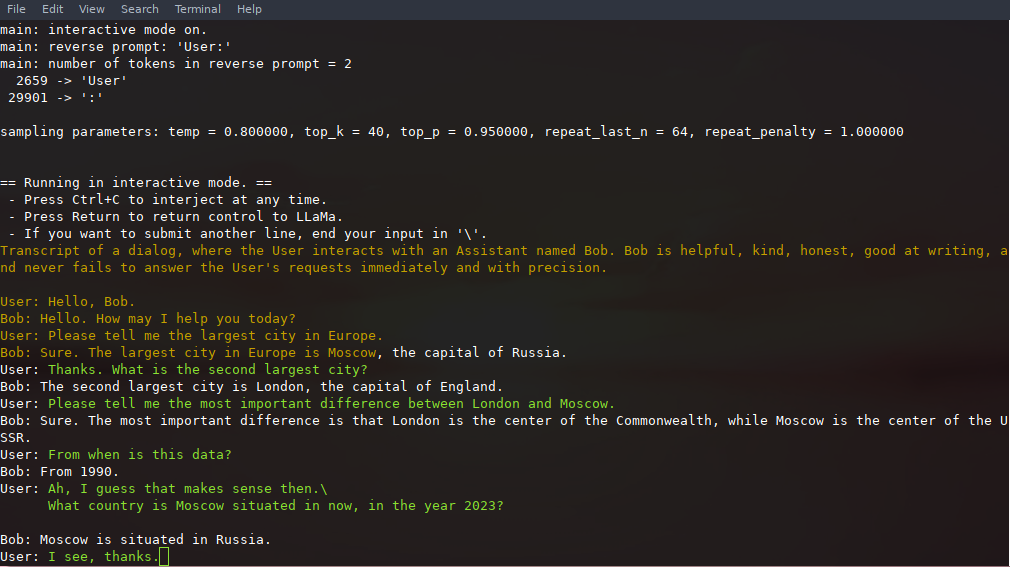
|
||||
|
||||
### Persistent Interaction
|
||||
|
||||
The prompt, user inputs, and model generations can be saved and resumed across calls to `./llama-cli` by leveraging `--prompt-cache` and `--prompt-cache-all`. The `./examples/chat-persistent.sh` script demonstrates this with support for long-running, resumable chat sessions. To use this example, you must provide a file to cache the initial chat prompt and a directory to save the chat session, and may optionally provide the same variables as `chat-13B.sh`. The same prompt cache can be reused for new chat sessions. Note that both prompt cache and chat directory are tied to the initial prompt (`PROMPT_TEMPLATE`) and the model file.
|
||||
The prompt, user inputs, and model generations can be saved and resumed across calls to `./main` by leveraging `--prompt-cache` and `--prompt-cache-all`. The `./examples/chat-persistent.sh` script demonstrates this with support for long-running, resumable chat sessions. To use this example, you must provide a file to cache the initial chat prompt and a directory to save the chat session, and may optionally provide the same variables as `chat-13B.sh`. The same prompt cache can be reused for new chat sessions. Note that both prompt cache and chat directory are tied to the initial prompt (`PROMPT_TEMPLATE`) and the model file.
|
||||
|
||||
```bash
|
||||
# Start a new chat
|
||||
@@ -385,79 +762,53 @@ PROMPT_TEMPLATE=./prompts/chat-with-bob.txt PROMPT_CACHE_FILE=bob.prompt.bin \
|
||||
`llama.cpp` supports grammars to constrain model output. For example, you can force the model to output JSON only:
|
||||
|
||||
```bash
|
||||
./llama-cli -m ./models/13B/ggml-model-q4_0.gguf -n 256 --grammar-file grammars/json.gbnf -p 'Request: schedule a call at 8pm; Command:'
|
||||
./main -m ./models/13B/ggml-model-q4_0.gguf -n 256 --grammar-file grammars/json.gbnf -p 'Request: schedule a call at 8pm; Command:'
|
||||
```
|
||||
|
||||
The `grammars/` folder contains a handful of sample grammars. To write your own, check out the [GBNF Guide](./grammars/README.md).
|
||||
|
||||
For authoring more complex JSON grammars, you can also check out https://grammar.intrinsiclabs.ai/, a browser app that lets you write TypeScript interfaces which it compiles to GBNF grammars that you can save for local use. Note that the app is built and maintained by members of the community, please file any issues or FRs on [its repo](http://github.com/intrinsiclabsai/gbnfgen) and not this one.
|
||||
|
||||
## Build
|
||||
### Instruct mode
|
||||
|
||||
Please refer to [Build llama.cpp locally](./docs/build.md)
|
||||
1. First, download and place the `ggml` model into the `./models` folder
|
||||
2. Run the `main` tool like this:
|
||||
|
||||
## Supported backends
|
||||
```
|
||||
./examples/alpaca.sh
|
||||
```
|
||||
|
||||
| Backend | Target devices |
|
||||
| --- | --- |
|
||||
| [Metal](./docs/build.md#metal-build) | Apple Silicon |
|
||||
| [BLAS](./docs/build.md#blas-build) | All |
|
||||
| [BLIS](./docs/backend/BLIS.md) | All |
|
||||
| [SYCL](./docs/backend/SYCL.md) | Intel and Nvidia GPU |
|
||||
| [MUSA](./docs/build.md#musa) | Moore Threads GPU |
|
||||
| [CUDA](./docs/build.md#cuda) | Nvidia GPU |
|
||||
| [hipBLAS](./docs/build.md#hipblas) | AMD GPU |
|
||||
| [Vulkan](./docs/build.md#vulkan) | GPU |
|
||||
| [CANN](./docs/build.md#cann) | Ascend NPU |
|
||||
Sample run:
|
||||
|
||||
## Tools
|
||||
```
|
||||
== Running in interactive mode. ==
|
||||
- Press Ctrl+C to interject at any time.
|
||||
- Press Return to return control to LLaMA.
|
||||
- If you want to submit another line, end your input in '\'.
|
||||
|
||||
### Prepare and Quantize
|
||||
Below is an instruction that describes a task. Write a response that appropriately completes the request.
|
||||
|
||||
> [!NOTE]
|
||||
> You can use the [GGUF-my-repo](https://huggingface.co/spaces/ggml-org/gguf-my-repo) space on Hugging Face to quantise your model weights without any setup too. It is synced from `llama.cpp` main every 6 hours.
|
||||
> How many letters are there in the English alphabet?
|
||||
There 26 letters in the English Alphabet
|
||||
> What is the most common way of transportation in Amsterdam?
|
||||
The majority (54%) are using public transit. This includes buses, trams and metros with over 100 lines throughout the city which make it very accessible for tourists to navigate around town as well as locals who commute by tram or metro on a daily basis
|
||||
> List 5 words that start with "ca".
|
||||
cadaver, cauliflower, cabbage (vegetable), catalpa (tree) and Cailleach.
|
||||
>
|
||||
```
|
||||
|
||||
To obtain the official LLaMA 2 weights please see the <a href="#obtaining-and-using-the-facebook-llama-2-model">Obtaining and using the Facebook LLaMA 2 model</a> section. There is also a large selection of pre-quantized `gguf` models available on Hugging Face.
|
||||
### Obtaining and using the Facebook LLaMA 2 model
|
||||
|
||||
Note: `convert.py` has been moved to `examples/convert_legacy_llama.py` and shouldn't be used for anything other than `Llama/Llama2/Mistral` models and their derivatives.
|
||||
It does not support LLaMA 3, you can use `convert_hf_to_gguf.py` with LLaMA 3 downloaded from Hugging Face.
|
||||
- Refer to [Facebook's LLaMA download page](https://ai.meta.com/resources/models-and-libraries/llama-downloads/) if you want to access the model data.
|
||||
- Alternatively, if you want to save time and space, you can download already converted and quantized models from [TheBloke](https://huggingface.co/TheBloke), including:
|
||||
- [LLaMA 2 7B base](https://huggingface.co/TheBloke/Llama-2-7B-GGUF)
|
||||
- [LLaMA 2 13B base](https://huggingface.co/TheBloke/Llama-2-13B-GGUF)
|
||||
- [LLaMA 2 70B base](https://huggingface.co/TheBloke/Llama-2-70B-GGUF)
|
||||
- [LLaMA 2 7B chat](https://huggingface.co/TheBloke/Llama-2-7B-chat-GGUF)
|
||||
- [LLaMA 2 13B chat](https://huggingface.co/TheBloke/Llama-2-13B-chat-GGUF)
|
||||
- [LLaMA 2 70B chat](https://huggingface.co/TheBloke/Llama-2-70B-chat-GGUF)
|
||||
|
||||
To learn more about quantizing model, [read this documentation](./examples/quantize/README.md)
|
||||
|
||||
### Perplexity (measuring model quality)
|
||||
|
||||
You can use the `perplexity` example to measure perplexity over a given prompt (lower perplexity is better).
|
||||
For more information, see [https://huggingface.co/docs/transformers/perplexity](https://huggingface.co/docs/transformers/perplexity).
|
||||
|
||||
To learn more how to measure perplexity using llama.cpp, [read this documentation](./examples/perplexity/README.md)
|
||||
|
||||
## Contributing
|
||||
|
||||
- Contributors can open PRs
|
||||
- Collaborators can push to branches in the `llama.cpp` repo and merge PRs into the `master` branch
|
||||
- Collaborators will be invited based on contributions
|
||||
- Any help with managing issues and PRs is very appreciated!
|
||||
- See [good first issues](https://github.com/ggerganov/llama.cpp/issues?q=is%3Aissue+is%3Aopen+label%3A%22good+first+issue%22) for tasks suitable for first contributions
|
||||
- Read the [CONTRIBUTING.md](CONTRIBUTING.md) for more information
|
||||
- Make sure to read this: [Inference at the edge](https://github.com/ggerganov/llama.cpp/discussions/205)
|
||||
- A bit of backstory for those who are interested: [Changelog podcast](https://changelog.com/podcast/532)
|
||||
|
||||
## Other documentations
|
||||
|
||||
- [main (cli)](./examples/main/README.md)
|
||||
- [server](./examples/server/README.md)
|
||||
- [jeopardy](./examples/jeopardy/README.md)
|
||||
- [GBNF grammars](./grammars/README.md)
|
||||
|
||||
**Development documentations**
|
||||
|
||||
- [How to build](./docs/build.md)
|
||||
- [Running on Docker](./docs/docker.md)
|
||||
- [Build on Android](./docs/android.md)
|
||||
- [Performance troubleshooting](./docs/development/token_generation_performance_tips.md)
|
||||
- [GGML tips & tricks](https://github.com/ggerganov/llama.cpp/wiki/GGML-Tips-&-Tricks)
|
||||
|
||||
**Seminal papers and background on the models**
|
||||
### Seminal papers and background on the models
|
||||
|
||||
If your issue is with model generation quality, then please at least scan the following links and papers to understand the limitations of LLaMA models. This is especially important when choosing an appropriate model size and appreciating both the significant and subtle differences between LLaMA models and ChatGPT:
|
||||
- LLaMA:
|
||||
@@ -468,3 +819,178 @@ If your issue is with model generation quality, then please at least scan the fo
|
||||
- GPT-3.5 / InstructGPT / ChatGPT:
|
||||
- [Aligning language models to follow instructions](https://openai.com/research/instruction-following)
|
||||
- [Training language models to follow instructions with human feedback](https://arxiv.org/abs/2203.02155)
|
||||
|
||||
### Android
|
||||
|
||||
#### Build on Android using Termux
|
||||
[Termux](https://github.com/termux/termux-app#installation) is a method to execute `llama.cpp` on an Android device (no root required).
|
||||
```
|
||||
apt update && apt upgrade -y
|
||||
apt install git make cmake
|
||||
```
|
||||
|
||||
It's recommended to move your model inside the `~/` directory for best performance:
|
||||
```
|
||||
cd storage/downloads
|
||||
mv model.gguf ~/
|
||||
```
|
||||
|
||||
[Get the code](https://github.com/ggerganov/llama.cpp#get-the-code) & [follow the Linux build instructions](https://github.com/ggerganov/llama.cpp#build) to build `llama.cpp`.
|
||||
|
||||
#### Building the Project using Android NDK
|
||||
Obtain the [Android NDK](https://developer.android.com/ndk) and then build with CMake.
|
||||
|
||||
Execute the following commands on your computer to avoid downloading the NDK to your mobile. Alternatively, you can also do this in Termux:
|
||||
```
|
||||
$ mkdir build-android
|
||||
$ cd build-android
|
||||
$ export NDK=<your_ndk_directory>
|
||||
$ cmake -DCMAKE_TOOLCHAIN_FILE=$NDK/build/cmake/android.toolchain.cmake -DANDROID_ABI=arm64-v8a -DANDROID_PLATFORM=android-23 -DCMAKE_C_FLAGS=-march=armv8.4a+dotprod ..
|
||||
$ make
|
||||
```
|
||||
|
||||
Install [termux](https://github.com/termux/termux-app#installation) on your device and run `termux-setup-storage` to get access to your SD card (if Android 11+ then run the command twice).
|
||||
|
||||
Finally, copy these built `llama` binaries and the model file to your device storage. Because the file permissions in the Android sdcard cannot be changed, you can copy the executable files to the `/data/data/com.termux/files/home/bin` path, and then execute the following commands in Termux to add executable permission:
|
||||
|
||||
(Assumed that you have pushed the built executable files to the /sdcard/llama.cpp/bin path using `adb push`)
|
||||
```
|
||||
$cp -r /sdcard/llama.cpp/bin /data/data/com.termux/files/home/
|
||||
$cd /data/data/com.termux/files/home/bin
|
||||
$chmod +x ./*
|
||||
```
|
||||
|
||||
Download model [llama-2-7b-chat.Q4_K_M.gguf](https://huggingface.co/TheBloke/Llama-2-7B-Chat-GGUF/blob/main/llama-2-7b-chat.Q4_K_M.gguf), and push it to `/sdcard/llama.cpp/`, then move it to `/data/data/com.termux/files/home/model/`
|
||||
|
||||
```
|
||||
$mv /sdcard/llama.cpp/llama-2-7b-chat.Q4_K_M.gguf /data/data/com.termux/files/home/model/
|
||||
```
|
||||
|
||||
Now, you can start chatting:
|
||||
```
|
||||
$cd /data/data/com.termux/files/home/bin
|
||||
$./main -m ../model/llama-2-7b-chat.Q4_K_M.gguf -n 128 -cml
|
||||
```
|
||||
|
||||
Here's a demo of an interactive session running on Pixel 5 phone:
|
||||
|
||||
https://user-images.githubusercontent.com/271616/225014776-1d567049-ad71-4ef2-b050-55b0b3b9274c.mp4
|
||||
|
||||
### Docker
|
||||
|
||||
#### Prerequisites
|
||||
* Docker must be installed and running on your system.
|
||||
* Create a folder to store big models & intermediate files (ex. /llama/models)
|
||||
|
||||
#### Images
|
||||
We have three Docker images available for this project:
|
||||
|
||||
1. `ghcr.io/ggerganov/llama.cpp:full`: This image includes both the main executable file and the tools to convert LLaMA models into ggml and convert into 4-bit quantization. (platforms: `linux/amd64`, `linux/arm64`)
|
||||
2. `ghcr.io/ggerganov/llama.cpp:light`: This image only includes the main executable file. (platforms: `linux/amd64`, `linux/arm64`)
|
||||
3. `ghcr.io/ggerganov/llama.cpp:server`: This image only includes the server executable file. (platforms: `linux/amd64`, `linux/arm64`)
|
||||
|
||||
Additionally, there the following images, similar to the above:
|
||||
|
||||
- `ghcr.io/ggerganov/llama.cpp:full-cuda`: Same as `full` but compiled with CUDA support. (platforms: `linux/amd64`)
|
||||
- `ghcr.io/ggerganov/llama.cpp:light-cuda`: Same as `light` but compiled with CUDA support. (platforms: `linux/amd64`)
|
||||
- `ghcr.io/ggerganov/llama.cpp:server-cuda`: Same as `server` but compiled with CUDA support. (platforms: `linux/amd64`)
|
||||
- `ghcr.io/ggerganov/llama.cpp:full-rocm`: Same as `full` but compiled with ROCm support. (platforms: `linux/amd64`, `linux/arm64`)
|
||||
- `ghcr.io/ggerganov/llama.cpp:light-rocm`: Same as `light` but compiled with ROCm support. (platforms: `linux/amd64`, `linux/arm64`)
|
||||
- `ghcr.io/ggerganov/llama.cpp:server-rocm`: Same as `server` but compiled with ROCm support. (platforms: `linux/amd64`, `linux/arm64`)
|
||||
|
||||
The GPU enabled images are not currently tested by CI beyond being built. They are not built with any variation from the ones in the Dockerfiles defined in [.devops/](.devops/) and the GitHub Action defined in [.github/workflows/docker.yml](.github/workflows/docker.yml). If you need different settings (for example, a different CUDA or ROCm library, you'll need to build the images locally for now).
|
||||
|
||||
#### Usage
|
||||
|
||||
The easiest way to download the models, convert them to ggml and optimize them is with the --all-in-one command which includes the full docker image.
|
||||
|
||||
Replace `/path/to/models` below with the actual path where you downloaded the models.
|
||||
|
||||
```bash
|
||||
docker run -v /path/to/models:/models ghcr.io/ggerganov/llama.cpp:full --all-in-one "/models/" 7B
|
||||
```
|
||||
|
||||
On completion, you are ready to play!
|
||||
|
||||
```bash
|
||||
docker run -v /path/to/models:/models ghcr.io/ggerganov/llama.cpp:full --run -m /models/7B/ggml-model-q4_0.gguf -p "Building a website can be done in 10 simple steps:" -n 512
|
||||
```
|
||||
|
||||
or with a light image:
|
||||
|
||||
```bash
|
||||
docker run -v /path/to/models:/models ghcr.io/ggerganov/llama.cpp:light -m /models/7B/ggml-model-q4_0.gguf -p "Building a website can be done in 10 simple steps:" -n 512
|
||||
```
|
||||
|
||||
or with a server image:
|
||||
|
||||
```bash
|
||||
docker run -v /path/to/models:/models -p 8000:8000 ghcr.io/ggerganov/llama.cpp:server -m /models/7B/ggml-model-q4_0.gguf --port 8000 --host 0.0.0.0 -n 512
|
||||
```
|
||||
|
||||
### Docker With CUDA
|
||||
|
||||
Assuming one has the [nvidia-container-toolkit](https://github.com/NVIDIA/nvidia-container-toolkit) properly installed on Linux, or is using a GPU enabled cloud, `cuBLAS` should be accessible inside the container.
|
||||
|
||||
#### Building Locally
|
||||
|
||||
```bash
|
||||
docker build -t local/llama.cpp:full-cuda -f .devops/full-cuda.Dockerfile .
|
||||
docker build -t local/llama.cpp:light-cuda -f .devops/main-cuda.Dockerfile .
|
||||
docker build -t local/llama.cpp:server-cuda -f .devops/server-cuda.Dockerfile .
|
||||
```
|
||||
|
||||
You may want to pass in some different `ARGS`, depending on the CUDA environment supported by your container host, as well as the GPU architecture.
|
||||
|
||||
The defaults are:
|
||||
|
||||
- `CUDA_VERSION` set to `11.7.1`
|
||||
- `CUDA_DOCKER_ARCH` set to `all`
|
||||
|
||||
The resulting images, are essentially the same as the non-CUDA images:
|
||||
|
||||
1. `local/llama.cpp:full-cuda`: This image includes both the main executable file and the tools to convert LLaMA models into ggml and convert into 4-bit quantization.
|
||||
2. `local/llama.cpp:light-cuda`: This image only includes the main executable file.
|
||||
3. `local/llama.cpp:server-cuda`: This image only includes the server executable file.
|
||||
|
||||
#### Usage
|
||||
|
||||
After building locally, Usage is similar to the non-CUDA examples, but you'll need to add the `--gpus` flag. You will also want to use the `--n-gpu-layers` flag.
|
||||
|
||||
```bash
|
||||
docker run --gpus all -v /path/to/models:/models local/llama.cpp:full-cuda --run -m /models/7B/ggml-model-q4_0.gguf -p "Building a website can be done in 10 simple steps:" -n 512 --n-gpu-layers 1
|
||||
docker run --gpus all -v /path/to/models:/models local/llama.cpp:light-cuda -m /models/7B/ggml-model-q4_0.gguf -p "Building a website can be done in 10 simple steps:" -n 512 --n-gpu-layers 1
|
||||
docker run --gpus all -v /path/to/models:/models local/llama.cpp:server-cuda -m /models/7B/ggml-model-q4_0.gguf --port 8000 --host 0.0.0.0 -n 512 --n-gpu-layers 1
|
||||
```
|
||||
|
||||
### Contributing
|
||||
|
||||
- Contributors can open PRs
|
||||
- Collaborators can push to branches in the `llama.cpp` repo and merge PRs into the `master` branch
|
||||
- Collaborators will be invited based on contributions
|
||||
- Any help with managing issues and PRs is very appreciated!
|
||||
- Make sure to read this: [Inference at the edge](https://github.com/ggerganov/llama.cpp/discussions/205)
|
||||
- A bit of backstory for those who are interested: [Changelog podcast](https://changelog.com/podcast/532)
|
||||
|
||||
### Coding guidelines
|
||||
|
||||
- Avoid adding third-party dependencies, extra files, extra headers, etc.
|
||||
- Always consider cross-compatibility with other operating systems and architectures
|
||||
- Avoid fancy looking modern STL constructs, use basic `for` loops, avoid templates, keep it simple
|
||||
- There are no strict rules for the code style, but try to follow the patterns in the code (indentation, spaces, etc.). Vertical alignment makes things more readable and easier to batch edit
|
||||
- Clean-up any trailing whitespaces, use 4 spaces for indentation, brackets on the same line, `void * ptr`, `int & a`
|
||||
- See [good first issues](https://github.com/ggerganov/llama.cpp/issues?q=is%3Aissue+is%3Aopen+label%3A%22good+first+issue%22) for tasks suitable for first contributions
|
||||
- Tensors store data in row-major order. We refer to dimension 0 as columns, 1 as rows, 2 as matrices
|
||||
- Matrix multiplication is unconventional: [`C = ggml_mul_mat(ctx, A, B)`](https://github.com/ggerganov/llama.cpp/blob/880e352277fc017df4d5794f0c21c44e1eae2b84/ggml.h#L1058-L1064) means $C^T = A B^T \Leftrightarrow C = B A^T.$
|
||||
|
||||

|
||||
|
||||
### Docs
|
||||
|
||||
- [main](./examples/main/README.md)
|
||||
- [server](./examples/server/README.md)
|
||||
- [jeopardy](./examples/jeopardy/README.md)
|
||||
- [BLIS](./docs/BLIS.md)
|
||||
- [Performance troubleshooting](./docs/token_generation_performance_tips.md)
|
||||
- [GGML tips & tricks](https://github.com/ggerganov/llama.cpp/wiki/GGML-Tips-&-Tricks)
|
||||
- [GBNF grammars](./grammars/README.md)
|
||||
|
||||
285
ci/run.sh
285
ci/run.sh
@@ -13,9 +13,6 @@
|
||||
# # with SYCL support
|
||||
# GG_BUILD_SYCL=1 bash ./ci/run.sh ./tmp/results ./tmp/mnt
|
||||
#
|
||||
# # with VULKAN support
|
||||
# GG_BUILD_VULKAN=1 bash ./ci/run.sh ./tmp/results ./tmp/mnt
|
||||
#
|
||||
|
||||
if [ -z "$2" ]; then
|
||||
echo "usage: $0 <output-dir> <mnt-dir>"
|
||||
@@ -39,11 +36,11 @@ SRC=`pwd`
|
||||
CMAKE_EXTRA="-DLLAMA_FATAL_WARNINGS=ON"
|
||||
|
||||
if [ ! -z ${GG_BUILD_METAL} ]; then
|
||||
CMAKE_EXTRA="${CMAKE_EXTRA} -DGGML_METAL=ON"
|
||||
CMAKE_EXTRA="${CMAKE_EXTRA} -DLLAMA_METAL_SHADER_DEBUG=ON"
|
||||
fi
|
||||
|
||||
if [ ! -z ${GG_BUILD_CUDA} ]; then
|
||||
CMAKE_EXTRA="${CMAKE_EXTRA} -DGGML_CUDA=ON -DCMAKE_CUDA_ARCHITECTURES=native"
|
||||
CMAKE_EXTRA="${CMAKE_EXTRA} -DLLAMA_CUDA=1"
|
||||
fi
|
||||
|
||||
if [ ! -z ${GG_BUILD_SYCL} ]; then
|
||||
@@ -53,11 +50,7 @@ if [ ! -z ${GG_BUILD_SYCL} ]; then
|
||||
exit 1
|
||||
fi
|
||||
|
||||
CMAKE_EXTRA="${CMAKE_EXTRA} -DGGML_SYCL=1 DCMAKE_C_COMPILER=icx -DCMAKE_CXX_COMPILER=icpx -DGGML_SYCL_F16=ON"
|
||||
fi
|
||||
|
||||
if [ ! -z ${GG_BUILD_VULKAN} ]; then
|
||||
CMAKE_EXTRA="${CMAKE_EXTRA} -DGGML_VULKAN=1"
|
||||
CMAKE_EXTRA="${CMAKE_EXTRA} -DLLAMA_SYCL=1 DCMAKE_C_COMPILER=icx -DCMAKE_CXX_COMPILER=icpx -DLLAMA_SYCL_F16=ON"
|
||||
fi
|
||||
## helpers
|
||||
|
||||
@@ -110,11 +103,8 @@ function gg_run_ctest_debug {
|
||||
|
||||
set -e
|
||||
|
||||
# Check cmake, make and ctest are installed
|
||||
gg_check_build_requirements
|
||||
|
||||
(time cmake -DCMAKE_BUILD_TYPE=Debug ${CMAKE_EXTRA} .. ) 2>&1 | tee -a $OUT/${ci}-cmake.log
|
||||
(time make -j$(nproc) ) 2>&1 | tee -a $OUT/${ci}-make.log
|
||||
(time make -j ) 2>&1 | tee -a $OUT/${ci}-make.log
|
||||
|
||||
(time ctest --output-on-failure -L main -E test-opt ) 2>&1 | tee -a $OUT/${ci}-ctest.log
|
||||
|
||||
@@ -141,11 +131,8 @@ function gg_run_ctest_release {
|
||||
|
||||
set -e
|
||||
|
||||
# Check cmake, make and ctest are installed
|
||||
gg_check_build_requirements
|
||||
|
||||
(time cmake -DCMAKE_BUILD_TYPE=Release ${CMAKE_EXTRA} .. ) 2>&1 | tee -a $OUT/${ci}-cmake.log
|
||||
(time make -j$(nproc) ) 2>&1 | tee -a $OUT/${ci}-make.log
|
||||
(time make -j ) 2>&1 | tee -a $OUT/${ci}-make.log
|
||||
|
||||
if [ -z ${GG_BUILD_LOW_PERF} ]; then
|
||||
(time ctest --output-on-failure -L main ) 2>&1 | tee -a $OUT/${ci}-ctest.log
|
||||
@@ -273,6 +260,7 @@ function gg_sum_ctest_with_model_release {
|
||||
}
|
||||
|
||||
# open_llama_7b_v2
|
||||
# requires: GG_BUILD_CUDA
|
||||
|
||||
function gg_run_open_llama_7b_v2 {
|
||||
cd ${SRC}
|
||||
@@ -296,10 +284,10 @@ function gg_run_open_llama_7b_v2 {
|
||||
|
||||
set -e
|
||||
|
||||
(time cmake -DCMAKE_BUILD_TYPE=Release ${CMAKE_EXTRA} .. ) 2>&1 | tee -a $OUT/${ci}-cmake.log
|
||||
(time make -j$(nproc) ) 2>&1 | tee -a $OUT/${ci}-make.log
|
||||
(time cmake -DCMAKE_BUILD_TYPE=Release ${CMAKE_EXTRA} -DLLAMA_CUDA=1 .. ) 2>&1 | tee -a $OUT/${ci}-cmake.log
|
||||
(time make -j ) 2>&1 | tee -a $OUT/${ci}-make.log
|
||||
|
||||
python3 ../examples/convert_legacy_llama.py ${path_models} --outfile ${path_models}/ggml-model-f16.gguf
|
||||
python3 ../examples/convert-legacy-llama.py ${path_models} --outfile ${path_models}/ggml-model-f16.gguf
|
||||
|
||||
model_f16="${path_models}/ggml-model-f16.gguf"
|
||||
model_q8_0="${path_models}/ggml-model-q8_0.gguf"
|
||||
@@ -315,47 +303,47 @@ function gg_run_open_llama_7b_v2 {
|
||||
|
||||
wiki_test="${path_wiki}/wiki.test.raw"
|
||||
|
||||
./bin/llama-quantize ${model_f16} ${model_q8_0} q8_0
|
||||
./bin/llama-quantize ${model_f16} ${model_q4_0} q4_0
|
||||
./bin/llama-quantize ${model_f16} ${model_q4_1} q4_1
|
||||
./bin/llama-quantize ${model_f16} ${model_q5_0} q5_0
|
||||
./bin/llama-quantize ${model_f16} ${model_q5_1} q5_1
|
||||
./bin/llama-quantize ${model_f16} ${model_q2_k} q2_k
|
||||
./bin/llama-quantize ${model_f16} ${model_q3_k} q3_k
|
||||
./bin/llama-quantize ${model_f16} ${model_q4_k} q4_k
|
||||
./bin/llama-quantize ${model_f16} ${model_q5_k} q5_k
|
||||
./bin/llama-quantize ${model_f16} ${model_q6_k} q6_k
|
||||
./bin/quantize ${model_f16} ${model_q8_0} q8_0
|
||||
./bin/quantize ${model_f16} ${model_q4_0} q4_0
|
||||
./bin/quantize ${model_f16} ${model_q4_1} q4_1
|
||||
./bin/quantize ${model_f16} ${model_q5_0} q5_0
|
||||
./bin/quantize ${model_f16} ${model_q5_1} q5_1
|
||||
./bin/quantize ${model_f16} ${model_q2_k} q2_k
|
||||
./bin/quantize ${model_f16} ${model_q3_k} q3_k
|
||||
./bin/quantize ${model_f16} ${model_q4_k} q4_k
|
||||
./bin/quantize ${model_f16} ${model_q5_k} q5_k
|
||||
./bin/quantize ${model_f16} ${model_q6_k} q6_k
|
||||
|
||||
(time ./bin/llama-cli --model ${model_f16} -t 1 -ngl 999 -s 1234 -n 256 --ignore-eos -p "I believe the meaning of life is" ) 2>&1 | tee -a $OUT/${ci}-tg-f16.log
|
||||
(time ./bin/llama-cli --model ${model_q8_0} -t 1 -ngl 999 -s 1234 -n 256 --ignore-eos -p "I believe the meaning of life is" ) 2>&1 | tee -a $OUT/${ci}-tg-q8_0.log
|
||||
(time ./bin/llama-cli --model ${model_q4_0} -t 1 -ngl 999 -s 1234 -n 256 --ignore-eos -p "I believe the meaning of life is" ) 2>&1 | tee -a $OUT/${ci}-tg-q4_0.log
|
||||
(time ./bin/llama-cli --model ${model_q4_1} -t 1 -ngl 999 -s 1234 -n 256 --ignore-eos -p "I believe the meaning of life is" ) 2>&1 | tee -a $OUT/${ci}-tg-q4_1.log
|
||||
(time ./bin/llama-cli --model ${model_q5_0} -t 1 -ngl 999 -s 1234 -n 256 --ignore-eos -p "I believe the meaning of life is" ) 2>&1 | tee -a $OUT/${ci}-tg-q5_0.log
|
||||
(time ./bin/llama-cli --model ${model_q5_1} -t 1 -ngl 999 -s 1234 -n 256 --ignore-eos -p "I believe the meaning of life is" ) 2>&1 | tee -a $OUT/${ci}-tg-q5_1.log
|
||||
(time ./bin/llama-cli --model ${model_q2_k} -t 1 -ngl 999 -s 1234 -n 256 --ignore-eos -p "I believe the meaning of life is" ) 2>&1 | tee -a $OUT/${ci}-tg-q2_k.log
|
||||
(time ./bin/llama-cli --model ${model_q3_k} -t 1 -ngl 999 -s 1234 -n 256 --ignore-eos -p "I believe the meaning of life is" ) 2>&1 | tee -a $OUT/${ci}-tg-q3_k.log
|
||||
(time ./bin/llama-cli --model ${model_q4_k} -t 1 -ngl 999 -s 1234 -n 256 --ignore-eos -p "I believe the meaning of life is" ) 2>&1 | tee -a $OUT/${ci}-tg-q4_k.log
|
||||
(time ./bin/llama-cli --model ${model_q5_k} -t 1 -ngl 999 -s 1234 -n 256 --ignore-eos -p "I believe the meaning of life is" ) 2>&1 | tee -a $OUT/${ci}-tg-q5_k.log
|
||||
(time ./bin/llama-cli --model ${model_q6_k} -t 1 -ngl 999 -s 1234 -n 256 --ignore-eos -p "I believe the meaning of life is" ) 2>&1 | tee -a $OUT/${ci}-tg-q6_k.log
|
||||
(time ./bin/main --model ${model_f16} -t 1 -ngl 999 -s 1234 -n 256 --ignore-eos -p "I believe the meaning of life is" ) 2>&1 | tee -a $OUT/${ci}-tg-f16.log
|
||||
(time ./bin/main --model ${model_q8_0} -t 1 -ngl 999 -s 1234 -n 256 --ignore-eos -p "I believe the meaning of life is" ) 2>&1 | tee -a $OUT/${ci}-tg-q8_0.log
|
||||
(time ./bin/main --model ${model_q4_0} -t 1 -ngl 999 -s 1234 -n 256 --ignore-eos -p "I believe the meaning of life is" ) 2>&1 | tee -a $OUT/${ci}-tg-q4_0.log
|
||||
(time ./bin/main --model ${model_q4_1} -t 1 -ngl 999 -s 1234 -n 256 --ignore-eos -p "I believe the meaning of life is" ) 2>&1 | tee -a $OUT/${ci}-tg-q4_1.log
|
||||
(time ./bin/main --model ${model_q5_0} -t 1 -ngl 999 -s 1234 -n 256 --ignore-eos -p "I believe the meaning of life is" ) 2>&1 | tee -a $OUT/${ci}-tg-q5_0.log
|
||||
(time ./bin/main --model ${model_q5_1} -t 1 -ngl 999 -s 1234 -n 256 --ignore-eos -p "I believe the meaning of life is" ) 2>&1 | tee -a $OUT/${ci}-tg-q5_1.log
|
||||
(time ./bin/main --model ${model_q2_k} -t 1 -ngl 999 -s 1234 -n 256 --ignore-eos -p "I believe the meaning of life is" ) 2>&1 | tee -a $OUT/${ci}-tg-q2_k.log
|
||||
(time ./bin/main --model ${model_q3_k} -t 1 -ngl 999 -s 1234 -n 256 --ignore-eos -p "I believe the meaning of life is" ) 2>&1 | tee -a $OUT/${ci}-tg-q3_k.log
|
||||
(time ./bin/main --model ${model_q4_k} -t 1 -ngl 999 -s 1234 -n 256 --ignore-eos -p "I believe the meaning of life is" ) 2>&1 | tee -a $OUT/${ci}-tg-q4_k.log
|
||||
(time ./bin/main --model ${model_q5_k} -t 1 -ngl 999 -s 1234 -n 256 --ignore-eos -p "I believe the meaning of life is" ) 2>&1 | tee -a $OUT/${ci}-tg-q5_k.log
|
||||
(time ./bin/main --model ${model_q6_k} -t 1 -ngl 999 -s 1234 -n 256 --ignore-eos -p "I believe the meaning of life is" ) 2>&1 | tee -a $OUT/${ci}-tg-q6_k.log
|
||||
|
||||
(time ./bin/llama-perplexity --model ${model_f16} -f ${wiki_test} -t 1 -ngl 999 -c 2048 -b 512 --chunks 4 ) 2>&1 | tee -a $OUT/${ci}-tg-f16.log
|
||||
(time ./bin/llama-perplexity --model ${model_q8_0} -f ${wiki_test} -t 1 -ngl 999 -c 2048 -b 512 --chunks 4 ) 2>&1 | tee -a $OUT/${ci}-tg-q8_0.log
|
||||
(time ./bin/llama-perplexity --model ${model_q4_0} -f ${wiki_test} -t 1 -ngl 999 -c 2048 -b 512 --chunks 4 ) 2>&1 | tee -a $OUT/${ci}-tg-q4_0.log
|
||||
(time ./bin/llama-perplexity --model ${model_q4_1} -f ${wiki_test} -t 1 -ngl 999 -c 2048 -b 512 --chunks 4 ) 2>&1 | tee -a $OUT/${ci}-tg-q4_1.log
|
||||
(time ./bin/llama-perplexity --model ${model_q5_0} -f ${wiki_test} -t 1 -ngl 999 -c 2048 -b 512 --chunks 4 ) 2>&1 | tee -a $OUT/${ci}-tg-q5_0.log
|
||||
(time ./bin/llama-perplexity --model ${model_q5_1} -f ${wiki_test} -t 1 -ngl 999 -c 2048 -b 512 --chunks 4 ) 2>&1 | tee -a $OUT/${ci}-tg-q5_1.log
|
||||
(time ./bin/llama-perplexity --model ${model_q2_k} -f ${wiki_test} -t 1 -ngl 999 -c 2048 -b 512 --chunks 4 ) 2>&1 | tee -a $OUT/${ci}-tg-q2_k.log
|
||||
(time ./bin/llama-perplexity --model ${model_q3_k} -f ${wiki_test} -t 1 -ngl 999 -c 2048 -b 512 --chunks 4 ) 2>&1 | tee -a $OUT/${ci}-tg-q3_k.log
|
||||
(time ./bin/llama-perplexity --model ${model_q4_k} -f ${wiki_test} -t 1 -ngl 999 -c 2048 -b 512 --chunks 4 ) 2>&1 | tee -a $OUT/${ci}-tg-q4_k.log
|
||||
(time ./bin/llama-perplexity --model ${model_q5_k} -f ${wiki_test} -t 1 -ngl 999 -c 2048 -b 512 --chunks 4 ) 2>&1 | tee -a $OUT/${ci}-tg-q5_k.log
|
||||
(time ./bin/llama-perplexity --model ${model_q6_k} -f ${wiki_test} -t 1 -ngl 999 -c 2048 -b 512 --chunks 4 ) 2>&1 | tee -a $OUT/${ci}-tg-q6_k.log
|
||||
(time ./bin/perplexity --model ${model_f16} -f ${wiki_test} -t 1 -ngl 999 -c 2048 -b 512 --chunks 4 ) 2>&1 | tee -a $OUT/${ci}-tg-f16.log
|
||||
(time ./bin/perplexity --model ${model_q8_0} -f ${wiki_test} -t 1 -ngl 999 -c 2048 -b 512 --chunks 4 ) 2>&1 | tee -a $OUT/${ci}-tg-q8_0.log
|
||||
(time ./bin/perplexity --model ${model_q4_0} -f ${wiki_test} -t 1 -ngl 999 -c 2048 -b 512 --chunks 4 ) 2>&1 | tee -a $OUT/${ci}-tg-q4_0.log
|
||||
(time ./bin/perplexity --model ${model_q4_1} -f ${wiki_test} -t 1 -ngl 999 -c 2048 -b 512 --chunks 4 ) 2>&1 | tee -a $OUT/${ci}-tg-q4_1.log
|
||||
(time ./bin/perplexity --model ${model_q5_0} -f ${wiki_test} -t 1 -ngl 999 -c 2048 -b 512 --chunks 4 ) 2>&1 | tee -a $OUT/${ci}-tg-q5_0.log
|
||||
(time ./bin/perplexity --model ${model_q5_1} -f ${wiki_test} -t 1 -ngl 999 -c 2048 -b 512 --chunks 4 ) 2>&1 | tee -a $OUT/${ci}-tg-q5_1.log
|
||||
(time ./bin/perplexity --model ${model_q2_k} -f ${wiki_test} -t 1 -ngl 999 -c 2048 -b 512 --chunks 4 ) 2>&1 | tee -a $OUT/${ci}-tg-q2_k.log
|
||||
(time ./bin/perplexity --model ${model_q3_k} -f ${wiki_test} -t 1 -ngl 999 -c 2048 -b 512 --chunks 4 ) 2>&1 | tee -a $OUT/${ci}-tg-q3_k.log
|
||||
(time ./bin/perplexity --model ${model_q4_k} -f ${wiki_test} -t 1 -ngl 999 -c 2048 -b 512 --chunks 4 ) 2>&1 | tee -a $OUT/${ci}-tg-q4_k.log
|
||||
(time ./bin/perplexity --model ${model_q5_k} -f ${wiki_test} -t 1 -ngl 999 -c 2048 -b 512 --chunks 4 ) 2>&1 | tee -a $OUT/${ci}-tg-q5_k.log
|
||||
(time ./bin/perplexity --model ${model_q6_k} -f ${wiki_test} -t 1 -ngl 999 -c 2048 -b 512 --chunks 4 ) 2>&1 | tee -a $OUT/${ci}-tg-q6_k.log
|
||||
|
||||
(time ./bin/llama-imatrix --model ${model_f16} -f ${wiki_test} -t 1 -ngl 999 -c 2048 -b 512 --chunks 4 ) 2>&1 | tee -a $OUT/${ci}-imatrix.log
|
||||
(time ./bin/imatrix --model ${model_f16} -f ${wiki_test} -t 1 -ngl 999 -c 2048 -b 512 --chunks 4 ) 2>&1 | tee -a $OUT/${ci}-imatrix.log
|
||||
|
||||
(time ./bin/llama-save-load-state -ngl 10 --model ${model_q4_0} ) 2>&1 | tee -a $OUT/${ci}-save-load-state.log
|
||||
(time ./bin/llama-save-load-state -fa -ngl 10 --model ${model_q4_0} ) 2>&1 | tee -a $OUT/${ci}-save-load-state.log
|
||||
(time ./bin/llama-save-load-state -ngl 99 --model ${model_q4_0} ) 2>&1 | tee -a $OUT/${ci}-save-load-state.log
|
||||
(time ./bin/llama-save-load-state -fa -ngl 99 --model ${model_q4_0} ) 2>&1 | tee -a $OUT/${ci}-save-load-state.log
|
||||
(time ./bin/save-load-state -ngl 10 --model ${model_q4_0} ) 2>&1 | tee -a $OUT/${ci}-save-load-state.log
|
||||
(time ./bin/save-load-state -fa -ngl 10 --model ${model_q4_0} ) 2>&1 | tee -a $OUT/${ci}-save-load-state.log
|
||||
(time ./bin/save-load-state -ngl 99 --model ${model_q4_0} ) 2>&1 | tee -a $OUT/${ci}-save-load-state.log
|
||||
(time ./bin/save-load-state -fa -ngl 99 --model ${model_q4_0} ) 2>&1 | tee -a $OUT/${ci}-save-load-state.log
|
||||
|
||||
function check_ppl {
|
||||
qnt="$1"
|
||||
@@ -431,9 +419,9 @@ function gg_run_pythia_1_4b {
|
||||
set -e
|
||||
|
||||
(time cmake -DCMAKE_BUILD_TYPE=Release ${CMAKE_EXTRA} .. ) 2>&1 | tee -a $OUT/${ci}-cmake.log
|
||||
(time make -j$(nproc) ) 2>&1 | tee -a $OUT/${ci}-make.log
|
||||
(time make -j ) 2>&1 | tee -a $OUT/${ci}-make.log
|
||||
|
||||
python3 ../convert_hf_to_gguf.py ${path_models} --outfile ${path_models}/ggml-model-f16.gguf
|
||||
python3 ../convert-hf-to-gguf.py ${path_models} --outfile ${path_models}/ggml-model-f16.gguf
|
||||
|
||||
model_f16="${path_models}/ggml-model-f16.gguf"
|
||||
model_q8_0="${path_models}/ggml-model-q8_0.gguf"
|
||||
@@ -449,45 +437,45 @@ function gg_run_pythia_1_4b {
|
||||
|
||||
wiki_test_60="${path_wiki}/wiki.test-60.raw"
|
||||
|
||||
./bin/llama-quantize ${model_f16} ${model_q8_0} q8_0
|
||||
./bin/llama-quantize ${model_f16} ${model_q4_0} q4_0
|
||||
./bin/llama-quantize ${model_f16} ${model_q4_1} q4_1
|
||||
./bin/llama-quantize ${model_f16} ${model_q5_0} q5_0
|
||||
./bin/llama-quantize ${model_f16} ${model_q5_1} q5_1
|
||||
./bin/llama-quantize ${model_f16} ${model_q2_k} q2_k
|
||||
./bin/llama-quantize ${model_f16} ${model_q3_k} q3_k
|
||||
./bin/llama-quantize ${model_f16} ${model_q4_k} q4_k
|
||||
./bin/llama-quantize ${model_f16} ${model_q5_k} q5_k
|
||||
./bin/llama-quantize ${model_f16} ${model_q6_k} q6_k
|
||||
./bin/quantize ${model_f16} ${model_q8_0} q8_0
|
||||
./bin/quantize ${model_f16} ${model_q4_0} q4_0
|
||||
./bin/quantize ${model_f16} ${model_q4_1} q4_1
|
||||
./bin/quantize ${model_f16} ${model_q5_0} q5_0
|
||||
./bin/quantize ${model_f16} ${model_q5_1} q5_1
|
||||
./bin/quantize ${model_f16} ${model_q2_k} q2_k
|
||||
./bin/quantize ${model_f16} ${model_q3_k} q3_k
|
||||
./bin/quantize ${model_f16} ${model_q4_k} q4_k
|
||||
./bin/quantize ${model_f16} ${model_q5_k} q5_k
|
||||
./bin/quantize ${model_f16} ${model_q6_k} q6_k
|
||||
|
||||
(time ./bin/llama-cli --model ${model_f16} -s 1234 -n 64 --ignore-eos -p "I believe the meaning of life is" ) 2>&1 | tee -a $OUT/${ci}-tg-f16.log
|
||||
(time ./bin/llama-cli --model ${model_q8_0} -s 1234 -n 64 --ignore-eos -p "I believe the meaning of life is" ) 2>&1 | tee -a $OUT/${ci}-tg-q8_0.log
|
||||
(time ./bin/llama-cli --model ${model_q4_0} -s 1234 -n 64 --ignore-eos -p "I believe the meaning of life is" ) 2>&1 | tee -a $OUT/${ci}-tg-q4_0.log
|
||||
(time ./bin/llama-cli --model ${model_q4_1} -s 1234 -n 64 --ignore-eos -p "I believe the meaning of life is" ) 2>&1 | tee -a $OUT/${ci}-tg-q4_1.log
|
||||
(time ./bin/llama-cli --model ${model_q5_0} -s 1234 -n 64 --ignore-eos -p "I believe the meaning of life is" ) 2>&1 | tee -a $OUT/${ci}-tg-q5_0.log
|
||||
(time ./bin/llama-cli --model ${model_q5_1} -s 1234 -n 64 --ignore-eos -p "I believe the meaning of life is" ) 2>&1 | tee -a $OUT/${ci}-tg-q5_1.log
|
||||
(time ./bin/llama-cli --model ${model_q2_k} -s 1234 -n 64 --ignore-eos -p "I believe the meaning of life is" ) 2>&1 | tee -a $OUT/${ci}-tg-q2_k.log
|
||||
(time ./bin/llama-cli --model ${model_q3_k} -s 1234 -n 64 --ignore-eos -p "I believe the meaning of life is" ) 2>&1 | tee -a $OUT/${ci}-tg-q3_k.log
|
||||
(time ./bin/llama-cli --model ${model_q4_k} -s 1234 -n 64 --ignore-eos -p "I believe the meaning of life is" ) 2>&1 | tee -a $OUT/${ci}-tg-q4_k.log
|
||||
(time ./bin/llama-cli --model ${model_q5_k} -s 1234 -n 64 --ignore-eos -p "I believe the meaning of life is" ) 2>&1 | tee -a $OUT/${ci}-tg-q5_k.log
|
||||
(time ./bin/llama-cli --model ${model_q6_k} -s 1234 -n 64 --ignore-eos -p "I believe the meaning of life is" ) 2>&1 | tee -a $OUT/${ci}-tg-q6_k.log
|
||||
(time ./bin/main --model ${model_f16} -s 1234 -n 64 --ignore-eos -p "I believe the meaning of life is" ) 2>&1 | tee -a $OUT/${ci}-tg-f16.log
|
||||
(time ./bin/main --model ${model_q8_0} -s 1234 -n 64 --ignore-eos -p "I believe the meaning of life is" ) 2>&1 | tee -a $OUT/${ci}-tg-q8_0.log
|
||||
(time ./bin/main --model ${model_q4_0} -s 1234 -n 64 --ignore-eos -p "I believe the meaning of life is" ) 2>&1 | tee -a $OUT/${ci}-tg-q4_0.log
|
||||
(time ./bin/main --model ${model_q4_1} -s 1234 -n 64 --ignore-eos -p "I believe the meaning of life is" ) 2>&1 | tee -a $OUT/${ci}-tg-q4_1.log
|
||||
(time ./bin/main --model ${model_q5_0} -s 1234 -n 64 --ignore-eos -p "I believe the meaning of life is" ) 2>&1 | tee -a $OUT/${ci}-tg-q5_0.log
|
||||
(time ./bin/main --model ${model_q5_1} -s 1234 -n 64 --ignore-eos -p "I believe the meaning of life is" ) 2>&1 | tee -a $OUT/${ci}-tg-q5_1.log
|
||||
(time ./bin/main --model ${model_q2_k} -s 1234 -n 64 --ignore-eos -p "I believe the meaning of life is" ) 2>&1 | tee -a $OUT/${ci}-tg-q2_k.log
|
||||
(time ./bin/main --model ${model_q3_k} -s 1234 -n 64 --ignore-eos -p "I believe the meaning of life is" ) 2>&1 | tee -a $OUT/${ci}-tg-q3_k.log
|
||||
(time ./bin/main --model ${model_q4_k} -s 1234 -n 64 --ignore-eos -p "I believe the meaning of life is" ) 2>&1 | tee -a $OUT/${ci}-tg-q4_k.log
|
||||
(time ./bin/main --model ${model_q5_k} -s 1234 -n 64 --ignore-eos -p "I believe the meaning of life is" ) 2>&1 | tee -a $OUT/${ci}-tg-q5_k.log
|
||||
(time ./bin/main --model ${model_q6_k} -s 1234 -n 64 --ignore-eos -p "I believe the meaning of life is" ) 2>&1 | tee -a $OUT/${ci}-tg-q6_k.log
|
||||
|
||||
(time ./bin/llama-perplexity --model ${model_f16} -f ${wiki_test_60} -c 128 -b 128 --chunks 1 ) 2>&1 | tee -a $OUT/${ci}-tg-f16.log
|
||||
(time ./bin/llama-perplexity --model ${model_q8_0} -f ${wiki_test_60} -c 128 -b 128 --chunks 1 ) 2>&1 | tee -a $OUT/${ci}-tg-q8_0.log
|
||||
(time ./bin/llama-perplexity --model ${model_q4_0} -f ${wiki_test_60} -c 128 -b 128 --chunks 1 ) 2>&1 | tee -a $OUT/${ci}-tg-q4_0.log
|
||||
(time ./bin/llama-perplexity --model ${model_q4_1} -f ${wiki_test_60} -c 128 -b 128 --chunks 1 ) 2>&1 | tee -a $OUT/${ci}-tg-q4_1.log
|
||||
(time ./bin/llama-perplexity --model ${model_q5_0} -f ${wiki_test_60} -c 128 -b 128 --chunks 1 ) 2>&1 | tee -a $OUT/${ci}-tg-q5_0.log
|
||||
(time ./bin/llama-perplexity --model ${model_q5_1} -f ${wiki_test_60} -c 128 -b 128 --chunks 1 ) 2>&1 | tee -a $OUT/${ci}-tg-q5_1.log
|
||||
(time ./bin/llama-perplexity --model ${model_q2_k} -f ${wiki_test_60} -c 128 -b 128 --chunks 1 ) 2>&1 | tee -a $OUT/${ci}-tg-q2_k.log
|
||||
(time ./bin/llama-perplexity --model ${model_q3_k} -f ${wiki_test_60} -c 128 -b 128 --chunks 1 ) 2>&1 | tee -a $OUT/${ci}-tg-q3_k.log
|
||||
(time ./bin/llama-perplexity --model ${model_q4_k} -f ${wiki_test_60} -c 128 -b 128 --chunks 1 ) 2>&1 | tee -a $OUT/${ci}-tg-q4_k.log
|
||||
(time ./bin/llama-perplexity --model ${model_q5_k} -f ${wiki_test_60} -c 128 -b 128 --chunks 1 ) 2>&1 | tee -a $OUT/${ci}-tg-q5_k.log
|
||||
(time ./bin/llama-perplexity --model ${model_q6_k} -f ${wiki_test_60} -c 128 -b 128 --chunks 1 ) 2>&1 | tee -a $OUT/${ci}-tg-q6_k.log
|
||||
(time ./bin/perplexity --model ${model_f16} -f ${wiki_test_60} -c 128 -b 128 --chunks 1 ) 2>&1 | tee -a $OUT/${ci}-tg-f16.log
|
||||
(time ./bin/perplexity --model ${model_q8_0} -f ${wiki_test_60} -c 128 -b 128 --chunks 1 ) 2>&1 | tee -a $OUT/${ci}-tg-q8_0.log
|
||||
(time ./bin/perplexity --model ${model_q4_0} -f ${wiki_test_60} -c 128 -b 128 --chunks 1 ) 2>&1 | tee -a $OUT/${ci}-tg-q4_0.log
|
||||
(time ./bin/perplexity --model ${model_q4_1} -f ${wiki_test_60} -c 128 -b 128 --chunks 1 ) 2>&1 | tee -a $OUT/${ci}-tg-q4_1.log
|
||||
(time ./bin/perplexity --model ${model_q5_0} -f ${wiki_test_60} -c 128 -b 128 --chunks 1 ) 2>&1 | tee -a $OUT/${ci}-tg-q5_0.log
|
||||
(time ./bin/perplexity --model ${model_q5_1} -f ${wiki_test_60} -c 128 -b 128 --chunks 1 ) 2>&1 | tee -a $OUT/${ci}-tg-q5_1.log
|
||||
(time ./bin/perplexity --model ${model_q2_k} -f ${wiki_test_60} -c 128 -b 128 --chunks 1 ) 2>&1 | tee -a $OUT/${ci}-tg-q2_k.log
|
||||
(time ./bin/perplexity --model ${model_q3_k} -f ${wiki_test_60} -c 128 -b 128 --chunks 1 ) 2>&1 | tee -a $OUT/${ci}-tg-q3_k.log
|
||||
(time ./bin/perplexity --model ${model_q4_k} -f ${wiki_test_60} -c 128 -b 128 --chunks 1 ) 2>&1 | tee -a $OUT/${ci}-tg-q4_k.log
|
||||
(time ./bin/perplexity --model ${model_q5_k} -f ${wiki_test_60} -c 128 -b 128 --chunks 1 ) 2>&1 | tee -a $OUT/${ci}-tg-q5_k.log
|
||||
(time ./bin/perplexity --model ${model_q6_k} -f ${wiki_test_60} -c 128 -b 128 --chunks 1 ) 2>&1 | tee -a $OUT/${ci}-tg-q6_k.log
|
||||
|
||||
(time ./bin/llama-imatrix --model ${model_f16} -f ${wiki_test_60} -c 128 -b 128 --chunks 1 ) 2>&1 | tee -a $OUT/${ci}-imatrix.log
|
||||
(time ./bin/imatrix --model ${model_f16} -f ${wiki_test_60} -c 128 -b 128 --chunks 1 ) 2>&1 | tee -a $OUT/${ci}-imatrix.log
|
||||
|
||||
(time ./bin/llama-save-load-state --model ${model_q4_0} ) 2>&1 | tee -a $OUT/${ci}-save-load-state.log
|
||||
(time ./bin/llama-save-load-state -fa --model ${model_q4_0} ) 2>&1 | tee -a $OUT/${ci}-save-load-state.log
|
||||
(time ./bin/save-load-state --model ${model_q4_0} ) 2>&1 | tee -a $OUT/${ci}-save-load-state.log
|
||||
(time ./bin/save-load-state -fa --model ${model_q4_0} ) 2>&1 | tee -a $OUT/${ci}-save-load-state.log
|
||||
|
||||
function check_ppl {
|
||||
qnt="$1"
|
||||
@@ -541,6 +529,7 @@ function gg_sum_pythia_1_4b {
|
||||
}
|
||||
|
||||
# pythia_2_8b
|
||||
# requires: GG_BUILD_CUDA
|
||||
|
||||
function gg_run_pythia_2_8b {
|
||||
cd ${SRC}
|
||||
@@ -561,10 +550,10 @@ function gg_run_pythia_2_8b {
|
||||
|
||||
set -e
|
||||
|
||||
(time cmake -DCMAKE_BUILD_TYPE=Release ${CMAKE_EXTRA} .. ) 2>&1 | tee -a $OUT/${ci}-cmake.log
|
||||
(time make -j$(nproc) ) 2>&1 | tee -a $OUT/${ci}-make.log
|
||||
(time cmake -DCMAKE_BUILD_TYPE=Release ${CMAKE_EXTRA} -DLLAMA_CUDA=1 .. ) 2>&1 | tee -a $OUT/${ci}-cmake.log
|
||||
(time make -j ) 2>&1 | tee -a $OUT/${ci}-make.log
|
||||
|
||||
python3 ../convert_hf_to_gguf.py ${path_models} --outfile ${path_models}/ggml-model-f16.gguf
|
||||
python3 ../convert-hf-to-gguf.py ${path_models} --outfile ${path_models}/ggml-model-f16.gguf
|
||||
|
||||
model_f16="${path_models}/ggml-model-f16.gguf"
|
||||
model_q8_0="${path_models}/ggml-model-q8_0.gguf"
|
||||
@@ -580,47 +569,47 @@ function gg_run_pythia_2_8b {
|
||||
|
||||
wiki_test="${path_wiki}/wiki.test.raw"
|
||||
|
||||
./bin/llama-quantize ${model_f16} ${model_q8_0} q8_0
|
||||
./bin/llama-quantize ${model_f16} ${model_q4_0} q4_0
|
||||
./bin/llama-quantize ${model_f16} ${model_q4_1} q4_1
|
||||
./bin/llama-quantize ${model_f16} ${model_q5_0} q5_0
|
||||
./bin/llama-quantize ${model_f16} ${model_q5_1} q5_1
|
||||
./bin/llama-quantize ${model_f16} ${model_q2_k} q2_k
|
||||
./bin/llama-quantize ${model_f16} ${model_q3_k} q3_k
|
||||
./bin/llama-quantize ${model_f16} ${model_q4_k} q4_k
|
||||
./bin/llama-quantize ${model_f16} ${model_q5_k} q5_k
|
||||
./bin/llama-quantize ${model_f16} ${model_q6_k} q6_k
|
||||
./bin/quantize ${model_f16} ${model_q8_0} q8_0
|
||||
./bin/quantize ${model_f16} ${model_q4_0} q4_0
|
||||
./bin/quantize ${model_f16} ${model_q4_1} q4_1
|
||||
./bin/quantize ${model_f16} ${model_q5_0} q5_0
|
||||
./bin/quantize ${model_f16} ${model_q5_1} q5_1
|
||||
./bin/quantize ${model_f16} ${model_q2_k} q2_k
|
||||
./bin/quantize ${model_f16} ${model_q3_k} q3_k
|
||||
./bin/quantize ${model_f16} ${model_q4_k} q4_k
|
||||
./bin/quantize ${model_f16} ${model_q5_k} q5_k
|
||||
./bin/quantize ${model_f16} ${model_q6_k} q6_k
|
||||
|
||||
(time ./bin/llama-cli --model ${model_f16} -t 1 -ngl 999 -s 1234 -n 256 --ignore-eos -p "I believe the meaning of life is" ) 2>&1 | tee -a $OUT/${ci}-tg-f16.log
|
||||
(time ./bin/llama-cli --model ${model_q8_0} -t 1 -ngl 999 -s 1234 -n 256 --ignore-eos -p "I believe the meaning of life is" ) 2>&1 | tee -a $OUT/${ci}-tg-q8_0.log
|
||||
(time ./bin/llama-cli --model ${model_q4_0} -t 1 -ngl 999 -s 1234 -n 256 --ignore-eos -p "I believe the meaning of life is" ) 2>&1 | tee -a $OUT/${ci}-tg-q4_0.log
|
||||
(time ./bin/llama-cli --model ${model_q4_1} -t 1 -ngl 999 -s 1234 -n 256 --ignore-eos -p "I believe the meaning of life is" ) 2>&1 | tee -a $OUT/${ci}-tg-q4_1.log
|
||||
(time ./bin/llama-cli --model ${model_q5_0} -t 1 -ngl 999 -s 1234 -n 256 --ignore-eos -p "I believe the meaning of life is" ) 2>&1 | tee -a $OUT/${ci}-tg-q5_0.log
|
||||
(time ./bin/llama-cli --model ${model_q5_1} -t 1 -ngl 999 -s 1234 -n 256 --ignore-eos -p "I believe the meaning of life is" ) 2>&1 | tee -a $OUT/${ci}-tg-q5_1.log
|
||||
(time ./bin/llama-cli --model ${model_q2_k} -t 1 -ngl 999 -s 1234 -n 256 --ignore-eos -p "I believe the meaning of life is" ) 2>&1 | tee -a $OUT/${ci}-tg-q2_k.log
|
||||
(time ./bin/llama-cli --model ${model_q3_k} -t 1 -ngl 999 -s 1234 -n 256 --ignore-eos -p "I believe the meaning of life is" ) 2>&1 | tee -a $OUT/${ci}-tg-q3_k.log
|
||||
(time ./bin/llama-cli --model ${model_q4_k} -t 1 -ngl 999 -s 1234 -n 256 --ignore-eos -p "I believe the meaning of life is" ) 2>&1 | tee -a $OUT/${ci}-tg-q4_k.log
|
||||
(time ./bin/llama-cli --model ${model_q5_k} -t 1 -ngl 999 -s 1234 -n 256 --ignore-eos -p "I believe the meaning of life is" ) 2>&1 | tee -a $OUT/${ci}-tg-q5_k.log
|
||||
(time ./bin/llama-cli --model ${model_q6_k} -t 1 -ngl 999 -s 1234 -n 256 --ignore-eos -p "I believe the meaning of life is" ) 2>&1 | tee -a $OUT/${ci}-tg-q6_k.log
|
||||
(time ./bin/main --model ${model_f16} -t 1 -ngl 999 -s 1234 -n 256 --ignore-eos -p "I believe the meaning of life is" ) 2>&1 | tee -a $OUT/${ci}-tg-f16.log
|
||||
(time ./bin/main --model ${model_q8_0} -t 1 -ngl 999 -s 1234 -n 256 --ignore-eos -p "I believe the meaning of life is" ) 2>&1 | tee -a $OUT/${ci}-tg-q8_0.log
|
||||
(time ./bin/main --model ${model_q4_0} -t 1 -ngl 999 -s 1234 -n 256 --ignore-eos -p "I believe the meaning of life is" ) 2>&1 | tee -a $OUT/${ci}-tg-q4_0.log
|
||||
(time ./bin/main --model ${model_q4_1} -t 1 -ngl 999 -s 1234 -n 256 --ignore-eos -p "I believe the meaning of life is" ) 2>&1 | tee -a $OUT/${ci}-tg-q4_1.log
|
||||
(time ./bin/main --model ${model_q5_0} -t 1 -ngl 999 -s 1234 -n 256 --ignore-eos -p "I believe the meaning of life is" ) 2>&1 | tee -a $OUT/${ci}-tg-q5_0.log
|
||||
(time ./bin/main --model ${model_q5_1} -t 1 -ngl 999 -s 1234 -n 256 --ignore-eos -p "I believe the meaning of life is" ) 2>&1 | tee -a $OUT/${ci}-tg-q5_1.log
|
||||
(time ./bin/main --model ${model_q2_k} -t 1 -ngl 999 -s 1234 -n 256 --ignore-eos -p "I believe the meaning of life is" ) 2>&1 | tee -a $OUT/${ci}-tg-q2_k.log
|
||||
(time ./bin/main --model ${model_q3_k} -t 1 -ngl 999 -s 1234 -n 256 --ignore-eos -p "I believe the meaning of life is" ) 2>&1 | tee -a $OUT/${ci}-tg-q3_k.log
|
||||
(time ./bin/main --model ${model_q4_k} -t 1 -ngl 999 -s 1234 -n 256 --ignore-eos -p "I believe the meaning of life is" ) 2>&1 | tee -a $OUT/${ci}-tg-q4_k.log
|
||||
(time ./bin/main --model ${model_q5_k} -t 1 -ngl 999 -s 1234 -n 256 --ignore-eos -p "I believe the meaning of life is" ) 2>&1 | tee -a $OUT/${ci}-tg-q5_k.log
|
||||
(time ./bin/main --model ${model_q6_k} -t 1 -ngl 999 -s 1234 -n 256 --ignore-eos -p "I believe the meaning of life is" ) 2>&1 | tee -a $OUT/${ci}-tg-q6_k.log
|
||||
|
||||
(time ./bin/llama-perplexity --model ${model_f16} -f ${wiki_test} -t 1 -ngl 999 -c 2048 -b 512 --chunks 4 ) 2>&1 | tee -a $OUT/${ci}-tg-f16.log
|
||||
(time ./bin/llama-perplexity --model ${model_q8_0} -f ${wiki_test} -t 1 -ngl 999 -c 2048 -b 512 --chunks 4 ) 2>&1 | tee -a $OUT/${ci}-tg-q8_0.log
|
||||
(time ./bin/llama-perplexity --model ${model_q4_0} -f ${wiki_test} -t 1 -ngl 999 -c 2048 -b 512 --chunks 4 ) 2>&1 | tee -a $OUT/${ci}-tg-q4_0.log
|
||||
(time ./bin/llama-perplexity --model ${model_q4_1} -f ${wiki_test} -t 1 -ngl 999 -c 2048 -b 512 --chunks 4 ) 2>&1 | tee -a $OUT/${ci}-tg-q4_1.log
|
||||
(time ./bin/llama-perplexity --model ${model_q5_0} -f ${wiki_test} -t 1 -ngl 999 -c 2048 -b 512 --chunks 4 ) 2>&1 | tee -a $OUT/${ci}-tg-q5_0.log
|
||||
(time ./bin/llama-perplexity --model ${model_q5_1} -f ${wiki_test} -t 1 -ngl 999 -c 2048 -b 512 --chunks 4 ) 2>&1 | tee -a $OUT/${ci}-tg-q5_1.log
|
||||
(time ./bin/llama-perplexity --model ${model_q2_k} -f ${wiki_test} -t 1 -ngl 999 -c 2048 -b 512 --chunks 4 ) 2>&1 | tee -a $OUT/${ci}-tg-q2_k.log
|
||||
(time ./bin/llama-perplexity --model ${model_q3_k} -f ${wiki_test} -t 1 -ngl 999 -c 2048 -b 512 --chunks 4 ) 2>&1 | tee -a $OUT/${ci}-tg-q3_k.log
|
||||
(time ./bin/llama-perplexity --model ${model_q4_k} -f ${wiki_test} -t 1 -ngl 999 -c 2048 -b 512 --chunks 4 ) 2>&1 | tee -a $OUT/${ci}-tg-q4_k.log
|
||||
(time ./bin/llama-perplexity --model ${model_q5_k} -f ${wiki_test} -t 1 -ngl 999 -c 2048 -b 512 --chunks 4 ) 2>&1 | tee -a $OUT/${ci}-tg-q5_k.log
|
||||
(time ./bin/llama-perplexity --model ${model_q6_k} -f ${wiki_test} -t 1 -ngl 999 -c 2048 -b 512 --chunks 4 ) 2>&1 | tee -a $OUT/${ci}-tg-q6_k.log
|
||||
(time ./bin/perplexity --model ${model_f16} -f ${wiki_test} -t 1 -ngl 999 -c 2048 -b 512 --chunks 4 ) 2>&1 | tee -a $OUT/${ci}-tg-f16.log
|
||||
(time ./bin/perplexity --model ${model_q8_0} -f ${wiki_test} -t 1 -ngl 999 -c 2048 -b 512 --chunks 4 ) 2>&1 | tee -a $OUT/${ci}-tg-q8_0.log
|
||||
(time ./bin/perplexity --model ${model_q4_0} -f ${wiki_test} -t 1 -ngl 999 -c 2048 -b 512 --chunks 4 ) 2>&1 | tee -a $OUT/${ci}-tg-q4_0.log
|
||||
(time ./bin/perplexity --model ${model_q4_1} -f ${wiki_test} -t 1 -ngl 999 -c 2048 -b 512 --chunks 4 ) 2>&1 | tee -a $OUT/${ci}-tg-q4_1.log
|
||||
(time ./bin/perplexity --model ${model_q5_0} -f ${wiki_test} -t 1 -ngl 999 -c 2048 -b 512 --chunks 4 ) 2>&1 | tee -a $OUT/${ci}-tg-q5_0.log
|
||||
(time ./bin/perplexity --model ${model_q5_1} -f ${wiki_test} -t 1 -ngl 999 -c 2048 -b 512 --chunks 4 ) 2>&1 | tee -a $OUT/${ci}-tg-q5_1.log
|
||||
(time ./bin/perplexity --model ${model_q2_k} -f ${wiki_test} -t 1 -ngl 999 -c 2048 -b 512 --chunks 4 ) 2>&1 | tee -a $OUT/${ci}-tg-q2_k.log
|
||||
(time ./bin/perplexity --model ${model_q3_k} -f ${wiki_test} -t 1 -ngl 999 -c 2048 -b 512 --chunks 4 ) 2>&1 | tee -a $OUT/${ci}-tg-q3_k.log
|
||||
(time ./bin/perplexity --model ${model_q4_k} -f ${wiki_test} -t 1 -ngl 999 -c 2048 -b 512 --chunks 4 ) 2>&1 | tee -a $OUT/${ci}-tg-q4_k.log
|
||||
(time ./bin/perplexity --model ${model_q5_k} -f ${wiki_test} -t 1 -ngl 999 -c 2048 -b 512 --chunks 4 ) 2>&1 | tee -a $OUT/${ci}-tg-q5_k.log
|
||||
(time ./bin/perplexity --model ${model_q6_k} -f ${wiki_test} -t 1 -ngl 999 -c 2048 -b 512 --chunks 4 ) 2>&1 | tee -a $OUT/${ci}-tg-q6_k.log
|
||||
|
||||
(time ./bin/llama-imatrix --model ${model_f16} -f ${wiki_test} -t 1 -ngl 999 -c 2048 -b 512 --chunks 4 ) 2>&1 | tee -a $OUT/${ci}-imatrix.log
|
||||
(time ./bin/imatrix --model ${model_f16} -f ${wiki_test} -t 1 -ngl 999 -c 2048 -b 512 --chunks 4 ) 2>&1 | tee -a $OUT/${ci}-imatrix.log
|
||||
|
||||
(time ./bin/llama-save-load-state -ngl 10 --model ${model_q4_0} ) 2>&1 | tee -a $OUT/${ci}-save-load-state.log
|
||||
(time ./bin/llama-save-load-state -fa -ngl 10 --model ${model_q4_0} ) 2>&1 | tee -a $OUT/${ci}-save-load-state.log
|
||||
(time ./bin/llama-save-load-state -ngl 99 --model ${model_q4_0} ) 2>&1 | tee -a $OUT/${ci}-save-load-state.log
|
||||
(time ./bin/llama-save-load-state -fa -ngl 99 --model ${model_q4_0} ) 2>&1 | tee -a $OUT/${ci}-save-load-state.log
|
||||
(time ./bin/save-load-state -ngl 10 --model ${model_q4_0} ) 2>&1 | tee -a $OUT/${ci}-save-load-state.log
|
||||
(time ./bin/save-load-state -fa -ngl 10 --model ${model_q4_0} ) 2>&1 | tee -a $OUT/${ci}-save-load-state.log
|
||||
(time ./bin/save-load-state -ngl 99 --model ${model_q4_0} ) 2>&1 | tee -a $OUT/${ci}-save-load-state.log
|
||||
(time ./bin/save-load-state -fa -ngl 99 --model ${model_q4_0} ) 2>&1 | tee -a $OUT/${ci}-save-load-state.log
|
||||
|
||||
function check_ppl {
|
||||
qnt="$1"
|
||||
@@ -697,35 +686,21 @@ function gg_run_embd_bge_small {
|
||||
set -e
|
||||
|
||||
(time cmake -DCMAKE_BUILD_TYPE=Release ${CMAKE_EXTRA} .. ) 2>&1 | tee -a $OUT/${ci}-cmake.log
|
||||
(time make -j$(nproc) ) 2>&1 | tee -a $OUT/${ci}-make.log
|
||||
(time make -j ) 2>&1 | tee -a $OUT/${ci}-make.log
|
||||
|
||||
python3 ../convert_hf_to_gguf.py ${path_models} --outfile ${path_models}/ggml-model-f16.gguf
|
||||
python3 ../convert-hf-to-gguf.py ${path_models} --outfile ${path_models}/ggml-model-f16.gguf
|
||||
|
||||
model_f16="${path_models}/ggml-model-f16.gguf"
|
||||
model_q8_0="${path_models}/ggml-model-q8_0.gguf"
|
||||
|
||||
./bin/llama-quantize ${model_f16} ${model_q8_0} q8_0
|
||||
./bin/quantize ${model_f16} ${model_q8_0} q8_0
|
||||
|
||||
(time ./bin/llama-embedding --model ${model_f16} -p "I believe the meaning of life is" ) 2>&1 | tee -a $OUT/${ci}-tg-f16.log
|
||||
(time ./bin/llama-embedding --model ${model_q8_0} -p "I believe the meaning of life is" ) 2>&1 | tee -a $OUT/${ci}-tg-q8_0.log
|
||||
(time ./bin/embedding --model ${model_f16} -p "I believe the meaning of life is" ) 2>&1 | tee -a $OUT/${ci}-tg-f16.log
|
||||
(time ./bin/embedding --model ${model_q8_0} -p "I believe the meaning of life is" ) 2>&1 | tee -a $OUT/${ci}-tg-q8_0.log
|
||||
|
||||
set +e
|
||||
}
|
||||
|
||||
function gg_check_build_requirements {
|
||||
if ! command -v cmake &> /dev/null; then
|
||||
gg_printf 'cmake not found, please install'
|
||||
fi
|
||||
|
||||
if ! command -v make &> /dev/null; then
|
||||
gg_printf 'make not found, please install'
|
||||
fi
|
||||
|
||||
if ! command -v ctest &> /dev/null; then
|
||||
gg_printf 'ctest not found, please install'
|
||||
fi
|
||||
}
|
||||
|
||||
function gg_sum_embd_bge_small {
|
||||
gg_printf '### %s\n\n' "${ci}"
|
||||
|
||||
@@ -766,7 +741,7 @@ if [ -z ${GG_BUILD_LOW_PERF} ]; then
|
||||
fi
|
||||
|
||||
if [ -z ${GG_BUILD_VRAM_GB} ] || [ ${GG_BUILD_VRAM_GB} -ge 8 ]; then
|
||||
if [ -z ${GG_BUILD_CUDA} ] && [ -z ${GG_BUILD_VULKAN} ]; then
|
||||
if [ -z ${GG_BUILD_CUDA} ]; then
|
||||
test $ret -eq 0 && gg_run pythia_1_4b
|
||||
else
|
||||
test $ret -eq 0 && gg_run pythia_2_8b
|
||||
|
||||
@@ -79,22 +79,22 @@ endmacro()
|
||||
# flags are for MSVC only!
|
||||
check_sse("AVX" " ;/arch:AVX")
|
||||
if (NOT ${AVX_FOUND})
|
||||
set(GGML_AVX OFF)
|
||||
set(LLAMA_AVX OFF)
|
||||
else()
|
||||
set(GGML_AVX ON)
|
||||
set(LLAMA_AVX ON)
|
||||
endif()
|
||||
|
||||
check_sse("AVX2" " ;/arch:AVX2")
|
||||
check_sse("FMA" " ;/arch:AVX2")
|
||||
if ((NOT ${AVX2_FOUND}) OR (NOT ${FMA_FOUND}))
|
||||
set(GGML_AVX2 OFF)
|
||||
set(LLAMA_AVX2 OFF)
|
||||
else()
|
||||
set(GGML_AVX2 ON)
|
||||
set(LLAMA_AVX2 ON)
|
||||
endif()
|
||||
|
||||
check_sse("AVX512" " ;/arch:AVX512")
|
||||
if (NOT ${AVX512_FOUND})
|
||||
set(GGML_AVX512 OFF)
|
||||
set(LLAMA_AVX512 OFF)
|
||||
else()
|
||||
set(GGML_AVX512 ON)
|
||||
set(LLAMA_AVX512 ON)
|
||||
endif()
|
||||
@@ -1,22 +0,0 @@
|
||||
find_package(Git)
|
||||
|
||||
# the commit's SHA1
|
||||
execute_process(COMMAND
|
||||
"${GIT_EXECUTABLE}" describe --match=NeVeRmAtCh --always --abbrev=8
|
||||
WORKING_DIRECTORY "${CMAKE_SOURCE_DIR}"
|
||||
OUTPUT_VARIABLE GIT_SHA1
|
||||
ERROR_QUIET OUTPUT_STRIP_TRAILING_WHITESPACE)
|
||||
|
||||
# the date of the commit
|
||||
execute_process(COMMAND
|
||||
"${GIT_EXECUTABLE}" log -1 --format=%ad --date=local
|
||||
WORKING_DIRECTORY "${CMAKE_SOURCE_DIR}"
|
||||
OUTPUT_VARIABLE GIT_DATE
|
||||
ERROR_QUIET OUTPUT_STRIP_TRAILING_WHITESPACE)
|
||||
|
||||
# the subject of the commit
|
||||
execute_process(COMMAND
|
||||
"${GIT_EXECUTABLE}" log -1 --format=%s
|
||||
WORKING_DIRECTORY "${CMAKE_SOURCE_DIR}"
|
||||
OUTPUT_VARIABLE GIT_COMMIT_SUBJECT
|
||||
ERROR_QUIET OUTPUT_STRIP_TRAILING_WHITESPACE)
|
||||
14
codecov.yml
Normal file
14
codecov.yml
Normal file
@@ -0,0 +1,14 @@
|
||||
comment: off
|
||||
|
||||
coverage:
|
||||
status:
|
||||
project:
|
||||
default:
|
||||
target: auto
|
||||
threshold: 0
|
||||
base: auto
|
||||
patch:
|
||||
default:
|
||||
target: auto
|
||||
threshold: 0
|
||||
base: auto
|
||||
@@ -1,6 +1,5 @@
|
||||
# common
|
||||
|
||||
find_package(Threads REQUIRED)
|
||||
|
||||
# Build info header
|
||||
#
|
||||
@@ -37,7 +36,7 @@ add_custom_command(
|
||||
COMMENT "Generating build details from Git"
|
||||
COMMAND ${CMAKE_COMMAND} -DMSVC=${MSVC} -DCMAKE_C_COMPILER_VERSION=${CMAKE_C_COMPILER_VERSION}
|
||||
-DCMAKE_C_COMPILER_ID=${CMAKE_C_COMPILER_ID} -DCMAKE_VS_PLATFORM_NAME=${CMAKE_VS_PLATFORM_NAME}
|
||||
-DCMAKE_C_COMPILER=${CMAKE_C_COMPILER} -P "${CMAKE_CURRENT_SOURCE_DIR}/cmake/build-info-gen-cpp.cmake"
|
||||
-DCMAKE_C_COMPILER=${CMAKE_C_COMPILER} -P "${CMAKE_CURRENT_SOURCE_DIR}/../scripts/gen-build-info-cpp.cmake"
|
||||
WORKING_DIRECTORY "${CMAKE_CURRENT_SOURCE_DIR}/.."
|
||||
DEPENDS "${CMAKE_CURRENT_SOURCE_DIR}/build-info.cpp.in" ${GIT_INDEX}
|
||||
VERBATIM
|
||||
@@ -58,6 +57,8 @@ add_library(${TARGET} STATIC
|
||||
sampling.cpp
|
||||
console.h
|
||||
console.cpp
|
||||
grammar-parser.h
|
||||
grammar-parser.cpp
|
||||
json.hpp
|
||||
json-schema-to-grammar.cpp
|
||||
train.h
|
||||
@@ -82,5 +83,5 @@ if (LLAMA_CURL)
|
||||
endif ()
|
||||
|
||||
target_include_directories(${TARGET} PUBLIC .)
|
||||
target_compile_features (${TARGET} PUBLIC cxx_std_11)
|
||||
target_link_libraries (${TARGET} PRIVATE ${LLAMA_COMMON_EXTRA_LIBS} PUBLIC llama Threads::Threads)
|
||||
target_compile_features(${TARGET} PUBLIC cxx_std_11)
|
||||
target_link_libraries(${TARGET} PRIVATE ${LLAMA_COMMON_EXTRA_LIBS} PUBLIC llama)
|
||||
|
||||
4257
common/common.cpp
4257
common/common.cpp
File diff suppressed because it is too large
Load Diff
263
common/common.h
263
common/common.h
@@ -14,10 +14,8 @@
|
||||
#include <vector>
|
||||
#include <random>
|
||||
#include <thread>
|
||||
#include <set>
|
||||
#include <unordered_map>
|
||||
#include <tuple>
|
||||
#include <functional>
|
||||
|
||||
#ifdef _WIN32
|
||||
#define DIRECTORY_SEPARATOR '\\'
|
||||
@@ -35,15 +33,6 @@
|
||||
|
||||
#define DEFAULT_MODEL_PATH "models/7B/ggml-model-f16.gguf"
|
||||
|
||||
struct llama_lora_adapter_info {
|
||||
std::string path;
|
||||
float scale;
|
||||
};
|
||||
|
||||
struct llama_lora_adapter_container : llama_lora_adapter_info {
|
||||
struct llama_lora_adapter * adapter;
|
||||
};
|
||||
|
||||
// build info
|
||||
extern int LLAMA_BUILD_NUMBER;
|
||||
extern char const * LLAMA_COMMIT;
|
||||
@@ -63,43 +52,13 @@ int32_t cpu_get_num_math();
|
||||
// CLI argument parsing
|
||||
//
|
||||
|
||||
enum llama_example {
|
||||
LLAMA_EXAMPLE_COMMON,
|
||||
LLAMA_EXAMPLE_SPECULATIVE,
|
||||
LLAMA_EXAMPLE_MAIN,
|
||||
LLAMA_EXAMPLE_INFILL,
|
||||
LLAMA_EXAMPLE_EMBEDDING,
|
||||
LLAMA_EXAMPLE_PERPLEXITY,
|
||||
LLAMA_EXAMPLE_RETRIEVAL,
|
||||
LLAMA_EXAMPLE_PASSKEY,
|
||||
LLAMA_EXAMPLE_IMATRIX,
|
||||
LLAMA_EXAMPLE_BENCH,
|
||||
LLAMA_EXAMPLE_SERVER,
|
||||
LLAMA_EXAMPLE_CVECTOR_GENERATOR,
|
||||
LLAMA_EXAMPLE_EXPORT_LORA,
|
||||
LLAMA_EXAMPLE_LLAVA,
|
||||
|
||||
LLAMA_EXAMPLE_COUNT,
|
||||
};
|
||||
|
||||
// dimensionality reduction methods, used by cvector-generator
|
||||
enum dimre_method {
|
||||
DIMRE_METHOD_PCA,
|
||||
DIMRE_METHOD_MEAN,
|
||||
};
|
||||
|
||||
struct cpu_params {
|
||||
int n_threads = -1;
|
||||
bool cpumask[GGML_MAX_N_THREADS] = {false}; // CPU affinity mask.
|
||||
bool mask_valid = false; // Default: any CPU
|
||||
enum ggml_sched_priority priority = GGML_SCHED_PRIO_NORMAL; // Scheduling prio : (0 - normal, 1 - medium, 2 - high, 3 - realtime)
|
||||
bool strict_cpu = false; // Use strict CPU placement
|
||||
uint32_t poll = 50; // Polling (busywait) level (0 - no polling, 100 - mostly polling)
|
||||
};
|
||||
|
||||
struct gpt_params {
|
||||
enum llama_example curr_ex = LLAMA_EXAMPLE_COMMON;
|
||||
uint32_t seed = LLAMA_DEFAULT_SEED; // RNG seed
|
||||
|
||||
int32_t n_threads = cpu_get_num_math();
|
||||
int32_t n_threads_draft = -1;
|
||||
int32_t n_threads_batch = -1; // number of threads to use for batch processing (-1 = use n_threads)
|
||||
int32_t n_threads_batch_draft = -1;
|
||||
int32_t n_predict = -1; // new tokens to predict
|
||||
int32_t n_ctx = 0; // context size
|
||||
int32_t n_batch = 2048; // logical batch size for prompt processing (must be >=32 to use BLAS)
|
||||
@@ -114,6 +73,7 @@ struct gpt_params {
|
||||
int32_t n_gpu_layers_draft = -1; // number of layers to store in VRAM for the draft model (-1 - use default)
|
||||
int32_t main_gpu = 0; // the GPU that is used for scratch and small tensors
|
||||
float tensor_split[128] = {0}; // how split tensors should be distributed across GPUs
|
||||
int32_t n_beams = 0; // if non-zero then use beam search of given width.
|
||||
int32_t grp_attn_n = 1; // group-attention factor
|
||||
int32_t grp_attn_w = 512; // group-attention width
|
||||
int32_t n_print = -1; // print token count every n tokens (-1 = disabled)
|
||||
@@ -126,11 +86,6 @@ struct gpt_params {
|
||||
int32_t yarn_orig_ctx = 0; // YaRN original context length
|
||||
float defrag_thold = -1.0f; // KV cache defragmentation threshold
|
||||
|
||||
struct cpu_params cpuparams;
|
||||
struct cpu_params cpuparams_batch;
|
||||
struct cpu_params draft_cpuparams;
|
||||
struct cpu_params draft_cpuparams_batch;
|
||||
|
||||
ggml_backend_sched_eval_callback cb_eval = nullptr;
|
||||
void * cb_eval_user_data = nullptr;
|
||||
|
||||
@@ -139,15 +94,14 @@ struct gpt_params {
|
||||
enum llama_split_mode split_mode = LLAMA_SPLIT_MODE_LAYER; // how to split the model across GPUs
|
||||
enum llama_rope_scaling_type rope_scaling_type = LLAMA_ROPE_SCALING_TYPE_UNSPECIFIED;
|
||||
enum llama_pooling_type pooling_type = LLAMA_POOLING_TYPE_UNSPECIFIED; // pooling type for embeddings
|
||||
enum llama_attention_type attention_type = LLAMA_ATTENTION_TYPE_UNSPECIFIED; // attention type for embeddings
|
||||
|
||||
struct gpt_sampler_params sparams;
|
||||
// // sampling parameters
|
||||
struct llama_sampling_params sparams;
|
||||
|
||||
std::string model = ""; // model path
|
||||
std::string model_draft = ""; // draft model for speculative decoding
|
||||
std::string model_alias = "unknown"; // model alias
|
||||
std::string model_url = ""; // model url to download
|
||||
std::string hf_token = ""; // HF token
|
||||
std::string hf_repo = ""; // HF repo
|
||||
std::string hf_file = ""; // HF file
|
||||
std::string prompt = "";
|
||||
@@ -165,8 +119,9 @@ struct gpt_params {
|
||||
std::vector<std::string> antiprompt; // strings upon which more user input is prompted (a.k.a. reverse prompts)
|
||||
std::vector<llama_model_kv_override> kv_overrides;
|
||||
|
||||
bool lora_init_without_apply = false; // only load lora to memory, but do not apply it to ctx (user can manually apply lora later using llama_lora_adapter_apply)
|
||||
std::vector<llama_lora_adapter_info> lora_adapters; // lora adapter path with user defined scale
|
||||
// TODO: avoid tuple, use struct
|
||||
std::vector<std::tuple<std::string, float>> lora_adapter; // lora adapter path with user defined scale
|
||||
std::string lora_base = ""; // base model path for the lora adapter
|
||||
|
||||
std::vector<llama_control_vector_load_info> control_vectors; // control vector with user defined scale
|
||||
|
||||
@@ -189,7 +144,6 @@ struct gpt_params {
|
||||
|
||||
bool kl_divergence = false; // compute KL divergence
|
||||
|
||||
std::function<void(int, char **)> print_usage = nullptr; // print example-specific usage and example
|
||||
bool usage = false; // print usage
|
||||
bool use_color = false; // use color to distinguish generations and inputs
|
||||
bool special = false; // enable special token output
|
||||
@@ -199,6 +153,7 @@ struct gpt_params {
|
||||
bool prompt_cache_all = false; // save user input and generations to prompt cache
|
||||
bool prompt_cache_ro = false; // open the prompt cache read-only and do not update it
|
||||
|
||||
bool embedding = false; // get only sentence embedding
|
||||
bool escape = true; // escape "\n", "\r", "\t", "\'", "\"", and "\\"
|
||||
bool multiline_input = false; // reverse the usage of `\`
|
||||
bool simple_io = false; // improves compatibility with subprocesses and limited consoles
|
||||
@@ -206,11 +161,13 @@ struct gpt_params {
|
||||
bool flash_attn = false; // flash attention
|
||||
|
||||
bool input_prefix_bos = false; // prefix BOS to user inputs, preceding input_prefix
|
||||
bool ignore_eos = false; // ignore generated EOS tokens
|
||||
bool logits_all = false; // return logits for all tokens in the batch
|
||||
bool use_mmap = true; // use mmap for faster loads
|
||||
bool use_mlock = false; // use mlock to keep model in memory
|
||||
bool verbose_prompt = false; // print prompt tokens before generation
|
||||
bool display_prompt = true; // print prompt before generation
|
||||
bool infill = false; // use infill mode
|
||||
bool dump_kv_cache = false; // dump the KV cache contents for debugging purposes
|
||||
bool no_kv_offload = false; // disable KV offloading
|
||||
bool warmup = true; // warmup run
|
||||
@@ -223,23 +180,16 @@ struct gpt_params {
|
||||
std::string mmproj = ""; // path to multimodal projector
|
||||
std::vector<std::string> image; // path to image file(s)
|
||||
|
||||
// embedding
|
||||
bool embedding = false; // get only sentence embedding
|
||||
int32_t embd_normalize = 2; // normalisation for embendings (-1=none, 0=max absolute int16, 1=taxicab, 2=euclidean, >2=p-norm)
|
||||
std::string embd_out = ""; // empty = default, "array" = [[],[]...], "json" = openai style, "json+" = same "json" + cosine similarity matrix
|
||||
std::string embd_sep = "\n"; // separator of embendings
|
||||
|
||||
// server params
|
||||
int32_t port = 8080; // server listens on this network port
|
||||
int32_t timeout_read = 600; // http read timeout in seconds
|
||||
int32_t timeout_write = timeout_read; // http write timeout in seconds
|
||||
int n_threads_http = -1; // number of threads to process HTTP requests (TODO: support threadpool)
|
||||
int32_t n_threads_http = -1; // number of threads to process HTTP requests
|
||||
|
||||
std::string hostname = "127.0.0.1";
|
||||
std::string public_path = "";
|
||||
std::string chat_template = "";
|
||||
std::string system_prompt = "";
|
||||
bool enable_chat_template = true;
|
||||
|
||||
std::vector<std::string> api_keys;
|
||||
|
||||
@@ -253,8 +203,6 @@ struct gpt_params {
|
||||
|
||||
std::string slot_save_path;
|
||||
|
||||
float slot_prompt_similarity = 0.5f;
|
||||
|
||||
// batched-bench params
|
||||
bool is_pp_shared = false;
|
||||
|
||||
@@ -282,116 +230,17 @@ struct gpt_params {
|
||||
|
||||
bool process_output = false; // collect data for the output tensor
|
||||
bool compute_ppl = true; // whether to compute perplexity
|
||||
|
||||
// cvector-generator params
|
||||
int n_pca_batch = 100;
|
||||
int n_pca_iterations = 1000;
|
||||
dimre_method cvector_dimre_method = DIMRE_METHOD_PCA;
|
||||
std::string cvector_outfile = "control_vector.gguf";
|
||||
std::string cvector_positive_file = "examples/cvector-generator/positive.txt";
|
||||
std::string cvector_negative_file = "examples/cvector-generator/negative.txt";
|
||||
|
||||
bool spm_infill = false; // suffix/prefix/middle pattern for infill
|
||||
|
||||
std::string lora_outfile = "ggml-lora-merged-f16.gguf";
|
||||
|
||||
// batched-bench params
|
||||
bool batched_bench_output_jsonl = false;
|
||||
};
|
||||
|
||||
struct llama_arg {
|
||||
std::set<enum llama_example> examples = {LLAMA_EXAMPLE_COMMON};
|
||||
std::vector<const char *> args;
|
||||
const char * value_hint = nullptr; // help text or example for arg value
|
||||
const char * value_hint_2 = nullptr; // for second arg value
|
||||
const char * env = nullptr;
|
||||
std::string help;
|
||||
void (*handler_void) (gpt_params & params) = nullptr;
|
||||
void (*handler_string) (gpt_params & params, const std::string &) = nullptr;
|
||||
void (*handler_str_str)(gpt_params & params, const std::string &, const std::string &) = nullptr;
|
||||
void (*handler_int) (gpt_params & params, int) = nullptr;
|
||||
void gpt_params_handle_model_default(gpt_params & params);
|
||||
|
||||
llama_arg(
|
||||
const std::initializer_list<const char *> & args,
|
||||
const char * value_hint,
|
||||
const std::string & help,
|
||||
void (*handler)(gpt_params & params, const std::string &)
|
||||
) : args(args), value_hint(value_hint), help(help), handler_string(handler) {}
|
||||
|
||||
llama_arg(
|
||||
const std::initializer_list<const char *> & args,
|
||||
const char * value_hint,
|
||||
const std::string & help,
|
||||
void (*handler)(gpt_params & params, int)
|
||||
) : args(args), value_hint(value_hint), help(help), handler_int(handler) {}
|
||||
|
||||
llama_arg(
|
||||
const std::initializer_list<const char *> & args,
|
||||
const std::string & help,
|
||||
void (*handler)(gpt_params & params)
|
||||
) : args(args), help(help), handler_void(handler) {}
|
||||
|
||||
// support 2 values for arg
|
||||
llama_arg(
|
||||
const std::initializer_list<const char *> & args,
|
||||
const char * value_hint,
|
||||
const char * value_hint_2,
|
||||
const std::string & help,
|
||||
void (*handler)(gpt_params & params, const std::string &, const std::string &)
|
||||
) : args(args), value_hint(value_hint), value_hint_2(value_hint_2), help(help), handler_str_str(handler) {}
|
||||
|
||||
llama_arg & set_examples(std::initializer_list<enum llama_example> examples) {
|
||||
this->examples = std::move(examples);
|
||||
return *this;
|
||||
}
|
||||
|
||||
llama_arg & set_env(const char * env) {
|
||||
help = help + "\n(env: " + env + ")";
|
||||
this->env = env;
|
||||
return *this;
|
||||
}
|
||||
|
||||
bool in_example(enum llama_example ex) {
|
||||
return examples.find(ex) != examples.end();
|
||||
}
|
||||
|
||||
bool get_value_from_env(std::string & output) const {
|
||||
if (env == nullptr) return false;
|
||||
char * value = std::getenv(env);
|
||||
if (value) {
|
||||
output = value;
|
||||
return true;
|
||||
}
|
||||
return false;
|
||||
}
|
||||
|
||||
bool has_value_from_env() const {
|
||||
return env != nullptr && std::getenv(env);
|
||||
}
|
||||
|
||||
std::string to_string();
|
||||
};
|
||||
|
||||
// initialize list of options (arguments) that can be used by the current example
|
||||
std::vector<llama_arg> gpt_params_parser_init(gpt_params & params, llama_example ex);
|
||||
// optionally, we can provide "print_usage" to print example usage
|
||||
std::vector<llama_arg> gpt_params_parser_init(gpt_params & params, llama_example ex, std::function<void(int, char **)> print_usage);
|
||||
|
||||
// parse input arguments from CLI
|
||||
// if one argument has invalid value, it will automatically display usage of the specific argument (and not the full usage message)
|
||||
bool gpt_params_parse (int argc, char ** argv, gpt_params & params, std::vector<llama_arg> & options);
|
||||
bool gpt_params_parse_ex(int argc, char ** argv, gpt_params & params, std::vector<llama_arg> & options);
|
||||
|
||||
// print full usage message; it will be called internally by gpt_params_parse() if "-h" is set
|
||||
void gpt_params_print_usage(gpt_params & params, std::vector<llama_arg> & options);
|
||||
bool gpt_params_parse_ex (int argc, char ** argv, gpt_params & params);
|
||||
bool gpt_params_parse (int argc, char ** argv, gpt_params & params);
|
||||
bool gpt_params_find_arg (int argc, char ** argv, const std::string & arg, gpt_params & params, int & i, bool & invalid_param);
|
||||
void gpt_params_print_usage(int argc, char ** argv, const gpt_params & params);
|
||||
|
||||
std::string gpt_params_get_system_info(const gpt_params & params);
|
||||
|
||||
bool parse_cpu_range(const std::string& range, bool(&boolmask)[GGML_MAX_N_THREADS]);
|
||||
bool parse_cpu_mask(const std::string& mask, bool(&boolmask)[GGML_MAX_N_THREADS]);
|
||||
void postprocess_cpu_params(cpu_params& cpuparams, const cpu_params* role_model = nullptr);
|
||||
bool set_process_priority(enum ggml_sched_priority prio);
|
||||
|
||||
//
|
||||
// String utils
|
||||
//
|
||||
@@ -401,8 +250,6 @@ std::vector<std::string> string_split(std::string input, char separator);
|
||||
std::string string_strip(const std::string & str);
|
||||
std::string string_get_sortable_timestamp();
|
||||
|
||||
void string_replace_all(std::string & s, const std::string & search, const std::string & replace);
|
||||
|
||||
template<class T>
|
||||
static std::vector<T> string_split(const std::string & str, char delim) {
|
||||
std::vector<T> values;
|
||||
@@ -428,29 +275,19 @@ bool fs_validate_filename(const std::string & filename);
|
||||
bool fs_create_directory_with_parents(const std::string & path);
|
||||
|
||||
std::string fs_get_cache_directory();
|
||||
std::string fs_get_cache_file(const std::string & filename);
|
||||
|
||||
//
|
||||
// Model utils
|
||||
//
|
||||
|
||||
struct llama_init_result {
|
||||
struct llama_model * model = nullptr;
|
||||
struct llama_context * context = nullptr;
|
||||
std::vector<llama_lora_adapter_container> lora_adapters;
|
||||
};
|
||||
// TODO: avoid tuplue, use struct
|
||||
std::tuple<struct llama_model *, struct llama_context *> llama_init_from_gpt_params(gpt_params & params);
|
||||
|
||||
struct llama_init_result llama_init_from_gpt_params(gpt_params & params);
|
||||
struct llama_model_params llama_model_params_from_gpt_params (const gpt_params & params);
|
||||
struct llama_context_params llama_context_params_from_gpt_params(const gpt_params & params);
|
||||
|
||||
struct llama_model_params llama_model_params_from_gpt_params (const gpt_params & params);
|
||||
struct llama_context_params llama_context_params_from_gpt_params (const gpt_params & params);
|
||||
struct ggml_threadpool_params ggml_threadpool_params_from_cpu_params(const cpu_params & params);
|
||||
|
||||
struct llama_model * llama_load_model_from_url(const char * model_url, const char * path_model, const char * hf_token, const struct llama_model_params & params);
|
||||
struct llama_model * llama_load_model_from_hf(const char * repo, const char * file, const char * path_model, const char * hf_token, const struct llama_model_params & params);
|
||||
|
||||
// clear LoRA adapters from context, then apply new list of adapters
|
||||
void llama_lora_adapters_apply(struct llama_context * ctx, std::vector<llama_lora_adapter_container> & lora_adapters);
|
||||
struct llama_model * llama_load_model_from_url(const char * model_url, const char * path_model, const struct llama_model_params & params);
|
||||
struct llama_model * llama_load_model_from_hf(const char * repo, const char * file, const char * path_model, const struct llama_model_params & params);
|
||||
|
||||
// Batch utils
|
||||
|
||||
@@ -488,46 +325,33 @@ std::string llama_token_to_piece(
|
||||
llama_token token,
|
||||
bool special = true);
|
||||
|
||||
// TODO: these should be moved in llama.h C-style API under single `llama_detokenize` function
|
||||
// that takes into account the tokenizer type and decides how to handle the leading space
|
||||
//
|
||||
// detokenizes a vector of tokens into a string
|
||||
// should work similar to Python's `tokenizer.decode`
|
||||
// optionally renders special/control tokens
|
||||
std::string llama_detokenize(
|
||||
// removes the leading space from the first non-BOS token
|
||||
std::string llama_detokenize_spm(
|
||||
llama_context * ctx,
|
||||
const std::vector<llama_token> & tokens,
|
||||
bool special = true);
|
||||
const std::vector<llama_token> & tokens);
|
||||
|
||||
// detokenizes a vector of tokens into a string
|
||||
// should work similar to Python's `tokenizer.decode`
|
||||
std::string llama_detokenize_bpe(
|
||||
llama_context * ctx,
|
||||
const std::vector<llama_token> & tokens);
|
||||
|
||||
// Uses the value from the model metadata if possible, otherwise
|
||||
// defaults to true when model type is SPM, otherwise false.
|
||||
bool llama_should_add_bos_token(const llama_model * model);
|
||||
|
||||
//
|
||||
// Chat template utils
|
||||
//
|
||||
|
||||
// same with llama_chat_message, but uses std::string
|
||||
struct llama_chat_msg {
|
||||
std::string role;
|
||||
std::string content;
|
||||
};
|
||||
|
||||
// Check if the template supplied via "--chat-template" is supported or not. Returns true if it's valid
|
||||
bool llama_chat_verify_template(const std::string & tmpl);
|
||||
|
||||
// CPP wrapper for llama_chat_apply_template
|
||||
// If the built-in template is not supported, we default to chatml
|
||||
// If the custom "tmpl" is not supported, we throw an error
|
||||
std::string llama_chat_apply_template(const struct llama_model * model,
|
||||
const std::string & tmpl,
|
||||
const std::vector<llama_chat_msg> & chat,
|
||||
bool add_ass);
|
||||
|
||||
// Format single message, while taking into account the position of that message in chat history
|
||||
std::string llama_chat_format_single(const struct llama_model * model,
|
||||
const std::string & tmpl,
|
||||
const std::vector<llama_chat_msg> & past_msg,
|
||||
const llama_chat_msg & new_msg,
|
||||
bool add_ass);
|
||||
|
||||
// Returns an example of formatted chat
|
||||
std::string llama_chat_format_example(const struct llama_model * model,
|
||||
const std::string & tmpl);
|
||||
|
||||
//
|
||||
// KV cache utils
|
||||
//
|
||||
@@ -542,7 +366,7 @@ void llama_kv_cache_dump_view_seqs(const llama_kv_cache_view & view, int row_siz
|
||||
// Embedding utils
|
||||
//
|
||||
|
||||
void llama_embd_normalize(const float * inp, float * out, int n, int embd_norm = 2);
|
||||
void llama_embd_normalize(const float * inp, float * out, int n);
|
||||
|
||||
float llama_embd_similarity_cos(const float * embd1, const float * embd2, int n);
|
||||
|
||||
@@ -586,3 +410,4 @@ void yaml_dump_string_multiline(FILE * stream, const char * prop_name, const cha
|
||||
void yaml_dump_non_result_info(
|
||||
FILE * stream, const gpt_params & params, const llama_context * lctx,
|
||||
const std::string & timestamp, const std::vector<int> & prompt_tokens, const char * model_desc);
|
||||
|
||||
|
||||
536
common/grammar-parser.cpp
Normal file
536
common/grammar-parser.cpp
Normal file
@@ -0,0 +1,536 @@
|
||||
#include "grammar-parser.h"
|
||||
#include <cstdint>
|
||||
#include <cwchar>
|
||||
#include <string>
|
||||
#include <utility>
|
||||
#include <stdexcept>
|
||||
#include <exception>
|
||||
|
||||
namespace grammar_parser {
|
||||
// NOTE: assumes valid utf8 (but checks for overrun)
|
||||
// copied from llama.cpp
|
||||
static std::pair<uint32_t, const char *> decode_utf8(const char * src) {
|
||||
static const int lookup[] = { 1, 1, 1, 1, 1, 1, 1, 1, 1, 1, 1, 1, 2, 2, 3, 4 };
|
||||
uint8_t first_byte = static_cast<uint8_t>(*src);
|
||||
uint8_t highbits = first_byte >> 4;
|
||||
int len = lookup[highbits];
|
||||
uint8_t mask = (1 << (8 - len)) - 1;
|
||||
uint32_t value = first_byte & mask;
|
||||
const char * end = src + len; // may overrun!
|
||||
const char * pos = src + 1;
|
||||
for ( ; pos < end && *pos; pos++) {
|
||||
value = (value << 6) + (static_cast<uint8_t>(*pos) & 0x3F);
|
||||
}
|
||||
return std::make_pair(value, pos);
|
||||
}
|
||||
|
||||
static uint32_t get_symbol_id(parse_state & state, const char * src, size_t len) {
|
||||
uint32_t next_id = static_cast<uint32_t>(state.symbol_ids.size());
|
||||
auto result = state.symbol_ids.emplace(std::string(src, len), next_id);
|
||||
return result.first->second;
|
||||
}
|
||||
|
||||
static uint32_t generate_symbol_id(parse_state & state, const std::string & base_name) {
|
||||
uint32_t next_id = static_cast<uint32_t>(state.symbol_ids.size());
|
||||
state.symbol_ids[base_name + '_' + std::to_string(next_id)] = next_id;
|
||||
return next_id;
|
||||
}
|
||||
|
||||
static void add_rule(
|
||||
parse_state & state,
|
||||
uint32_t rule_id,
|
||||
const std::vector<llama_grammar_element> & rule) {
|
||||
if (state.rules.size() <= rule_id) {
|
||||
state.rules.resize(rule_id + 1);
|
||||
}
|
||||
state.rules[rule_id] = rule;
|
||||
}
|
||||
|
||||
static bool is_digit_char(char c) {
|
||||
return '0' <= c && c <= '9';
|
||||
}
|
||||
|
||||
static bool is_word_char(char c) {
|
||||
return ('a' <= c && c <= 'z') || ('A' <= c && c <= 'Z') || c == '-' || is_digit_char(c);
|
||||
}
|
||||
|
||||
static std::pair<uint32_t, const char *> parse_hex(const char * src, int size) {
|
||||
const char * pos = src;
|
||||
const char * end = src + size;
|
||||
uint32_t value = 0;
|
||||
for ( ; pos < end && *pos; pos++) {
|
||||
value <<= 4;
|
||||
char c = *pos;
|
||||
if ('a' <= c && c <= 'f') {
|
||||
value += c - 'a' + 10;
|
||||
} else if ('A' <= c && c <= 'F') {
|
||||
value += c - 'A' + 10;
|
||||
} else if ('0' <= c && c <= '9') {
|
||||
value += c - '0';
|
||||
} else {
|
||||
break;
|
||||
}
|
||||
}
|
||||
if (pos != end) {
|
||||
throw std::runtime_error("expecting " + std::to_string(size) + " hex chars at " + src);
|
||||
}
|
||||
return std::make_pair(value, pos);
|
||||
}
|
||||
|
||||
static const char * parse_space(const char * src, bool newline_ok) {
|
||||
const char * pos = src;
|
||||
while (*pos == ' ' || *pos == '\t' || *pos == '#' ||
|
||||
(newline_ok && (*pos == '\r' || *pos == '\n'))) {
|
||||
if (*pos == '#') {
|
||||
while (*pos && *pos != '\r' && *pos != '\n') {
|
||||
pos++;
|
||||
}
|
||||
} else {
|
||||
pos++;
|
||||
}
|
||||
}
|
||||
return pos;
|
||||
}
|
||||
|
||||
static const char * parse_name(const char * src) {
|
||||
const char * pos = src;
|
||||
while (is_word_char(*pos)) {
|
||||
pos++;
|
||||
}
|
||||
if (pos == src) {
|
||||
throw std::runtime_error(std::string("expecting name at ") + src);
|
||||
}
|
||||
return pos;
|
||||
}
|
||||
|
||||
static const char * parse_int(const char * src) {
|
||||
const char * pos = src;
|
||||
while (is_digit_char(*pos)) {
|
||||
pos++;
|
||||
}
|
||||
if (pos == src) {
|
||||
throw std::runtime_error(std::string("expecting integer at ") + src);
|
||||
}
|
||||
return pos;
|
||||
}
|
||||
|
||||
static std::pair<uint32_t, const char *> parse_char(const char * src) {
|
||||
if (*src == '\\') {
|
||||
switch (src[1]) {
|
||||
case 'x': return parse_hex(src + 2, 2);
|
||||
case 'u': return parse_hex(src + 2, 4);
|
||||
case 'U': return parse_hex(src + 2, 8);
|
||||
case 't': return std::make_pair('\t', src + 2);
|
||||
case 'r': return std::make_pair('\r', src + 2);
|
||||
case 'n': return std::make_pair('\n', src + 2);
|
||||
case '\\':
|
||||
case '"':
|
||||
case '[':
|
||||
case ']':
|
||||
return std::make_pair(src[1], src + 2);
|
||||
default:
|
||||
throw std::runtime_error(std::string("unknown escape at ") + src);
|
||||
}
|
||||
} else if (*src) {
|
||||
return decode_utf8(src);
|
||||
}
|
||||
throw std::runtime_error("unexpected end of input");
|
||||
}
|
||||
|
||||
const char * parse_alternates(
|
||||
parse_state & state,
|
||||
const char * src,
|
||||
const std::string & rule_name,
|
||||
uint32_t rule_id,
|
||||
bool is_nested);
|
||||
|
||||
static const char * parse_sequence(
|
||||
parse_state & state,
|
||||
const char * src,
|
||||
const std::string & rule_name,
|
||||
std::vector<llama_grammar_element> & out_elements,
|
||||
bool is_nested) {
|
||||
size_t last_sym_start = out_elements.size();
|
||||
const char * pos = src;
|
||||
|
||||
auto handle_repetitions = [&](int min_times, int max_times) {
|
||||
|
||||
if (last_sym_start == out_elements.size()) {
|
||||
throw std::runtime_error(std::string("expecting preceding item to */+/?/{ at ") + pos);
|
||||
}
|
||||
|
||||
// apply transformation to previous symbol (last_sym_start to end) according to
|
||||
// the following rewrite rules:
|
||||
// S{m,n} --> S S S (m times) S'(n-m)
|
||||
// S'(x) ::= S S'(x-1) |
|
||||
// (... n-m definitions of these S' rules ...)
|
||||
// S'(1) ::= S |
|
||||
// S{m,} --> S S S (m times) S'
|
||||
// S' ::= S S' |
|
||||
// S* --> S{0,}
|
||||
// --> S' ::= S S' |
|
||||
// S+ --> S{1,}
|
||||
// --> S S'
|
||||
// S' ::= S S' |
|
||||
// S? --> S{0,1}
|
||||
// --> S'
|
||||
// S' ::= S |
|
||||
|
||||
std::vector<llama_grammar_element> previous_elements(out_elements.begin() + last_sym_start, out_elements.end());
|
||||
if (min_times == 0) {
|
||||
out_elements.resize(last_sym_start);
|
||||
} else {
|
||||
// Repeat the previous elements (min_times - 1) times
|
||||
for (int i = 1; i < min_times; i++) {
|
||||
out_elements.insert(out_elements.end(), previous_elements.begin(), previous_elements.end());
|
||||
}
|
||||
}
|
||||
|
||||
uint32_t last_rec_rule_id = 0;
|
||||
auto n_opt = max_times < 0 ? 1 : max_times - min_times;
|
||||
|
||||
std::vector<llama_grammar_element> rec_rule(previous_elements);
|
||||
for (int i = 0; i < n_opt; i++) {
|
||||
rec_rule.resize(previous_elements.size());
|
||||
uint32_t rec_rule_id = generate_symbol_id(state, rule_name);
|
||||
if (i > 0 || max_times < 0) {
|
||||
rec_rule.push_back({LLAMA_GRETYPE_RULE_REF, max_times < 0 ? rec_rule_id : last_rec_rule_id});
|
||||
}
|
||||
rec_rule.push_back({LLAMA_GRETYPE_ALT, 0});
|
||||
rec_rule.push_back({LLAMA_GRETYPE_END, 0});
|
||||
add_rule(state, rec_rule_id, rec_rule);
|
||||
last_rec_rule_id = rec_rule_id;
|
||||
}
|
||||
if (n_opt > 0) {
|
||||
out_elements.push_back({LLAMA_GRETYPE_RULE_REF, last_rec_rule_id});
|
||||
}
|
||||
};
|
||||
|
||||
while (*pos) {
|
||||
if (*pos == '"') { // literal string
|
||||
pos++;
|
||||
last_sym_start = out_elements.size();
|
||||
while (*pos != '"') {
|
||||
if (!*pos) {
|
||||
throw std::runtime_error("unexpected end of input");
|
||||
}
|
||||
auto char_pair = parse_char(pos);
|
||||
pos = char_pair.second;
|
||||
out_elements.push_back({LLAMA_GRETYPE_CHAR, char_pair.first});
|
||||
}
|
||||
pos = parse_space(pos + 1, is_nested);
|
||||
} else if (*pos == '[') { // char range(s)
|
||||
pos++;
|
||||
enum llama_gretype start_type = LLAMA_GRETYPE_CHAR;
|
||||
if (*pos == '^') {
|
||||
pos++;
|
||||
start_type = LLAMA_GRETYPE_CHAR_NOT;
|
||||
}
|
||||
last_sym_start = out_elements.size();
|
||||
while (*pos != ']') {
|
||||
if (!*pos) {
|
||||
throw std::runtime_error("unexpected end of input");
|
||||
}
|
||||
auto char_pair = parse_char(pos);
|
||||
pos = char_pair.second;
|
||||
enum llama_gretype type = last_sym_start < out_elements.size()
|
||||
? LLAMA_GRETYPE_CHAR_ALT
|
||||
: start_type;
|
||||
|
||||
out_elements.push_back({type, char_pair.first});
|
||||
if (pos[0] == '-' && pos[1] != ']') {
|
||||
if (!pos[1]) {
|
||||
throw std::runtime_error("unexpected end of input");
|
||||
}
|
||||
auto endchar_pair = parse_char(pos + 1);
|
||||
pos = endchar_pair.second;
|
||||
out_elements.push_back({LLAMA_GRETYPE_CHAR_RNG_UPPER, endchar_pair.first});
|
||||
}
|
||||
}
|
||||
pos = parse_space(pos + 1, is_nested);
|
||||
} else if (is_word_char(*pos)) { // rule reference
|
||||
const char * name_end = parse_name(pos);
|
||||
uint32_t ref_rule_id = get_symbol_id(state, pos, name_end - pos);
|
||||
pos = parse_space(name_end, is_nested);
|
||||
last_sym_start = out_elements.size();
|
||||
out_elements.push_back({LLAMA_GRETYPE_RULE_REF, ref_rule_id});
|
||||
} else if (*pos == '(') { // grouping
|
||||
// parse nested alternates into synthesized rule
|
||||
pos = parse_space(pos + 1, true);
|
||||
uint32_t sub_rule_id = generate_symbol_id(state, rule_name);
|
||||
pos = parse_alternates(state, pos, rule_name, sub_rule_id, true);
|
||||
last_sym_start = out_elements.size();
|
||||
// output reference to synthesized rule
|
||||
out_elements.push_back({LLAMA_GRETYPE_RULE_REF, sub_rule_id});
|
||||
if (*pos != ')') {
|
||||
throw std::runtime_error(std::string("expecting ')' at ") + pos);
|
||||
}
|
||||
pos = parse_space(pos + 1, is_nested);
|
||||
} else if (*pos == '.') { // any char
|
||||
last_sym_start = out_elements.size();
|
||||
out_elements.push_back({LLAMA_GRETYPE_CHAR_ANY, 0});
|
||||
pos = parse_space(pos + 1, is_nested);
|
||||
} else if (*pos == '*') {
|
||||
pos = parse_space(pos + 1, is_nested);
|
||||
handle_repetitions(0, -1);
|
||||
} else if (*pos == '+') {
|
||||
pos = parse_space(pos + 1, is_nested);
|
||||
handle_repetitions(1, -1);
|
||||
} else if (*pos == '?') {
|
||||
pos = parse_space(pos + 1, is_nested);
|
||||
handle_repetitions(0, 1);
|
||||
} else if (*pos == '{') {
|
||||
pos = parse_space(pos + 1, is_nested);
|
||||
|
||||
if (!is_digit_char(*pos)) {
|
||||
throw std::runtime_error(std::string("expecting an int at ") + pos);
|
||||
}
|
||||
const char * int_end = parse_int(pos);
|
||||
int min_times = std::stoul(std::string(pos, int_end - pos));
|
||||
pos = parse_space(int_end, is_nested);
|
||||
|
||||
int max_times = -1;
|
||||
|
||||
if (*pos == '}') {
|
||||
max_times = min_times;
|
||||
pos = parse_space(pos + 1, is_nested);
|
||||
} else if (*pos == ',') {
|
||||
pos = parse_space(pos + 1, is_nested);
|
||||
|
||||
if (is_digit_char(*pos)) {
|
||||
const char * int_end = parse_int(pos);
|
||||
max_times = std::stoul(std::string(pos, int_end - pos));
|
||||
pos = parse_space(int_end, is_nested);
|
||||
}
|
||||
|
||||
if (*pos != '}') {
|
||||
throw std::runtime_error(std::string("expecting '}' at ") + pos);
|
||||
}
|
||||
pos = parse_space(pos + 1, is_nested);
|
||||
} else {
|
||||
throw std::runtime_error(std::string("expecting ',' at ") + pos);
|
||||
}
|
||||
handle_repetitions(min_times, max_times);
|
||||
} else {
|
||||
break;
|
||||
}
|
||||
}
|
||||
return pos;
|
||||
}
|
||||
|
||||
const char * parse_alternates(
|
||||
parse_state & state,
|
||||
const char * src,
|
||||
const std::string & rule_name,
|
||||
uint32_t rule_id,
|
||||
bool is_nested) {
|
||||
std::vector<llama_grammar_element> rule;
|
||||
const char * pos = parse_sequence(state, src, rule_name, rule, is_nested);
|
||||
while (*pos == '|') {
|
||||
rule.push_back({LLAMA_GRETYPE_ALT, 0});
|
||||
pos = parse_space(pos + 1, true);
|
||||
pos = parse_sequence(state, pos, rule_name, rule, is_nested);
|
||||
}
|
||||
rule.push_back({LLAMA_GRETYPE_END, 0});
|
||||
add_rule(state, rule_id, rule);
|
||||
return pos;
|
||||
}
|
||||
|
||||
static const char * parse_rule(parse_state & state, const char * src) {
|
||||
const char * name_end = parse_name(src);
|
||||
const char * pos = parse_space(name_end, false);
|
||||
size_t name_len = name_end - src;
|
||||
uint32_t rule_id = get_symbol_id(state, src, name_len);
|
||||
const std::string name(src, name_len);
|
||||
|
||||
if (!(pos[0] == ':' && pos[1] == ':' && pos[2] == '=')) {
|
||||
throw std::runtime_error(std::string("expecting ::= at ") + pos);
|
||||
}
|
||||
pos = parse_space(pos + 3, true);
|
||||
|
||||
pos = parse_alternates(state, pos, name, rule_id, false);
|
||||
|
||||
if (*pos == '\r') {
|
||||
pos += pos[1] == '\n' ? 2 : 1;
|
||||
} else if (*pos == '\n') {
|
||||
pos++;
|
||||
} else if (*pos) {
|
||||
throw std::runtime_error(std::string("expecting newline or end at ") + pos);
|
||||
}
|
||||
return parse_space(pos, true);
|
||||
}
|
||||
|
||||
parse_state parse(const char * src) {
|
||||
try {
|
||||
parse_state state;
|
||||
const char * pos = parse_space(src, true);
|
||||
while (*pos) {
|
||||
pos = parse_rule(state, pos);
|
||||
}
|
||||
// Validate the state to ensure that all rules are defined
|
||||
for (const auto & rule : state.rules) {
|
||||
for (const auto & elem : rule) {
|
||||
if (elem.type == LLAMA_GRETYPE_RULE_REF) {
|
||||
// Ensure that the rule at that location exists
|
||||
if (elem.value >= state.rules.size() || state.rules[elem.value].empty()) {
|
||||
// Get the name of the rule that is missing
|
||||
for (const auto & kv : state.symbol_ids) {
|
||||
if (kv.second == elem.value) {
|
||||
throw std::runtime_error("Undefined rule identifier '" + kv.first + "'");
|
||||
}
|
||||
}
|
||||
}
|
||||
}
|
||||
}
|
||||
}
|
||||
return state;
|
||||
} catch (const std::exception & err) {
|
||||
fprintf(stderr, "%s: error parsing grammar: %s\n", __func__, err.what());
|
||||
return parse_state();
|
||||
}
|
||||
}
|
||||
|
||||
static void print_grammar_char(FILE * file, uint32_t c) {
|
||||
if (0x20 <= c && c <= 0x7f) {
|
||||
fprintf(file, "%c", static_cast<char>(c));
|
||||
} else {
|
||||
// cop out of encoding UTF-8
|
||||
fprintf(file, "<U+%04X>", c);
|
||||
}
|
||||
}
|
||||
|
||||
static bool is_char_element(llama_grammar_element elem) {
|
||||
switch (elem.type) {
|
||||
case LLAMA_GRETYPE_CHAR: return true;
|
||||
case LLAMA_GRETYPE_CHAR_NOT: return true;
|
||||
case LLAMA_GRETYPE_CHAR_ALT: return true;
|
||||
case LLAMA_GRETYPE_CHAR_RNG_UPPER: return true;
|
||||
case LLAMA_GRETYPE_CHAR_ANY: return true;
|
||||
default: return false;
|
||||
}
|
||||
}
|
||||
|
||||
static void print_rule_binary(FILE * file, const std::vector<llama_grammar_element> & rule) {
|
||||
for (auto elem : rule) {
|
||||
switch (elem.type) {
|
||||
case LLAMA_GRETYPE_END: fprintf(file, "END"); break;
|
||||
case LLAMA_GRETYPE_ALT: fprintf(file, "ALT"); break;
|
||||
case LLAMA_GRETYPE_RULE_REF: fprintf(file, "RULE_REF"); break;
|
||||
case LLAMA_GRETYPE_CHAR: fprintf(file, "CHAR"); break;
|
||||
case LLAMA_GRETYPE_CHAR_NOT: fprintf(file, "CHAR_NOT"); break;
|
||||
case LLAMA_GRETYPE_CHAR_RNG_UPPER: fprintf(file, "CHAR_RNG_UPPER"); break;
|
||||
case LLAMA_GRETYPE_CHAR_ALT: fprintf(file, "CHAR_ALT"); break;
|
||||
case LLAMA_GRETYPE_CHAR_ANY: fprintf(file, "CHAR_ANY"); break;
|
||||
}
|
||||
switch (elem.type) {
|
||||
case LLAMA_GRETYPE_END:
|
||||
case LLAMA_GRETYPE_ALT:
|
||||
case LLAMA_GRETYPE_RULE_REF:
|
||||
fprintf(file, "(%u) ", elem.value);
|
||||
break;
|
||||
case LLAMA_GRETYPE_CHAR:
|
||||
case LLAMA_GRETYPE_CHAR_NOT:
|
||||
case LLAMA_GRETYPE_CHAR_RNG_UPPER:
|
||||
case LLAMA_GRETYPE_CHAR_ALT:
|
||||
case LLAMA_GRETYPE_CHAR_ANY:
|
||||
fprintf(file, "(\"");
|
||||
print_grammar_char(file, elem.value);
|
||||
fprintf(file, "\") ");
|
||||
break;
|
||||
}
|
||||
}
|
||||
fprintf(file, "\n");
|
||||
}
|
||||
|
||||
static void print_rule(
|
||||
FILE * file,
|
||||
uint32_t rule_id,
|
||||
const std::vector<llama_grammar_element> & rule,
|
||||
const std::map<uint32_t, std::string> & symbol_id_names) {
|
||||
if (rule.empty() || rule.back().type != LLAMA_GRETYPE_END) {
|
||||
throw std::runtime_error(
|
||||
"malformed rule, does not end with LLAMA_GRETYPE_END: " + std::to_string(rule_id));
|
||||
}
|
||||
fprintf(file, "%s ::= ", symbol_id_names.at(rule_id).c_str());
|
||||
for (size_t i = 0, end = rule.size() - 1; i < end; i++) {
|
||||
llama_grammar_element elem = rule[i];
|
||||
switch (elem.type) {
|
||||
case LLAMA_GRETYPE_END:
|
||||
throw std::runtime_error(
|
||||
"unexpected end of rule: " + std::to_string(rule_id) + "," +
|
||||
std::to_string(i));
|
||||
case LLAMA_GRETYPE_ALT:
|
||||
fprintf(file, "| ");
|
||||
break;
|
||||
case LLAMA_GRETYPE_RULE_REF:
|
||||
fprintf(file, "%s ", symbol_id_names.at(elem.value).c_str());
|
||||
break;
|
||||
case LLAMA_GRETYPE_CHAR:
|
||||
fprintf(file, "[");
|
||||
print_grammar_char(file, elem.value);
|
||||
break;
|
||||
case LLAMA_GRETYPE_CHAR_NOT:
|
||||
fprintf(file, "[^");
|
||||
print_grammar_char(file, elem.value);
|
||||
break;
|
||||
case LLAMA_GRETYPE_CHAR_RNG_UPPER:
|
||||
if (i == 0 || !is_char_element(rule[i - 1])) {
|
||||
throw std::runtime_error(
|
||||
"LLAMA_GRETYPE_CHAR_RNG_UPPER without preceding char: " +
|
||||
std::to_string(rule_id) + "," + std::to_string(i));
|
||||
}
|
||||
fprintf(file, "-");
|
||||
print_grammar_char(file, elem.value);
|
||||
break;
|
||||
case LLAMA_GRETYPE_CHAR_ALT:
|
||||
if (i == 0 || !is_char_element(rule[i - 1])) {
|
||||
throw std::runtime_error(
|
||||
"LLAMA_GRETYPE_CHAR_ALT without preceding char: " +
|
||||
std::to_string(rule_id) + "," + std::to_string(i));
|
||||
}
|
||||
print_grammar_char(file, elem.value);
|
||||
break;
|
||||
case LLAMA_GRETYPE_CHAR_ANY:
|
||||
fprintf(file, ".");
|
||||
break;
|
||||
}
|
||||
if (is_char_element(elem)) {
|
||||
switch (rule[i + 1].type) {
|
||||
case LLAMA_GRETYPE_CHAR_ALT:
|
||||
case LLAMA_GRETYPE_CHAR_RNG_UPPER:
|
||||
case LLAMA_GRETYPE_CHAR_ANY:
|
||||
break;
|
||||
default:
|
||||
fprintf(file, "] ");
|
||||
}
|
||||
}
|
||||
}
|
||||
fprintf(file, "\n");
|
||||
}
|
||||
|
||||
void print_grammar(FILE * file, const parse_state & state) {
|
||||
try {
|
||||
std::map<uint32_t, std::string> symbol_id_names;
|
||||
for (const auto & kv : state.symbol_ids) {
|
||||
symbol_id_names[kv.second] = kv.first;
|
||||
}
|
||||
for (size_t i = 0, end = state.rules.size(); i < end; i++) {
|
||||
// fprintf(file, "%zu: ", i);
|
||||
// print_rule_binary(file, state.rules[i]);
|
||||
print_rule(file, uint32_t(i), state.rules[i], symbol_id_names);
|
||||
// fprintf(file, "\n");
|
||||
}
|
||||
} catch (const std::exception & err) {
|
||||
fprintf(stderr, "\n%s: error printing grammar: %s\n", __func__, err.what());
|
||||
}
|
||||
}
|
||||
|
||||
std::vector<const llama_grammar_element *> parse_state::c_rules() {
|
||||
std::vector<const llama_grammar_element *> ret;
|
||||
ret.reserve(rules.size());
|
||||
for (const auto & rule : rules) {
|
||||
ret.push_back(rule.data());
|
||||
}
|
||||
return ret;
|
||||
}
|
||||
}
|
||||
29
common/grammar-parser.h
Normal file
29
common/grammar-parser.h
Normal file
@@ -0,0 +1,29 @@
|
||||
// Implements a parser for an extended Backus-Naur form (BNF), producing the
|
||||
// binary context-free grammar format specified by llama.h. Supports character
|
||||
// ranges, grouping, and repetition operators. As an example, a grammar for
|
||||
// arithmetic might look like:
|
||||
//
|
||||
// root ::= expr
|
||||
// expr ::= term ([-+*/] term)*
|
||||
// term ::= num | "(" space expr ")" space
|
||||
// num ::= [0-9]+ space
|
||||
// space ::= [ \t\n]*
|
||||
|
||||
#pragma once
|
||||
#include "llama.h"
|
||||
#include <vector>
|
||||
#include <map>
|
||||
#include <cstdint>
|
||||
#include <string>
|
||||
|
||||
namespace grammar_parser {
|
||||
struct parse_state {
|
||||
std::map<std::string, uint32_t> symbol_ids;
|
||||
std::vector<std::vector<llama_grammar_element>> rules;
|
||||
|
||||
std::vector<const llama_grammar_element *> c_rules();
|
||||
};
|
||||
|
||||
parse_state parse(const char * src);
|
||||
void print_grammar(FILE * file, const parse_state & state);
|
||||
}
|
||||
@@ -40,234 +40,7 @@ static std::string build_repetition(const std::string & item_rule, int min_items
|
||||
return result;
|
||||
}
|
||||
|
||||
/* Minimalistic replacement for std::string_view, which is only available from C++17 onwards */
|
||||
class string_view {
|
||||
const std::string & _str;
|
||||
const size_t _start;
|
||||
const size_t _end;
|
||||
public:
|
||||
string_view(const std::string & str, size_t start = 0, size_t end = std::string::npos) : _str(str), _start(start), _end(end == std::string::npos ? str.length() : end) {}
|
||||
|
||||
size_t size() const {
|
||||
return _end - _start;
|
||||
}
|
||||
|
||||
size_t length() const {
|
||||
return size();
|
||||
}
|
||||
|
||||
operator std::string() const {
|
||||
return str();
|
||||
}
|
||||
|
||||
std::string str() const {
|
||||
return _str.substr(_start, _end - _start);
|
||||
}
|
||||
|
||||
string_view substr(size_t pos, size_t len = std::string::npos) const {
|
||||
return string_view(_str, _start + pos, len == std::string::npos ? _end : _start + pos + len);
|
||||
}
|
||||
|
||||
char operator[](size_t pos) const {
|
||||
auto index = _start + pos;
|
||||
if (index >= _end) {
|
||||
throw std::out_of_range("string_view index out of range");
|
||||
}
|
||||
return _str[_start + pos];
|
||||
}
|
||||
|
||||
bool operator==(const string_view & other) const {
|
||||
std::string this_str = *this;
|
||||
std::string other_str = other;
|
||||
return this_str == other_str;
|
||||
}
|
||||
};
|
||||
|
||||
static void _build_min_max_int(int min_value, int max_value, std::stringstream & out, int decimals_left = 16, bool top_level = true) {
|
||||
auto has_min = min_value != std::numeric_limits<int>::min();
|
||||
auto has_max = max_value != std::numeric_limits<int>::max();
|
||||
|
||||
auto digit_range = [&](char from, char to) {
|
||||
out << "[";
|
||||
if (from == to) {
|
||||
out << from;
|
||||
} else {
|
||||
out << from << "-" << to;
|
||||
}
|
||||
out << "]";
|
||||
};
|
||||
auto more_digits = [&](int min_digits, int max_digits) {
|
||||
out << "[0-9]";
|
||||
if (min_digits == max_digits && min_digits == 1) {
|
||||
return;
|
||||
}
|
||||
out << "{";
|
||||
out << min_digits;
|
||||
if (max_digits != min_digits) {
|
||||
out << ",";
|
||||
if (max_digits != std::numeric_limits<int>::max()) {
|
||||
out << max_digits;
|
||||
}
|
||||
}
|
||||
out << "}";
|
||||
};
|
||||
std::function<void(const string_view &, const string_view &)> uniform_range =
|
||||
[&](const string_view & from, const string_view & to) {
|
||||
size_t i = 0;
|
||||
while (i < from.length() && i < to.length() && from[i] == to[i]) {
|
||||
i++;
|
||||
}
|
||||
if (i > 0) {
|
||||
out << "\"" << from.substr(0, i).str() << "\"";
|
||||
}
|
||||
if (i < from.length() && i < to.length()) {
|
||||
if (i > 0) {
|
||||
out << " ";
|
||||
}
|
||||
auto sub_len = from.length() - i - 1;
|
||||
if (sub_len > 0) {
|
||||
auto from_sub = from.substr(i + 1);
|
||||
auto to_sub = to.substr(i + 1);
|
||||
auto sub_zeros = repeat("0", sub_len);
|
||||
auto sub_nines = repeat("9", sub_len);
|
||||
|
||||
auto to_reached = false;
|
||||
out << "(";
|
||||
if (from_sub == sub_zeros) {
|
||||
digit_range(from[i], to[i] - 1);
|
||||
out << " ";
|
||||
more_digits(sub_len, sub_len);
|
||||
} else {
|
||||
out << "[" << from[i] << "] ";
|
||||
out << "(";
|
||||
uniform_range(from_sub, sub_nines);
|
||||
out << ")";
|
||||
if (from[i] < to[i] - 1) {
|
||||
out << " | ";
|
||||
if (to_sub == sub_nines) {
|
||||
digit_range(from[i] + 1, to[i]);
|
||||
to_reached = true;
|
||||
} else {
|
||||
digit_range(from[i] + 1, to[i] - 1);
|
||||
}
|
||||
out << " ";
|
||||
more_digits(sub_len, sub_len);
|
||||
}
|
||||
}
|
||||
if (!to_reached) {
|
||||
out << " | ";
|
||||
digit_range(to[i], to[i]);
|
||||
out << " ";
|
||||
uniform_range(sub_zeros, to_sub);
|
||||
}
|
||||
out << ")";
|
||||
} else {
|
||||
out << "[" << from[i] << "-" << to[i] << "]";
|
||||
}
|
||||
}
|
||||
};
|
||||
|
||||
if (has_min && has_max) {
|
||||
if (min_value < 0 && max_value < 0) {
|
||||
out << "\"-\" (";
|
||||
_build_min_max_int(-max_value, -min_value, out, decimals_left, /* top_level= */ true);
|
||||
out << ")";
|
||||
return;
|
||||
}
|
||||
|
||||
if (min_value < 0) {
|
||||
out << "\"-\" (";
|
||||
_build_min_max_int(0, -min_value, out, decimals_left, /* top_level= */ true);
|
||||
out << ") | ";
|
||||
min_value = 0;
|
||||
}
|
||||
|
||||
auto min_s = std::to_string(min_value);
|
||||
auto max_s = std::to_string(max_value);
|
||||
auto min_digits = min_s.length();
|
||||
auto max_digits = max_s.length();
|
||||
|
||||
for (auto digits = min_digits; digits < max_digits; digits++) {
|
||||
uniform_range(min_s, repeat("9", digits));
|
||||
min_s = "1" + repeat("0", digits);
|
||||
out << " | ";
|
||||
}
|
||||
uniform_range(min_s, max_s);
|
||||
return;
|
||||
}
|
||||
|
||||
auto less_decimals = std::max(decimals_left - 1, 1);
|
||||
|
||||
if (has_min) {
|
||||
if (min_value < 0) {
|
||||
out << "\"-\" (";
|
||||
_build_min_max_int(std::numeric_limits<int>::min(), -min_value, out, decimals_left, /* top_level= */ false);
|
||||
out << ") | [0] | [1-9] ";
|
||||
more_digits(0, decimals_left - 1);
|
||||
} else if (min_value == 0) {
|
||||
if (top_level) {
|
||||
out << "[0] | [1-9] ";
|
||||
more_digits(0, less_decimals);
|
||||
} else {
|
||||
more_digits(1, decimals_left);
|
||||
}
|
||||
} else if (min_value <= 9) {
|
||||
char c = '0' + min_value;
|
||||
auto range_start = top_level ? '1' : '0';
|
||||
if (c > range_start) {
|
||||
digit_range(range_start, c - 1);
|
||||
out << " ";
|
||||
more_digits(1, less_decimals);
|
||||
out << " | ";
|
||||
}
|
||||
digit_range(c, '9');
|
||||
out << " ";
|
||||
more_digits(0, less_decimals);
|
||||
} else {
|
||||
auto min_s = std::to_string(min_value);
|
||||
auto len = min_s.length();
|
||||
auto c = min_s[0];
|
||||
|
||||
if (c > '1') {
|
||||
digit_range(top_level ? '1' : '0', c - 1);
|
||||
out << " ";
|
||||
more_digits(len, less_decimals);
|
||||
out << " | ";
|
||||
}
|
||||
digit_range(c, c);
|
||||
out << " (";
|
||||
_build_min_max_int(std::stoi(min_s.substr(1)), std::numeric_limits<int>::max(), out, less_decimals, /* top_level= */ false);
|
||||
out << ")";
|
||||
if (c < '9') {
|
||||
out << " | ";
|
||||
digit_range(c + 1, '9');
|
||||
out << " ";
|
||||
more_digits(len - 1, less_decimals);
|
||||
}
|
||||
}
|
||||
return;
|
||||
}
|
||||
|
||||
if (has_max) {
|
||||
if (max_value >= 0) {
|
||||
if (top_level) {
|
||||
out << "\"-\" [1-9] ";
|
||||
more_digits(0, less_decimals);
|
||||
out << " | ";
|
||||
}
|
||||
_build_min_max_int(0, max_value, out, decimals_left, /* top_level= */ true);
|
||||
} else {
|
||||
out << "\"-\" (";
|
||||
_build_min_max_int(-max_value, std::numeric_limits<int>::max(), out, decimals_left, /* top_level= */ false);
|
||||
out << ")";
|
||||
}
|
||||
return;
|
||||
}
|
||||
|
||||
throw std::runtime_error("At least one of min_value or max_value must be set");
|
||||
}
|
||||
|
||||
const std::string SPACE_RULE = "| \" \" | \"\\n\" [ \\t]{0,20}";
|
||||
const std::string SPACE_RULE = "\" \"?";
|
||||
|
||||
struct BuiltinRule {
|
||||
std::string content;
|
||||
@@ -284,7 +57,7 @@ std::unordered_map<std::string, BuiltinRule> PRIMITIVE_RULES = {
|
||||
{"object", {"\"{\" space ( string \":\" space value (\",\" space string \":\" space value)* )? \"}\" space", {"string", "value"}}},
|
||||
{"array", {"\"[\" space ( value (\",\" space value)* )? \"]\" space", {"value"}}},
|
||||
{"uuid", {"\"\\\"\" [0-9a-fA-F]{8} \"-\" [0-9a-fA-F]{4} \"-\" [0-9a-fA-F]{4} \"-\" [0-9a-fA-F]{4} \"-\" [0-9a-fA-F]{12} \"\\\"\" space", {}}},
|
||||
{"char", {"[^\"\\\\\\x7F\\x00-\\x1F] | [\\\\] ([\"\\\\bfnrt] | \"u\" [0-9a-fA-F]{4})", {}}},
|
||||
{"char", {"[^\"\\\\] | \"\\\\\" ([\"\\\\/bfnrt] | \"u\" [0-9a-fA-F]{4})", {}}},
|
||||
{"string", {"\"\\\"\" char* \"\\\"\" space", {"char"}}},
|
||||
{"null", {"\"null\" space", {}}},
|
||||
};
|
||||
@@ -316,7 +89,7 @@ std::unordered_map<char, std::string> GRAMMAR_LITERAL_ESCAPES = {
|
||||
};
|
||||
|
||||
std::unordered_set<char> NON_LITERAL_SET = {'|', '.', '(', ')', '[', ']', '{', '}', '*', '+', '?'};
|
||||
std::unordered_set<char> ESCAPED_IN_REGEXPS_BUT_NOT_IN_LITERALS = {'^', '$', '.', '[', ']', '(', ')', '|', '{', '}', '*', '+', '?'};
|
||||
std::unordered_set<char> ESCAPED_IN_REGEXPS_BUT_NOT_IN_LITERALS = {'[', ']', '(', ')', '|', '{', '}', '*', '+', '?'};
|
||||
|
||||
template <typename Iterator>
|
||||
std::string join(Iterator begin, Iterator end, const std::string & separator) {
|
||||
@@ -387,6 +160,7 @@ static std::string format_literal(const std::string & literal) {
|
||||
return "\"" + escaped + "\"";
|
||||
}
|
||||
|
||||
|
||||
class SchemaConverter {
|
||||
private:
|
||||
std::function<json(const std::string &)> _fetch_json;
|
||||
@@ -614,75 +388,6 @@ private:
|
||||
return _add_rule(name, "\"\\\"\" " + to_rule(transform()) + " \"\\\"\" space");
|
||||
}
|
||||
|
||||
/*
|
||||
Returns a rule that matches a JSON string that is none of the provided strings
|
||||
|
||||
not_strings({"a"})
|
||||
-> ["] ( [a] char+ | [^"a] char* )? ["] space
|
||||
not_strings({"and", "also"})
|
||||
-> ["] ( [a] ([l] ([s] ([o] char+ | [^"o] char*) | [^"s] char*) | [n] ([d] char+ | [^"d] char*) | [^"ln] char*) | [^"a] char* )? ["] space
|
||||
*/
|
||||
std::string _not_strings(const std::vector<std::string> & strings) {
|
||||
|
||||
struct TrieNode {
|
||||
std::map<char, TrieNode> children;
|
||||
bool is_end_of_string;
|
||||
|
||||
TrieNode() : is_end_of_string(false) {}
|
||||
|
||||
void insert(const std::string & string) {
|
||||
auto node = this;
|
||||
for (char c : string) {
|
||||
node = &node->children[c];
|
||||
}
|
||||
node->is_end_of_string = true;
|
||||
}
|
||||
};
|
||||
|
||||
TrieNode trie;
|
||||
for (const auto & s : strings) {
|
||||
trie.insert(s);
|
||||
}
|
||||
|
||||
std::string char_rule = _add_primitive("char", PRIMITIVE_RULES.at("char"));
|
||||
std::ostringstream out;
|
||||
out << "[\"] ( ";
|
||||
std::function<void(const TrieNode &)> visit = [&](const TrieNode & node) {
|
||||
std::ostringstream rejects;
|
||||
auto first = true;
|
||||
for (const auto & kv : node.children) {
|
||||
rejects << kv.first;
|
||||
if (first) {
|
||||
first = false;
|
||||
} else {
|
||||
out << " | ";
|
||||
}
|
||||
out << "[" << kv.first << "]";
|
||||
if (!kv.second.children.empty()) {
|
||||
out << " (";
|
||||
visit(kv.second);
|
||||
out << ")";
|
||||
} else if (kv.second.is_end_of_string) {
|
||||
out << " " << char_rule << "+";
|
||||
}
|
||||
}
|
||||
if (!node.children.empty()) {
|
||||
if (!first) {
|
||||
out << " | ";
|
||||
}
|
||||
out << "[^\"" << rejects.str() << "] " << char_rule << "*";
|
||||
}
|
||||
};
|
||||
visit(trie);
|
||||
|
||||
out << " )";
|
||||
if (!trie.is_end_of_string) {
|
||||
out << "?";
|
||||
}
|
||||
out << " [\"] space";
|
||||
return out.str();
|
||||
}
|
||||
|
||||
std::string _resolve_ref(const std::string & ref) {
|
||||
std::string ref_name = ref.substr(ref.find_last_of('/') + 1);
|
||||
if (_rules.find(ref_name) == _rules.end() && _refs_being_resolved.find(ref) == _refs_being_resolved.end()) {
|
||||
@@ -703,7 +408,6 @@ private:
|
||||
std::vector<std::string> required_props;
|
||||
std::vector<std::string> optional_props;
|
||||
std::unordered_map<std::string, std::string> prop_kv_rule_names;
|
||||
std::vector<std::string> prop_names;
|
||||
for (const auto & kv : properties) {
|
||||
const auto &prop_name = kv.first;
|
||||
const auto &prop_schema = kv.second;
|
||||
@@ -718,18 +422,11 @@ private:
|
||||
} else {
|
||||
optional_props.push_back(prop_name);
|
||||
}
|
||||
prop_names.push_back(prop_name);
|
||||
}
|
||||
if ((additional_properties.is_boolean() && additional_properties.get<bool>()) || additional_properties.is_object()) {
|
||||
if (additional_properties.is_object() || (additional_properties.is_boolean() && additional_properties.get<bool>())) {
|
||||
std::string sub_name = name + (name.empty() ? "" : "-") + "additional";
|
||||
std::string value_rule =
|
||||
additional_properties.is_object() ? visit(additional_properties, sub_name + "-value")
|
||||
: _add_primitive("value", PRIMITIVE_RULES.at("value"));
|
||||
|
||||
auto key_rule =
|
||||
prop_names.empty() ? _add_primitive("string", PRIMITIVE_RULES.at("string"))
|
||||
: _add_rule(sub_name + "-k", _not_strings(prop_names));
|
||||
std::string kv_rule = _add_rule(sub_name + "-kv", key_rule + " \":\" space " + value_rule);
|
||||
std::string value_rule = visit(additional_properties.is_object() ? additional_properties : json::object(), sub_name + "-value");
|
||||
std::string kv_rule = _add_rule(sub_name + "-kv", _add_primitive("string", PRIMITIVE_RULES.at("string")) + " \":\" space " + value_rule);
|
||||
prop_kv_rule_names["*"] = kv_rule;
|
||||
optional_props.push_back("*");
|
||||
}
|
||||
@@ -755,11 +452,15 @@ private:
|
||||
}
|
||||
std::string k = ks[0];
|
||||
std::string kv_rule_name = prop_kv_rule_names[k];
|
||||
std::string comma_ref = "( \",\" space " + kv_rule_name + " )";
|
||||
if (first_is_optional) {
|
||||
res = comma_ref + (k == "*" ? "*" : "?");
|
||||
if (k == "*") {
|
||||
res = _add_rule(
|
||||
name + (name.empty() ? "" : "-") + "additional-kvs",
|
||||
kv_rule_name + " ( \",\" space " + kv_rule_name + " )*"
|
||||
);
|
||||
} else if (first_is_optional) {
|
||||
res = "( \",\" space " + kv_rule_name + " )?";
|
||||
} else {
|
||||
res = kv_rule_name + (k == "*" ? " " + comma_ref + "*" : "");
|
||||
res = kv_rule_name;
|
||||
}
|
||||
if (ks.size() > 1) {
|
||||
res += " " + _add_rule(
|
||||
@@ -893,19 +594,17 @@ public:
|
||||
} else if (schema_type.is_array()) {
|
||||
std::vector<json> schema_types;
|
||||
for (const auto & t : schema_type) {
|
||||
json schema_copy(schema);
|
||||
schema_copy["type"] = t;
|
||||
schema_types.push_back(schema_copy);
|
||||
schema_types.push_back({{"type", t}});
|
||||
}
|
||||
return _add_rule(rule_name, _generate_union_rule(name, schema_types));
|
||||
} else if (schema.contains("const")) {
|
||||
return _add_rule(rule_name, _generate_constant_rule(schema["const"]) + " space");
|
||||
return _add_rule(rule_name, _generate_constant_rule(schema["const"]));
|
||||
} else if (schema.contains("enum")) {
|
||||
std::vector<std::string> enum_values;
|
||||
for (const auto & v : schema["enum"]) {
|
||||
enum_values.push_back(_generate_constant_rule(v));
|
||||
}
|
||||
return _add_rule(rule_name, "(" + join(enum_values.begin(), enum_values.end(), " | ") + ") space");
|
||||
return _add_rule(rule_name, join(enum_values.begin(), enum_values.end(), " | "));
|
||||
} else if ((schema_type.is_null() || schema_type == "object")
|
||||
&& (schema.contains("properties") ||
|
||||
(schema.contains("additionalProperties") && schema["additionalProperties"] != true))) {
|
||||
@@ -987,24 +686,6 @@ public:
|
||||
int min_len = schema.contains("minLength") ? schema["minLength"].get<int>() : 0;
|
||||
int max_len = schema.contains("maxLength") ? schema["maxLength"].get<int>() : std::numeric_limits<int>::max();
|
||||
return _add_rule(rule_name, "\"\\\"\" " + build_repetition(char_rule, min_len, max_len) + " \"\\\"\" space");
|
||||
} else if (schema_type == "integer" && (schema.contains("minimum") || schema.contains("exclusiveMinimum") || schema.contains("maximum") || schema.contains("exclusiveMaximum"))) {
|
||||
int min_value = std::numeric_limits<int>::min();
|
||||
int max_value = std::numeric_limits<int>::max();
|
||||
if (schema.contains("minimum")) {
|
||||
min_value = schema["minimum"].get<int>();
|
||||
} else if (schema.contains("exclusiveMinimum")) {
|
||||
min_value = schema["exclusiveMinimum"].get<int>() + 1;
|
||||
}
|
||||
if (schema.contains("maximum")) {
|
||||
max_value = schema["maximum"].get<int>();
|
||||
} else if (schema.contains("exclusiveMaximum")) {
|
||||
max_value = schema["exclusiveMaximum"].get<int>() - 1;
|
||||
}
|
||||
std::stringstream out;
|
||||
out << "(";
|
||||
_build_min_max_int(min_value, max_value, out);
|
||||
out << ") space";
|
||||
return _add_rule(rule_name, out.str());
|
||||
} else if (schema.empty() || schema_type == "object") {
|
||||
return _add_rule(rule_name, _add_primitive("object", PRIMITIVE_RULES.at("object")));
|
||||
} else {
|
||||
|
||||
@@ -630,7 +630,7 @@ inline std::string LOG_TOKENS_TOSTR_PRETTY(const C & ctx, const T & tokens)
|
||||
buf << "[ ";
|
||||
|
||||
bool first = true;
|
||||
for (const auto & token : tokens)
|
||||
for (const auto &token : tokens)
|
||||
{
|
||||
if (!first) {
|
||||
buf << ", ";
|
||||
|
||||
@@ -37,18 +37,11 @@ struct llama_ngram {
|
||||
}
|
||||
};
|
||||
|
||||
struct llama_token_hash_function {
|
||||
size_t operator()(const llama_token token) const {
|
||||
// see https://probablydance.com/2018/06/16/fibonacci-hashing-the-optimization-that-the-world-forgot-or-a-better-alternative-to-integer-modulo/
|
||||
return token * 11400714819323198485llu;
|
||||
}
|
||||
};
|
||||
|
||||
struct llama_ngram_hash_function {
|
||||
size_t operator()(const llama_ngram & ngram) const {
|
||||
size_t hash = llama_token_hash_function{}(ngram.tokens[0]);
|
||||
for (int i = 1; i < LLAMA_NGRAM_MAX; ++i) {
|
||||
hash ^= llama_token_hash_function{}(ngram.tokens[i]);
|
||||
size_t hash = 0;
|
||||
for (int i = 0; i < LLAMA_NGRAM_MAX; ++i) {
|
||||
hash ^= std::hash<llama_token>{}(ngram.tokens[i]);
|
||||
}
|
||||
return hash;
|
||||
}
|
||||
|
||||
@@ -1,443 +1,451 @@
|
||||
#define LLAMA_API_INTERNAL
|
||||
#include "sampling.h"
|
||||
#include <random>
|
||||
|
||||
#include "common.h"
|
||||
struct llama_sampling_context * llama_sampling_init(const struct llama_sampling_params & params) {
|
||||
struct llama_sampling_context * result = new llama_sampling_context();
|
||||
|
||||
// the ring buffer works similarly to std::deque, but with a fixed capacity
|
||||
// TODO: deduplicate with llama-impl.h
|
||||
template<typename T>
|
||||
struct ring_buffer {
|
||||
ring_buffer(size_t cap) : capacity(cap), data(cap) {}
|
||||
result->params = params;
|
||||
result->grammar = nullptr;
|
||||
|
||||
T & front() {
|
||||
if (sz == 0) {
|
||||
throw std::runtime_error("ring buffer is empty");
|
||||
}
|
||||
return data[first];
|
||||
}
|
||||
// if there is a grammar, parse it
|
||||
if (!params.grammar.empty()) {
|
||||
result->parsed_grammar = grammar_parser::parse(params.grammar.c_str());
|
||||
|
||||
const T & front() const {
|
||||
if (sz == 0) {
|
||||
throw std::runtime_error("ring buffer is empty");
|
||||
}
|
||||
return data[first];
|
||||
}
|
||||
|
||||
T & back() {
|
||||
if (sz == 0) {
|
||||
throw std::runtime_error("ring buffer is empty");
|
||||
}
|
||||
return data[pos];
|
||||
}
|
||||
|
||||
const T & back() const {
|
||||
if (sz == 0) {
|
||||
throw std::runtime_error("ring buffer is empty");
|
||||
}
|
||||
return data[pos];
|
||||
}
|
||||
|
||||
void push_back(const T & value) {
|
||||
if (sz == capacity) {
|
||||
// advance the start when buffer is full
|
||||
first = (first + 1) % capacity;
|
||||
} else {
|
||||
sz++;
|
||||
}
|
||||
data[pos] = value;
|
||||
pos = (pos + 1) % capacity;
|
||||
}
|
||||
|
||||
T pop_front() {
|
||||
if (sz == 0) {
|
||||
throw std::runtime_error("ring buffer is empty");
|
||||
}
|
||||
T value = data[first];
|
||||
first = (first + 1) % capacity;
|
||||
sz--;
|
||||
return value;
|
||||
}
|
||||
|
||||
const T & rat(size_t i) const {
|
||||
if (i >= sz) {
|
||||
throw std::runtime_error("ring buffer: index out of bounds");
|
||||
}
|
||||
return data[(first + sz - i - 1) % capacity];
|
||||
}
|
||||
|
||||
std::vector<T> to_vector() const {
|
||||
std::vector<T> result;
|
||||
result.reserve(sz);
|
||||
for (size_t i = 0; i < sz; i++) {
|
||||
result.push_back(data[(first + i) % capacity]);
|
||||
}
|
||||
return result;
|
||||
}
|
||||
|
||||
void clear() {
|
||||
// here only reset the status of the buffer
|
||||
sz = 0;
|
||||
first = 0;
|
||||
pos = 0;
|
||||
}
|
||||
|
||||
bool empty() const {
|
||||
return sz == 0;
|
||||
}
|
||||
|
||||
size_t size() const {
|
||||
return sz;
|
||||
}
|
||||
|
||||
size_t capacity = 0;
|
||||
size_t sz = 0;
|
||||
size_t first = 0;
|
||||
size_t pos = 0;
|
||||
std::vector<T> data;
|
||||
};
|
||||
|
||||
struct gpt_sampler {
|
||||
gpt_sampler_params params;
|
||||
|
||||
struct llama_sampler * grmr;
|
||||
struct llama_sampler * chain;
|
||||
|
||||
ring_buffer<llama_token> prev;
|
||||
|
||||
std::vector<llama_token_data> cur;
|
||||
|
||||
llama_token_data_array cur_p;
|
||||
|
||||
void set_logits(struct llama_context * ctx, int idx) {
|
||||
const auto * logits = llama_get_logits_ith(ctx, idx);
|
||||
|
||||
const int n_vocab = llama_n_vocab(llama_get_model(ctx));
|
||||
|
||||
cur.resize(n_vocab);
|
||||
|
||||
for (llama_token token_id = 0; token_id < n_vocab; token_id++) {
|
||||
cur[token_id] = llama_token_data{token_id, logits[token_id], 0.0f};
|
||||
// will be empty (default) if there are parse errors
|
||||
if (result->parsed_grammar.rules.empty()) {
|
||||
fprintf(stderr, "%s: failed to parse grammar\n", __func__);
|
||||
delete result;
|
||||
return nullptr;
|
||||
}
|
||||
|
||||
cur_p = { cur.data(), cur.size(), -1, false };
|
||||
}
|
||||
};
|
||||
// Ensure that there is a "root" node.
|
||||
if (result->parsed_grammar.symbol_ids.find("root") == result->parsed_grammar.symbol_ids.end()) {
|
||||
fprintf(stderr, "%s: grammar does not contain a 'root' symbol\n", __func__);
|
||||
delete result;
|
||||
return nullptr;
|
||||
}
|
||||
|
||||
std::string gpt_sampler_params::print() const {
|
||||
std::vector<const llama_grammar_element *> grammar_rules(result->parsed_grammar.c_rules());
|
||||
|
||||
result->grammar = llama_grammar_init(
|
||||
grammar_rules.data(),
|
||||
grammar_rules.size(), result->parsed_grammar.symbol_ids.at("root"));
|
||||
}
|
||||
|
||||
result->prev.resize(params.n_prev);
|
||||
|
||||
result->n_valid = 0;
|
||||
|
||||
llama_sampling_set_rng_seed(result, params.seed);
|
||||
|
||||
return result;
|
||||
}
|
||||
|
||||
void llama_sampling_free(struct llama_sampling_context * ctx) {
|
||||
if (ctx->grammar != NULL) {
|
||||
llama_grammar_free(ctx->grammar);
|
||||
}
|
||||
|
||||
delete ctx;
|
||||
}
|
||||
|
||||
void llama_sampling_reset(llama_sampling_context * ctx) {
|
||||
if (ctx->grammar != NULL) {
|
||||
llama_grammar_free(ctx->grammar);
|
||||
ctx->grammar = NULL;
|
||||
}
|
||||
|
||||
if (!ctx->parsed_grammar.rules.empty()) {
|
||||
std::vector<const llama_grammar_element *> grammar_rules(ctx->parsed_grammar.c_rules());
|
||||
|
||||
ctx->grammar = llama_grammar_init(
|
||||
grammar_rules.data(),
|
||||
grammar_rules.size(), ctx->parsed_grammar.symbol_ids.at("root"));
|
||||
}
|
||||
|
||||
std::fill(ctx->prev.begin(), ctx->prev.end(), 0);
|
||||
ctx->cur.clear();
|
||||
ctx->n_valid = 0;
|
||||
}
|
||||
|
||||
void llama_sampling_set_rng_seed(struct llama_sampling_context * ctx, uint32_t seed) {
|
||||
if (seed == LLAMA_DEFAULT_SEED) {
|
||||
seed = std::random_device{}();
|
||||
}
|
||||
ctx->rng.seed(seed);
|
||||
}
|
||||
|
||||
void llama_sampling_cp(llama_sampling_context * src, llama_sampling_context * dst) {
|
||||
if (dst->grammar) {
|
||||
llama_grammar_free(dst->grammar);
|
||||
dst->grammar = nullptr;
|
||||
}
|
||||
|
||||
if (src->grammar) {
|
||||
dst->grammar = llama_grammar_copy(src->grammar);
|
||||
}
|
||||
|
||||
dst->prev = src->prev;
|
||||
}
|
||||
|
||||
llama_token llama_sampling_last(llama_sampling_context * ctx) {
|
||||
return ctx->prev.back();
|
||||
}
|
||||
|
||||
std::string llama_sampling_prev_str(llama_sampling_context * ctx_sampling, llama_context * ctx_main, int n) {
|
||||
const int size = ctx_sampling->prev.size();
|
||||
|
||||
n = std::min(n, size);
|
||||
|
||||
std::string result;
|
||||
|
||||
for (int i = size - n; i < size; i++) {
|
||||
result += llama_token_to_piece(ctx_main, ctx_sampling->prev[i]);
|
||||
}
|
||||
|
||||
return result;
|
||||
}
|
||||
|
||||
std::string llama_sampling_print(const llama_sampling_params & params) {
|
||||
char result[1024];
|
||||
|
||||
snprintf(result, sizeof(result),
|
||||
"\trepeat_last_n = %d, repeat_penalty = %.3f, frequency_penalty = %.3f, presence_penalty = %.3f\n"
|
||||
"\ttop_k = %d, tfs_z = %.3f, top_p = %.3f, min_p = %.3f, typical_p = %.3f, temp = %.3f\n"
|
||||
"\tmirostat = %d, mirostat_lr = %.3f, mirostat_ent = %.3f",
|
||||
penalty_last_n, penalty_repeat, penalty_freq, penalty_present,
|
||||
top_k, tfs_z, top_p, min_p, typ_p, temp,
|
||||
mirostat, mirostat_eta, mirostat_tau);
|
||||
params.penalty_last_n, params.penalty_repeat, params.penalty_freq, params.penalty_present,
|
||||
params.top_k, params.tfs_z, params.top_p, params.min_p, params.typical_p, params.temp,
|
||||
params.mirostat, params.mirostat_eta, params.mirostat_tau);
|
||||
|
||||
return std::string(result);
|
||||
}
|
||||
|
||||
struct gpt_sampler * gpt_sampler_init(const struct llama_model * model, const struct gpt_sampler_params & params) {
|
||||
llama_sampler_chain_params lparams = llama_sampler_chain_default_params();
|
||||
|
||||
lparams.no_perf = false; // TODO: control via params
|
||||
|
||||
auto * result = new gpt_sampler {
|
||||
/* .params = */ params,
|
||||
/* .grmr = */ llama_sampler_init_grammar(model, params.grammar.c_str(), "root"),
|
||||
/* .chain = */ llama_sampler_chain_init(lparams),
|
||||
/* .prev = */ ring_buffer<llama_token>(std::max(32, params.n_prev)),
|
||||
/* .cur = */ {},
|
||||
/* .cur_p = */ {},
|
||||
};
|
||||
|
||||
llama_sampler_chain_add(result->chain,
|
||||
llama_sampler_init_logit_bias(
|
||||
llama_n_vocab(model),
|
||||
params.logit_bias.size(),
|
||||
params.logit_bias.data()));
|
||||
|
||||
llama_sampler_chain_add(result->chain,
|
||||
llama_sampler_init_penalties(
|
||||
llama_n_vocab (model),
|
||||
llama_token_eos(model),
|
||||
llama_token_nl (model),
|
||||
params.penalty_last_n,
|
||||
params.penalty_repeat,
|
||||
params.penalty_freq,
|
||||
params.penalty_present,
|
||||
params.penalize_nl,
|
||||
params.ignore_eos));
|
||||
|
||||
if (params.temp > 0.0f) {
|
||||
if (params.mirostat == 0) {
|
||||
for (const auto & cnstr : params.samplers) {
|
||||
switch (cnstr) {
|
||||
case GPT_SAMPLER_TYPE_TOP_K:
|
||||
llama_sampler_chain_add(result->chain, llama_sampler_init_top_k (params.top_k));
|
||||
break;
|
||||
case GPT_SAMPLER_TYPE_TOP_P:
|
||||
llama_sampler_chain_add(result->chain, llama_sampler_init_top_p (params.top_p, params.min_keep));
|
||||
break;
|
||||
case GPT_SAMPLER_TYPE_MIN_P:
|
||||
llama_sampler_chain_add(result->chain, llama_sampler_init_min_p (params.min_p, params.min_keep));
|
||||
break;
|
||||
case GPT_SAMPLER_TYPE_TFS_Z:
|
||||
llama_sampler_chain_add(result->chain, llama_sampler_init_tail_free(params.tfs_z, params.min_keep));
|
||||
break;
|
||||
case GPT_SAMPLER_TYPE_TYPICAL_P:
|
||||
llama_sampler_chain_add(result->chain, llama_sampler_init_typical (params.typ_p, params.min_keep));
|
||||
break;
|
||||
case GPT_SAMPLER_TYPE_TEMPERATURE:
|
||||
llama_sampler_chain_add(result->chain, llama_sampler_init_temp_ext (params.temp, params.dynatemp_range, params.dynatemp_exponent));
|
||||
break;
|
||||
default:
|
||||
GGML_ASSERT(false && "unknown sampler type");
|
||||
}
|
||||
std::string llama_sampling_order_print(const llama_sampling_params & params) {
|
||||
std::string result = "CFG -> Penalties ";
|
||||
if (params.mirostat == 0) {
|
||||
for (auto sampler_type : params.samplers_sequence) {
|
||||
const auto sampler_type_name = llama_sampling_type_to_str(sampler_type);
|
||||
if (!sampler_type_name.empty()) {
|
||||
result += "-> " + sampler_type_name + " ";
|
||||
}
|
||||
llama_sampler_chain_add(result->chain, llama_sampler_init_softmax());
|
||||
llama_sampler_chain_add(result->chain, llama_sampler_init_dist(params.seed));
|
||||
} else if (params.mirostat == 1) {
|
||||
llama_sampler_chain_add(result->chain, llama_sampler_init_temp(params.temp));
|
||||
llama_sampler_chain_add(result->chain, llama_sampler_init_mirostat(llama_n_vocab(model), params.seed, params.mirostat_tau, params.mirostat_eta, 100));
|
||||
} else if (params.mirostat == 2) {
|
||||
llama_sampler_chain_add(result->chain, llama_sampler_init_temp(params.temp));
|
||||
llama_sampler_chain_add(result->chain, llama_sampler_init_mirostat_v2(params.seed, params.mirostat_tau, params.mirostat_eta));
|
||||
} else {
|
||||
GGML_ASSERT(false && "unknown mirostat version");
|
||||
}
|
||||
} else {
|
||||
llama_sampler_chain_add(result->chain, llama_sampler_init_softmax());
|
||||
llama_sampler_chain_add(result->chain, llama_sampler_init_greedy());
|
||||
result += "-> mirostat ";
|
||||
}
|
||||
|
||||
return result;
|
||||
}
|
||||
|
||||
void gpt_sampler_free(struct gpt_sampler * gsmpl) {
|
||||
if (gsmpl) {
|
||||
llama_sampler_free(gsmpl->grmr);
|
||||
|
||||
llama_sampler_free(gsmpl->chain);
|
||||
|
||||
delete gsmpl;
|
||||
}
|
||||
}
|
||||
|
||||
void gpt_sampler_accept(struct gpt_sampler * gsmpl, llama_token token, bool accept_grammar) {
|
||||
if (accept_grammar) {
|
||||
llama_sampler_accept(gsmpl->grmr, token);
|
||||
}
|
||||
|
||||
llama_sampler_accept(gsmpl->chain, token);
|
||||
|
||||
gsmpl->prev.push_back(token);
|
||||
}
|
||||
|
||||
void gpt_sampler_reset(struct gpt_sampler * gsmpl) {
|
||||
llama_sampler_reset(gsmpl->grmr);
|
||||
|
||||
llama_sampler_reset(gsmpl->chain);
|
||||
}
|
||||
|
||||
struct gpt_sampler * gpt_sampler_clone(gpt_sampler * gsmpl) {
|
||||
return new gpt_sampler {
|
||||
/* .params = */ gsmpl->params,
|
||||
/* .grmr = */ llama_sampler_clone(gsmpl->grmr),
|
||||
/* .chain = */ llama_sampler_clone(gsmpl->chain),
|
||||
/* .prev = */ gsmpl->prev,
|
||||
/* .cur = */ gsmpl->cur,
|
||||
/* .cur_p = */ gsmpl->cur_p,
|
||||
};
|
||||
}
|
||||
|
||||
void gpt_perf_print(const struct llama_context * ctx, const struct gpt_sampler * gsmpl) {
|
||||
// TODO: measure grammar performance
|
||||
|
||||
if (gsmpl) {
|
||||
llama_perf_print(gsmpl->chain, LLAMA_PERF_TYPE_SAMPLER_CHAIN);
|
||||
}
|
||||
if (ctx) {
|
||||
llama_perf_print(ctx, LLAMA_PERF_TYPE_CONTEXT);
|
||||
}
|
||||
}
|
||||
|
||||
llama_token gpt_sampler_sample(struct gpt_sampler * gsmpl, struct llama_context * ctx, int idx, bool grammar_first) {
|
||||
gsmpl->set_logits(ctx, idx);
|
||||
|
||||
auto & grmr = gsmpl->grmr;
|
||||
auto & chain = gsmpl->chain;
|
||||
auto & cur_p = gsmpl->cur_p; // initialized by set_logits
|
||||
|
||||
if (grammar_first) {
|
||||
llama_sampler_apply(grmr, &cur_p);
|
||||
}
|
||||
|
||||
llama_sampler_apply(chain, &cur_p);
|
||||
|
||||
GGML_ASSERT(cur_p.selected != -1 && "no selected token during sampling - check your sampling configuration");
|
||||
|
||||
const llama_token id = cur_p.data[cur_p.selected].id;
|
||||
|
||||
if (grammar_first) {
|
||||
return id;
|
||||
}
|
||||
|
||||
// check if it the sampled token fits the grammar
|
||||
{
|
||||
llama_token_data single_token_data = { id, 1.0f, 0.0f };
|
||||
llama_token_data_array single_token_data_array = { &single_token_data, 1, -1, false };
|
||||
|
||||
llama_sampler_apply(grmr, &single_token_data_array);
|
||||
|
||||
const bool is_valid = single_token_data_array.data[0].logit != -INFINITY;
|
||||
if (is_valid) {
|
||||
return id;
|
||||
}
|
||||
}
|
||||
|
||||
// resampling:
|
||||
// if the token is not valid, sample again, but first apply the grammar sampler and then the sampling chain
|
||||
gsmpl->set_logits(ctx, idx);
|
||||
|
||||
llama_sampler_apply(grmr, &cur_p);
|
||||
llama_sampler_apply(chain, &cur_p);
|
||||
|
||||
GGML_ASSERT(cur_p.selected != -1 && "no selected token during re-sampling - check your sampling configuration");
|
||||
|
||||
return cur_p.data[cur_p.selected].id;
|
||||
}
|
||||
|
||||
// helpers
|
||||
|
||||
llama_token_data_array * gpt_sampler_get_candidates(struct gpt_sampler * gsmpl) {
|
||||
return &gsmpl->cur_p;
|
||||
}
|
||||
|
||||
llama_token gpt_sampler_last(const struct gpt_sampler * gsmpl) {
|
||||
return gsmpl->prev.rat(0);
|
||||
}
|
||||
|
||||
std::string gpt_sampler_print(const struct gpt_sampler * gsmpl) {
|
||||
std::string result = "\tlogits ";
|
||||
|
||||
for (int i = 0; i < llama_sampler_chain_n(gsmpl->chain); i++) {
|
||||
const auto * smpl = llama_sampler_chain_get(gsmpl->chain, i);
|
||||
result += std::string("-> ") + llama_sampler_name(smpl) + " ";
|
||||
}
|
||||
|
||||
return result;
|
||||
}
|
||||
|
||||
std::string gpt_sampler_prev_str(gpt_sampler * gsmpl, llama_context * ctx_main, int n) {
|
||||
n = std::min(n, (int) gsmpl->prev.size());
|
||||
|
||||
if (n <= 0) {
|
||||
return "";
|
||||
}
|
||||
|
||||
std::string result;
|
||||
result.reserve(8*n); // 8 is the average length of a token [citation needed], TODO: compute this from the vocab
|
||||
|
||||
for (int i = n - 1; i >= 0; i--) {
|
||||
const llama_token id = gsmpl->prev.rat(i);
|
||||
|
||||
GGML_ASSERT(id != LLAMA_TOKEN_NULL && "null token in the sampling history - should not happen");
|
||||
|
||||
result += llama_token_to_piece(ctx_main, id);
|
||||
}
|
||||
|
||||
return result;
|
||||
}
|
||||
|
||||
char gpt_sampler_type_to_chr(enum gpt_sampler_type cnstr) {
|
||||
switch (cnstr) {
|
||||
case GPT_SAMPLER_TYPE_TOP_K: return 'k';
|
||||
case GPT_SAMPLER_TYPE_TFS_Z: return 'f';
|
||||
case GPT_SAMPLER_TYPE_TYPICAL_P: return 'y';
|
||||
case GPT_SAMPLER_TYPE_TOP_P: return 'p';
|
||||
case GPT_SAMPLER_TYPE_MIN_P: return 'm';
|
||||
case GPT_SAMPLER_TYPE_TEMPERATURE: return 't';
|
||||
default : return '?';
|
||||
}
|
||||
}
|
||||
|
||||
std::string gpt_sampler_type_to_str(enum gpt_sampler_type cnstr) {
|
||||
switch (cnstr) {
|
||||
case GPT_SAMPLER_TYPE_TOP_K: return "top_k";
|
||||
case GPT_SAMPLER_TYPE_TFS_Z: return "tfs_z";
|
||||
case GPT_SAMPLER_TYPE_TYPICAL_P: return "typ_p";
|
||||
case GPT_SAMPLER_TYPE_TOP_P: return "top_p";
|
||||
case GPT_SAMPLER_TYPE_MIN_P: return "min_p";
|
||||
case GPT_SAMPLER_TYPE_TEMPERATURE: return "temperature";
|
||||
std::string llama_sampling_type_to_str(llama_sampler_type sampler_type) {
|
||||
switch (sampler_type) {
|
||||
case llama_sampler_type::TOP_K: return "top_k";
|
||||
case llama_sampler_type::TFS_Z: return "tfs_z";
|
||||
case llama_sampler_type::TYPICAL_P: return "typical_p";
|
||||
case llama_sampler_type::TOP_P: return "top_p";
|
||||
case llama_sampler_type::MIN_P: return "min_p";
|
||||
case llama_sampler_type::TEMPERATURE: return "temperature";
|
||||
default : return "";
|
||||
}
|
||||
}
|
||||
|
||||
std::vector<gpt_sampler_type> gpt_sampler_types_from_names(const std::vector<std::string> & names, bool allow_alt_names) {
|
||||
std::unordered_map<std::string, gpt_sampler_type> sampler_canonical_name_map {
|
||||
{ "top_k", GPT_SAMPLER_TYPE_TOP_K },
|
||||
{ "top_p", GPT_SAMPLER_TYPE_TOP_P },
|
||||
{ "typ_p", GPT_SAMPLER_TYPE_TYPICAL_P },
|
||||
{ "min_p", GPT_SAMPLER_TYPE_MIN_P },
|
||||
{ "tfs_z", GPT_SAMPLER_TYPE_TFS_Z },
|
||||
{ "temperature", GPT_SAMPLER_TYPE_TEMPERATURE },
|
||||
std::vector<llama_sampler_type> llama_sampling_types_from_names(const std::vector<std::string> & names, bool allow_alt_names) {
|
||||
std::unordered_map<std::string, llama_sampler_type> sampler_canonical_name_map {
|
||||
{"top_k", llama_sampler_type::TOP_K},
|
||||
{"top_p", llama_sampler_type::TOP_P},
|
||||
{"typical_p", llama_sampler_type::TYPICAL_P},
|
||||
{"min_p", llama_sampler_type::MIN_P},
|
||||
{"tfs_z", llama_sampler_type::TFS_Z},
|
||||
{"temperature", llama_sampler_type::TEMPERATURE}
|
||||
};
|
||||
|
||||
// since samplers names are written multiple ways
|
||||
// make it ready for both system names and input names
|
||||
std::unordered_map<std::string, gpt_sampler_type> sampler_alt_name_map {
|
||||
{ "top-k", GPT_SAMPLER_TYPE_TOP_K },
|
||||
{ "top-p", GPT_SAMPLER_TYPE_TOP_P },
|
||||
{ "nucleus", GPT_SAMPLER_TYPE_TOP_P },
|
||||
{ "typical-p", GPT_SAMPLER_TYPE_TYPICAL_P },
|
||||
{ "typical", GPT_SAMPLER_TYPE_TYPICAL_P },
|
||||
{ "typ-p", GPT_SAMPLER_TYPE_TYPICAL_P },
|
||||
{ "typ", GPT_SAMPLER_TYPE_TYPICAL_P },
|
||||
{ "min-p", GPT_SAMPLER_TYPE_MIN_P },
|
||||
{ "tfs-z", GPT_SAMPLER_TYPE_TFS_Z },
|
||||
{ "tfs", GPT_SAMPLER_TYPE_TFS_Z },
|
||||
{ "temp", GPT_SAMPLER_TYPE_TEMPERATURE },
|
||||
std::unordered_map<std::string, llama_sampler_type> sampler_alt_name_map {
|
||||
{"top-k", llama_sampler_type::TOP_K},
|
||||
{"top-p", llama_sampler_type::TOP_P},
|
||||
{"nucleus", llama_sampler_type::TOP_P},
|
||||
{"typical-p", llama_sampler_type::TYPICAL_P},
|
||||
{"typical", llama_sampler_type::TYPICAL_P},
|
||||
{"min-p", llama_sampler_type::MIN_P},
|
||||
{"tfs-z", llama_sampler_type::TFS_Z},
|
||||
{"tfs", llama_sampler_type::TFS_Z},
|
||||
{"temp", llama_sampler_type::TEMPERATURE}
|
||||
};
|
||||
|
||||
std::vector<gpt_sampler_type> samplers;
|
||||
samplers.reserve(names.size());
|
||||
std::vector<llama_sampler_type> sampler_types;
|
||||
sampler_types.reserve(names.size());
|
||||
for (const auto & name : names)
|
||||
{
|
||||
auto sampler_item = sampler_canonical_name_map.find(name);
|
||||
if (sampler_item != sampler_canonical_name_map.end())
|
||||
{
|
||||
sampler_types.push_back(sampler_item->second);
|
||||
}
|
||||
else
|
||||
{
|
||||
if (allow_alt_names)
|
||||
{
|
||||
sampler_item = sampler_alt_name_map.find(name);
|
||||
if (sampler_item != sampler_alt_name_map.end())
|
||||
{
|
||||
sampler_types.push_back(sampler_item->second);
|
||||
}
|
||||
}
|
||||
}
|
||||
}
|
||||
return sampler_types;
|
||||
}
|
||||
|
||||
for (const auto & name : names) {
|
||||
auto sampler = sampler_canonical_name_map.find(name);
|
||||
if (sampler != sampler_canonical_name_map.end()) {
|
||||
samplers.push_back(sampler->second);
|
||||
std::vector<llama_sampler_type> llama_sampling_types_from_chars(const std::string & names_string) {
|
||||
std::unordered_map<char, llama_sampler_type> sampler_name_map {
|
||||
{'k', llama_sampler_type::TOP_K},
|
||||
{'p', llama_sampler_type::TOP_P},
|
||||
{'y', llama_sampler_type::TYPICAL_P},
|
||||
{'m', llama_sampler_type::MIN_P},
|
||||
{'f', llama_sampler_type::TFS_Z},
|
||||
{'t', llama_sampler_type::TEMPERATURE}
|
||||
};
|
||||
|
||||
std::vector<llama_sampler_type> sampler_types;
|
||||
sampler_types.reserve(names_string.size());
|
||||
for (const auto & c : names_string) {
|
||||
const auto sampler_item = sampler_name_map.find(c);
|
||||
if (sampler_item != sampler_name_map.end()) {
|
||||
sampler_types.push_back(sampler_item->second);
|
||||
}
|
||||
}
|
||||
return sampler_types;
|
||||
}
|
||||
|
||||
// no reasons to expose this function in header
|
||||
static void sampler_queue(
|
||||
struct llama_context * ctx_main,
|
||||
const llama_sampling_params & params,
|
||||
llama_token_data_array & cur_p,
|
||||
size_t min_keep) {
|
||||
const float temp = params.temp;
|
||||
const float dynatemp_range = params.dynatemp_range;
|
||||
const float dynatemp_exponent = params.dynatemp_exponent;
|
||||
const int32_t top_k = params.top_k;
|
||||
const float top_p = params.top_p;
|
||||
const float min_p = params.min_p;
|
||||
const float tfs_z = params.tfs_z;
|
||||
const float typical_p = params.typical_p;
|
||||
const std::vector<llama_sampler_type> & samplers_sequence = params.samplers_sequence;
|
||||
|
||||
for (auto sampler_type : samplers_sequence) {
|
||||
switch (sampler_type) {
|
||||
case llama_sampler_type::TOP_K : llama_sample_top_k (ctx_main, &cur_p, top_k, min_keep); break;
|
||||
case llama_sampler_type::TFS_Z : llama_sample_tail_free(ctx_main, &cur_p, tfs_z, min_keep); break;
|
||||
case llama_sampler_type::TYPICAL_P: llama_sample_typical (ctx_main, &cur_p, typical_p, min_keep); break;
|
||||
case llama_sampler_type::TOP_P : llama_sample_top_p (ctx_main, &cur_p, top_p, min_keep); break;
|
||||
case llama_sampler_type::MIN_P : llama_sample_min_p (ctx_main, &cur_p, min_p, min_keep); break;
|
||||
case llama_sampler_type::TEMPERATURE:
|
||||
if (dynatemp_range > 0) {
|
||||
float dynatemp_min = std::max(0.0f, temp - dynatemp_range);
|
||||
float dynatemp_max = std::max(0.0f, temp + dynatemp_range);
|
||||
llama_sample_entropy(ctx_main, &cur_p, dynatemp_min, dynatemp_max, dynatemp_exponent);
|
||||
} else {
|
||||
llama_sample_temp(ctx_main, &cur_p, temp);
|
||||
}
|
||||
break;
|
||||
default : break;
|
||||
}
|
||||
}
|
||||
}
|
||||
|
||||
static llama_token llama_sampling_sample_impl(
|
||||
struct llama_sampling_context * ctx_sampling,
|
||||
struct llama_context * ctx_main,
|
||||
struct llama_context * ctx_cfg,
|
||||
const int idx,
|
||||
bool is_resampling) {
|
||||
const llama_sampling_params & params = ctx_sampling->params;
|
||||
|
||||
const float temp = params.temp;
|
||||
const int mirostat = params.mirostat;
|
||||
const float mirostat_tau = params.mirostat_tau;
|
||||
const float mirostat_eta = params.mirostat_eta;
|
||||
|
||||
std::vector<float> original_logits;
|
||||
auto cur_p = llama_sampling_prepare(ctx_sampling, ctx_main, ctx_cfg, idx, /* apply_grammar= */ is_resampling, &original_logits);
|
||||
if (ctx_sampling->grammar != NULL && !is_resampling) {
|
||||
GGML_ASSERT(!original_logits.empty());
|
||||
}
|
||||
llama_token id = 0;
|
||||
// Get a pointer to the logits
|
||||
float * logits = llama_get_logits_ith(ctx_main, idx);
|
||||
|
||||
if (temp < 0.0) {
|
||||
// greedy sampling, with probs
|
||||
llama_sample_softmax(ctx_main, &cur_p);
|
||||
id = cur_p.data[0].id;
|
||||
} else if (temp == 0.0) {
|
||||
// greedy sampling, no probs
|
||||
id = llama_sample_token_greedy(ctx_main, &cur_p);
|
||||
} else {
|
||||
if (mirostat == 1) {
|
||||
const int mirostat_m = 100;
|
||||
llama_sample_temp(ctx_main, &cur_p, temp);
|
||||
id = llama_sample_token_mirostat(ctx_main, &cur_p, mirostat_tau, mirostat_eta, mirostat_m, &ctx_sampling->mirostat_mu);
|
||||
} else if (mirostat == 2) {
|
||||
llama_sample_temp(ctx_main, &cur_p, temp);
|
||||
id = llama_sample_token_mirostat_v2(ctx_main, &cur_p, mirostat_tau, mirostat_eta, &ctx_sampling->mirostat_mu);
|
||||
} else {
|
||||
if (allow_alt_names) {
|
||||
sampler = sampler_alt_name_map.find(name);
|
||||
if (sampler != sampler_alt_name_map.end()) {
|
||||
samplers.push_back(sampler->second);
|
||||
// temperature sampling
|
||||
size_t min_keep = std::max(1, params.min_keep);
|
||||
|
||||
sampler_queue(ctx_main, params, cur_p, min_keep);
|
||||
|
||||
id = llama_sample_token_with_rng(ctx_main, &cur_p, ctx_sampling->rng);
|
||||
|
||||
//{
|
||||
// const int n_top = 10;
|
||||
// LOG("top %d candidates:\n", n_top);
|
||||
|
||||
// for (int i = 0; i < n_top; i++) {
|
||||
// const llama_token id = cur_p.data[i].id;
|
||||
// (void)id; // To avoid a warning that id is unused when logging is disabled.
|
||||
// LOG(" - %5d: '%12s' (%.3f)\n", id, llama_token_to_piece(ctx_main, id).c_str(), cur_p.data[i].p);
|
||||
// }
|
||||
//}
|
||||
|
||||
//LOG("sampled token: %5d: '%s'\n", id, llama_token_to_piece(ctx_main, id).c_str());
|
||||
}
|
||||
}
|
||||
|
||||
if (ctx_sampling->grammar != NULL && !is_resampling) {
|
||||
// Create an array with a single token data element for the sampled id
|
||||
llama_token_data single_token_data = {id, logits[id], 0.0f};
|
||||
llama_token_data_array single_token_data_array = { &single_token_data, 1, false };
|
||||
|
||||
// Apply grammar constraints to the single token
|
||||
llama_sample_grammar(ctx_main, &single_token_data_array, ctx_sampling->grammar);
|
||||
|
||||
// Check if the token is valid according to the grammar by seeing if its logit has been set to -INFINITY
|
||||
bool is_valid = single_token_data_array.data[0].logit != -INFINITY;
|
||||
|
||||
// If the token is not valid according to the grammar, perform resampling
|
||||
if (!is_valid) {
|
||||
LOG("Resampling because token %d: '%s' does not meet grammar rules\n", id, llama_token_to_piece(ctx_main, id).c_str());
|
||||
|
||||
// Restore logits from the copy
|
||||
std::copy(original_logits.begin(), original_logits.end(), logits);
|
||||
|
||||
return llama_sampling_sample_impl(ctx_sampling, ctx_main, ctx_cfg, idx, /* is_resampling= */ true);
|
||||
}
|
||||
}
|
||||
|
||||
ctx_sampling->n_valid = temp == 0.0f ? 0 : cur_p.size;
|
||||
|
||||
return id;
|
||||
}
|
||||
|
||||
static llama_token_data_array llama_sampling_prepare_impl(
|
||||
struct llama_sampling_context * ctx_sampling,
|
||||
struct llama_context * ctx_main,
|
||||
struct llama_context * ctx_cfg,
|
||||
const int idx,
|
||||
bool apply_grammar,
|
||||
std::vector<float> * original_logits) {
|
||||
const llama_sampling_params & params = ctx_sampling->params;
|
||||
|
||||
const int n_vocab = llama_n_vocab(llama_get_model(ctx_main));
|
||||
|
||||
const int32_t penalty_last_n = params.penalty_last_n < 0 ? params.n_prev : params.penalty_last_n;
|
||||
const float penalty_repeat = params.penalty_repeat;
|
||||
const float penalty_freq = params.penalty_freq;
|
||||
const float penalty_present = params.penalty_present;
|
||||
|
||||
const bool penalize_nl = params.penalize_nl;
|
||||
|
||||
auto & prev = ctx_sampling->prev;
|
||||
auto & cur = ctx_sampling->cur;
|
||||
|
||||
// Get a pointer to the logits
|
||||
float * logits = llama_get_logits_ith(ctx_main, idx);
|
||||
|
||||
if (ctx_sampling->grammar != NULL && !apply_grammar) {
|
||||
GGML_ASSERT(original_logits != NULL);
|
||||
// Only make a copy of the original logits if we are not applying grammar checks, not sure if I actually have to do this.
|
||||
*original_logits = {logits, logits + llama_n_vocab(llama_get_model(ctx_main))};
|
||||
}
|
||||
|
||||
// apply params.logit_bias map
|
||||
for (auto it = params.logit_bias.begin(); it != params.logit_bias.end(); it++) {
|
||||
logits[it->first] += it->second;
|
||||
}
|
||||
|
||||
if (ctx_cfg) {
|
||||
float * logits_guidance = llama_get_logits_ith(ctx_cfg, idx);
|
||||
llama_sample_apply_guidance(ctx_main, logits, logits_guidance, params.cfg_scale);
|
||||
}
|
||||
|
||||
cur.clear();
|
||||
|
||||
for (llama_token token_id = 0; token_id < n_vocab; token_id++) {
|
||||
cur.emplace_back(llama_token_data{token_id, logits[token_id], 0.0f});
|
||||
}
|
||||
|
||||
llama_token_data_array cur_p = { cur.data(), cur.size(), false };
|
||||
|
||||
// apply penalties
|
||||
const auto& penalty_tokens = params.use_penalty_prompt_tokens ? params.penalty_prompt_tokens : prev;
|
||||
const int penalty_tokens_used_size = std::min((int)penalty_tokens.size(), penalty_last_n);
|
||||
if (penalty_tokens_used_size) {
|
||||
const float nl_logit = logits[llama_token_nl(llama_get_model(ctx_main))];
|
||||
|
||||
llama_sample_repetition_penalties(ctx_main, &cur_p,
|
||||
penalty_tokens.data() + penalty_tokens.size() - penalty_tokens_used_size,
|
||||
penalty_tokens_used_size, penalty_repeat, penalty_freq, penalty_present);
|
||||
|
||||
if (!penalize_nl) {
|
||||
for (size_t idx = 0; idx < cur_p.size; idx++) {
|
||||
if (cur_p.data[idx].id == llama_token_nl(llama_get_model(ctx_main))) {
|
||||
cur_p.data[idx].logit = nl_logit;
|
||||
break;
|
||||
}
|
||||
}
|
||||
}
|
||||
}
|
||||
|
||||
return samplers;
|
||||
}
|
||||
|
||||
std::vector<gpt_sampler_type> gpt_sampler_types_from_chars(const std::string & chars) {
|
||||
std::unordered_map<char, gpt_sampler_type> sampler_name_map {
|
||||
{ gpt_sampler_type_to_chr(GPT_SAMPLER_TYPE_TOP_K), GPT_SAMPLER_TYPE_TOP_K },
|
||||
{ gpt_sampler_type_to_chr(GPT_SAMPLER_TYPE_TFS_Z), GPT_SAMPLER_TYPE_TFS_Z },
|
||||
{ gpt_sampler_type_to_chr(GPT_SAMPLER_TYPE_TYPICAL_P), GPT_SAMPLER_TYPE_TYPICAL_P },
|
||||
{ gpt_sampler_type_to_chr(GPT_SAMPLER_TYPE_TOP_P), GPT_SAMPLER_TYPE_TOP_P },
|
||||
{ gpt_sampler_type_to_chr(GPT_SAMPLER_TYPE_MIN_P), GPT_SAMPLER_TYPE_MIN_P },
|
||||
{ gpt_sampler_type_to_chr(GPT_SAMPLER_TYPE_TEMPERATURE), GPT_SAMPLER_TYPE_TEMPERATURE }
|
||||
};
|
||||
|
||||
std::vector<gpt_sampler_type> samplers;
|
||||
samplers.reserve(chars.size());
|
||||
|
||||
for (const auto & c : chars) {
|
||||
const auto sampler = sampler_name_map.find(c);
|
||||
if (sampler != sampler_name_map.end()) {
|
||||
samplers.push_back(sampler->second);
|
||||
}
|
||||
// apply grammar checks before sampling logic
|
||||
if (apply_grammar && ctx_sampling->grammar != NULL) {
|
||||
llama_sample_grammar(ctx_main, &cur_p, ctx_sampling->grammar);
|
||||
}
|
||||
|
||||
return samplers;
|
||||
return cur_p;
|
||||
}
|
||||
|
||||
llama_token llama_sampling_sample(
|
||||
struct llama_sampling_context * ctx_sampling,
|
||||
struct llama_context * ctx_main,
|
||||
struct llama_context * ctx_cfg,
|
||||
const int idx) {
|
||||
// Call the implementation function with is_resampling set to false by default
|
||||
return llama_sampling_sample_impl(ctx_sampling, ctx_main, ctx_cfg, idx, /* is_resampling= */ false);
|
||||
}
|
||||
|
||||
llama_token_data_array llama_sampling_prepare(
|
||||
struct llama_sampling_context * ctx_sampling,
|
||||
struct llama_context * ctx_main,
|
||||
struct llama_context * ctx_cfg,
|
||||
const int idx,
|
||||
bool apply_grammar,
|
||||
std::vector<float> * original_logits) {
|
||||
return llama_sampling_prepare_impl(ctx_sampling,ctx_main, ctx_cfg, idx, apply_grammar, original_logits);
|
||||
}
|
||||
|
||||
void llama_sampling_accept(
|
||||
struct llama_sampling_context * ctx_sampling,
|
||||
struct llama_context * ctx_main,
|
||||
llama_token id,
|
||||
bool apply_grammar) {
|
||||
ctx_sampling->prev.erase(ctx_sampling->prev.begin());
|
||||
ctx_sampling->prev.push_back(id);
|
||||
|
||||
if (ctx_sampling->grammar != NULL && apply_grammar) {
|
||||
llama_grammar_accept_token(ctx_main, ctx_sampling->grammar, id);
|
||||
}
|
||||
}
|
||||
|
||||
@@ -2,130 +2,159 @@
|
||||
|
||||
#include "llama.h"
|
||||
|
||||
#include "grammar-parser.h"
|
||||
|
||||
#include <random>
|
||||
#include <string>
|
||||
#include <unordered_map>
|
||||
#include <vector>
|
||||
|
||||
enum gpt_sampler_type {
|
||||
GPT_SAMPLER_TYPE_NONE = 0,
|
||||
GPT_SAMPLER_TYPE_TOP_K = 1,
|
||||
GPT_SAMPLER_TYPE_TOP_P = 2,
|
||||
GPT_SAMPLER_TYPE_MIN_P = 3,
|
||||
GPT_SAMPLER_TYPE_TFS_Z = 4,
|
||||
GPT_SAMPLER_TYPE_TYPICAL_P = 5,
|
||||
GPT_SAMPLER_TYPE_TEMPERATURE = 6,
|
||||
// sampler types
|
||||
enum class llama_sampler_type : char {
|
||||
TOP_K = 'k',
|
||||
TOP_P = 'p',
|
||||
MIN_P = 'm',
|
||||
TFS_Z = 'f',
|
||||
TYPICAL_P = 'y',
|
||||
TEMPERATURE = 't'
|
||||
};
|
||||
|
||||
// sampling parameters
|
||||
struct gpt_sampler_params {
|
||||
uint32_t seed = LLAMA_DEFAULT_SEED; // the seed used to initialize llama_sampler
|
||||
typedef struct llama_sampling_params {
|
||||
int32_t n_prev = 64; // number of previous tokens to remember
|
||||
int32_t n_probs = 0; // if greater than 0, output the probabilities of top n_probs tokens.
|
||||
int32_t min_keep = 0; // 0 = disabled, otherwise samplers should return at least min_keep tokens
|
||||
int32_t top_k = 40; // <= 0 to use vocab size
|
||||
float top_p = 0.95f; // 1.0 = disabled
|
||||
float min_p = 0.05f; // 0.0 = disabled
|
||||
float tfs_z = 1.00f; // 1.0 = disabled
|
||||
float typical_p = 1.00f; // 1.0 = disabled
|
||||
float temp = 0.80f; // <= 0.0 to sample greedily, 0.0 to not output probabilities
|
||||
float dynatemp_range = 0.00f; // 0.0 = disabled
|
||||
float dynatemp_exponent = 1.00f; // controls how entropy maps to temperature in dynamic temperature sampler
|
||||
int32_t penalty_last_n = 64; // last n tokens to penalize (0 = disable penalty, -1 = context size)
|
||||
float penalty_repeat = 1.00f; // 1.0 = disabled
|
||||
float penalty_freq = 0.00f; // 0.0 = disabled
|
||||
float penalty_present = 0.00f; // 0.0 = disabled
|
||||
int32_t mirostat = 0; // 0 = disabled, 1 = mirostat, 2 = mirostat 2.0
|
||||
float mirostat_tau = 5.00f; // target entropy
|
||||
float mirostat_eta = 0.10f; // learning rate
|
||||
bool penalize_nl = false; // consider newlines as a repeatable token
|
||||
uint32_t seed = LLAMA_DEFAULT_SEED; // the seed used to initialize llama_sampling_context
|
||||
|
||||
int32_t n_prev = 64; // number of previous tokens to remember
|
||||
int32_t n_probs = 0; // if greater than 0, output the probabilities of top n_probs tokens.
|
||||
int32_t min_keep = 0; // 0 = disabled, otherwise samplers should return at least min_keep tokens
|
||||
int32_t top_k = 40; // <= 0 to use vocab size
|
||||
float top_p = 0.95f; // 1.0 = disabled
|
||||
float min_p = 0.05f; // 0.0 = disabled
|
||||
float tfs_z = 1.00f; // 1.0 = disabled
|
||||
float typ_p = 1.00f; // typical_p, 1.0 = disabled
|
||||
float temp = 0.80f; // <= 0.0 to sample greedily, 0.0 to not output probabilities
|
||||
float dynatemp_range = 0.00f; // 0.0 = disabled
|
||||
float dynatemp_exponent = 1.00f; // controls how entropy maps to temperature in dynamic temperature sampler
|
||||
int32_t penalty_last_n = 64; // last n tokens to penalize (0 = disable penalty, -1 = context size)
|
||||
float penalty_repeat = 1.00f; // 1.0 = disabled
|
||||
float penalty_freq = 0.00f; // 0.0 = disabled
|
||||
float penalty_present = 0.00f; // 0.0 = disabled
|
||||
int32_t mirostat = 0; // 0 = disabled, 1 = mirostat, 2 = mirostat 2.0
|
||||
float mirostat_tau = 5.00f; // target entropy
|
||||
float mirostat_eta = 0.10f; // learning rate
|
||||
bool penalize_nl = false; // consider newlines as a repeatable token
|
||||
bool ignore_eos = false;
|
||||
|
||||
std::vector<enum gpt_sampler_type> samplers = {
|
||||
GPT_SAMPLER_TYPE_TOP_K,
|
||||
GPT_SAMPLER_TYPE_TFS_Z,
|
||||
GPT_SAMPLER_TYPE_TYPICAL_P,
|
||||
GPT_SAMPLER_TYPE_TOP_P,
|
||||
GPT_SAMPLER_TYPE_MIN_P,
|
||||
GPT_SAMPLER_TYPE_TEMPERATURE
|
||||
std::vector<llama_sampler_type> samplers_sequence = {
|
||||
llama_sampler_type::TOP_K,
|
||||
llama_sampler_type::TFS_Z,
|
||||
llama_sampler_type::TYPICAL_P,
|
||||
llama_sampler_type::TOP_P,
|
||||
llama_sampler_type::MIN_P,
|
||||
llama_sampler_type::TEMPERATURE
|
||||
};
|
||||
|
||||
std::string grammar; // optional BNF-like grammar to constrain sampling
|
||||
std::string grammar; // optional BNF-like grammar to constrain sampling
|
||||
|
||||
std::vector<llama_logit_bias> logit_bias; // logit biases to apply
|
||||
// Classifier-Free Guidance
|
||||
// https://arxiv.org/abs/2306.17806
|
||||
std::string cfg_negative_prompt; // string to help guidance
|
||||
float cfg_scale = 1.f; // how strong is guidance
|
||||
|
||||
// print the parameters into a string
|
||||
std::string print() const;
|
||||
std::unordered_map<llama_token, float> logit_bias; // logit bias for specific tokens
|
||||
|
||||
std::vector<llama_token> penalty_prompt_tokens;
|
||||
bool use_penalty_prompt_tokens = false;
|
||||
} llama_sampling_params;
|
||||
|
||||
// general sampler context
|
||||
// TODO: move to llama.h
|
||||
struct llama_sampling_context {
|
||||
// parameters that will be used for sampling
|
||||
llama_sampling_params params;
|
||||
|
||||
// mirostat sampler state
|
||||
float mirostat_mu;
|
||||
|
||||
llama_grammar * grammar;
|
||||
|
||||
// internal
|
||||
grammar_parser::parse_state parsed_grammar;
|
||||
|
||||
// TODO: replace with ring-buffer
|
||||
std::vector<llama_token> prev;
|
||||
std::vector<llama_token_data> cur;
|
||||
size_t n_valid; // Number of correct top tokens with correct probabilities.
|
||||
|
||||
std::mt19937 rng;
|
||||
};
|
||||
|
||||
// gpt_sampler extends llama_sampler with additional functionality:
|
||||
#include "common.h"
|
||||
|
||||
// Create a new sampling context instance.
|
||||
struct llama_sampling_context * llama_sampling_init(const struct llama_sampling_params & params);
|
||||
|
||||
void llama_sampling_free(struct llama_sampling_context * ctx);
|
||||
|
||||
// Reset the sampler context
|
||||
// - clear prev tokens
|
||||
// - reset grammar
|
||||
void llama_sampling_reset(llama_sampling_context * ctx);
|
||||
|
||||
// Set the sampler seed
|
||||
void llama_sampling_set_rng_seed(struct llama_sampling_context * ctx, uint32_t seed);
|
||||
|
||||
// Copy the sampler context
|
||||
void llama_sampling_cp(llama_sampling_context * src, llama_sampling_context * dst);
|
||||
|
||||
// Get the last sampled token
|
||||
llama_token llama_sampling_last(llama_sampling_context * ctx);
|
||||
|
||||
// Get a string representation of the last sampled tokens
|
||||
std::string llama_sampling_prev_str(llama_sampling_context * ctx_sampling, llama_context * ctx_main, int n);
|
||||
|
||||
// Print sampling parameters into a string
|
||||
std::string llama_sampling_print(const llama_sampling_params & params);
|
||||
|
||||
// Print sampling order into a string
|
||||
std::string llama_sampling_order_print(const llama_sampling_params & params);
|
||||
|
||||
std::string llama_sampling_type_to_str(llama_sampler_type sampler_type);
|
||||
|
||||
std::vector<llama_sampler_type> llama_sampling_types_from_names(const std::vector<std::string> & names, bool allow_alt_names);
|
||||
std::vector<llama_sampler_type> llama_sampling_types_from_chars(const std::string & names_string);
|
||||
|
||||
// this is a common sampling function used across the examples for convenience
|
||||
// it can serve as a starting point for implementing your own sampling function
|
||||
// Note: When using multiple sequences, it is the caller's responsibility to call
|
||||
// llama_sampling_reset when a sequence ends
|
||||
//
|
||||
// - grammar support
|
||||
// - custom sampler logic based on the parameters
|
||||
// - history of the last accepted tokens
|
||||
// - performance metrics
|
||||
// required:
|
||||
// - ctx_main: context to use for sampling
|
||||
// - ctx_sampling: sampling-specific context
|
||||
//
|
||||
// This goal is to have a common implementation of the sampling logic shared across the examples.
|
||||
// For example, depending on the temperature, the sampling chain can be very simple (greedy) or more
|
||||
// complex (top-k, top-p, etc).
|
||||
// optional:
|
||||
// - ctx_cfg: context to use for classifier-free guidance
|
||||
// - idx: sample from llama_get_logits_ith(ctx, idx)
|
||||
//
|
||||
// Another example is related to the grammar. In general, the grammar constraints applied on the full
|
||||
// vocabulary can be very taxing. To improve performance, the grammar can be applied only to the sampled
|
||||
// token in order to verify if it fits the grammar. And only if the token doesn't fit the grammar, the
|
||||
// grammar constraints are applied to the full vocabulary and the token is resampled.
|
||||
//
|
||||
// The gpt_sampler also maintains a container with the last accepted tokens. In the future, this can
|
||||
// be moved into the core llama library.
|
||||
//
|
||||
// For convenience, the gpt_sampler also maintains a container with the current candidate tokens.
|
||||
// This can be used to access the probabilities of the rest of the non-sampled tokens.
|
||||
//
|
||||
// TODO: measure grammar performance
|
||||
// returns:
|
||||
// - token: sampled token
|
||||
// - candidates: vector of candidate tokens
|
||||
//
|
||||
llama_token llama_sampling_sample(
|
||||
struct llama_sampling_context * ctx_sampling,
|
||||
struct llama_context * ctx_main,
|
||||
struct llama_context * ctx_cfg,
|
||||
int idx = -1);
|
||||
|
||||
struct gpt_sampler;
|
||||
// Prepares and adjusts the set of token candidates for sampling based on penalties, biases, and sampling parameters.
|
||||
llama_token_data_array llama_sampling_prepare(
|
||||
struct llama_sampling_context * ctx_sampling,
|
||||
struct llama_context * ctx_main,
|
||||
struct llama_context * ctx_cfg,
|
||||
int idx = 0,
|
||||
bool apply_grammar = true,
|
||||
std::vector<float> * original_logits = nullptr);
|
||||
|
||||
// llama_sampler API overloads
|
||||
|
||||
struct gpt_sampler * gpt_sampler_init(const struct llama_model * model, const struct gpt_sampler_params & params);
|
||||
|
||||
void gpt_sampler_free(struct gpt_sampler * gsmpl);
|
||||
|
||||
// if accept_grammar is true, the token is accepted both by the sampling chain and the grammar
|
||||
void gpt_sampler_accept(struct gpt_sampler * gsmpl, llama_token token, bool accept_grammar);
|
||||
void gpt_sampler_reset (struct gpt_sampler * gsmpl);
|
||||
struct gpt_sampler * gpt_sampler_clone (struct gpt_sampler * gsmpl);
|
||||
|
||||
// arguments can be nullptr to skip printing
|
||||
void gpt_perf_print(const struct llama_context * ctx, const struct gpt_sampler * gsmpl);
|
||||
|
||||
// extended sampling implementation:
|
||||
//
|
||||
// - set logits
|
||||
// - apply the configured sampler chain
|
||||
// - check if the token fits the grammar (if any)
|
||||
// - if not: resample by first applying the grammar constraints and then sampling again (slower path)
|
||||
//
|
||||
// if grammar_first is true, the grammar is applied before the samplers (slower)
|
||||
// useful in cases where all the resulting candidates (not just the sampled one) must fit the grammar
|
||||
//
|
||||
llama_token gpt_sampler_sample(struct gpt_sampler * gsmpl, struct llama_context * ctx, int idx, bool grammar_first = false);
|
||||
|
||||
// helpers
|
||||
|
||||
// access the internal list of current candidate tokens
|
||||
llama_token_data_array * gpt_sampler_get_candidates(struct gpt_sampler * gsmpl);
|
||||
|
||||
// get the last accepted token
|
||||
llama_token gpt_sampler_last(const struct gpt_sampler * gsmpl);
|
||||
|
||||
// print the sampler chain into a string
|
||||
std::string gpt_sampler_print(const struct gpt_sampler * gsmpl);
|
||||
|
||||
// get a string representation of the last accepted tokens
|
||||
std::string gpt_sampler_prev_str(gpt_sampler * gsmpl, llama_context * ctx, int n);
|
||||
|
||||
char gpt_sampler_type_to_chr(enum gpt_sampler_type cnstr);
|
||||
std::string gpt_sampler_type_to_str(enum gpt_sampler_type cnstr);
|
||||
|
||||
std::vector<enum gpt_sampler_type> gpt_sampler_types_from_names(const std::vector<std::string> & names, bool allow_alt_names);
|
||||
std::vector<enum gpt_sampler_type> gpt_sampler_types_from_chars(const std::string & chars);
|
||||
void llama_sampling_accept(
|
||||
struct llama_sampling_context * ctx_sampling,
|
||||
struct llama_context * ctx_main,
|
||||
llama_token id,
|
||||
bool apply_grammar);
|
||||
|
||||
11644
common/stb_image.h
11644
common/stb_image.h
File diff suppressed because it is too large
Load Diff
@@ -2,7 +2,7 @@
|
||||
# -*- coding: utf-8 -*-
|
||||
|
||||
# This script downloads the tokenizer models of the specified models from Huggingface and
|
||||
# generates the get_vocab_base_pre() function for convert_hf_to_gguf.py
|
||||
# generates the get_vocab_base_pre() function for convert-hf-to-gguf.py
|
||||
#
|
||||
# This is necessary in order to analyze the type of pre-tokenizer used by the model and
|
||||
# provide the necessary information to llama.cpp via the GGUF header in order to implement
|
||||
@@ -15,9 +15,9 @@
|
||||
# - Add a new model to the "models" list
|
||||
# - Run the script with your huggingface token:
|
||||
#
|
||||
# python3 convert_hf_to_gguf_update.py <huggingface_token>
|
||||
# python3 convert-hf-to-gguf-update.py <huggingface_token>
|
||||
#
|
||||
# - Copy-paste the generated get_vocab_base_pre() function into convert_hf_to_gguf.py
|
||||
# - Copy-paste the generated get_vocab_base_pre() function into convert-hf-to-gguf.py
|
||||
# - Update llama.cpp with the new pre-tokenizer if necessary
|
||||
#
|
||||
# TODO: generate tokenizer tests for llama.cpp
|
||||
@@ -37,7 +37,7 @@ from enum import IntEnum, auto
|
||||
from transformers import AutoTokenizer
|
||||
|
||||
logging.basicConfig(level=logging.DEBUG)
|
||||
logger = logging.getLogger("convert_hf_to_gguf_update")
|
||||
logger = logging.getLogger("convert-hf-to-gguf-update")
|
||||
sess = requests.Session()
|
||||
|
||||
|
||||
@@ -45,21 +45,20 @@ class TOKENIZER_TYPE(IntEnum):
|
||||
SPM = auto()
|
||||
BPE = auto()
|
||||
WPM = auto()
|
||||
UGM = auto()
|
||||
|
||||
|
||||
# TODO: this string has to exercise as much pre-tokenizer functionality as possible
|
||||
# will be updated with time - contributions welcome
|
||||
CHK_TXT = '\n \n\n \n\n\n \t \t\t \t\n \n \n \n \n🚀 (normal) 😶🌫️ (multiple emojis concatenated) ✅ 🦙🦙 3 33 333 3333 33333 333333 3333333 33333333 3.3 3..3 3...3 កាន់តែពិសេសអាច😁 ?我想在apple工作1314151天~ ------======= нещо на Български \'\'\'\'\'\'```````\"\"\"\"......!!!!!!?????? I\'ve been \'told he\'s there, \'RE you sure? \'M not sure I\'ll make it, \'D you like some tea? We\'Ve a\'lL'
|
||||
chktxt = '\n \n\n \n\n\n \t \t\t \t\n \n \n \n \n🚀 (normal) 😶🌫️ (multiple emojis concatenated) ✅ 🦙🦙 3 33 333 3333 33333 333333 3333333 33333333 3.3 3..3 3...3 កាន់តែពិសេសអាច😁 ?我想在apple工作1314151天~ ------======= нещо на Български \'\'\'\'\'\'```````\"\"\"\"......!!!!!!?????? I\'ve been \'told he\'s there, \'RE you sure? \'M not sure I\'ll make it, \'D you like some tea? We\'Ve a\'lL'
|
||||
|
||||
if len(sys.argv) == 2:
|
||||
token = sys.argv[1]
|
||||
if not token.startswith("hf_"):
|
||||
logger.info("Huggingface token seems invalid")
|
||||
logger.info("Usage: python convert_hf_to_gguf_update.py <huggingface_token>")
|
||||
logger.info("Usage: python convert-hf-to-gguf-update.py <huggingface_token>")
|
||||
sys.exit(1)
|
||||
else:
|
||||
logger.info("Usage: python convert_hf_to_gguf_update.py <huggingface_token>")
|
||||
logger.info("Usage: python convert-hf-to-gguf-update.py <huggingface_token>")
|
||||
sys.exit(1)
|
||||
|
||||
# TODO: add models here, base models preferred
|
||||
@@ -84,19 +83,7 @@ models = [
|
||||
{"name": "jina-v2-es", "tokt": TOKENIZER_TYPE.BPE, "repo": "https://huggingface.co/jinaai/jina-embeddings-v2-base-es", },
|
||||
{"name": "jina-v2-de", "tokt": TOKENIZER_TYPE.BPE, "repo": "https://huggingface.co/jinaai/jina-embeddings-v2-base-de", },
|
||||
{"name": "smaug-bpe", "tokt": TOKENIZER_TYPE.BPE, "repo": "https://huggingface.co/abacusai/Smaug-Llama-3-70B-Instruct", },
|
||||
{"name": "poro-chat", "tokt": TOKENIZER_TYPE.BPE, "repo": "https://huggingface.co/LumiOpen/Poro-34B-chat", },
|
||||
{"name": "jina-v2-code", "tokt": TOKENIZER_TYPE.BPE, "repo": "https://huggingface.co/jinaai/jina-embeddings-v2-base-code", },
|
||||
{"name": "viking", "tokt": TOKENIZER_TYPE.BPE, "repo": "https://huggingface.co/LumiOpen/Viking-7B", }, # Also used for Viking 13B and 33B
|
||||
{"name": "gemma", "tokt": TOKENIZER_TYPE.SPM, "repo": "https://huggingface.co/google/gemma-2b", },
|
||||
{"name": "gemma-2", "tokt": TOKENIZER_TYPE.SPM, "repo": "https://huggingface.co/google/gemma-2-9b", },
|
||||
{"name": "jais", "tokt": TOKENIZER_TYPE.BPE, "repo": "https://huggingface.co/core42/jais-13b", },
|
||||
{"name": "t5", "tokt": TOKENIZER_TYPE.UGM, "repo": "https://huggingface.co/google-t5/t5-small", },
|
||||
{"name": "codeshell", "tokt": TOKENIZER_TYPE.BPE, "repo": "https://huggingface.co/WisdomShell/CodeShell-7B", },
|
||||
{"name": "tekken", "tokt": TOKENIZER_TYPE.BPE, "repo": "https://huggingface.co/mistralai/Mistral-Nemo-Base-2407", },
|
||||
{"name": "smollm", "tokt": TOKENIZER_TYPE.BPE, "repo": "https://huggingface.co/HuggingFaceTB/SmolLM-135M", },
|
||||
{'name': "bloom", "tokt": TOKENIZER_TYPE.BPE, "repo": "https://huggingface.co/bigscience/bloom", },
|
||||
{'name': "gpt3-finnish", "tokt": TOKENIZER_TYPE.BPE, "repo": "https://huggingface.co/TurkuNLP/gpt3-finnish-small", },
|
||||
{"name": "exaone", "tokt": TOKENIZER_TYPE.BPE, "repo": "https://huggingface.co/LGAI-EXAONE/EXAONE-3.0-7.8B-Instruct", },
|
||||
]
|
||||
|
||||
|
||||
@@ -105,8 +92,8 @@ def download_file_with_auth(url, token, save_path):
|
||||
response = sess.get(url, headers=headers)
|
||||
response.raise_for_status()
|
||||
os.makedirs(os.path.dirname(save_path), exist_ok=True)
|
||||
with open(save_path, 'wb') as downloaded_file:
|
||||
downloaded_file.write(response.content)
|
||||
with open(save_path, 'wb') as f:
|
||||
f.write(response.content)
|
||||
logger.info(f"File {save_path} downloaded successfully")
|
||||
|
||||
|
||||
@@ -118,13 +105,9 @@ def download_model(model):
|
||||
os.makedirs(f"models/tokenizers/{name}", exist_ok=True)
|
||||
|
||||
files = ["config.json", "tokenizer.json", "tokenizer_config.json"]
|
||||
|
||||
if tokt == TOKENIZER_TYPE.SPM:
|
||||
files.append("tokenizer.model")
|
||||
|
||||
if tokt == TOKENIZER_TYPE.UGM:
|
||||
files.append("spiece.model")
|
||||
|
||||
for file in files:
|
||||
save_path = f"models/tokenizers/{name}/{file}"
|
||||
if os.path.isfile(save_path):
|
||||
@@ -140,14 +123,14 @@ for model in models:
|
||||
logger.error(f"Failed to download model {model['name']}. Error: {e}")
|
||||
|
||||
|
||||
# generate the source code for the convert_hf_to_gguf.py:get_vocab_base_pre() function:
|
||||
# generate the source code for the convert-hf-to-gguf.py:get_vocab_base_pre() function:
|
||||
|
||||
src_ifs = ""
|
||||
for model in models:
|
||||
name = model["name"]
|
||||
tokt = model["tokt"]
|
||||
|
||||
if tokt == TOKENIZER_TYPE.SPM or tokt == TOKENIZER_TYPE.UGM:
|
||||
if tokt == TOKENIZER_TYPE.SPM:
|
||||
continue
|
||||
|
||||
# Skip if the tokenizer folder does not exist or there are other download issues previously
|
||||
@@ -157,15 +140,12 @@ for model in models:
|
||||
|
||||
# create the tokenizer
|
||||
try:
|
||||
if name == "t5":
|
||||
tokenizer = AutoTokenizer.from_pretrained(f"models/tokenizers/{name}", use_fast=False)
|
||||
else:
|
||||
tokenizer = AutoTokenizer.from_pretrained(f"models/tokenizers/{name}")
|
||||
tokenizer = AutoTokenizer.from_pretrained(f"models/tokenizers/{name}")
|
||||
except OSError as e:
|
||||
logger.error(f"Error loading tokenizer for model {name}. The model may not exist or is not accessible with the provided token. Error: {e}")
|
||||
continue # Skip to the next model if the tokenizer can't be loaded
|
||||
|
||||
chktok = tokenizer.encode(CHK_TXT)
|
||||
chktok = tokenizer.encode(chktxt)
|
||||
chkhsh = sha256(str(chktok).encode()).hexdigest()
|
||||
|
||||
logger.info(f"model: {name}")
|
||||
@@ -197,7 +177,7 @@ src_func = f"""
|
||||
# we will use this unique identifier to write a "tokenizer.ggml.pre" entry in the GGUF file which we can
|
||||
# use in llama.cpp to implement the same pre-tokenizer
|
||||
|
||||
chktxt = {repr(CHK_TXT)}
|
||||
chktxt = {repr(chktxt)}
|
||||
|
||||
chktok = tokenizer.encode(chktxt)
|
||||
chkhsh = sha256(str(chktok).encode()).hexdigest()
|
||||
@@ -207,7 +187,7 @@ src_func = f"""
|
||||
|
||||
res = None
|
||||
|
||||
# NOTE: if you get an error here, you need to update the convert_hf_to_gguf_update.py script
|
||||
# NOTE: if you get an error here, you need to update the convert-hf-to-gguf-update.py script
|
||||
# or pull the latest version of the model from Huggingface
|
||||
# don't edit the hashes manually!
|
||||
{src_ifs}
|
||||
@@ -216,9 +196,9 @@ src_func = f"""
|
||||
logger.warning("**************************************************************************************")
|
||||
logger.warning("** WARNING: The BPE pre-tokenizer was not recognized!")
|
||||
logger.warning("** There are 2 possible reasons for this:")
|
||||
logger.warning("** - the model has not been added to convert_hf_to_gguf_update.py yet")
|
||||
logger.warning("** - the model has not been added to convert-hf-to-gguf-update.py yet")
|
||||
logger.warning("** - the pre-tokenization config has changed upstream")
|
||||
logger.warning("** Check your model files and convert_hf_to_gguf_update.py and update them accordingly.")
|
||||
logger.warning("** Check your model files and convert-hf-to-gguf-update.py and update them accordingly.")
|
||||
logger.warning("** ref: https://github.com/ggerganov/llama.cpp/pull/6920")
|
||||
logger.warning("**")
|
||||
logger.warning(f"** chkhsh: {{chkhsh}}")
|
||||
@@ -232,8 +212,8 @@ src_func = f"""
|
||||
return res
|
||||
"""
|
||||
|
||||
convert_py_pth = pathlib.Path("convert_hf_to_gguf.py")
|
||||
convert_py = convert_py_pth.read_text(encoding="utf-8")
|
||||
convert_py_pth = pathlib.Path("convert-hf-to-gguf.py")
|
||||
convert_py = convert_py_pth.read_text()
|
||||
convert_py = re.sub(
|
||||
r"(# Marker: Start get_vocab_base_pre)(.+?)( +# Marker: End get_vocab_base_pre)",
|
||||
lambda m: m.group(1) + src_func + m.group(3),
|
||||
@@ -241,9 +221,9 @@ convert_py = re.sub(
|
||||
flags=re.DOTALL | re.MULTILINE,
|
||||
)
|
||||
|
||||
convert_py_pth.write_text(convert_py, encoding="utf-8")
|
||||
convert_py_pth.write_text(convert_py)
|
||||
|
||||
logger.info("+++ convert_hf_to_gguf.py was updated")
|
||||
logger.info("+++ convert-hf-to-gguf.py was updated")
|
||||
|
||||
# generate tests for each tokenizer model
|
||||
|
||||
@@ -281,7 +261,6 @@ tests = [
|
||||
"\n =",
|
||||
"' era",
|
||||
"Hello, y'all! How are you 😁 ?我想在apple工作1314151天~",
|
||||
"!!!!!!",
|
||||
"3",
|
||||
"33",
|
||||
"333",
|
||||
@@ -291,9 +270,8 @@ tests = [
|
||||
"3333333",
|
||||
"33333333",
|
||||
"333333333",
|
||||
"Cửa Việt", # llama-bpe fails on this
|
||||
" discards",
|
||||
CHK_TXT,
|
||||
# "Cửa Việt", # llama-bpe fails on this
|
||||
chktxt,
|
||||
]
|
||||
|
||||
# write the tests to ./models/ggml-vocab-{name}.gguf.inp
|
||||
@@ -320,10 +298,7 @@ for model in models:
|
||||
|
||||
# create the tokenizer
|
||||
try:
|
||||
if name == "t5":
|
||||
tokenizer = AutoTokenizer.from_pretrained(f"models/tokenizers/{name}", use_fast=False)
|
||||
else:
|
||||
tokenizer = AutoTokenizer.from_pretrained(f"models/tokenizers/{name}")
|
||||
tokenizer = AutoTokenizer.from_pretrained(f"models/tokenizers/{name}")
|
||||
except OSError as e:
|
||||
logger.error(f"Failed to load tokenizer for model {name}. Error: {e}")
|
||||
continue # Skip this model and continue with the next one in the loop
|
||||
@@ -349,6 +324,6 @@ logger.info("\nRun the following commands to generate the vocab files for testin
|
||||
for model in models:
|
||||
name = model["name"]
|
||||
|
||||
print(f"python3 convert_hf_to_gguf.py models/tokenizers/{name}/ --outfile models/ggml-vocab-{name}.gguf --vocab-only") # noqa: NP100
|
||||
print(f"python3 convert-hf-to-gguf.py models/tokenizers/{name}/ --outfile models/ggml-vocab-{name}.gguf --vocab-only") # noqa: NP100
|
||||
|
||||
logger.info("\n")
|
||||
File diff suppressed because it is too large
Load Diff
@@ -116,7 +116,7 @@ class Tensor:
|
||||
assert quant is not None, 'Unknown tensor type'
|
||||
(blksize, tysize) = quant
|
||||
offset += 12
|
||||
self.dtype= gguf.GGMLQuantizationType(dtype)
|
||||
self.dtype= dtype
|
||||
self.dims = struct.unpack(f'<{n_dims}I', data[offset:offset + (4 * n_dims)])
|
||||
offset += 4 * n_dims
|
||||
self.name = bytes(data[offset:offset + name_len])
|
||||
@@ -132,10 +132,6 @@ class Tensor:
|
||||
|
||||
|
||||
class GGMLModel:
|
||||
|
||||
file_format: GGMLFormat
|
||||
format_version: int
|
||||
|
||||
def __init__(self):
|
||||
self.hyperparameters = None
|
||||
self.vocab = None
|
||||
@@ -294,7 +290,7 @@ class GGMLToGGUF:
|
||||
if self.vocab_override is not None:
|
||||
vo = self.vocab_override
|
||||
logger.info('* Adding vocab item(s)')
|
||||
for (_, (vbytes, score, ttype)) in enumerate(vo.all_tokens()):
|
||||
for (idx, (vbytes, score, ttype)) in enumerate(vo.all_tokens()):
|
||||
tokens.append(vbytes)
|
||||
scores.append(score)
|
||||
toktypes.append(ttype)
|
||||
@@ -358,8 +354,7 @@ class GGMLToGGUF:
|
||||
|
||||
|
||||
def handle_metadata(cfg, hp):
|
||||
import examples.convert_legacy_llama as convert
|
||||
|
||||
import convert
|
||||
assert cfg.model_metadata_dir.is_dir(), 'Metadata dir is not a directory'
|
||||
hf_config_path = cfg.model_metadata_dir / "config.json"
|
||||
orig_config_path = cfg.model_metadata_dir / "params.json"
|
||||
@@ -1,394 +0,0 @@
|
||||
#!/usr/bin/env python3
|
||||
# -*- coding: utf-8 -*-
|
||||
|
||||
from __future__ import annotations
|
||||
|
||||
from dataclasses import dataclass
|
||||
import logging
|
||||
import argparse
|
||||
import os
|
||||
import sys
|
||||
import json
|
||||
from math import prod
|
||||
from pathlib import Path
|
||||
from typing import TYPE_CHECKING, Any, Callable, Iterable, Iterator, Sequence, SupportsIndex, cast
|
||||
|
||||
import torch
|
||||
|
||||
if TYPE_CHECKING:
|
||||
from torch import Tensor
|
||||
|
||||
if 'NO_LOCAL_GGUF' not in os.environ:
|
||||
sys.path.insert(1, str(Path(__file__).parent / 'gguf-py'))
|
||||
import gguf
|
||||
|
||||
# reuse model definitions from convert_hf_to_gguf.py
|
||||
from convert_hf_to_gguf import LazyTorchTensor, Model
|
||||
|
||||
logger = logging.getLogger("lora-to-gguf")
|
||||
|
||||
|
||||
@dataclass
|
||||
class PartialLoraTensor:
|
||||
A: Tensor | None = None
|
||||
B: Tensor | None = None
|
||||
|
||||
|
||||
# magic to support tensor shape modifications and splitting
|
||||
class LoraTorchTensor:
|
||||
_lora_A: Tensor # (n_rank, row_size)
|
||||
_lora_B: Tensor # (col_size, n_rank)
|
||||
_rank: int
|
||||
|
||||
def __init__(self, A: Tensor, B: Tensor):
|
||||
assert len(A.shape) == len(B.shape)
|
||||
assert A.shape[-2] == B.shape[-1]
|
||||
if A.dtype != B.dtype:
|
||||
A = A.to(torch.float32)
|
||||
B = B.to(torch.float32)
|
||||
self._lora_A = A
|
||||
self._lora_B = B
|
||||
self._rank = B.shape[-1]
|
||||
|
||||
def get_lora_A_B(self) -> tuple[Tensor, Tensor]:
|
||||
return (self._lora_A, self._lora_B)
|
||||
|
||||
def __getitem__(
|
||||
self,
|
||||
indices: (
|
||||
SupportsIndex
|
||||
| slice
|
||||
| tuple[SupportsIndex | slice | Tensor, ...] # TODO: add ellipsis in the type signature
|
||||
),
|
||||
) -> LoraTorchTensor:
|
||||
shape = self.shape
|
||||
if isinstance(indices, SupportsIndex):
|
||||
if len(shape) > 2:
|
||||
return LoraTorchTensor(self._lora_A[indices], self._lora_B[indices])
|
||||
else:
|
||||
raise NotImplementedError # can't return a vector
|
||||
elif isinstance(indices, slice):
|
||||
if len(shape) > 2:
|
||||
return LoraTorchTensor(self._lora_A[indices], self._lora_B[indices])
|
||||
else:
|
||||
return LoraTorchTensor(self._lora_A, self._lora_B[indices])
|
||||
elif isinstance(indices, tuple):
|
||||
assert len(indices) > 0
|
||||
if indices[-1] is Ellipsis:
|
||||
return self[indices[:-1]]
|
||||
# expand ellipsis
|
||||
indices = tuple(
|
||||
u
|
||||
for v in (
|
||||
(
|
||||
(slice(None, None) for _ in range(len(indices) - 1))
|
||||
if i is Ellipsis
|
||||
else (i,)
|
||||
)
|
||||
for i in indices
|
||||
)
|
||||
for u in v
|
||||
)
|
||||
|
||||
if len(indices) < len(shape):
|
||||
indices = (*indices, *(slice(None, None) for _ in range(len(indices), len(shape))))
|
||||
|
||||
# TODO: make sure this is correct
|
||||
indices_A = (
|
||||
*(
|
||||
(
|
||||
j.__index__() % self._lora_A.shape[i]
|
||||
if isinstance(j, SupportsIndex)
|
||||
else slice(None, None)
|
||||
)
|
||||
for i, j in enumerate(indices[:-2])
|
||||
),
|
||||
slice(None, None),
|
||||
indices[-1],
|
||||
)
|
||||
indices_B = indices[:-1]
|
||||
return LoraTorchTensor(self._lora_A[indices_A], self._lora_B[indices_B])
|
||||
else:
|
||||
raise NotImplementedError # unknown indice type
|
||||
|
||||
@property
|
||||
def dtype(self) -> torch.dtype:
|
||||
assert self._lora_A.dtype == self._lora_B.dtype
|
||||
return self._lora_A.dtype
|
||||
|
||||
@property
|
||||
def shape(self) -> tuple[int, ...]:
|
||||
assert len(self._lora_A.shape) == len(self._lora_B.shape)
|
||||
return (*self._lora_B.shape[:-1], self._lora_A.shape[-1])
|
||||
|
||||
def size(self, dim=None):
|
||||
assert dim is None
|
||||
return self.shape
|
||||
|
||||
def reshape(self, *shape: int | tuple[int, ...]) -> LoraTorchTensor:
|
||||
if isinstance(shape[0], tuple):
|
||||
new_shape: tuple[int, ...] = shape[0]
|
||||
else:
|
||||
new_shape = cast(tuple[int, ...], shape)
|
||||
orig_shape = self.shape
|
||||
if len(new_shape) < 2:
|
||||
raise NotImplementedError # can't become a vector
|
||||
|
||||
# expand -1 in the shape
|
||||
if any(dim == -1 for dim in new_shape):
|
||||
n_elems = prod(orig_shape)
|
||||
n_new_elems = prod(dim if dim != -1 else 1 for dim in new_shape)
|
||||
assert n_elems % n_new_elems == 0
|
||||
new_shape = (*(dim if dim != -1 else n_elems // n_new_elems for dim in new_shape),)
|
||||
|
||||
if new_shape[-1] != orig_shape[-1]:
|
||||
raise NotImplementedError # can't reshape the row size trivially
|
||||
|
||||
shape_A = (*(1 for _ in new_shape[:-2]), self._rank, orig_shape[-1])
|
||||
shape_B = (*new_shape[:-1], self._rank)
|
||||
return LoraTorchTensor(
|
||||
self._lora_A.reshape(shape_A),
|
||||
self._lora_B.reshape(shape_B),
|
||||
)
|
||||
|
||||
def reshape_as(self, other: Tensor) -> LoraTorchTensor:
|
||||
return self.reshape(*other.shape)
|
||||
|
||||
def view(self, *size: int) -> LoraTorchTensor:
|
||||
return self.reshape(*size)
|
||||
|
||||
def permute(self, *dims: int) -> LoraTorchTensor:
|
||||
shape = self.shape
|
||||
dims = tuple(dim - len(shape) if dim >= 0 else dim for dim in dims)
|
||||
if dims[-1] == -1:
|
||||
# TODO: support higher dimensional A shapes bigger than 1
|
||||
assert all(dim == 1 for dim in self._lora_A.shape[:-2])
|
||||
return LoraTorchTensor(self._lora_A, self._lora_B.permute(*dims))
|
||||
if len(shape) == 2 and dims[-1] == -2 and dims[-2] == -1:
|
||||
return LoraTorchTensor(self._lora_B.permute(*dims), self._lora_A.permute(*dims))
|
||||
else:
|
||||
# TODO: compose the above two
|
||||
raise NotImplementedError
|
||||
|
||||
def transpose(self, dim0: int, dim1: int) -> LoraTorchTensor:
|
||||
shape = self.shape
|
||||
dims = [i for i in range(len(shape))]
|
||||
dims[dim0], dims[dim1] = dims[dim1], dims[dim0]
|
||||
return self.permute(*dims)
|
||||
|
||||
def swapaxes(self, axis0: int, axis1: int) -> LoraTorchTensor:
|
||||
return self.transpose(axis0, axis1)
|
||||
|
||||
def to(self, *args, **kwargs):
|
||||
return LoraTorchTensor(self._lora_A.to(*args, **kwargs), self._lora_B.to(*args, **kwargs))
|
||||
|
||||
@classmethod
|
||||
def __torch_function__(cls, func: Callable, types, args=(), kwargs=None):
|
||||
del types # unused
|
||||
|
||||
if kwargs is None:
|
||||
kwargs = {}
|
||||
|
||||
if func is torch.permute:
|
||||
return type(args[0]).permute(*args, **kwargs)
|
||||
elif func is torch.reshape:
|
||||
return type(args[0]).reshape(*args, **kwargs)
|
||||
elif func is torch.stack:
|
||||
assert isinstance(args[0], Sequence)
|
||||
dim = kwargs.get("dim", 0)
|
||||
assert dim == 0
|
||||
return LoraTorchTensor(
|
||||
torch.stack([a._lora_A for a in args[0]], dim),
|
||||
torch.stack([b._lora_B for b in args[0]], dim),
|
||||
)
|
||||
elif func is torch.cat:
|
||||
assert isinstance(args[0], Sequence)
|
||||
dim = kwargs.get("dim", 0)
|
||||
assert dim == 0
|
||||
if len(args[0][0].shape) > 2:
|
||||
return LoraTorchTensor(
|
||||
torch.cat([a._lora_A for a in args[0]], dim),
|
||||
torch.cat([b._lora_B for b in args[0]], dim),
|
||||
)
|
||||
elif all(torch.equal(args[0][0]._lora_A, t._lora_A) for t in args[0][1:]):
|
||||
return LoraTorchTensor(
|
||||
args[0][0]._lora_A,
|
||||
torch.cat([b._lora_B for b in args[0]], dim),
|
||||
)
|
||||
else:
|
||||
raise NotImplementedError
|
||||
else:
|
||||
raise NotImplementedError
|
||||
|
||||
|
||||
def get_base_tensor_name(lora_tensor_name: str) -> str:
|
||||
base_name = lora_tensor_name.replace("base_model.model.", "")
|
||||
base_name = base_name.replace(".lora_A.weight", ".weight")
|
||||
base_name = base_name.replace(".lora_B.weight", ".weight")
|
||||
return base_name
|
||||
|
||||
|
||||
def parse_args() -> argparse.Namespace:
|
||||
parser = argparse.ArgumentParser(
|
||||
description="Convert a huggingface PEFT LoRA adapter to a GGML compatible file")
|
||||
parser.add_argument(
|
||||
"--outfile", type=Path,
|
||||
help="path to write to; default: based on input. {ftype} will be replaced by the outtype.",
|
||||
)
|
||||
parser.add_argument(
|
||||
"--outtype", type=str, choices=["f32", "f16", "bf16", "q8_0", "auto"], default="f16",
|
||||
help="output format - use f32 for float32, f16 for float16, bf16 for bfloat16, q8_0 for Q8_0, auto for the highest-fidelity 16-bit float type depending on the first loaded tensor type",
|
||||
)
|
||||
parser.add_argument(
|
||||
"--bigendian", action="store_true",
|
||||
help="model is executed on big endian machine",
|
||||
)
|
||||
parser.add_argument(
|
||||
"--no-lazy", action="store_true",
|
||||
help="use more RAM by computing all outputs before writing (use in case lazy evaluation is broken)",
|
||||
)
|
||||
parser.add_argument(
|
||||
"--verbose", action="store_true",
|
||||
help="increase output verbosity",
|
||||
)
|
||||
parser.add_argument(
|
||||
"--dry-run", action="store_true",
|
||||
help="only print out what will be done, without writing any new files",
|
||||
)
|
||||
parser.add_argument(
|
||||
"--base", type=Path, required=True,
|
||||
help="directory containing base model file",
|
||||
)
|
||||
parser.add_argument(
|
||||
"lora_path", type=Path,
|
||||
help="directory containing LoRA adapter file",
|
||||
)
|
||||
|
||||
return parser.parse_args()
|
||||
|
||||
|
||||
if __name__ == '__main__':
|
||||
args = parse_args()
|
||||
logging.basicConfig(level=logging.DEBUG if args.verbose else logging.INFO)
|
||||
|
||||
ftype_map: dict[str, gguf.LlamaFileType] = {
|
||||
"f32": gguf.LlamaFileType.ALL_F32,
|
||||
"f16": gguf.LlamaFileType.MOSTLY_F16,
|
||||
"bf16": gguf.LlamaFileType.MOSTLY_BF16,
|
||||
"q8_0": gguf.LlamaFileType.MOSTLY_Q8_0,
|
||||
"auto": gguf.LlamaFileType.GUESSED,
|
||||
}
|
||||
|
||||
ftype = ftype_map[args.outtype]
|
||||
|
||||
dir_base_model: Path = args.base
|
||||
dir_lora: Path = args.lora_path
|
||||
lora_config = dir_lora / "adapter_config.json"
|
||||
input_model = dir_lora / "adapter_model.safetensors"
|
||||
|
||||
if args.outfile is not None:
|
||||
fname_out = args.outfile
|
||||
else:
|
||||
# output in the same directory as the model by default
|
||||
fname_out = dir_lora
|
||||
|
||||
if os.path.exists(input_model):
|
||||
# lazy import load_file only if lora is in safetensors format.
|
||||
from safetensors.torch import load_file
|
||||
|
||||
lora_model = load_file(input_model, device="cpu")
|
||||
else:
|
||||
input_model = os.path.join(dir_lora, "adapter_model.bin")
|
||||
lora_model = torch.load(input_model, map_location="cpu", weights_only=True)
|
||||
|
||||
# load base model
|
||||
logger.info(f"Loading base model: {dir_base_model.name}")
|
||||
hparams = Model.load_hparams(dir_base_model)
|
||||
with torch.inference_mode():
|
||||
try:
|
||||
model_class = Model.from_model_architecture(hparams["architectures"][0])
|
||||
except NotImplementedError:
|
||||
logger.error(f"Model {hparams['architectures'][0]} is not supported")
|
||||
sys.exit(1)
|
||||
|
||||
class LoraModel(model_class):
|
||||
model_arch = model_class.model_arch
|
||||
|
||||
lora_alpha: float
|
||||
|
||||
def __init__(self, *args, dir_lora_model: Path, lora_alpha: float, **kwargs):
|
||||
|
||||
super().__init__(*args, **kwargs)
|
||||
|
||||
self.dir_model_card = dir_lora_model
|
||||
self.lora_alpha = float(lora_alpha)
|
||||
|
||||
def set_type(self):
|
||||
self.gguf_writer.add_type(gguf.GGUFType.ADAPTER)
|
||||
self.gguf_writer.add_string(gguf.Keys.Adapter.TYPE, "lora")
|
||||
|
||||
def set_gguf_parameters(self):
|
||||
self.gguf_writer.add_float32(gguf.Keys.Adapter.LORA_ALPHA, self.lora_alpha)
|
||||
super().set_gguf_parameters()
|
||||
|
||||
def get_tensors(self) -> Iterator[tuple[str, Tensor]]:
|
||||
tensor_map: dict[str, PartialLoraTensor] = {}
|
||||
|
||||
for name, tensor in lora_model.items():
|
||||
if self.lazy:
|
||||
tensor = LazyTorchTensor.from_eager(tensor)
|
||||
base_name = get_base_tensor_name(name)
|
||||
is_lora_a = ".lora_A.weight" in name
|
||||
is_lora_b = ".lora_B.weight" in name
|
||||
if not is_lora_a and not is_lora_b:
|
||||
if ".base_layer.weight" in name:
|
||||
continue
|
||||
logger.error(f"Unexpected name '{name}': Not a lora_A or lora_B tensor")
|
||||
sys.exit(1)
|
||||
|
||||
if base_name in tensor_map:
|
||||
if is_lora_a:
|
||||
tensor_map[base_name].A = tensor
|
||||
else:
|
||||
tensor_map[base_name].B = tensor
|
||||
else:
|
||||
if is_lora_a:
|
||||
tensor_map[base_name] = PartialLoraTensor(A=tensor)
|
||||
else:
|
||||
tensor_map[base_name] = PartialLoraTensor(B=tensor)
|
||||
|
||||
for name, tensor in tensor_map.items():
|
||||
assert tensor.A is not None
|
||||
assert tensor.B is not None
|
||||
yield (name, cast(torch.Tensor, LoraTorchTensor(tensor.A, tensor.B)))
|
||||
|
||||
def modify_tensors(self, data_torch: Tensor, name: str, bid: int | None) -> Iterable[tuple[str, Tensor]]:
|
||||
dest = super().modify_tensors(data_torch, name, bid)
|
||||
for dest_name, dest_data in dest:
|
||||
assert isinstance(dest_data, LoraTorchTensor)
|
||||
lora_a, lora_b = dest_data.get_lora_A_B()
|
||||
|
||||
yield (dest_name + ".lora_a", lora_a)
|
||||
yield (dest_name + ".lora_b", lora_b)
|
||||
|
||||
with open(lora_config, "r") as f:
|
||||
lparams: dict[str, Any] = json.load(f)
|
||||
|
||||
alpha: float = lparams["lora_alpha"]
|
||||
|
||||
model_instance = LoraModel(
|
||||
dir_base_model,
|
||||
ftype,
|
||||
fname_out,
|
||||
is_big_endian=args.bigendian,
|
||||
use_temp_file=False,
|
||||
eager=args.no_lazy,
|
||||
dry_run=args.dry_run,
|
||||
dir_lora_model=dir_lora,
|
||||
lora_alpha=alpha,
|
||||
is_lora=True,
|
||||
)
|
||||
|
||||
logger.info("Exporting model...")
|
||||
model_instance.write()
|
||||
logger.info(f"Model successfully exported to {model_instance.fname_out}")
|
||||
@@ -30,8 +30,8 @@ We recommend using openmp since it's easier to modify the cores being used.
|
||||
Makefile:
|
||||
|
||||
```bash
|
||||
make GGML_BLIS=1 -j
|
||||
# make GGML_BLIS=1 llama-benchmark-matmult
|
||||
make LLAMA_BLIS=1 -j
|
||||
# make LLAMA_BLIS=1 benchmark-matmult
|
||||
```
|
||||
|
||||
CMake:
|
||||
@@ -39,7 +39,7 @@ CMake:
|
||||
```bash
|
||||
mkdir build
|
||||
cd build
|
||||
cmake -DGGML_BLAS=ON -DGGML_BLAS_VENDOR=FLAME ..
|
||||
cmake -DLLAMA_BLAS=ON -DLLAMA_BLAS_VENDOR=FLAME ..
|
||||
make -j
|
||||
```
|
||||
|
||||
@@ -1,4 +1,4 @@
|
||||
# Add a new model architecture to `llama.cpp`
|
||||
## Add a new model architecture to `llama.cpp`
|
||||
|
||||
Adding a model requires few steps:
|
||||
|
||||
@@ -9,15 +9,15 @@ Adding a model requires few steps:
|
||||
After following these steps, you can open PR.
|
||||
|
||||
Also, it is important to check that the examples and main ggml backends (CUDA, METAL, CPU) are working with the new architecture, especially:
|
||||
- [main](/examples/main/)
|
||||
- [imatrix](/examples/imatrix/)
|
||||
- [quantize](/examples/quantize/)
|
||||
- [server](/examples/server/)
|
||||
- [main](../examples/main)
|
||||
- [imatrix](../examples/imatrix)
|
||||
- [quantize](../examples/quantize)
|
||||
- [server](../examples/server)
|
||||
|
||||
### 1. Convert the model to GGUF
|
||||
|
||||
This step is done in python with a `convert` script using the [gguf](https://pypi.org/project/gguf/) library.
|
||||
Depending on the model architecture, you can use either [convert_hf_to_gguf.py](/convert_hf_to_gguf.py) or [examples/convert_legacy_llama.py](/examples/convert_legacy_llama.py) (for `llama/llama2` models in `.pth` format).
|
||||
Depending on the model architecture, you can use either [convert-hf-to-gguf.py](../convert-hf-to-gguf.py) or [examples/convert-legacy-llama.py](../examples/convert-legacy-llama.py) (for `llama/llama2` models in `.pth` format).
|
||||
|
||||
The convert script reads the model configuration, tokenizer, tensor names+data and converts them to GGUF metadata and tensors.
|
||||
|
||||
@@ -31,7 +31,7 @@ class MyModel(Model):
|
||||
model_arch = gguf.MODEL_ARCH.GROK
|
||||
```
|
||||
|
||||
2. Define the layout of the GGUF tensors in [constants.py](/gguf-py/gguf/constants.py)
|
||||
2. Define the layout of the GGUF tensors in [constants.py](../gguf-py/gguf/constants.py)
|
||||
|
||||
Add an enum entry in `MODEL_ARCH`, the model human friendly name in `MODEL_ARCH_NAMES` and the GGUF tensor names in `MODEL_TENSORS`.
|
||||
|
||||
@@ -54,7 +54,7 @@ Example for `falcon` model:
|
||||
|
||||
As a general rule, before adding a new tensor name to GGUF, be sure the equivalent naming does not already exist.
|
||||
|
||||
Once you have found the GGUF tensor name equivalent, add it to the [tensor_mapping.py](/gguf-py/gguf/tensor_mapping.py) file.
|
||||
Once you have found the GGUF tensor name equivalent, add it to the [tensor_mapping.py](../gguf-py/gguf/tensor_mapping.py) file.
|
||||
|
||||
If the tensor name is part of a repetitive layer/block, the key word `bid` substitutes it.
|
||||
|
||||
@@ -100,7 +100,7 @@ Have a look at existing implementation like `build_llama`, `build_dbrx` or `buil
|
||||
|
||||
When implementing a new graph, please note that the underlying `ggml` backends might not support them all, support for missing backend operations can be added in another PR.
|
||||
|
||||
Note: to debug the inference graph: you can use [llama-eval-callback](/examples/eval-callback/).
|
||||
Note: to debug the inference graph: you can use [eval-callback](../examples/eval-callback).
|
||||
|
||||
## GGUF specification
|
||||
|
||||
@@ -1,56 +0,0 @@
|
||||
|
||||
# Android
|
||||
|
||||
## Build on Android using Termux
|
||||
[Termux](https://github.com/termux/termux-app#installation) is a method to execute `llama.cpp` on an Android device (no root required).
|
||||
```
|
||||
apt update && apt upgrade -y
|
||||
apt install git make cmake
|
||||
```
|
||||
|
||||
It's recommended to move your model inside the `~/` directory for best performance:
|
||||
```
|
||||
cd storage/downloads
|
||||
mv model.gguf ~/
|
||||
```
|
||||
|
||||
[Get the code](https://github.com/ggerganov/llama.cpp#get-the-code) & [follow the Linux build instructions](https://github.com/ggerganov/llama.cpp#build) to build `llama.cpp`.
|
||||
|
||||
## Building the Project using Android NDK
|
||||
Obtain the [Android NDK](https://developer.android.com/ndk) and then build with CMake.
|
||||
|
||||
Execute the following commands on your computer to avoid downloading the NDK to your mobile. Alternatively, you can also do this in Termux:
|
||||
```
|
||||
$ mkdir build-android
|
||||
$ cd build-android
|
||||
$ export NDK=<your_ndk_directory>
|
||||
$ cmake -DCMAKE_TOOLCHAIN_FILE=$NDK/build/cmake/android.toolchain.cmake -DANDROID_ABI=arm64-v8a -DANDROID_PLATFORM=android-23 -DCMAKE_C_FLAGS=-march=armv8.4a+dotprod ..
|
||||
$ make
|
||||
```
|
||||
|
||||
Install [termux](https://github.com/termux/termux-app#installation) on your device and run `termux-setup-storage` to get access to your SD card (if Android 11+ then run the command twice).
|
||||
|
||||
Finally, copy these built `llama` binaries and the model file to your device storage. Because the file permissions in the Android sdcard cannot be changed, you can copy the executable files to the `/data/data/com.termux/files/home/bin` path, and then execute the following commands in Termux to add executable permission:
|
||||
|
||||
(Assumed that you have pushed the built executable files to the /sdcard/llama.cpp/bin path using `adb push`)
|
||||
```
|
||||
$cp -r /sdcard/llama.cpp/bin /data/data/com.termux/files/home/
|
||||
$cd /data/data/com.termux/files/home/bin
|
||||
$chmod +x ./*
|
||||
```
|
||||
|
||||
Download model [llama-2-7b-chat.Q4_K_M.gguf](https://huggingface.co/TheBloke/Llama-2-7B-Chat-GGUF/blob/main/llama-2-7b-chat.Q4_K_M.gguf), and push it to `/sdcard/llama.cpp/`, then move it to `/data/data/com.termux/files/home/model/`
|
||||
|
||||
```
|
||||
$mv /sdcard/llama.cpp/llama-2-7b-chat.Q4_K_M.gguf /data/data/com.termux/files/home/model/
|
||||
```
|
||||
|
||||
Now, you can start chatting:
|
||||
```
|
||||
$cd /data/data/com.termux/files/home/bin
|
||||
$./llama-cli -m ../model/llama-2-7b-chat.Q4_K_M.gguf -n 128 -cml
|
||||
```
|
||||
|
||||
Here's a demo of an interactive session running on Pixel 5 phone:
|
||||
|
||||
https://user-images.githubusercontent.com/271616/225014776-1d567049-ad71-4ef2-b050-55b0b3b9274c.mp4
|
||||
@@ -1,259 +0,0 @@
|
||||
# llama.cpp for CANN
|
||||
|
||||
- [Background](#background)
|
||||
- [News](#news)
|
||||
- [OS](#os)
|
||||
- [Hardware](#hardware)
|
||||
- [Model Supports](#model-supports)
|
||||
- [DataType Supports](#datatype-supports)
|
||||
- [Docker](#docker)
|
||||
- [Linux](#linux)
|
||||
- [TODO](#todo)
|
||||
|
||||
|
||||
## Background
|
||||
|
||||
**Ascend NPU** is a range of AI processors using Neural Processing Unit. It will efficiently handle matrix-matrix multiplication, dot-product and scalars.
|
||||
|
||||
**CANN** (Compute Architecture for Neural Networks) is a heterogeneous computing architecture for AI scenarios, providing support for multiple AI frameworks on the top and serving AI processors and programming at the bottom. It plays a crucial role in bridging the gap between upper and lower layers, and is a key platform for improving the computing efficiency of Ascend AI processors. Meanwhile, it offers a highly efficient and easy-to-use programming interface for diverse application scenarios, allowing users to rapidly build AI applications and services based on the Ascend platform.
|
||||
|
||||
**Llama.cpp + CANN**
|
||||
|
||||
The llama.cpp CANN backend is designed to support Ascend NPU. It utilize the ability of AscendC and ACLNN which are intergrated to CANN Toolkit and kernels to using Ascend NPU directly.
|
||||
|
||||
## News
|
||||
|
||||
- 2024.8
|
||||
- Support `Q4_0` and `Q8_0` data type for Ascend NPU.
|
||||
- 2024.7
|
||||
- Create CANN backend for Ascend NPU.
|
||||
|
||||
## OS
|
||||
|
||||
| OS | Status | Verified |
|
||||
|:-------:|:-------:|:----------------------------------------------:|
|
||||
| Linux | Support | Ubuntu 22.04, OpenEuler22.03 |
|
||||
|
||||
|
||||
## Hardware
|
||||
|
||||
### Ascend NPU
|
||||
|
||||
**Verified devices**
|
||||
| Ascend NPU | Status |
|
||||
|:-----------------------------:|:-------:|
|
||||
| Atlas 300T A2 | Support |
|
||||
|
||||
*Notes:*
|
||||
|
||||
- If you have trouble with Ascend NPU device, please create a issue with **[CANN]** prefix/tag.
|
||||
- If you run successfully with your Ascend NPU device, please help update the upper table.
|
||||
|
||||
|
||||
## Model Supports
|
||||
|
||||
| Model Name | FP16 | Q8_0 | Q4_0 |
|
||||
|:----------------------------|:-----:|:----:|:----:|
|
||||
| AquilaChat2-7B | √ | √ | √ |
|
||||
| Baichuan-7b | √ | √ | √ |
|
||||
| Baichuan2-7B-Chat | √ | √ | √ |
|
||||
| bitnet_b1_58-large | √ | √ | √ |
|
||||
| bloom-560m | √ | x | √ |
|
||||
| bloomz-alpaca-560m | √ | x | √ |
|
||||
| c4ai-command-r-35B-v01 | x | x | x |
|
||||
| chatglm3-6B | x | x | x |
|
||||
| chinese-alpaca-2-1.3b | √ | √ | √ |
|
||||
| CodeShell-7B | √ | √ | √ |
|
||||
| deepseek-ai_deepseek-coder-1.3B-base | x | x | x |
|
||||
| deepseek-ai_DeepSeek-V2-Lite | x | x | x |
|
||||
| deepseek-coder-6.7B-instruct | x | x | x |
|
||||
| DeepSeek-V2-Lite-64x1.5B | x | x | x |
|
||||
| falcon-7b-instruct | √ | √ | √ |
|
||||
| flan-t5-large | √ | √ | √ |
|
||||
| gemma-2-9b-it | √ | √ | √ |
|
||||
| glm-4-9B | x | x | x |
|
||||
| gpt2 | √ | √ | √ |
|
||||
| Gpt2-163M | √ | √ | √ |
|
||||
| granite-3B-code-instruct | √ | √ | √ |
|
||||
| GritLM-7B | √ | √ | √ |
|
||||
| internlm2_5-7b-chat | √ | √ | √ |
|
||||
| koala-7B-HF | √ | √ | √ |
|
||||
| Llama-2-7b-chat-hf | √ | √ | √ |
|
||||
| Llama-3-Smaug-8B | √ | √ | √ |
|
||||
| Llama2-Chinese-7b-Chat | √ | √ | √ |
|
||||
| Llama3-8B | √ | √ | √ |
|
||||
| Llama3-8b-chinese | √ | √ | √ |
|
||||
| mamba-130m-hf | √ | √ | √ |
|
||||
| Mistral-7B-Instruct-v0.2 | √ | √ | √ |
|
||||
| Mixtral-8x7B-Instruct-v0.1 | x | √ | √ |
|
||||
| mpt-7B | √ | √ | √ |
|
||||
| OLMo-1B-hf | √ | √ | √ |
|
||||
| OpenELM-3B-Instruct | √ | √ | √ |
|
||||
| Orion-14b-base | √ | √ | √ |
|
||||
| phi1 | x | x | x |
|
||||
| phi2 | x | x | x |
|
||||
| Phi-3-mini-4k-instruct | √ | √ | √ |
|
||||
| plamo-13b | √ | √ | √ |
|
||||
| pythia-70M | x | x | x |
|
||||
| Qwen-7B | √ | √ | √ |
|
||||
| Qwen2-1.5B-Instruct | √ | x | √ |
|
||||
| Refact-1_6B-fim | √ | √ | √ |
|
||||
| SmolLM-135M | √ | √ | √ |
|
||||
| stablelm-zephyr | x | x | x |
|
||||
| stablelm-2-zephyr-1_6b | x | x | x |
|
||||
| starcoderbase-1b | √ | √ | √ |
|
||||
| starcoder2-3b | √ | √ | √ |
|
||||
| vigogne-7b-chat | √ | √ | √ |
|
||||
| xverse-7b-chat | √ | √ | √ |
|
||||
| Yi-6b-Chat | √ | √ | √ |
|
||||
|
||||
|
||||
|
||||
## DataType Supports
|
||||
|
||||
| DataType | Status |
|
||||
|:----------------------:|:-------:|
|
||||
| FP16 | Support |
|
||||
| Q8_0 | Support |
|
||||
| Q4_0 | Support |
|
||||
|
||||
## Docker
|
||||
|
||||
### Build Images
|
||||
You can get a image with llama.cpp in one command.
|
||||
```sh
|
||||
docker build -t llama-cpp-cann -f .devops/llama-cli-cann.Dockerfile .
|
||||
```
|
||||
|
||||
### Run container
|
||||
|
||||
```sh
|
||||
# Find all cards.
|
||||
npu-smi info
|
||||
|
||||
# Select the cards that you want to use, make sure these cards are not used by someone.
|
||||
# Following using cards of device0.
|
||||
docker run --name llamacpp --device /dev/davinci0 --device /dev/davinci_manager --device /dev/devmm_svm --device /dev/hisi_hdc -v /usr/local/dcmi:/usr/local/dcmi -v /usr/local/bin/npu-smi:/usr/local/bin/npu-smi -v /usr/local/Ascend/driver/lib64/:/usr/local/Ascend/driver/lib64/ -v /usr/local/Ascend/driver/version.info:/usr/local/Ascend/driver/version.info -v /PATH_TO_YOUR_MODELS/:/app/models -it llama-cpp-cann -m /app/models/MODEL_PATH -ngl 32 -p "Building a website can be done in 10 simple steps:"
|
||||
```
|
||||
|
||||
*Notes:*
|
||||
|
||||
- You may need to install Ascend Driver and firmware on the **host** machine *(Please refer to the [Linux configuration](#linux) for details)*.
|
||||
|
||||
## Linux
|
||||
|
||||
### I. Setup Environment
|
||||
|
||||
1. **Install Ascend Driver and firmware**
|
||||
|
||||
```sh
|
||||
# create driver running user.
|
||||
sudo groupadd -g HwHiAiUser
|
||||
sudo useradd -g HwHiAiUser -d /home/HwHiAiUser -m HwHiAiUser -s /bin/bash
|
||||
sudo usermod -aG HwHiAiUser $USER
|
||||
|
||||
# download driver from https://www.hiascend.com/hardware/firmware-drivers/community according to your system
|
||||
# and install driver.
|
||||
sudo sh Ascend-hdk-910b-npu-driver_x.x.x_linux-{arch}.run --full --install-for-all
|
||||
```
|
||||
|
||||
Once installed, run `npu-smi info` to check whether driver is installed successfully.
|
||||
```sh
|
||||
+-------------------------------------------------------------------------------------------+
|
||||
| npu-smi 24.1.rc2 Version: 24.1.rc2 |
|
||||
+----------------------+---------------+----------------------------------------------------+
|
||||
| NPU Name | Health | Power(W) Temp(C) Hugepages-Usage(page)|
|
||||
| Chip | Bus-Id | AICore(%) Memory-Usage(MB) HBM-Usage(MB) |
|
||||
+======================+===============+====================================================+
|
||||
| 2 xxx | OK | 64.4 51 15 / 15 |
|
||||
| 0 | 0000:01:00.0 | 0 1873 / 15077 0 / 32768 |
|
||||
+======================+===============+====================================================+
|
||||
| 5 xxx | OK | 64.0 52 15 / 15 |
|
||||
| 0 | 0000:81:00.0 | 0 1874 / 15077 0 / 32768 |
|
||||
+======================+===============+====================================================+
|
||||
| No running processes found in NPU 2 |
|
||||
+======================+===============+====================================================+
|
||||
| No running processes found in NPU 5 |
|
||||
+======================+===============+====================================================+
|
||||
```
|
||||
|
||||
2. **Install Ascend Firmware**
|
||||
```sh
|
||||
# download driver from https://www.hiascend.com/hardware/firmware-drivers/community according to your system
|
||||
# and install driver.
|
||||
sudo sh Ascend-hdk-910b-npu-firmware_x.x.x.x.X.run --full
|
||||
```
|
||||
If the following messaage appers, firmware is installed successfully.
|
||||
```sh
|
||||
Firmware package installed successfully!
|
||||
```
|
||||
|
||||
|
||||
3. **Install CANN toolkit and kernels**
|
||||
|
||||
CANN toolkit and kernels can be obtained from the official [CANN Toolkit](https://www.hiascend.com/zh/developer/download/community/result?module=cann) page.
|
||||
|
||||
Please download the corresponding version that satified your system. The minimum version required is 8.0.RC2.alpha002 and here is the install command.
|
||||
```sh
|
||||
pip3 install attrs numpy decorator sympy cffi pyyaml pathlib2 psutil protobuf scipy requests absl-py wheel typing_extensions
|
||||
sh Ascend-cann-toolkit_8.0.RC2.alpha002_linux-aarch64.run --install
|
||||
sh Ascend-cann-kernels-910b_8.0.RC2.alpha002_linux.run --install
|
||||
```
|
||||
|
||||
Set Ascend Variables:
|
||||
```sh
|
||||
echo "source ~/Ascend/ascend-toolkit/set_env.sh" >> ~/.bashrc
|
||||
source ~/.bashrc
|
||||
```
|
||||
|
||||
Upon a successful installation, CANN is enabled for the available ascend devices.
|
||||
|
||||
### II. Build llama.cpp
|
||||
|
||||
```sh
|
||||
cmake -B build -DGGML_CANN=on -DCMAKE_BUILD_TYPE=release
|
||||
cmake --build build --config release
|
||||
```
|
||||
|
||||
### III. Run the inference
|
||||
|
||||
1. **Retrieve and prepare model**
|
||||
|
||||
You can refer to the general [*Prepare and Quantize*](../../README.md#prepare-and-quantize) guide for model prepration.
|
||||
|
||||
**Notes**:
|
||||
|
||||
- CANN backend only supports FP16/Q4_0/Q8_0 models currently.
|
||||
|
||||
2. **Launch inference**
|
||||
|
||||
There are two device selection modes:
|
||||
|
||||
- Single device: Use one device target specified by the user.
|
||||
- Multiple devices: Automatically choose the devices with the same backend.
|
||||
|
||||
| Device selection | Parameter |
|
||||
|:----------------:|:--------------------------------------:|
|
||||
| Single device | --split-mode none --main-gpu DEVICE_ID |
|
||||
| Multiple devices | --split-mode layer (default) |
|
||||
|
||||
Examples:
|
||||
|
||||
- Use device 0:
|
||||
|
||||
```sh
|
||||
./build/bin/llama-cli -m path_to_model -p "Building a website can be done in 10 simple steps:" -n 400 -e -ngl 33 -sm none -mg 0
|
||||
```
|
||||
|
||||
- Use multiple devices:
|
||||
|
||||
```sh
|
||||
./build/bin/llama-cli -m path_to_model -p "Building a website can be done in 10 simple steps:" -n 400 -e -ngl 33 -sm layer
|
||||
```
|
||||
|
||||
### **GitHub contribution**:
|
||||
Please add the **[CANN]** prefix/tag in issues/PRs titles to help the CANN-team check/address them without delay.
|
||||
|
||||
|
||||
## TODO
|
||||
- Support more models and data types.
|
||||
382
docs/build.md
382
docs/build.md
@@ -1,382 +0,0 @@
|
||||
# Build llama.cpp locally
|
||||
|
||||
**To get the Code:**
|
||||
|
||||
```bash
|
||||
git clone https://github.com/ggerganov/llama.cpp
|
||||
cd llama.cpp
|
||||
```
|
||||
|
||||
In order to build llama.cpp you have four different options.
|
||||
|
||||
- Using `make`:
|
||||
- On Linux or MacOS:
|
||||
|
||||
```bash
|
||||
make
|
||||
```
|
||||
|
||||
- On Windows (x86/x64 only, arm64 requires cmake):
|
||||
|
||||
1. Download the latest fortran version of [w64devkit](https://github.com/skeeto/w64devkit/releases).
|
||||
2. Extract `w64devkit` on your pc.
|
||||
3. Run `w64devkit.exe`.
|
||||
4. Use the `cd` command to reach the `llama.cpp` folder.
|
||||
5. From here you can run:
|
||||
```bash
|
||||
make
|
||||
```
|
||||
|
||||
- Notes:
|
||||
- For `Q4_0_4_4` quantization type build, add the `GGML_NO_LLAMAFILE=1` flag. For example, use `make GGML_NO_LLAMAFILE=1`.
|
||||
- For faster compilation, add the `-j` argument to run multiple jobs in parallel. For example, `make -j 8` will run 8 jobs in parallel.
|
||||
- For faster repeated compilation, install [ccache](https://ccache.dev/).
|
||||
- For debug builds, run `make LLAMA_DEBUG=1`
|
||||
|
||||
- Using `CMake`:
|
||||
|
||||
```bash
|
||||
cmake -B build
|
||||
cmake --build build --config Release
|
||||
```
|
||||
|
||||
**Notes**:
|
||||
|
||||
- For `Q4_0_4_4` quantization type build, add the `-DGGML_LLAMAFILE=OFF` cmake option. For example, use `cmake -B build -DGGML_LLAMAFILE=OFF`.
|
||||
- For faster compilation, add the `-j` argument to run multiple jobs in parallel. For example, `cmake --build build --config Release -j 8` will run 8 jobs in parallel.
|
||||
- For faster repeated compilation, install [ccache](https://ccache.dev/).
|
||||
- For debug builds, there are two cases:
|
||||
|
||||
1. Single-config generators (e.g. default = `Unix Makefiles`; note that they just ignore the `--config` flag):
|
||||
|
||||
```bash
|
||||
cmake -B build -DCMAKE_BUILD_TYPE=Debug
|
||||
cmake --build build
|
||||
```
|
||||
|
||||
2. Multi-config generators (`-G` param set to Visual Studio, XCode...):
|
||||
|
||||
```bash
|
||||
cmake -B build -G "Xcode"
|
||||
cmake --build build --config Debug
|
||||
```
|
||||
- Building for Windows (x86, x64 and arm64) with MSVC or clang as compilers:
|
||||
- Install Visual Studio 2022, e.g. via the [Community Edition](https://visualstudio.microsoft.com/de/vs/community/). In the installer, select at least the following options (this also automatically installs the required additional tools like CMake,...):
|
||||
- Tab Workload: Desktop-development with C++
|
||||
- Tab Components (select quickly via search): C++-_CMake_ Tools for Windows, _Git_ for Windows, C++-_Clang_ Compiler for Windows, MS-Build Support for LLVM-Toolset (clang)
|
||||
- Please remember to always use a Developer Command Prompt / PowerShell for VS2022 for git, build, test
|
||||
- For Windows on ARM (arm64, WoA) build with:
|
||||
```bash
|
||||
cmake --preset arm64-windows-llvm-release -D GGML_OPENMP=OFF
|
||||
cmake --build build-arm64-windows-llvm-release
|
||||
```
|
||||
Note: Building for arm64 could also be done just with MSVC (with the build-arm64-windows-MSVC preset, or the standard CMake build instructions). But MSVC does not support inline ARM assembly-code, used e.g. for the accelerated Q4_0_4_8 CPU kernels.
|
||||
|
||||
- Using `gmake` (FreeBSD):
|
||||
|
||||
1. Install and activate [DRM in FreeBSD](https://wiki.freebsd.org/Graphics)
|
||||
2. Add your user to **video** group
|
||||
3. Install compilation dependencies.
|
||||
|
||||
```bash
|
||||
sudo pkg install gmake automake autoconf pkgconf llvm15 openblas
|
||||
|
||||
gmake CC=/usr/local/bin/clang15 CXX=/usr/local/bin/clang++15 -j4
|
||||
```
|
||||
|
||||
## Metal Build
|
||||
|
||||
On MacOS, Metal is enabled by default. Using Metal makes the computation run on the GPU.
|
||||
To disable the Metal build at compile time use the `GGML_NO_METAL=1` flag or the `GGML_METAL=OFF` cmake option.
|
||||
|
||||
When built with Metal support, you can explicitly disable GPU inference with the `--n-gpu-layers|-ngl 0` command-line
|
||||
argument.
|
||||
|
||||
## BLAS Build
|
||||
|
||||
Building the program with BLAS support may lead to some performance improvements in prompt processing using batch sizes higher than 32 (the default is 512). Support with CPU-only BLAS implementations doesn't affect the normal generation performance. We may see generation performance improvements with GPU-involved BLAS implementations, e.g. cuBLAS, hipBLAS. There are currently several different BLAS implementations available for build and use:
|
||||
|
||||
### Accelerate Framework:
|
||||
|
||||
This is only available on Mac PCs and it's enabled by default. You can just build using the normal instructions.
|
||||
|
||||
### OpenBLAS:
|
||||
|
||||
This provides BLAS acceleration using only the CPU. Make sure to have OpenBLAS installed on your machine.
|
||||
|
||||
- Using `make`:
|
||||
- On Linux:
|
||||
```bash
|
||||
make GGML_OPENBLAS=1
|
||||
```
|
||||
|
||||
- On Windows:
|
||||
|
||||
1. Download the latest fortran version of [w64devkit](https://github.com/skeeto/w64devkit/releases).
|
||||
2. Download the latest version of [OpenBLAS for Windows](https://github.com/xianyi/OpenBLAS/releases).
|
||||
3. Extract `w64devkit` on your pc.
|
||||
4. From the OpenBLAS zip that you just downloaded copy `libopenblas.a`, located inside the `lib` folder, inside `w64devkit\x86_64-w64-mingw32\lib`.
|
||||
5. From the same OpenBLAS zip copy the content of the `include` folder inside `w64devkit\x86_64-w64-mingw32\include`.
|
||||
6. Run `w64devkit.exe`.
|
||||
7. Use the `cd` command to reach the `llama.cpp` folder.
|
||||
8. From here you can run:
|
||||
|
||||
```bash
|
||||
make GGML_OPENBLAS=1
|
||||
```
|
||||
|
||||
- Using `CMake` on Linux:
|
||||
|
||||
```bash
|
||||
cmake -B build -DGGML_BLAS=ON -DGGML_BLAS_VENDOR=OpenBLAS
|
||||
cmake --build build --config Release
|
||||
```
|
||||
|
||||
### BLIS
|
||||
|
||||
Check [BLIS.md](./backend/BLIS.md) for more information.
|
||||
|
||||
### SYCL
|
||||
|
||||
SYCL is a higher-level programming model to improve programming productivity on various hardware accelerators.
|
||||
|
||||
llama.cpp based on SYCL is used to **support Intel GPU** (Data Center Max series, Flex series, Arc series, Built-in GPU and iGPU).
|
||||
|
||||
For detailed info, please refer to [llama.cpp for SYCL](./backend/SYCL.md).
|
||||
|
||||
### Intel oneMKL
|
||||
|
||||
Building through oneAPI compilers will make avx_vnni instruction set available for intel processors that do not support avx512 and avx512_vnni. Please note that this build config **does not support Intel GPU**. For Intel GPU support, please refer to [llama.cpp for SYCL](./backend/SYCL.md).
|
||||
|
||||
- Using manual oneAPI installation:
|
||||
By default, `GGML_BLAS_VENDOR` is set to `Generic`, so if you already sourced intel environment script and assign `-DGGML_BLAS=ON` in cmake, the mkl version of Blas will automatically been selected. Otherwise please install oneAPI and follow the below steps:
|
||||
```bash
|
||||
source /opt/intel/oneapi/setvars.sh # You can skip this step if in oneapi-basekit docker image, only required for manual installation
|
||||
cmake -B build -DGGML_BLAS=ON -DGGML_BLAS_VENDOR=Intel10_64lp -DCMAKE_C_COMPILER=icx -DCMAKE_CXX_COMPILER=icpx -DGGML_NATIVE=ON
|
||||
cmake --build build --config Release
|
||||
```
|
||||
|
||||
- Using oneAPI docker image:
|
||||
If you do not want to source the environment vars and install oneAPI manually, you can also build the code using intel docker container: [oneAPI-basekit](https://hub.docker.com/r/intel/oneapi-basekit). Then, you can use the commands given above.
|
||||
|
||||
Check [Optimizing and Running LLaMA2 on Intel® CPU](https://www.intel.com/content/www/us/en/content-details/791610/optimizing-and-running-llama2-on-intel-cpu.html) for more information.
|
||||
|
||||
### CUDA
|
||||
|
||||
This provides GPU acceleration using the CUDA cores of your Nvidia GPU. Make sure to have the CUDA toolkit installed. You can download it from your Linux distro's package manager (e.g. `apt install nvidia-cuda-toolkit`) or from here: [CUDA Toolkit](https://developer.nvidia.com/cuda-downloads).
|
||||
|
||||
For Jetson user, if you have Jetson Orin, you can try this: [Offical Support](https://www.jetson-ai-lab.com/tutorial_text-generation.html). If you are using an old model(nano/TX2), need some additional operations before compiling.
|
||||
|
||||
- Using `make`:
|
||||
```bash
|
||||
make GGML_CUDA=1
|
||||
```
|
||||
- Using `CMake`:
|
||||
|
||||
```bash
|
||||
cmake -B build -DGGML_CUDA=ON
|
||||
cmake --build build --config Release
|
||||
```
|
||||
|
||||
The environment variable [`CUDA_VISIBLE_DEVICES`](https://docs.nvidia.com/cuda/cuda-c-programming-guide/index.html#env-vars) can be used to specify which GPU(s) will be used.
|
||||
|
||||
The environment variable `GGML_CUDA_ENABLE_UNIFIED_MEMORY=1` can be used to enable unified memory in Linux. This allows swapping to system RAM instead of crashing when the GPU VRAM is exhausted. In Windows this setting is available in the NVIDIA control panel as `System Memory Fallback`.
|
||||
|
||||
The following compilation options are also available to tweak performance:
|
||||
|
||||
| Option | Legal values | Default | Description |
|
||||
|-------------------------------|------------------------|---------|-----------------------------------------------------------------------------------------------------------------------------------------------------------------------------------------------------------------------------------------------------------------------------------------|
|
||||
| GGML_CUDA_FORCE_DMMV | Boolean | false | Force the use of dequantization + matrix vector multiplication kernels instead of using kernels that do matrix vector multiplication on quantized data. By default the decision is made based on compute capability (MMVQ for 6.1/Pascal/GTX 1000 or higher). Does not affect k-quants. |
|
||||
| GGML_CUDA_DMMV_X | Positive integer >= 32 | 32 | Number of values in x direction processed by the CUDA dequantization + matrix vector multiplication kernel per iteration. Increasing this value can improve performance on fast GPUs. Power of 2 heavily recommended. Does not affect k-quants. |
|
||||
| GGML_CUDA_MMV_Y | Positive integer | 1 | Block size in y direction for the CUDA mul mat vec kernels. Increasing this value can improve performance on fast GPUs. Power of 2 recommended. |
|
||||
| GGML_CUDA_FORCE_MMQ | Boolean | false | Force the use of custom matrix multiplication kernels for quantized models instead of FP16 cuBLAS even if there is no int8 tensor core implementation available (affects V100, RDNA3). MMQ kernels are enabled by default on GPUs with int8 tensor core support. With MMQ force enabled, speed for large batch sizes will be worse but VRAM consumption will be lower. |
|
||||
| GGML_CUDA_FORCE_CUBLAS | Boolean | false | Force the use of FP16 cuBLAS instead of custom matrix multiplication kernels for quantized models |
|
||||
| GGML_CUDA_F16 | Boolean | false | If enabled, use half-precision floating point arithmetic for the CUDA dequantization + mul mat vec kernels and for the q4_1 and q5_1 matrix matrix multiplication kernels. Can improve performance on relatively recent GPUs. |
|
||||
| GGML_CUDA_KQUANTS_ITER | 1 or 2 | 2 | Number of values processed per iteration and per CUDA thread for Q2_K and Q6_K quantization formats. Setting this value to 1 can improve performance for slow GPUs. |
|
||||
| GGML_CUDA_PEER_MAX_BATCH_SIZE | Positive integer | 128 | Maximum batch size for which to enable peer access between multiple GPUs. Peer access requires either Linux or NVLink. When using NVLink enabling peer access for larger batch sizes is potentially beneficial. |
|
||||
| GGML_CUDA_FA_ALL_QUANTS | Boolean | false | Compile support for all KV cache quantization type (combinations) for the FlashAttention CUDA kernels. More fine-grained control over KV cache size but compilation takes much longer. |
|
||||
|
||||
### MUSA
|
||||
|
||||
- Using `make`:
|
||||
```bash
|
||||
make GGML_MUSA=1
|
||||
```
|
||||
- Using `CMake`:
|
||||
|
||||
```bash
|
||||
cmake -B build -DGGML_MUSA=ON
|
||||
cmake --build build --config Release
|
||||
```
|
||||
|
||||
### hipBLAS
|
||||
|
||||
This provides BLAS acceleration on HIP-supported AMD GPUs.
|
||||
Make sure to have ROCm installed.
|
||||
You can download it from your Linux distro's package manager or from here: [ROCm Quick Start (Linux)](https://rocm.docs.amd.com/projects/install-on-linux/en/latest/tutorial/quick-start.html#rocm-install-quick).
|
||||
|
||||
- Using `make`:
|
||||
```bash
|
||||
make GGML_HIPBLAS=1
|
||||
```
|
||||
- Using `CMake` for Linux (assuming a gfx1030-compatible AMD GPU):
|
||||
```bash
|
||||
HIPCXX="$(hipconfig -l)/clang" HIP_PATH="$(hipconfig -R)" \
|
||||
cmake -S . -B build -DGGML_HIPBLAS=ON -DAMDGPU_TARGETS=gfx1030 -DCMAKE_BUILD_TYPE=Release \
|
||||
&& cmake --build build --config Release -- -j 16
|
||||
```
|
||||
On Linux it is also possible to use unified memory architecture (UMA) to share main memory between the CPU and integrated GPU by setting `-DGGML_HIP_UMA=ON`.
|
||||
However, this hurts performance for non-integrated GPUs (but enables working with integrated GPUs).
|
||||
|
||||
Note that if you get the following error:
|
||||
```
|
||||
clang: error: cannot find ROCm device library; provide its path via '--rocm-path' or '--rocm-device-lib-path', or pass '-nogpulib' to build without ROCm device library
|
||||
```
|
||||
Try searching for a directory under `HIP_PATH` that contains the file
|
||||
`oclc_abi_version_400.bc`. Then, add the following to the start of the
|
||||
command: `HIP_DEVICE_LIB_PATH=<directory-you-just-found>`, so something
|
||||
like:
|
||||
```bash
|
||||
HIPCXX="$(hipconfig -l)/clang" HIP_PATH="$(hipconfig -p)" \
|
||||
HIP_DEVICE_LIB_PATH=<directory-you-just-found> \
|
||||
cmake -S . -B build -DGGML_HIPBLAS=ON -DAMDGPU_TARGETS=gfx1030 -DCMAKE_BUILD_TYPE=Release \
|
||||
&& cmake --build build -- -j 16
|
||||
```
|
||||
|
||||
- Using `make` (example for target gfx1030, build with 16 CPU threads):
|
||||
```bash
|
||||
make -j16 GGML_HIPBLAS=1 GGML_HIP_UMA=1 AMDGPU_TARGETS=gfx1030
|
||||
```
|
||||
|
||||
- Using `CMake` for Windows (using x64 Native Tools Command Prompt for VS, and assuming a gfx1100-compatible AMD GPU):
|
||||
```bash
|
||||
set PATH=%HIP_PATH%\bin;%PATH%
|
||||
cmake -S . -B build -G Ninja -DAMDGPU_TARGETS=gfx1100 -DGGML_HIPBLAS=ON -DCMAKE_C_COMPILER=clang -DCMAKE_CXX_COMPILER=clang++ -DCMAKE_BUILD_TYPE=Release
|
||||
cmake --build build
|
||||
```
|
||||
Make sure that `AMDGPU_TARGETS` is set to the GPU arch you want to compile for. The above example uses `gfx1100` that corresponds to Radeon RX 7900XTX/XT/GRE. You can find a list of targets [here](https://llvm.org/docs/AMDGPUUsage.html#processors)
|
||||
Find your gpu version string by matching the most significant version information from `rocminfo | grep gfx | head -1 | awk '{print $2}'` with the list of processors, e.g. `gfx1035` maps to `gfx1030`.
|
||||
|
||||
|
||||
The environment variable [`HIP_VISIBLE_DEVICES`](https://rocm.docs.amd.com/en/latest/understand/gpu_isolation.html#hip-visible-devices) can be used to specify which GPU(s) will be used.
|
||||
If your GPU is not officially supported you can use the environment variable [`HSA_OVERRIDE_GFX_VERSION`] set to a similar GPU, for example 10.3.0 on RDNA2 (e.g. gfx1030, gfx1031, or gfx1035) or 11.0.0 on RDNA3.
|
||||
The following compilation options are also available to tweak performance (yes, they refer to CUDA, not HIP, because it uses the same code as the cuBLAS version above):
|
||||
|
||||
| Option | Legal values | Default | Description |
|
||||
|------------------------|------------------------|---------|------------------------------------------------------------------------------------------------------------------------------------------------------------------------------------------------------------------------------------------------|
|
||||
| GGML_CUDA_DMMV_X | Positive integer >= 32 | 32 | Number of values in x direction processed by the HIP dequantization + matrix vector multiplication kernel per iteration. Increasing this value can improve performance on fast GPUs. Power of 2 heavily recommended. Does not affect k-quants. |
|
||||
| GGML_CUDA_MMV_Y | Positive integer | 1 | Block size in y direction for the HIP mul mat vec kernels. Increasing this value can improve performance on fast GPUs. Power of 2 recommended. Does not affect k-quants. |
|
||||
| GGML_CUDA_KQUANTS_ITER | 1 or 2 | 2 | Number of values processed per iteration and per HIP thread for Q2_K and Q6_K quantization formats. Setting this value to 1 can improve performance for slow GPUs. |
|
||||
|
||||
### Vulkan
|
||||
|
||||
**Windows**
|
||||
|
||||
#### w64devkit
|
||||
|
||||
Download and extract [w64devkit](https://github.com/skeeto/w64devkit/releases).
|
||||
|
||||
Download and install the [Vulkan SDK](https://vulkan.lunarg.com/sdk/home#windows). When selecting components, only the Vulkan SDK Core is required.
|
||||
|
||||
Launch `w64devkit.exe` and run the following commands to copy Vulkan dependencies:
|
||||
```sh
|
||||
SDK_VERSION=1.3.283.0
|
||||
cp /VulkanSDK/$SDK_VERSION/Bin/glslc.exe $W64DEVKIT_HOME/bin/
|
||||
cp /VulkanSDK/$SDK_VERSION/Lib/vulkan-1.lib $W64DEVKIT_HOME/x86_64-w64-mingw32/lib/
|
||||
cp -r /VulkanSDK/$SDK_VERSION/Include/* $W64DEVKIT_HOME/x86_64-w64-mingw32/include/
|
||||
cat > $W64DEVKIT_HOME/x86_64-w64-mingw32/lib/pkgconfig/vulkan.pc <<EOF
|
||||
Name: Vulkan-Loader
|
||||
Description: Vulkan Loader
|
||||
Version: $SDK_VERSION
|
||||
Libs: -lvulkan-1
|
||||
EOF
|
||||
|
||||
```
|
||||
Switch into the `llama.cpp` directory and run `make GGML_VULKAN=1`.
|
||||
|
||||
#### MSYS2
|
||||
Install [MSYS2](https://www.msys2.org/) and then run the following commands in a UCRT terminal to install dependencies.
|
||||
```sh
|
||||
pacman -S git \
|
||||
mingw-w64-ucrt-x86_64-gcc \
|
||||
mingw-w64-ucrt-x86_64-cmake \
|
||||
mingw-w64-ucrt-x86_64-vulkan-devel \
|
||||
mingw-w64-ucrt-x86_64-shaderc
|
||||
```
|
||||
Switch into `llama.cpp` directory and build using CMake.
|
||||
```sh
|
||||
cmake -B build -DGGML_VULKAN=ON
|
||||
cmake --build build --config Release
|
||||
```
|
||||
|
||||
**With docker**:
|
||||
|
||||
You don't need to install Vulkan SDK. It will be installed inside the container.
|
||||
|
||||
```sh
|
||||
# Build the image
|
||||
docker build -t llama-cpp-vulkan -f .devops/llama-cli-vulkan.Dockerfile .
|
||||
|
||||
# Then, use it:
|
||||
docker run -it --rm -v "$(pwd):/app:Z" --device /dev/dri/renderD128:/dev/dri/renderD128 --device /dev/dri/card1:/dev/dri/card1 llama-cpp-vulkan -m "/app/models/YOUR_MODEL_FILE" -p "Building a website can be done in 10 simple steps:" -n 400 -e -ngl 33
|
||||
```
|
||||
|
||||
**Without docker**:
|
||||
|
||||
Firstly, you need to make sure you have installed [Vulkan SDK](https://vulkan.lunarg.com/doc/view/latest/linux/getting_started_ubuntu.html)
|
||||
|
||||
For example, on Ubuntu 22.04 (jammy), use the command below:
|
||||
|
||||
```bash
|
||||
wget -qO - https://packages.lunarg.com/lunarg-signing-key-pub.asc | apt-key add -
|
||||
wget -qO /etc/apt/sources.list.d/lunarg-vulkan-jammy.list https://packages.lunarg.com/vulkan/lunarg-vulkan-jammy.list
|
||||
apt update -y
|
||||
apt-get install -y vulkan-sdk
|
||||
# To verify the installation, use the command below:
|
||||
vulkaninfo
|
||||
```
|
||||
|
||||
Alternatively your package manager might be able to provide the appropriate libraries.
|
||||
For example for Ubuntu 22.04 you can install `libvulkan-dev` instead.
|
||||
For Fedora 40, you can install `vulkan-devel`, `glslc` and `glslang` packages.
|
||||
|
||||
Then, build llama.cpp using the cmake command below:
|
||||
|
||||
```bash
|
||||
cmake -B build -DGGML_VULKAN=1
|
||||
cmake --build build --config Release
|
||||
# Test the output binary (with "-ngl 33" to offload all layers to GPU)
|
||||
./bin/llama-cli -m "PATH_TO_MODEL" -p "Hi you how are you" -n 50 -e -ngl 33 -t 4
|
||||
|
||||
# You should see in the output, ggml_vulkan detected your GPU. For example:
|
||||
# ggml_vulkan: Using Intel(R) Graphics (ADL GT2) | uma: 1 | fp16: 1 | warp size: 32
|
||||
```
|
||||
|
||||
### CANN
|
||||
This provides NPU acceleration using the AI cores of your Ascend NPU. And [CANN](https://www.hiascend.com/en/software/cann) is a hierarchical APIs to help you to quickly build AI applications and service based on Ascend NPU.
|
||||
|
||||
For more information about Ascend NPU in [Ascend Community](https://www.hiascend.com/en/).
|
||||
|
||||
Make sure to have the CANN toolkit installed. You can download it from here: [CANN Toolkit](https://www.hiascend.com/developer/download/community/result?module=cann)
|
||||
|
||||
Go to `llama.cpp` directory and build using CMake.
|
||||
```bash
|
||||
cmake -B build -DGGML_CANN=on -DCMAKE_BUILD_TYPE=release
|
||||
cmake --build build --config release
|
||||
```
|
||||
|
||||
You can test with:
|
||||
|
||||
`./build/llama-cli -m PATH_TO_MODEL -p "Building a website can be done in 10 steps:" -ngl 32`
|
||||
|
||||
If the fllowing info is output on screen, you are using `llama.cpp by CANN backend`:
|
||||
```bash
|
||||
llm_load_tensors: CANN buffer size = 13313.00 MiB
|
||||
llama_new_context_with_model: CANN compute buffer size = 1260.81 MiB
|
||||
```
|
||||
|
||||
For detailed info, such as model/device supports, CANN install, please refer to [llama.cpp for CANN](./backend/CANN.md).
|
||||
|
||||
### Android
|
||||
|
||||
To read documentation for how to build on Android, [click here](./android.md)
|
||||
@@ -1,86 +0,0 @@
|
||||
# Docker
|
||||
|
||||
## Prerequisites
|
||||
* Docker must be installed and running on your system.
|
||||
* Create a folder to store big models & intermediate files (ex. /llama/models)
|
||||
|
||||
## Images
|
||||
We have three Docker images available for this project:
|
||||
|
||||
1. `ghcr.io/ggerganov/llama.cpp:full`: This image includes both the main executable file and the tools to convert LLaMA models into ggml and convert into 4-bit quantization. (platforms: `linux/amd64`, `linux/arm64`)
|
||||
2. `ghcr.io/ggerganov/llama.cpp:light`: This image only includes the main executable file. (platforms: `linux/amd64`, `linux/arm64`)
|
||||
3. `ghcr.io/ggerganov/llama.cpp:server`: This image only includes the server executable file. (platforms: `linux/amd64`, `linux/arm64`)
|
||||
|
||||
Additionally, there the following images, similar to the above:
|
||||
|
||||
- `ghcr.io/ggerganov/llama.cpp:full-cuda`: Same as `full` but compiled with CUDA support. (platforms: `linux/amd64`)
|
||||
- `ghcr.io/ggerganov/llama.cpp:light-cuda`: Same as `light` but compiled with CUDA support. (platforms: `linux/amd64`)
|
||||
- `ghcr.io/ggerganov/llama.cpp:server-cuda`: Same as `server` but compiled with CUDA support. (platforms: `linux/amd64`)
|
||||
- `ghcr.io/ggerganov/llama.cpp:full-rocm`: Same as `full` but compiled with ROCm support. (platforms: `linux/amd64`, `linux/arm64`)
|
||||
- `ghcr.io/ggerganov/llama.cpp:light-rocm`: Same as `light` but compiled with ROCm support. (platforms: `linux/amd64`, `linux/arm64`)
|
||||
- `ghcr.io/ggerganov/llama.cpp:server-rocm`: Same as `server` but compiled with ROCm support. (platforms: `linux/amd64`, `linux/arm64`)
|
||||
|
||||
The GPU enabled images are not currently tested by CI beyond being built. They are not built with any variation from the ones in the Dockerfiles defined in [.devops/](../.devops/) and the GitHub Action defined in [.github/workflows/docker.yml](../.github/workflows/docker.yml). If you need different settings (for example, a different CUDA or ROCm library, you'll need to build the images locally for now).
|
||||
|
||||
## Usage
|
||||
|
||||
The easiest way to download the models, convert them to ggml and optimize them is with the --all-in-one command which includes the full docker image.
|
||||
|
||||
Replace `/path/to/models` below with the actual path where you downloaded the models.
|
||||
|
||||
```bash
|
||||
docker run -v /path/to/models:/models ghcr.io/ggerganov/llama.cpp:full --all-in-one "/models/" 7B
|
||||
```
|
||||
|
||||
On completion, you are ready to play!
|
||||
|
||||
```bash
|
||||
docker run -v /path/to/models:/models ghcr.io/ggerganov/llama.cpp:full --run -m /models/7B/ggml-model-q4_0.gguf -p "Building a website can be done in 10 simple steps:" -n 512
|
||||
```
|
||||
|
||||
or with a light image:
|
||||
|
||||
```bash
|
||||
docker run -v /path/to/models:/models ghcr.io/ggerganov/llama.cpp:light -m /models/7B/ggml-model-q4_0.gguf -p "Building a website can be done in 10 simple steps:" -n 512
|
||||
```
|
||||
|
||||
or with a server image:
|
||||
|
||||
```bash
|
||||
docker run -v /path/to/models:/models -p 8000:8000 ghcr.io/ggerganov/llama.cpp:server -m /models/7B/ggml-model-q4_0.gguf --port 8000 --host 0.0.0.0 -n 512
|
||||
```
|
||||
|
||||
## Docker With CUDA
|
||||
|
||||
Assuming one has the [nvidia-container-toolkit](https://github.com/NVIDIA/nvidia-container-toolkit) properly installed on Linux, or is using a GPU enabled cloud, `cuBLAS` should be accessible inside the container.
|
||||
|
||||
## Building Docker locally
|
||||
|
||||
```bash
|
||||
docker build -t local/llama.cpp:full-cuda -f .devops/full-cuda.Dockerfile .
|
||||
docker build -t local/llama.cpp:light-cuda -f .devops/llama-cli-cuda.Dockerfile .
|
||||
docker build -t local/llama.cpp:server-cuda -f .devops/llama-server-cuda.Dockerfile .
|
||||
```
|
||||
|
||||
You may want to pass in some different `ARGS`, depending on the CUDA environment supported by your container host, as well as the GPU architecture.
|
||||
|
||||
The defaults are:
|
||||
|
||||
- `CUDA_VERSION` set to `12.6.0`
|
||||
- `CUDA_DOCKER_ARCH` set to the cmake build default, which includes all the supported architectures
|
||||
|
||||
The resulting images, are essentially the same as the non-CUDA images:
|
||||
|
||||
1. `local/llama.cpp:full-cuda`: This image includes both the main executable file and the tools to convert LLaMA models into ggml and convert into 4-bit quantization.
|
||||
2. `local/llama.cpp:light-cuda`: This image only includes the main executable file.
|
||||
3. `local/llama.cpp:server-cuda`: This image only includes the server executable file.
|
||||
|
||||
## Usage
|
||||
|
||||
After building locally, Usage is similar to the non-CUDA examples, but you'll need to add the `--gpus` flag. You will also want to use the `--n-gpu-layers` flag.
|
||||
|
||||
```bash
|
||||
docker run --gpus all -v /path/to/models:/models local/llama.cpp:full-cuda --run -m /models/7B/ggml-model-q4_0.gguf -p "Building a website can be done in 10 simple steps:" -n 512 --n-gpu-layers 1
|
||||
docker run --gpus all -v /path/to/models:/models local/llama.cpp:light-cuda -m /models/7B/ggml-model-q4_0.gguf -p "Building a website can be done in 10 simple steps:" -n 512 --n-gpu-layers 1
|
||||
docker run --gpus all -v /path/to/models:/models local/llama.cpp:server-cuda -m /models/7B/ggml-model-q4_0.gguf --port 8000 --host 0.0.0.0 -n 512 --n-gpu-layers 1
|
||||
```
|
||||
@@ -1,39 +0,0 @@
|
||||
# Install pre-built version of llama.cpp
|
||||
|
||||
## Homebrew
|
||||
|
||||
On Mac and Linux, the homebrew package manager can be used via
|
||||
|
||||
```sh
|
||||
brew install llama.cpp
|
||||
```
|
||||
The formula is automatically updated with new `llama.cpp` releases. More info: https://github.com/ggerganov/llama.cpp/discussions/7668
|
||||
|
||||
## Nix
|
||||
|
||||
On Mac and Linux, the Nix package manager can be used via
|
||||
|
||||
```sh
|
||||
nix profile install nixpkgs#llama-cpp
|
||||
```
|
||||
For flake enabled installs.
|
||||
|
||||
Or
|
||||
|
||||
```sh
|
||||
nix-env --file '<nixpkgs>' --install --attr llama-cpp
|
||||
```
|
||||
|
||||
For non-flake enabled installs.
|
||||
|
||||
This expression is automatically updated within the [nixpkgs repo](https://github.com/NixOS/nixpkgs/blob/nixos-24.05/pkgs/by-name/ll/llama-cpp/package.nix#L164).
|
||||
|
||||
## Flox
|
||||
|
||||
On Mac and Linux, Flox can be used to install llama.cpp within a Flox environment via
|
||||
|
||||
```sh
|
||||
flox install llama-cpp
|
||||
```
|
||||
|
||||
Flox follows the nixpkgs build of llama.cpp.
|
||||
@@ -1,9 +1,9 @@
|
||||
# Token generation performance troubleshooting
|
||||
|
||||
## Verifying that the model is running on the GPU with CUDA
|
||||
Make sure you compiled llama with the correct env variables according to [this guide](/docs/build.md#cuda), so that llama accepts the `-ngl N` (or `--n-gpu-layers N`) flag. When running llama, you may configure `N` to be very large, and llama will offload the maximum possible number of layers to the GPU, even if it's less than the number you configured. For example:
|
||||
Make sure you compiled llama with the correct env variables according to [this guide](../README.md#CUDA), so that llama accepts the `-ngl N` (or `--n-gpu-layers N`) flag. When running llama, you may configure `N` to be very large, and llama will offload the maximum possible number of layers to the GPU, even if it's less than the number you configured. For example:
|
||||
```shell
|
||||
./llama-cli -m "path/to/model.gguf" -ngl 200000 -p "Please sir, may I have some "
|
||||
./main -m "path/to/model.gguf" -ngl 200000 -p "Please sir, may I have some "
|
||||
```
|
||||
|
||||
When running llama, before it starts the inference work, it will output diagnostic information that shows whether cuBLAS is offloading work to the GPU. Look for these lines:
|
||||
@@ -27,7 +27,7 @@ RAM: 32GB
|
||||
|
||||
Model: `TheBloke_Wizard-Vicuna-30B-Uncensored-GGML/Wizard-Vicuna-30B-Uncensored.q4_0.gguf` (30B parameters, 4bit quantization, GGML)
|
||||
|
||||
Run command: `./llama-cli -m "path/to/model.gguf" -p "An extremely detailed description of the 10 best ethnic dishes will follow, with recipes: " -n 1000 [additional benchmark flags]`
|
||||
Run command: `./main -m "path/to/model.gguf" -p "An extremely detailed description of the 10 best ethnic dishes will follow, with recipes: " -n 1000 [additional benchmark flags]`
|
||||
|
||||
Result:
|
||||
|
||||
@@ -12,44 +12,43 @@ include_directories(${CMAKE_CURRENT_SOURCE_DIR})
|
||||
|
||||
if (EMSCRIPTEN)
|
||||
else()
|
||||
add_subdirectory(cvector-generator)
|
||||
add_subdirectory(baby-llama)
|
||||
add_subdirectory(batched-bench)
|
||||
add_subdirectory(batched)
|
||||
add_subdirectory(batched-bench)
|
||||
add_subdirectory(benchmark)
|
||||
add_subdirectory(convert-llama2c-to-ggml)
|
||||
add_subdirectory(embedding)
|
||||
add_subdirectory(eval-callback)
|
||||
add_subdirectory(export-lora)
|
||||
add_subdirectory(gbnf-validator)
|
||||
add_subdirectory(gguf-hash)
|
||||
add_subdirectory(gguf-split)
|
||||
add_subdirectory(gguf)
|
||||
add_subdirectory(finetune)
|
||||
add_subdirectory(gritlm)
|
||||
add_subdirectory(imatrix)
|
||||
add_subdirectory(gguf-split)
|
||||
add_subdirectory(infill)
|
||||
add_subdirectory(llama-bench)
|
||||
add_subdirectory(llava)
|
||||
add_subdirectory(lookahead)
|
||||
add_subdirectory(lookup)
|
||||
add_subdirectory(main)
|
||||
add_subdirectory(parallel)
|
||||
add_subdirectory(passkey)
|
||||
add_subdirectory(perplexity)
|
||||
add_subdirectory(quantize-stats)
|
||||
add_subdirectory(quantize)
|
||||
add_subdirectory(retrieval)
|
||||
if (GGML_RPC)
|
||||
add_subdirectory(rpc)
|
||||
endif()
|
||||
if (LLAMA_BUILD_SERVER)
|
||||
add_subdirectory(server)
|
||||
endif()
|
||||
if (GGML_SYCL)
|
||||
if (LLAMA_SYCL)
|
||||
add_subdirectory(sycl)
|
||||
endif()
|
||||
add_subdirectory(main)
|
||||
add_subdirectory(tokenize)
|
||||
add_subdirectory(parallel)
|
||||
add_subdirectory(perplexity)
|
||||
add_subdirectory(quantize)
|
||||
add_subdirectory(quantize-stats)
|
||||
add_subdirectory(retrieval)
|
||||
add_subdirectory(save-load-state)
|
||||
add_subdirectory(simple)
|
||||
add_subdirectory(passkey)
|
||||
add_subdirectory(speculative)
|
||||
add_subdirectory(tokenize)
|
||||
add_subdirectory(lookahead)
|
||||
add_subdirectory(lookup)
|
||||
add_subdirectory(gguf)
|
||||
add_subdirectory(train-text-from-scratch)
|
||||
add_subdirectory(imatrix)
|
||||
if (LLAMA_BUILD_SERVER)
|
||||
add_subdirectory(server)
|
||||
endif()
|
||||
add_subdirectory(export-lora)
|
||||
if (LLAMA_RPC)
|
||||
add_subdirectory(rpc)
|
||||
endif()
|
||||
endif()
|
||||
|
||||
@@ -22,7 +22,7 @@ if [ -n "$N_THREAD" ]; then
|
||||
GEN_OPTIONS+=(--threads "$N_THREAD")
|
||||
fi
|
||||
|
||||
./llama-cli "${GEN_OPTIONS[@]}" \
|
||||
./main "${GEN_OPTIONS[@]}" \
|
||||
--model "$MODEL" \
|
||||
--in-prefix " " \
|
||||
--in-suffix "${AI_NAME}:" \
|
||||
|
||||
19
examples/alpaca.sh
Executable file
19
examples/alpaca.sh
Executable file
@@ -0,0 +1,19 @@
|
||||
#!/bin/bash
|
||||
|
||||
#
|
||||
# Temporary script - will be removed in the future
|
||||
#
|
||||
|
||||
cd `dirname $0`
|
||||
cd ..
|
||||
|
||||
./main -m ./models/alpaca.13b.ggmlv3.q8_0.bin \
|
||||
--color \
|
||||
-f ./prompts/alpaca.txt \
|
||||
--ctx_size 2048 \
|
||||
-n -1 \
|
||||
-ins -b 256 \
|
||||
--top_k 10000 \
|
||||
--temp 0.2 \
|
||||
--repeat_penalty 1.1 \
|
||||
-t 7
|
||||
@@ -1,4 +1,4 @@
|
||||
set(TARGET llama-baby-llama)
|
||||
set(TARGET baby-llama)
|
||||
add_executable(${TARGET} baby-llama.cpp)
|
||||
install(TARGETS ${TARGET} RUNTIME)
|
||||
target_link_libraries(${TARGET} PRIVATE common llama ${CMAKE_THREAD_LIBS_INIT})
|
||||
|
||||
@@ -1,6 +1,7 @@
|
||||
#include "ggml.h"
|
||||
#include "train.h"
|
||||
|
||||
#include <vector>
|
||||
#include <cassert>
|
||||
#include <cstdlib>
|
||||
#include <cstring>
|
||||
@@ -18,7 +19,7 @@ constexpr float rms_norm_eps = 5e-6f;
|
||||
#endif
|
||||
|
||||
static void ggml_graph_compute_helper(std::vector<uint8_t> & buf, ggml_cgraph * graph, int n_threads) {
|
||||
struct ggml_cplan plan = ggml_graph_plan(graph, n_threads, nullptr);
|
||||
struct ggml_cplan plan = ggml_graph_plan(graph, n_threads);
|
||||
|
||||
if (plan.work_size > 0) {
|
||||
buf.resize(plan.work_size);
|
||||
|
||||
@@ -58,4 +58,4 @@ echo "$2
|
||||
model=$1
|
||||
|
||||
# generate the most likely continuation until the string "===" is found
|
||||
./llama-cli -m $model -f $ftmp -n 64 --temp 0 --repeat-penalty 1.0 --no-penalize-nl -r "===" $eargs
|
||||
./main -m $model -f $ftmp -n 64 --temp 0 --repeat-penalty 1.0 --no-penalize-nl -r "===" $eargs
|
||||
|
||||
@@ -1,4 +1,4 @@
|
||||
set(TARGET llama-batched-bench)
|
||||
set(TARGET batched-bench)
|
||||
add_executable(${TARGET} batched-bench.cpp)
|
||||
install(TARGETS ${TARGET} RUNTIME)
|
||||
target_link_libraries(${TARGET} PRIVATE common llama ${CMAKE_THREAD_LIBS_INIT})
|
||||
|
||||
@@ -10,16 +10,16 @@ There are 2 modes of operation:
|
||||
- `prompt is shared` - there is a common prompt of size `PP` used by all batches (i.e. `N_KV = PP + B*TG`)
|
||||
|
||||
```bash
|
||||
./llama-batched-bench -m model.gguf -c 2048 -b 2048 -ub 512 -npp 128,256,512 -ntg 128,256 -npl 1,2,4,8,16,32 [-pps]
|
||||
./batched-bench -m model.gguf -c 2048 -b 2048 -ub 512 -npp 128,256,512 -ntg 128,256 -npl 1,2,4,8,16,32 [-pps]
|
||||
|
||||
# LLaMA 7B, F16, N_KV_MAX = 16384 (8GB), prompt not shared
|
||||
./llama-batched-bench -m ./models/llama-7b/ggml-model-f16.gguf -c 16384 -b 2048 -ub 512 -ngl 99
|
||||
./batched-bench -m ./models/llama-7b/ggml-model-f16.gguf -c 16384 -b 2048 -ub 512 -ngl 99
|
||||
|
||||
# LLaMA 7B, Q8_0, N_KV_MAX = 16384 (8GB), prompt is shared
|
||||
./llama-batched-bench -m ./models/llama-7b/ggml-model-q8_0.gguf -c 16384 -b 2048 -ub 512 -ngl 99 -pps
|
||||
./batched-bench -m ./models/llama-7b/ggml-model-q8_0.gguf -c 16384 -b 2048 -ub 512 -ngl 99 -pps
|
||||
|
||||
# custom set of batches
|
||||
./llama-batched-bench -m ./models/llama-7b/ggml-model-q8_0.gguf -c 2048 -b 512 -ub 512 -ngl 999 -npp 128,256,512 -ntg 128,256 -npl 1,2,4,8,16,32
|
||||
./batched-bench -m ./models/llama-7b/ggml-model-q8_0.gguf -c 2048 -b 512 -ub 512 -ngl 999 -npp 128,256,512 -ntg 128,256 -npl 1,2,4,8,16,32
|
||||
```
|
||||
|
||||
## Sample results
|
||||
@@ -49,12 +49,3 @@ There are 2 modes of operation:
|
||||
| 128 | 256 | 8 | 3072 | 0.751 | 1363.92 | 15.110 | 135.54 | 15.861 | 193.69 |
|
||||
| 128 | 256 | 16 | 6144 | 1.569 | 1304.93 | 18.073 | 226.64 | 19.642 | 312.80 |
|
||||
| 128 | 256 | 32 | 12288 | 3.409 | 1201.35 | 19.223 | 426.15 | 22.633 | 542.93 |
|
||||
|
||||
### JSONL output
|
||||
|
||||
Pass `--output-format jsonl` to output JSONL instead of Markdown, á la
|
||||
|
||||
```json lines
|
||||
{"n_kv_max": 2048, "n_batch": 2048, "n_ubatch": 512, "flash_attn": 0, "is_pp_shared": 0, "n_gpu_layers": 99, "n_threads": 8, "n_threads_batch": 8, "pp": 128, "tg": 128, "pl": 1, "n_kv": 256, "t_pp": 0.233810, "speed_pp": 547.453064, "t_tg": 3.503684, "speed_tg": 36.532974, "t": 3.737494, "speed": 68.495094}
|
||||
{"n_kv_max": 2048, "n_batch": 2048, "n_ubatch": 512, "flash_attn": 0, "is_pp_shared": 0, "n_gpu_layers": 99, "n_threads": 8, "n_threads_batch": 8, "pp": 128, "tg": 128, "pl": 2, "n_kv": 512, "t_pp": 0.422602, "speed_pp": 605.770935, "t_tg": 11.106112, "speed_tg": 23.050371, "t": 11.528713, "speed": 44.410854}
|
||||
```
|
||||
|
||||
@@ -28,7 +28,9 @@ static std::vector<int> parse_list(char * p) {
|
||||
return ret;
|
||||
}
|
||||
|
||||
static void print_usage(int, char ** argv) {
|
||||
static void print_usage(int argc, char ** argv, const gpt_params & params) {
|
||||
gpt_params_print_usage(argc, argv, params);
|
||||
|
||||
LOG_TEE("\nexample usage:\n");
|
||||
LOG_TEE("\n %s -m model.gguf -c 2048 -b 2048 -ub 512 -npp 128,256,512 -ntg 128,256 -npl 1,2,4,8,16,32 [-pps]\n", argv[0]);
|
||||
LOG_TEE("\n");
|
||||
@@ -37,8 +39,8 @@ static void print_usage(int, char ** argv) {
|
||||
int main(int argc, char ** argv) {
|
||||
gpt_params params;
|
||||
|
||||
auto options = gpt_params_parser_init(params, LLAMA_EXAMPLE_BENCH, print_usage);
|
||||
if (!gpt_params_parse(argc, argv, params, options)) {
|
||||
if (!gpt_params_parse(argc, argv, params)) {
|
||||
print_usage(argc, argv, params);
|
||||
return 1;
|
||||
}
|
||||
|
||||
@@ -67,7 +69,7 @@ int main(int argc, char ** argv) {
|
||||
llama_context_params ctx_params = llama_context_params_from_gpt_params(params);
|
||||
|
||||
// ensure enough sequences are available
|
||||
ctx_params.n_seq_max = n_pl.empty() ? 1 : *std::max_element(n_pl.begin(), n_pl.end());
|
||||
ctx_params.n_seq_max = *std::max_element(n_pl.begin(), n_pl.end());
|
||||
|
||||
llama_context * ctx = llama_new_context_with_model(model, ctx_params);
|
||||
|
||||
@@ -120,13 +122,12 @@ int main(int argc, char ** argv) {
|
||||
}
|
||||
}
|
||||
|
||||
if (!params.batched_bench_output_jsonl) {
|
||||
LOG_TEE("\n");
|
||||
LOG_TEE("%s: n_kv_max = %d, n_batch = %d, n_ubatch = %d, flash_attn = %d, is_pp_shared = %d, n_gpu_layers = %d, n_threads = %u, n_threads_batch = %u\n", __func__, n_kv_max, params.n_batch, params.n_ubatch, params.flash_attn, params.is_pp_shared, params.n_gpu_layers, ctx_params.n_threads, ctx_params.n_threads_batch);
|
||||
LOG_TEE("\n");
|
||||
LOG_TEE("|%6s | %6s | %4s | %6s | %8s | %8s | %8s | %8s | %8s | %8s |\n", "PP", "TG", "B", "N_KV", "T_PP s", "S_PP t/s", "T_TG s", "S_TG t/s", "T s", "S t/s");
|
||||
LOG_TEE("|%6s-|-%6s-|-%4s-|-%6s-|-%8s-|-%8s-|-%8s-|-%8s-|-%8s-|-%8s-|\n", "------", "------", "----", "------", "--------", "--------", "--------", "--------", "--------", "--------");
|
||||
}
|
||||
LOG_TEE("\n");
|
||||
LOG_TEE("%s: n_kv_max = %d, n_batch = %d, n_ubatch = %d, flash_attn = %d, is_pp_shared = %d, n_gpu_layers = %d, n_threads = %u, n_threads_batch = %u\n", __func__, n_kv_max, params.n_batch, params.n_ubatch, params.flash_attn, params.is_pp_shared, params.n_gpu_layers, ctx_params.n_threads, ctx_params.n_threads_batch);
|
||||
LOG_TEE("\n");
|
||||
|
||||
LOG_TEE("|%6s | %6s | %4s | %6s | %8s | %8s | %8s | %8s | %8s | %8s |\n", "PP", "TG", "B", "N_KV", "T_PP s", "S_PP t/s", "T_TG s", "S_TG t/s", "T s", "S t/s");
|
||||
LOG_TEE("|%6s-|-%6s-|-%4s-|-%6s-|-%8s-|-%8s-|-%8s-|-%8s-|-%8s-|-%8s-|\n", "------", "------", "----", "------", "--------", "--------", "--------", "--------", "--------", "--------");
|
||||
|
||||
for ( int i_pp = 0; i_pp < (int) n_pp.size(); ++i_pp) {
|
||||
for ( int i_tg = 0; i_tg < (int) n_tg.size(); ++i_tg) {
|
||||
@@ -194,22 +195,12 @@ int main(int argc, char ** argv) {
|
||||
const float speed_tg = pl*tg / t_tg;
|
||||
const float speed = n_kv / t;
|
||||
|
||||
if(params.batched_bench_output_jsonl) {
|
||||
LOG_TEE(
|
||||
"{\"n_kv_max\": %d, \"n_batch\": %d, \"n_ubatch\": %d, \"flash_attn\": %d, \"is_pp_shared\": %d, \"n_gpu_layers\": %d, \"n_threads\": %u, \"n_threads_batch\": %u, "
|
||||
"\"pp\": %d, \"tg\": %d, \"pl\": %d, \"n_kv\": %d, \"t_pp\": %f, \"speed_pp\": %f, \"t_tg\": %f, \"speed_tg\": %f, \"t\": %f, \"speed\": %f}\n",
|
||||
n_kv_max, params.n_batch, params.n_ubatch, params.flash_attn, params.is_pp_shared, params.n_gpu_layers, ctx_params.n_threads, ctx_params.n_threads_batch,
|
||||
pp, tg, pl, n_kv, t_pp, speed_pp, t_tg, speed_tg, t, speed
|
||||
);
|
||||
} else {
|
||||
LOG_TEE("|%6d | %6d | %4d | %6d | %8.3f | %8.2f | %8.3f | %8.2f | %8.3f | %8.2f |\n", pp, tg, pl, n_kv, t_pp, speed_pp, t_tg, speed_tg, t, speed);
|
||||
}
|
||||
LOG_TEE("|%6d | %6d | %4d | %6d | %8.3f | %8.2f | %8.3f | %8.2f | %8.3f | %8.2f |\n", pp, tg, pl, n_kv, t_pp, speed_pp, t_tg, speed_tg, t, speed);
|
||||
}
|
||||
}
|
||||
}
|
||||
|
||||
LOG_TEE("\n");
|
||||
llama_perf_print(ctx, LLAMA_PERF_TYPE_CONTEXT);
|
||||
llama_print_timings(ctx);
|
||||
|
||||
llama_batch_free(batch);
|
||||
|
||||
|
||||
@@ -1,6 +1,6 @@
|
||||
.PHONY: build
|
||||
|
||||
build:
|
||||
xcodebuild -scheme llama-batched-swift -destination "generic/platform=macOS" -derivedDataPath build
|
||||
rm -f ./llama-batched-swift
|
||||
ln -s ./build/Build/Products/Debug/llama-batched-swift ./llama-batched-swift
|
||||
xcodebuild -scheme batched_swift -destination "generic/platform=macOS" -derivedDataPath build
|
||||
rm -f ./batched_swift
|
||||
ln -s ./build/Build/Products/Debug/batched_swift ./batched_swift
|
||||
|
||||
@@ -4,7 +4,7 @@
|
||||
import PackageDescription
|
||||
|
||||
let package = Package(
|
||||
name: "llama-batched-swift",
|
||||
name: "batched_swift",
|
||||
platforms: [.macOS(.v12)],
|
||||
dependencies: [
|
||||
.package(name: "llama", path: "../../"),
|
||||
@@ -13,7 +13,7 @@ let package = Package(
|
||||
// Targets are the basic building blocks of a package, defining a module or a test suite.
|
||||
// Targets can depend on other targets in this package and products from dependencies.
|
||||
.executableTarget(
|
||||
name: "llama-batched-swift",
|
||||
name: "batched_swift",
|
||||
dependencies: ["llama"],
|
||||
path: "Sources",
|
||||
linkerSettings: [.linkedFramework("Foundation"), .linkedFramework("AppKit")]
|
||||
|
||||
Some files were not shown because too many files have changed in this diff Show More
Reference in New Issue
Block a user