mirror of
https://github.com/ggerganov/llama.cpp.git
synced 2026-04-16 16:27:32 +03:00
Compare commits
267 Commits
master-464
...
master-0b5
| Author | SHA1 | Date | |
|---|---|---|---|

|
0b5a935099 | ||
|
|
ec728e44d7 | ||
|
|
214b6a3570 | ||
|
|
305eb5afd5 | ||
|
|
84ca9c2ecf | ||
|
|
334637e43e | ||
|
|
dd7eff57d8 | ||
|
|
7fc50c051a | ||
|
|
b1ee8f59b4 | ||
|
|
36d19a603b | ||
|
|
7f15c5c477 | ||
|
|
55390bcaf2 | ||
|
|
5fba3c016b | ||
|
|
1481a9cf25 | ||
|
|
11d902364b | ||
|
|
7296c961d9 | ||
|
|
78ec543733 | ||
|
|
92a6e13a31 | ||
|
|
04aaae1d79 | ||
|
|
0b2da20538 | ||
|
|
f9be42add0 | ||
|
|
574406dc7e | ||
|
|
87a6f846d3 | ||
|
|
ea3ad7eb60 | ||
|
|
859fee6dfb | ||
|
|
4afcc37869 | ||
|
|
667c501334 | ||
|
|
bb98e77be7 | ||
|
|
7a32fcb3b2 | ||
|
|
dd0eabc049 | ||
|
|
54bb60e268 | ||
|
|
8a0f8673ba | ||
|
|
0c5692345d | ||
|
|
957c8ae21d | ||
|
|
9b0a4d4214 | ||
|
|
2ec83428de | ||
|
|
e4cf982e0d | ||
|
|
c4fe84fb0d | ||
|
|
1d78fecdab | ||
|
|
284685f169 | ||
|
|
edce63baa9 | ||
|
|
ec9cdb6752 | ||
|
|
e4422e299c | ||
|
|
53c8434398 | ||
|
|
c6524f46eb | ||
|
|
c9e2c26f41 | ||
|
|
0e018fe008 | ||
|
|
857308d1e8 | ||
|
|
c50b628810 | ||
|
|
5f939498d5 | ||
|
|
36b4f7e064 | ||
|
|
10f19c1121 | ||
|
|
7e312f165c | ||
|
|
872c365a91 | ||
|
|
955ef9a5d5 | ||
|
|
c5aa5e5777 | ||
|
|
e9a9cb0c54 | ||
|
|
b6e7f9b09e | ||
|
|
50cb666b8a | ||
|
|
25d7abbd1f | ||
|
|
018f2279f5 | ||
|
|
9411288271 | ||
|
|
8687c1f258 | ||
|
|
1bfc153e2f | ||
|
|
3d59769c3b | ||
|
|
d40fded93e | ||
|
|
2510c1831f | ||
|
|
12b5900dbc | ||
|
|
9ff334f3c9 | ||
|
|
2005469ea1 | ||
|
|
8a1756abdf | ||
|
|
66aab46079 | ||
|
|
38de86a711 | ||
|
|
e0305ead3a | ||
|
|
6a9661ea5a | ||
|
|
5addcb120c | ||
|
|
c8c2c52482 | ||
|
|
02d6988121 | ||
|
|
834695fe3a | ||
|
|
f7d05095b4 | ||
|
|
884e7d7a2b | ||
|
|
7cd5c4a3e9 | ||
|
|
f3d4edf504 | ||
|
|
8944a13296 | ||
|
|
6667401238 | ||
|
|
77a73403ca | ||
|
|
50a8a2af97 | ||
|
|
4caebf6d40 | ||
|
|
dcdd65e296 | ||
|
|
5ecff35151 | ||
|
|
7faa7460f0 | ||
|
|
5af8e32238 | ||
|
|
42747220b4 | ||
|
|
e9298af389 | ||
|
|
4ad73137a1 | ||
|
|
315a95a4d3 | ||
|
|
efd05648c8 | ||
|
|
eb17a026fd | ||
|
|
69b740289f | ||
|
|
f266259ad9 | ||
|
|
47f61aaa5f | ||
|
|
3173a62eb9 | ||
|
|
489537e6cf | ||
|
|
2d3481c721 | ||
|
|
74f5899df4 | ||
|
|
2f7c8e014e | ||
|
|
0ad964631f | ||
|
|
e95b6554b4 | ||
|
|
aa485cee33 | ||
|
|
c12b14b77f | ||
|
|
106faaf297 | ||
|
|
c85e03d12e | ||
|
|
489093548c | ||
|
|
93265e988a | ||
|
|
c56b715269 | ||
|
|
f4d277ae17 | ||
|
|
c9a59b70a5 | ||
|
|
a32f7acc9f | ||
|
|
43ffdefb74 | ||
|
|
1623a6e9b4 | ||
|
|
c14e0d2f23 | ||
|
|
723dac55fa | ||
|
|
0f07cacb05 | ||
|
|
c5d70f5c9e | ||
|
|
be87b6ed20 | ||
|
|
0e07e6a839 | ||
|
|
a3a2a0eda8 | ||
|
|
d990e3fffc | ||
|
|
9190e8eac8 | ||
|
|
c85980acd0 | ||
|
|
6232f2d7fd | ||
|
|
6c248707f5 | ||
|
|
8cda5c981d | ||
|
|
ec29272175 | ||
|
|
7e941b95eb | ||
|
|
c729ff730a | ||
|
|
4579af95e8 | ||
|
|
8c3ffc2f04 | ||
|
|
107980d970 | ||
|
|
585d91a156 | ||
|
|
95ea26f6e9 | ||
|
|
82d146df9b | ||
|
|
e7f6997f89 | ||
|
|
f76cb3a34d | ||
|
|
782438070f | ||
|
|
4dbbd40750 | ||
|
|
8b679987cd | ||
|
|
3e6e70d8e8 | ||
|
|
2663d2c678 | ||
|
|
a0caa34b16 | ||
|
|
461ba9e66e | ||
|
|
c3ac702e5e | ||
|
|
9d634ef452 | ||
|
|
d9a239c410 | ||
|
|
684da25926 | ||
|
|
180b693a47 | ||
|
|
f963b63afa | ||
|
|
aaf3b23deb | ||
|
|
f2d1c47294 | ||
|
|
317fb12fbd | ||
|
|
62cfc54f77 | ||
|
|
698f7b5d63 | ||
|
|
c1950c3431 | ||
|
|
4953e9007f | ||
|
|
cc9cee8e9e | ||
|
|
d2beca95dc | ||
|
|
eeaa7b0492 | ||
|
|
986b6ce9f9 | ||
|
|
3416298929 | ||
|
|
5a8c4f6240 | ||
|
|
ff05d05c96 | ||
|
|
62b3e81aae | ||
|
|
8d10406d6e | ||
|
|
ed1c214e66 | ||
|
|
0c44427df1 | ||
|
|
594cc95fab | ||
|
|
88ed5761b8 | ||
|
|
58c438cf7d | ||
|
|
53dbba7695 | ||
|
|
437e77855a | ||
|
|
cd7fa95690 | ||
|
|
a0c0516416 | ||
|
|
d8d4e865cd | ||
|
|
e986f94829 | ||
|
|
c0bb1d3ce2 | ||
|
|
6e7801d08d | ||
|
|
81040f10aa | ||
|
|
c4f89d8d73 | ||
|
|
5b70e7de4c | ||
|
|
a717cba844 | ||
|
|
d0a7f742e7 | ||
|
|
0d054e292e | ||
|
|
3525899277 | ||
|
|
1d08882afa | ||
|
|
02c5b27e91 | ||
|
|
cbef542879 | ||
|
|
9733104be5 | ||
|
|
3df890aef4 | ||
|
|
ee0c40dd6d | ||
|
|
6f23ba5ee2 | ||
|
|
78ca9838ee | ||
|
|
a017390358 | ||
|
|
ac184d5147 | ||
|
|
276e5b7811 | ||
|
|
d68c5dc435 | ||
|
|
64bde3ffd4 | ||
|
|
c03ae8dca1 | ||
|
|
3bcc129ba8 | ||
|
|
a4755cf288 | ||
|
|
1f0414feec | ||
|
|
77efdf5a50 | ||
|
|
ed3c680bcd | ||
|
|
9cbc404ba6 | ||
|
|
b51c717d5c | ||
|
|
0ba76c1e73 | ||
|
|
cea1c85948 | ||
|
|
f202ada131 | ||
|
|
3b44d30d9b | ||
|
|
61cbfff5c9 | ||
|
|
d9ad104440 | ||
|
|
b467702b87 | ||
|
|
516d88e75c | ||
|
|
53635c081c | ||
|
|
41318d708e | ||
|
|
a6956b25a1 | ||
|
|
83df5639eb | ||
|
|
a5c42c4b13 | ||
|
|
5a5f8b1501 | ||
|
|
f1217055ea | ||
|
|
7f4c5c6651 | ||
|
|
2a98bc18ea | ||
|
|
d0aaff571c | ||
|
|
d0330fd783 | ||
|
|
99c5b27654 | ||
|
|
692ce3164e | ||
|
|
96f9c0506f | ||
|
|
d502bc7c9d | ||
|
|
436e561931 | ||
|
|
20e1e84884 | ||
|
|
c1f885067c | ||
|
|
e0670260fb | ||
|
|
28ba975aea | ||
|
|
a6bdc47cba | ||
|
|
7b8dbcb78b | ||
|
|
4b8efff0e3 | ||
|
|
7e5395575a | ||
|
|
34c1072e49 | ||
|
|
939ad2d3a5 | ||
|
|
8c2ec5e21d | ||
|
|
b391579db9 | ||
|
|
7a87d31f4f | ||
|
|
348d6926ee | ||
|
|
33e35b8fe8 | ||
|
|
19726169b3 | ||
|
|
f732695cd5 | ||
|
|
2f7bf7dd7c | ||
|
|
34ab526843 | ||
|
|
c2b25b6912 | ||
|
|
79b2b266db | ||
|
|
e2d490dafd | ||
|
|
03f7e33560 | ||
|
|
55ad42af84 | ||
|
|
459e93cce0 | ||
|
|
a316a425d0 | ||
|
|
ecbe466a36 | ||
|
|
502a400192 | ||
|
|
09aecbf628 |
@@ -5,8 +5,10 @@ FROM ubuntu:$UBUNTU_VERSION as build
|
||||
RUN apt-get update && \
|
||||
apt-get install -y build-essential python3 python3-pip
|
||||
|
||||
COPY requirements.txt requirements.txt
|
||||
|
||||
RUN pip install --upgrade pip setuptools wheel \
|
||||
&& pip install numpy requests sentencepiece torch tqdm
|
||||
&& pip install -r requirements.txt
|
||||
|
||||
WORKDIR /app
|
||||
|
||||
|
||||
@@ -15,4 +15,4 @@ FROM ubuntu:$UBUNTU_VERSION as runtime
|
||||
|
||||
COPY --from=build /app/main /main
|
||||
|
||||
ENTRYPOINT [ "/main" ]
|
||||
ENTRYPOINT [ "/main" ]
|
||||
|
||||
@@ -23,7 +23,7 @@ elif [[ $arg1 == '--all-in-one' || $arg1 == '-a' ]]; then
|
||||
echo "Skip model quantization, it already exists: ${i/f16/q4_0}"
|
||||
else
|
||||
echo "Converting PTH to GGML: $i into ${i/f16/q4_0}..."
|
||||
./quantize "$i" "${i/f16/q4_0}" 2
|
||||
./quantize "$i" "${i/f16/q4_0}" q4_0
|
||||
fi
|
||||
done
|
||||
else
|
||||
|
||||
@@ -21,4 +21,4 @@ models/*
|
||||
|
||||
arm_neon.h
|
||||
compile_commands.json
|
||||
Dockerfile
|
||||
Dockerfile
|
||||
|
||||
19
.editorconfig
Normal file
19
.editorconfig
Normal file
@@ -0,0 +1,19 @@
|
||||
# https://EditorConfig.org
|
||||
|
||||
# Top-most EditorConfig file
|
||||
root = true
|
||||
|
||||
# Unix-style newlines with a newline ending every file, utf-8 charset
|
||||
[*]
|
||||
end_of_line = lf
|
||||
insert_final_newline = true
|
||||
trim_trailing_whitespace = true
|
||||
charset = utf-8
|
||||
indent_style = space
|
||||
indent_size = 4
|
||||
|
||||
[Makefile]
|
||||
indent_style = tab
|
||||
|
||||
[prompts/*.txt]
|
||||
insert_final_newline = unset
|
||||
16
.github/ISSUE_TEMPLATE/custom.md
vendored
16
.github/ISSUE_TEMPLATE/custom.md
vendored
@@ -22,9 +22,9 @@ Please provide a detailed written description of what you were trying to do, and
|
||||
|
||||
# Current Behavior
|
||||
|
||||
Please provide a detailed written description of what `llama.cpp` did, instead.
|
||||
Please provide a detailed written description of what `llama.cpp` did, instead.
|
||||
|
||||
# Environment and Context
|
||||
# Environment and Context
|
||||
|
||||
Please provide detailed information about your computer setup. This is important in case the issue is not reproducible except for under certain specific conditions.
|
||||
|
||||
@@ -133,7 +133,7 @@ llama_model_load: loading model part 8/8 from './models/65B/ggml-model-q4_0.bin.
|
||||
llama_model_load: .......................................................................................... done
|
||||
llama_model_load: model size = 4869.09 MB / num tensors = 723
|
||||
|
||||
system_info: n_threads = 16 / 32 | AVX = 1 | AVX2 = 1 | AVX512 = 0 | FMA = 1 | NEON = 0 | ARM_FMA = 0 | F16C = 1 | FP16_VA = 0 | WASM_SIMD = 0 | BLAS = 0 | SSE3 = 1 | VSX = 0 |
|
||||
system_info: n_threads = 16 / 32 | AVX = 1 | AVX2 = 1 | AVX512 = 0 | FMA = 1 | NEON = 0 | ARM_FMA = 0 | F16C = 1 | FP16_VA = 0 | WASM_SIMD = 0 | BLAS = 0 | SSE3 = 1 | VSX = 0 |
|
||||
|
||||
main: prompt: 'Please close your issue when it has been answered.'
|
||||
main: number of tokens in prompt = 11
|
||||
@@ -166,14 +166,14 @@ main: total time = 246406.42 ms
|
||||
|
||||
Performance counter stats for './main -m ./models/65B/ggml-model-q4_0.bin -t 16 -n 1024 -p Please close your issue when it has been answered.':
|
||||
|
||||
3636882.89 msec task-clock # 14.677 CPUs utilized
|
||||
13509 context-switches # 3.714 /sec
|
||||
2436 cpu-migrations # 0.670 /sec
|
||||
10476679 page-faults # 2.881 K/sec
|
||||
3636882.89 msec task-clock # 14.677 CPUs utilized
|
||||
13509 context-switches # 3.714 /sec
|
||||
2436 cpu-migrations # 0.670 /sec
|
||||
10476679 page-faults # 2.881 K/sec
|
||||
13133115082869 cycles # 3.611 GHz (16.77%)
|
||||
29314462753 stalled-cycles-frontend # 0.22% frontend cycles idle (16.76%)
|
||||
10294402631459 stalled-cycles-backend # 78.39% backend cycles idle (16.74%)
|
||||
23479217109614 instructions # 1.79 insn per cycle
|
||||
23479217109614 instructions # 1.79 insn per cycle
|
||||
# 0.44 stalled cycles per insn (16.76%)
|
||||
2353072268027 branches # 647.002 M/sec (16.77%)
|
||||
1998682780 branch-misses # 0.08% of all branches (16.76%)
|
||||
|
||||
142
.github/workflows/build.yml
vendored
142
.github/workflows/build.yml
vendored
@@ -8,17 +8,19 @@ on:
|
||||
required: true
|
||||
type: boolean
|
||||
push:
|
||||
paths: ['.github/workflows/**', 'CMakeLists.txt', 'Makefile', '**.h', '*.c', '**.cpp']
|
||||
branches:
|
||||
- master
|
||||
paths: ['.github/workflows/**', '**/CMakeLists.txt', '**/Makefile', '**/*.h', '**/*.c', '**/*.cpp']
|
||||
pull_request:
|
||||
types: [opened, synchronize, edited, reopened, review_requested, ready_for_review]
|
||||
paths: ['CMakeLists.txt', 'Makefile', '**.h', '*.c', '**.cpp']
|
||||
types: [opened, synchronize, reopened]
|
||||
paths: ['**/CMakeLists.txt', '**/Makefile', '**/*.h', '**/*.c', '**/*.cpp']
|
||||
|
||||
env:
|
||||
BRANCH_NAME: ${{ github.head_ref || github.ref_name }}
|
||||
|
||||
jobs:
|
||||
ubuntu-latest-make:
|
||||
runs-on: ubuntu-latest
|
||||
ubuntu-focal-make:
|
||||
runs-on: ubuntu-20.04
|
||||
|
||||
steps:
|
||||
- name: Clone
|
||||
@@ -29,12 +31,12 @@ jobs:
|
||||
id: depends
|
||||
run: |
|
||||
sudo apt-get update
|
||||
sudo apt-get install build-essential
|
||||
sudo apt-get install build-essential gcc-8
|
||||
|
||||
- name: Build
|
||||
id: make_build
|
||||
run: |
|
||||
make
|
||||
CC=gcc-8 make
|
||||
|
||||
ubuntu-latest-cmake:
|
||||
runs-on: ubuntu-latest
|
||||
@@ -62,7 +64,42 @@ jobs:
|
||||
id: cmake_test
|
||||
run: |
|
||||
cd build
|
||||
ctest --output-on-failure
|
||||
ctest --verbose
|
||||
|
||||
ubuntu-latest-cmake-sanitizer:
|
||||
runs-on: ubuntu-latest
|
||||
|
||||
continue-on-error: true
|
||||
|
||||
strategy:
|
||||
matrix:
|
||||
sanitizer: [ADDRESS, THREAD, UNDEFINED]
|
||||
build_type: [Debug, Release]
|
||||
|
||||
steps:
|
||||
- name: Clone
|
||||
id: checkout
|
||||
uses: actions/checkout@v1
|
||||
|
||||
- name: Dependencies
|
||||
id: depends
|
||||
run: |
|
||||
sudo apt-get update
|
||||
sudo apt-get install build-essential
|
||||
|
||||
- name: Build
|
||||
id: cmake_build
|
||||
run: |
|
||||
mkdir build
|
||||
cd build
|
||||
cmake .. -DLLAMA_SANITIZE_${{ matrix.sanitizer }}=ON -DCMAKE_BUILD_TYPE=${{ matrix.build_type }}
|
||||
cmake --build . --config ${{ matrix.build_type }}
|
||||
|
||||
- name: Test
|
||||
id: cmake_test
|
||||
run: |
|
||||
cd build
|
||||
ctest --verbose
|
||||
|
||||
macOS-latest-make:
|
||||
runs-on: macos-latest
|
||||
@@ -107,11 +144,21 @@ jobs:
|
||||
id: cmake_test
|
||||
run: |
|
||||
cd build
|
||||
ctest --output-on-failure
|
||||
ctest --verbose
|
||||
|
||||
windows-latest-cmake:
|
||||
runs-on: windows-latest
|
||||
|
||||
strategy:
|
||||
matrix:
|
||||
include:
|
||||
- build: 'avx2'
|
||||
defines: ''
|
||||
- build: 'avx'
|
||||
defines: '-DLLAMA_AVX2=OFF'
|
||||
- build: 'avx512'
|
||||
defines: '-DLLAMA_AVX512=ON -DBUILD_SHARED_LIBS=ON'
|
||||
|
||||
steps:
|
||||
- name: Clone
|
||||
id: checkout
|
||||
@@ -122,14 +169,28 @@ jobs:
|
||||
run: |
|
||||
mkdir build
|
||||
cd build
|
||||
cmake ..
|
||||
cmake .. ${{ matrix.defines }}
|
||||
cmake --build . --config Release
|
||||
|
||||
- name: Check AVX512F support
|
||||
id: check_avx512f
|
||||
if: ${{ matrix.build == 'avx512' }}
|
||||
continue-on-error: true
|
||||
run: |
|
||||
cd build
|
||||
$vcdir = $(vswhere -latest -products * -requires Microsoft.VisualStudio.Component.VC.Tools.x86.x64 -property installationPath)
|
||||
$msvc = $(join-path $vcdir $('VC\Tools\MSVC\'+$(gc -raw $(join-path $vcdir 'VC\Auxiliary\Build\Microsoft.VCToolsVersion.default.txt')).Trim()))
|
||||
$cl = $(join-path $msvc 'bin\Hostx64\x64\cl.exe')
|
||||
echo 'int main(void){unsigned int a[4];__cpuid(a,7);return !(a[1]&65536);}' >> avx512f.c
|
||||
& $cl /O2 /GS- /kernel avx512f.c /link /nodefaultlib /entry:main
|
||||
.\avx512f.exe && echo "AVX512F: YES" && ( echo HAS_AVX512F=1 >> $env:GITHUB_ENV ) || echo "AVX512F: NO"
|
||||
|
||||
- name: Test
|
||||
id: cmake_test
|
||||
if: ${{ matrix.build != 'avx512' || env.HAS_AVX512F == '1' }} # Test AVX-512 only when possible
|
||||
run: |
|
||||
cd build
|
||||
ctest -C Release --output-on-failure
|
||||
ctest -C Release --verbose
|
||||
|
||||
- name: Get commit hash
|
||||
id: commit
|
||||
@@ -140,12 +201,39 @@ jobs:
|
||||
id: pack_artifacts
|
||||
if: ${{ ( github.event_name == 'push' && github.ref == 'refs/heads/master' ) || github.event.inputs.create_release == 'true' }}
|
||||
run: |
|
||||
7z a llama-${{ env.BRANCH_NAME }}-${{ steps.commit.outputs.short }}-bin-win-x64.zip .\build\bin\Release\*
|
||||
7z a llama-${{ env.BRANCH_NAME }}-${{ steps.commit.outputs.short }}-bin-win-${{ matrix.build }}-x64.zip .\build\bin\Release\*
|
||||
|
||||
- name: Upload artifacts
|
||||
if: ${{ ( github.event_name == 'push' && github.ref == 'refs/heads/master' ) || github.event.inputs.create_release == 'true' }}
|
||||
uses: actions/upload-artifact@v3
|
||||
with:
|
||||
path: |
|
||||
llama-${{ env.BRANCH_NAME }}-${{ steps.commit.outputs.short }}-bin-win-${{ matrix.build }}-x64.zip
|
||||
|
||||
release:
|
||||
if: ${{ ( github.event_name == 'push' && github.ref == 'refs/heads/master' ) || github.event.inputs.create_release == 'true' }}
|
||||
|
||||
runs-on: ubuntu-latest
|
||||
|
||||
needs:
|
||||
- ubuntu-focal-make
|
||||
- ubuntu-latest-cmake
|
||||
- macOS-latest-make
|
||||
- macOS-latest-cmake
|
||||
- windows-latest-cmake
|
||||
|
||||
steps:
|
||||
- name: Download artifacts
|
||||
id: download-artifact
|
||||
uses: actions/download-artifact@v3
|
||||
|
||||
- name: Get commit hash
|
||||
id: commit
|
||||
uses: pr-mpt/actions-commit-hash@v2
|
||||
|
||||
- name: Create release
|
||||
id: create_release
|
||||
if: ${{ ( github.event_name == 'push' && github.ref == 'refs/heads/master' ) || github.event.inputs.create_release == 'true' }}
|
||||
uses: zendesk/action-create-release@v1
|
||||
uses: anzz1/action-create-release@v1
|
||||
env:
|
||||
GITHUB_TOKEN: ${{ secrets.GITHUB_TOKEN }}
|
||||
with:
|
||||
@@ -153,15 +241,25 @@ jobs:
|
||||
|
||||
- name: Upload release
|
||||
id: upload_release
|
||||
if: ${{ ( github.event_name == 'push' && github.ref == 'refs/heads/master' ) || github.event.inputs.create_release == 'true' }}
|
||||
uses: actions/upload-release-asset@v1
|
||||
env:
|
||||
GITHUB_TOKEN: ${{ secrets.GITHUB_TOKEN }}
|
||||
uses: actions/github-script@v3
|
||||
with:
|
||||
upload_url: ${{ steps.create_release.outputs.upload_url }}
|
||||
asset_path: .\llama-${{ env.BRANCH_NAME }}-${{ steps.commit.outputs.short }}-bin-win-x64.zip
|
||||
asset_name: llama-${{ env.BRANCH_NAME }}-${{ steps.commit.outputs.short }}-bin-win-x64.zip
|
||||
asset_content_type: application/octet-stream
|
||||
github-token: ${{secrets.GITHUB_TOKEN}}
|
||||
script: |
|
||||
const path = require('path');
|
||||
const fs = require('fs');
|
||||
const release_id = '${{ steps.create_release.outputs.id }}';
|
||||
for (let file of await fs.readdirSync('./artifact')) {
|
||||
if (path.extname(file) === '.zip') {
|
||||
console.log('uploadReleaseAsset', file);
|
||||
await github.repos.uploadReleaseAsset({
|
||||
owner: context.repo.owner,
|
||||
repo: context.repo.repo,
|
||||
release_id: release_id,
|
||||
name: file,
|
||||
data: await fs.readFileSync(`./artifact/${file}`)
|
||||
});
|
||||
}
|
||||
}
|
||||
|
||||
# ubuntu-latest-gcc:
|
||||
# runs-on: ubuntu-latest
|
||||
|
||||
6
.github/workflows/docker.yml
vendored
6
.github/workflows/docker.yml
vendored
@@ -18,6 +18,8 @@ on:
|
||||
jobs:
|
||||
push_to_registry:
|
||||
name: Push Docker image to Docker Hub
|
||||
if: github.event.pull_request.draft == false
|
||||
|
||||
runs-on: ubuntu-latest
|
||||
env:
|
||||
COMMIT_SHA: ${{ github.sha }}
|
||||
@@ -49,6 +51,7 @@ jobs:
|
||||
with:
|
||||
context: .
|
||||
push: true
|
||||
platforms: linux/amd64,linux/arm64
|
||||
tags: "ghcr.io/ggerganov/llama.cpp:${{ matrix.config.tag }}-${{ env.COMMIT_SHA }}"
|
||||
file: ${{ matrix.config.dockerfile }}
|
||||
|
||||
@@ -57,5 +60,6 @@ jobs:
|
||||
with:
|
||||
context: .
|
||||
push: ${{ github.event_name == 'push' }}
|
||||
platforms: linux/amd64,linux/arm64
|
||||
tags: "ghcr.io/ggerganov/llama.cpp:${{ matrix.config.tag }}"
|
||||
file: ${{ matrix.config.dockerfile }}
|
||||
file: ${{ matrix.config.dockerfile }}
|
||||
|
||||
17
.github/workflows/editorconfig.yml
vendored
Normal file
17
.github/workflows/editorconfig.yml
vendored
Normal file
@@ -0,0 +1,17 @@
|
||||
name: EditorConfig Checker
|
||||
|
||||
on:
|
||||
push:
|
||||
branches:
|
||||
- master
|
||||
pull_request:
|
||||
branches:
|
||||
- master
|
||||
|
||||
jobs:
|
||||
editorconfig:
|
||||
runs-on: ubuntu-latest
|
||||
steps:
|
||||
- uses: actions/checkout@v3
|
||||
- uses: editorconfig-checker/action-editorconfig-checker@main
|
||||
- run: editorconfig-checker
|
||||
24
.gitignore
vendored
24
.gitignore
vendored
@@ -1,15 +1,21 @@
|
||||
*.o
|
||||
*.a
|
||||
.DS_Store
|
||||
.build/
|
||||
.cache/
|
||||
.direnv/
|
||||
.envrc
|
||||
.swiftpm
|
||||
.venv
|
||||
.vs/
|
||||
.vscode/
|
||||
.DS_Store
|
||||
|
||||
build/
|
||||
build-em/
|
||||
build-debug/
|
||||
build-release/
|
||||
build-static/
|
||||
build-cublas/
|
||||
build-no-accel/
|
||||
build-sanitize-addr/
|
||||
build-sanitize-thread/
|
||||
@@ -18,10 +24,22 @@ models/*
|
||||
|
||||
/main
|
||||
/quantize
|
||||
/quantize-stats
|
||||
/result
|
||||
/perplexity
|
||||
/embedding
|
||||
/benchmark-q4_0-matmult
|
||||
/vdot
|
||||
/Pipfile
|
||||
|
||||
arm_neon.h
|
||||
compile_commands.json
|
||||
|
||||
.envrc
|
||||
.direnv/
|
||||
__pycache__
|
||||
|
||||
zig-out/
|
||||
zig-cache/
|
||||
|
||||
ppl-*.txt
|
||||
|
||||
examples/jeopardy/results.txt
|
||||
|
||||
168
CMakeLists.txt
168
CMakeLists.txt
@@ -54,11 +54,20 @@ option(LLAMA_SANITIZE_UNDEFINED "llama: enable undefined sanitizer"
|
||||
# instruction set specific
|
||||
option(LLAMA_AVX "llama: enable AVX" ON)
|
||||
option(LLAMA_AVX2 "llama: enable AVX2" ON)
|
||||
option(LLAMA_AVX512 "llama: enable AVX512" OFF)
|
||||
option(LLAMA_AVX512_VBMI "llama: enable AVX512-VBMI" OFF)
|
||||
option(LLAMA_AVX512_VNNI "llama: enable AVX512-VNNI" OFF)
|
||||
option(LLAMA_FMA "llama: enable FMA" ON)
|
||||
# in MSVC F16C is implied with AVX2/AVX512
|
||||
if (NOT MSVC)
|
||||
option(LLAMA_F16C "llama: enable F16C" ON)
|
||||
endif()
|
||||
|
||||
# 3rd party libs
|
||||
option(LLAMA_ACCELERATE "llama: enable Accelerate framework" ON)
|
||||
option(LLAMA_OPENBLAS "llama: use OpenBLAS" OFF)
|
||||
option(LLAMA_CUBLAS "llama: use cuBLAS" OFF)
|
||||
option(LLAMA_CLBLAST "llama: use CLBlast" OFF)
|
||||
|
||||
option(LLAMA_BUILD_TESTS "llama: build tests" ${LLAMA_STANDALONE})
|
||||
option(LLAMA_BUILD_EXAMPLES "llama: build examples" ${LLAMA_STANDALONE})
|
||||
@@ -67,7 +76,9 @@ option(LLAMA_BUILD_EXAMPLES "llama: build examples" ${LLAMA_STANDALONE})
|
||||
# Compile flags
|
||||
#
|
||||
|
||||
set(CMAKE_CXX_STANDARD 11)
|
||||
set(CMAKE_CXX_STANDARD_REQUIRED true)
|
||||
set(CMAKE_C_STANDARD 11)
|
||||
set(CMAKE_C_STANDARD_REQUIRED true)
|
||||
set(THREADS_PREFER_PTHREAD_FLAG ON)
|
||||
find_package(Threads REQUIRED)
|
||||
@@ -75,14 +86,17 @@ find_package(Threads REQUIRED)
|
||||
if (NOT MSVC)
|
||||
if (LLAMA_SANITIZE_THREAD)
|
||||
add_compile_options(-fsanitize=thread)
|
||||
link_libraries(-fsanitize=thread)
|
||||
endif()
|
||||
|
||||
if (LLAMA_SANITIZE_ADDRESS)
|
||||
add_compile_options(-fsanitize=address -fno-omit-frame-pointer)
|
||||
link_libraries(-fsanitize=address)
|
||||
endif()
|
||||
|
||||
if (LLAMA_SANITIZE_UNDEFINED)
|
||||
add_compile_options(-fsanitize=undefined)
|
||||
link_libraries(-fsanitize=undefined)
|
||||
endif()
|
||||
endif()
|
||||
|
||||
@@ -97,6 +111,7 @@ if (APPLE AND LLAMA_ACCELERATE)
|
||||
message(WARNING "Accelerate framework not found")
|
||||
endif()
|
||||
endif()
|
||||
|
||||
if (LLAMA_OPENBLAS)
|
||||
if (LLAMA_STATIC)
|
||||
set(BLA_STATIC ON)
|
||||
@@ -109,28 +124,85 @@ if (LLAMA_OPENBLAS)
|
||||
|
||||
add_compile_definitions(GGML_USE_OPENBLAS)
|
||||
add_link_options(${BLAS_LIBRARIES})
|
||||
set(LLAMA_EXTRA_LIBS ${LLAMA_EXTRA_LIBS} openblas)
|
||||
|
||||
# find header file
|
||||
set(OPENBLAS_INCLUDE_SEARCH_PATHS
|
||||
/usr/include
|
||||
/usr/include/openblas
|
||||
/usr/include/openblas-base
|
||||
/usr/local/include
|
||||
/usr/local/include/openblas
|
||||
/usr/local/include/openblas-base
|
||||
/opt/OpenBLAS/include
|
||||
$ENV{OpenBLAS_HOME}
|
||||
$ENV{OpenBLAS_HOME}/include
|
||||
)
|
||||
find_path(OPENBLAS_INC NAMES cblas.h PATHS ${OPENBLAS_INCLUDE_SEARCH_PATHS})
|
||||
add_compile_options(-I${OPENBLAS_INC})
|
||||
else()
|
||||
message(WARNING "OpenBLAS not found")
|
||||
endif()
|
||||
endif()
|
||||
|
||||
if (LLAMA_CUBLAS)
|
||||
cmake_minimum_required(VERSION 3.17)
|
||||
|
||||
find_package(CUDAToolkit)
|
||||
if (CUDAToolkit_FOUND)
|
||||
message(STATUS "cuBLAS found")
|
||||
|
||||
enable_language(CUDA)
|
||||
|
||||
set(GGML_CUDA_SOURCES ggml-cuda.cu ggml-cuda.h)
|
||||
|
||||
add_compile_definitions(GGML_USE_CUBLAS)
|
||||
|
||||
if (LLAMA_STATIC)
|
||||
set(LLAMA_EXTRA_LIBS ${LLAMA_EXTRA_LIBS} CUDA::cudart_static CUDA::cublas_static CUDA::cublasLt_static)
|
||||
else()
|
||||
set(LLAMA_EXTRA_LIBS ${LLAMA_EXTRA_LIBS} CUDA::cudart CUDA::cublas CUDA::cublasLt)
|
||||
endif()
|
||||
|
||||
else()
|
||||
message(WARNING "cuBLAS not found")
|
||||
endif()
|
||||
endif()
|
||||
|
||||
if (LLAMA_CLBLAST)
|
||||
find_package(CLBlast)
|
||||
if (CLBlast_FOUND)
|
||||
message(STATUS "CLBlast found")
|
||||
|
||||
set(GGML_OPENCL_SOURCES ggml-opencl.c ggml-opencl.h)
|
||||
|
||||
add_compile_definitions(GGML_USE_CLBLAST)
|
||||
|
||||
set(LLAMA_EXTRA_LIBS ${LLAMA_EXTRA_LIBS} clblast)
|
||||
else()
|
||||
message(WARNING "CLBlast not found")
|
||||
endif()
|
||||
endif()
|
||||
|
||||
if (LLAMA_ALL_WARNINGS)
|
||||
if (NOT MSVC)
|
||||
set(c_flags
|
||||
-Wall
|
||||
-Wextra
|
||||
-Wpedantic
|
||||
-Wshadow
|
||||
-Wcast-qual
|
||||
-Wdouble-promotion
|
||||
-Wshadow
|
||||
-Wstrict-prototypes
|
||||
-Wpointer-arith
|
||||
-Wno-unused-function
|
||||
)
|
||||
set(cxx_flags
|
||||
-Wall
|
||||
-Wextra
|
||||
-Wpedantic
|
||||
-Wcast-qual
|
||||
-Wno-unused-function
|
||||
-Wno-multichar
|
||||
)
|
||||
else()
|
||||
# todo : msvc
|
||||
@@ -143,6 +215,14 @@ if (LLAMA_ALL_WARNINGS)
|
||||
|
||||
endif()
|
||||
|
||||
if (MSVC)
|
||||
add_compile_definitions(_CRT_SECURE_NO_WARNINGS)
|
||||
|
||||
if (BUILD_SHARED_LIBS)
|
||||
set(CMAKE_WINDOWS_EXPORT_ALL_SYMBOLS ON)
|
||||
endif()
|
||||
endif()
|
||||
|
||||
if (LLAMA_LTO)
|
||||
include(CheckIPOSupported)
|
||||
check_ipo_supported(RESULT result OUTPUT output)
|
||||
@@ -185,13 +265,32 @@ if (${CMAKE_SYSTEM_PROCESSOR} MATCHES "arm" OR ${CMAKE_SYSTEM_PROCESSOR} MATCHES
|
||||
elseif (${CMAKE_SYSTEM_PROCESSOR} MATCHES "^(x86_64|i686|AMD64)$")
|
||||
message(STATUS "x86 detected")
|
||||
if (MSVC)
|
||||
if (LLAMA_AVX2)
|
||||
add_compile_options(/arch:AVX2)
|
||||
if (LLAMA_AVX512)
|
||||
add_compile_options($<$<COMPILE_LANGUAGE:C>:/arch:AVX512>)
|
||||
add_compile_options($<$<COMPILE_LANGUAGE:CXX>:/arch:AVX512>)
|
||||
# MSVC has no compile-time flags enabling specific
|
||||
# AVX512 extensions, neither it defines the
|
||||
# macros corresponding to the extensions.
|
||||
# Do it manually.
|
||||
if (LLAMA_AVX512_VBMI)
|
||||
add_compile_definitions($<$<COMPILE_LANGUAGE:C>:__AVX512VBMI__>)
|
||||
add_compile_definitions($<$<COMPILE_LANGUAGE:CXX>:__AVX512VBMI__>)
|
||||
endif()
|
||||
if (LLAMA_AVX512_VNNI)
|
||||
add_compile_definitions($<$<COMPILE_LANGUAGE:C>:__AVX512VNNI__>)
|
||||
add_compile_definitions($<$<COMPILE_LANGUAGE:CXX>:__AVX512VNNI__>)
|
||||
endif()
|
||||
elseif (LLAMA_AVX2)
|
||||
add_compile_options($<$<COMPILE_LANGUAGE:C>:/arch:AVX2>)
|
||||
add_compile_options($<$<COMPILE_LANGUAGE:CXX>:/arch:AVX2>)
|
||||
elseif (LLAMA_AVX)
|
||||
add_compile_options(/arch:AVX)
|
||||
add_compile_options($<$<COMPILE_LANGUAGE:C>:/arch:AVX>)
|
||||
add_compile_options($<$<COMPILE_LANGUAGE:CXX>:/arch:AVX>)
|
||||
endif()
|
||||
else()
|
||||
add_compile_options(-mf16c)
|
||||
if (LLAMA_F16C)
|
||||
add_compile_options(-mf16c)
|
||||
endif()
|
||||
if (LLAMA_FMA)
|
||||
add_compile_options(-mfma)
|
||||
endif()
|
||||
@@ -201,6 +300,16 @@ elseif (${CMAKE_SYSTEM_PROCESSOR} MATCHES "^(x86_64|i686|AMD64)$")
|
||||
if (LLAMA_AVX2)
|
||||
add_compile_options(-mavx2)
|
||||
endif()
|
||||
if (LLAMA_AVX512)
|
||||
add_compile_options(-mavx512f)
|
||||
add_compile_options(-mavx512bw)
|
||||
endif()
|
||||
if (LLAMA_AVX512_VBMI)
|
||||
add_compile_options(-mavx512vbmi)
|
||||
endif()
|
||||
if (LLAMA_AVX512_VNNI)
|
||||
add_compile_options(-mavx512vnni)
|
||||
endif()
|
||||
endif()
|
||||
else()
|
||||
# TODO: support PowerPC
|
||||
@@ -211,59 +320,52 @@ endif()
|
||||
# Build libraries
|
||||
#
|
||||
|
||||
add_library(utils OBJECT
|
||||
utils.cpp
|
||||
utils.h)
|
||||
|
||||
target_include_directories(utils PUBLIC .)
|
||||
target_compile_features(utils PUBLIC cxx_std_11) # don't bump
|
||||
target_link_libraries(utils PRIVATE ${LLAMA_EXTRA_LIBS})
|
||||
if (BUILD_SHARED_LIBS)
|
||||
set_target_properties(utils PROPERTIES POSITION_INDEPENDENT_CODE ON)
|
||||
endif()
|
||||
|
||||
add_library(ggml OBJECT
|
||||
ggml.c
|
||||
ggml.h)
|
||||
ggml.h
|
||||
${GGML_CUDA_SOURCES}
|
||||
${GGML_OPENCL_SOURCES})
|
||||
|
||||
target_include_directories(ggml PUBLIC .)
|
||||
target_compile_features(ggml PUBLIC c_std_11) # don't bump
|
||||
target_link_libraries(ggml PRIVATE Threads::Threads ${LLAMA_EXTRA_LIBS})
|
||||
target_link_libraries(ggml PUBLIC Threads::Threads ${LLAMA_EXTRA_LIBS})
|
||||
|
||||
if (BUILD_SHARED_LIBS)
|
||||
set_target_properties(ggml PROPERTIES POSITION_INDEPENDENT_CODE ON)
|
||||
endif()
|
||||
|
||||
add_library(llama
|
||||
llama.cpp
|
||||
llama.h)
|
||||
llama.h
|
||||
llama-util.h)
|
||||
|
||||
target_include_directories(llama PUBLIC .)
|
||||
target_compile_features(llama PUBLIC cxx_std_11) # don't bump
|
||||
target_link_libraries(llama PRIVATE utils ggml ${LLAMA_EXTRA_LIBS})
|
||||
target_link_libraries(llama PRIVATE ggml ${LLAMA_EXTRA_LIBS})
|
||||
|
||||
if (BUILD_SHARED_LIBS)
|
||||
set_target_properties(llama PROPERTIES POSITION_INDEPENDENT_CODE ON)
|
||||
target_compile_definitions(llama PRIVATE LLAMA_SHARED LLAMA_BUILD)
|
||||
endif()
|
||||
|
||||
#
|
||||
# Executables
|
||||
#
|
||||
if (GGML_CUDA_SOURCES)
|
||||
message(STATUS "GGML CUDA sources found, configuring CUDA architecture")
|
||||
set_property(TARGET ggml PROPERTY CUDA_ARCHITECTURES OFF)
|
||||
set_property(TARGET ggml PROPERTY CUDA_SELECT_NVCC_ARCH_FLAGS "Auto")
|
||||
set_property(TARGET llama PROPERTY CUDA_ARCHITECTURES OFF)
|
||||
endif()
|
||||
|
||||
add_executable(main main.cpp)
|
||||
target_link_libraries(main PRIVATE llama ggml utils)
|
||||
|
||||
add_executable(quantize quantize.cpp)
|
||||
target_link_libraries(quantize PRIVATE llama ggml utils)
|
||||
|
||||
#
|
||||
# programs, examples and tests
|
||||
#
|
||||
|
||||
if (LLAMA_BUILD_TESTS AND NOT CMAKE_JS_VERSION)
|
||||
enable_testing()
|
||||
include(CTest)
|
||||
add_subdirectory(tests)
|
||||
endif ()
|
||||
|
||||
#if (LLAMA_BUILD_EXAMPLES)
|
||||
# add_subdirectory(examples)
|
||||
#endif()
|
||||
if (LLAMA_BUILD_EXAMPLES)
|
||||
add_subdirectory(examples)
|
||||
add_subdirectory(pocs)
|
||||
endif()
|
||||
|
||||
177
Makefile
177
Makefile
@@ -1,3 +1,6 @@
|
||||
# Define the default target now so that it is always the first target
|
||||
default: main quantize quantize-stats perplexity embedding vdot
|
||||
|
||||
ifndef UNAME_S
|
||||
UNAME_S := $(shell uname -s)
|
||||
endif
|
||||
@@ -31,10 +34,19 @@ endif
|
||||
#
|
||||
|
||||
# keep standard at C11 and C++11
|
||||
CFLAGS = -I. -O3 -DNDEBUG -std=c11 -fPIC
|
||||
CXXFLAGS = -I. -I./examples -O3 -DNDEBUG -std=c++11 -fPIC
|
||||
CFLAGS = -I. -O3 -std=c11 -fPIC
|
||||
CXXFLAGS = -I. -I./examples -O3 -std=c++11 -fPIC
|
||||
LDFLAGS =
|
||||
|
||||
ifndef LLAMA_DEBUG
|
||||
CFLAGS += -DNDEBUG
|
||||
CXXFLAGS += -DNDEBUG
|
||||
endif
|
||||
|
||||
# warnings
|
||||
CFLAGS += -Wall -Wextra -Wpedantic -Wcast-qual -Wdouble-promotion -Wshadow -Wstrict-prototypes -Wpointer-arith
|
||||
CXXFLAGS += -Wall -Wextra -Wpedantic -Wcast-qual -Wno-unused-function -Wno-multichar
|
||||
|
||||
# OS specific
|
||||
# TODO: support Windows
|
||||
ifeq ($(UNAME_S),Linux)
|
||||
@@ -66,97 +78,18 @@ endif
|
||||
# TODO: probably these flags need to be tweaked on some architectures
|
||||
# feel free to update the Makefile for your architecture and send a pull request or issue
|
||||
ifeq ($(UNAME_M),$(filter $(UNAME_M),x86_64 i686))
|
||||
ifeq ($(UNAME_S),Darwin)
|
||||
CFLAGS += -mf16c
|
||||
AVX1_M := $(shell sysctl machdep.cpu.features)
|
||||
ifneq (,$(findstring FMA,$(AVX1_M)))
|
||||
CFLAGS += -mfma
|
||||
endif
|
||||
ifneq (,$(findstring AVX1.0,$(AVX1_M)))
|
||||
CFLAGS += -mavx
|
||||
endif
|
||||
AVX2_M := $(shell sysctl machdep.cpu.leaf7_features)
|
||||
ifneq (,$(findstring AVX2,$(AVX2_M)))
|
||||
CFLAGS += -mavx2
|
||||
endif
|
||||
else ifeq ($(UNAME_S),Linux)
|
||||
AVX1_M := $(shell grep "avx " /proc/cpuinfo)
|
||||
ifneq (,$(findstring avx,$(AVX1_M)))
|
||||
CFLAGS += -mavx
|
||||
endif
|
||||
AVX2_M := $(shell grep "avx2 " /proc/cpuinfo)
|
||||
ifneq (,$(findstring avx2,$(AVX2_M)))
|
||||
CFLAGS += -mavx2
|
||||
endif
|
||||
FMA_M := $(shell grep "fma " /proc/cpuinfo)
|
||||
ifneq (,$(findstring fma,$(FMA_M)))
|
||||
CFLAGS += -mfma
|
||||
endif
|
||||
F16C_M := $(shell grep "f16c " /proc/cpuinfo)
|
||||
ifneq (,$(findstring f16c,$(F16C_M)))
|
||||
CFLAGS += -mf16c
|
||||
endif
|
||||
SSE3_M := $(shell grep "sse3 " /proc/cpuinfo)
|
||||
ifneq (,$(findstring sse3,$(SSE3_M)))
|
||||
CFLAGS += -msse3
|
||||
endif
|
||||
AVX512F_M := $(shell grep "avx512f " /proc/cpuinfo)
|
||||
ifneq (,$(findstring avx512f,$(AVX512F_M)))
|
||||
CFLAGS += -mavx512f
|
||||
endif
|
||||
AVX512BW_M := $(shell grep "avx512bw " /proc/cpuinfo)
|
||||
ifneq (,$(findstring avx512bw,$(AVX512BW_M)))
|
||||
CFLAGS += -mavx512bw
|
||||
endif
|
||||
AVX512DQ_M := $(shell grep "avx512dq " /proc/cpuinfo)
|
||||
ifneq (,$(findstring avx512dq,$(AVX512DQ_M)))
|
||||
CFLAGS += -mavx512dq
|
||||
endif
|
||||
AVX512VL_M := $(shell grep "avx512vl " /proc/cpuinfo)
|
||||
ifneq (,$(findstring avx512vl,$(AVX512VL_M)))
|
||||
CFLAGS += -mavx512vl
|
||||
endif
|
||||
AVX512CD_M := $(shell grep "avx512cd " /proc/cpuinfo)
|
||||
ifneq (,$(findstring avx512cd,$(AVX512CD_M)))
|
||||
CFLAGS += -mavx512cd
|
||||
endif
|
||||
AVX512ER_M := $(shell grep "avx512er " /proc/cpuinfo)
|
||||
ifneq (,$(findstring avx512er,$(AVX512ER_M)))
|
||||
CFLAGS += -mavx512er
|
||||
endif
|
||||
AVX512IFMA_M := $(shell grep "avx512ifma " /proc/cpuinfo)
|
||||
ifneq (,$(findstring avx512ifma,$(AVX512IFMA_M)))
|
||||
CFLAGS += -mavx512ifma
|
||||
endif
|
||||
AVX512PF_M := $(shell grep "avx512pf " /proc/cpuinfo)
|
||||
ifneq (,$(findstring avx512pf,$(AVX512PF_M)))
|
||||
CFLAGS += -mavx512pf
|
||||
endif
|
||||
else ifeq ($(UNAME_S),Haiku)
|
||||
AVX1_M := $(shell sysinfo -cpu | grep -w "AVX")
|
||||
ifneq (,$(findstring AVX,$(AVX1_M)))
|
||||
CFLAGS += -mavx
|
||||
endif
|
||||
AVX2_M := $(shell sysinfo -cpu | grep -w "AVX2")
|
||||
ifneq (,$(findstring AVX2,$(AVX2_M)))
|
||||
CFLAGS += -mavx2
|
||||
endif
|
||||
FMA_M := $(shell sysinfo -cpu | grep -w "FMA")
|
||||
ifneq (,$(findstring FMA,$(FMA_M)))
|
||||
CFLAGS += -mfma
|
||||
endif
|
||||
F16C_M := $(shell sysinfo -cpu | grep -w "F16C")
|
||||
ifneq (,$(findstring F16C,$(F16C_M)))
|
||||
CFLAGS += -mf16c
|
||||
endif
|
||||
else
|
||||
CFLAGS += -mfma -mf16c -mavx -mavx2
|
||||
endif
|
||||
# Use all CPU extensions that are available:
|
||||
CFLAGS += -march=native -mtune=native
|
||||
CXXFLAGS += -march=native -mtune=native
|
||||
|
||||
# Usage AVX-only
|
||||
#CFLAGS += -mfma -mf16c -mavx
|
||||
#CXXFLAGS += -mfma -mf16c -mavx
|
||||
endif
|
||||
ifneq ($(filter ppc64%,$(UNAME_M)),)
|
||||
POWER9_M := $(shell grep "POWER9" /proc/cpuinfo)
|
||||
ifneq (,$(findstring POWER9,$(POWER9_M)))
|
||||
CFLAGS += -mcpu=power9
|
||||
CFLAGS += -mcpu=power9
|
||||
CXXFLAGS += -mcpu=power9
|
||||
endif
|
||||
# Require c++23's std::byteswap for big-endian support.
|
||||
@@ -176,12 +109,33 @@ ifdef LLAMA_OPENBLAS
|
||||
CFLAGS += -DGGML_USE_OPENBLAS -I/usr/local/include/openblas
|
||||
LDFLAGS += -lopenblas
|
||||
endif
|
||||
ifdef LLAMA_CUBLAS
|
||||
CFLAGS += -DGGML_USE_CUBLAS -I/usr/local/cuda/include -I/opt/cuda/include -I$(CUDA_PATH)/targets/x86_64-linux/include
|
||||
CXXFLAGS += -DGGML_USE_CUBLAS -I/usr/local/cuda/include -I/opt/cuda/include -I$(CUDA_PATH)/targets/x86_64-linux/include
|
||||
LDFLAGS += -lcublas -lculibos -lcudart -lcublasLt -lpthread -ldl -lrt -L/usr/local/cuda/lib64 -L/opt/cuda/lib64 -L$(CUDA_PATH)/targets/x86_64-linux/lib
|
||||
OBJS += ggml-cuda.o
|
||||
NVCC = nvcc
|
||||
NVCCFLAGS = --forward-unknown-to-host-compiler -arch=native
|
||||
ggml-cuda.o: ggml-cuda.cu ggml-cuda.h
|
||||
$(NVCC) $(NVCCFLAGS) $(CXXFLAGS) -Wno-pedantic -c $< -o $@
|
||||
endif
|
||||
ifdef LLAMA_CLBLAST
|
||||
CFLAGS += -DGGML_USE_CLBLAST
|
||||
LDFLAGS += -lclblast -lOpenCL
|
||||
OBJS += ggml-opencl.o
|
||||
ggml-opencl.o: ggml-opencl.c ggml-opencl.h
|
||||
$(CC) $(CFLAGS) -c $< -o $@
|
||||
endif
|
||||
ifdef LLAMA_GPROF
|
||||
CFLAGS += -pg
|
||||
CXXFLAGS += -pg
|
||||
endif
|
||||
ifdef LLAMA_PERF
|
||||
CFLAGS += -DGGML_PERF
|
||||
CXXFLAGS += -DGGML_PERF
|
||||
endif
|
||||
ifneq ($(filter aarch64%,$(UNAME_M)),)
|
||||
CFLAGS += -mcpu=native
|
||||
CFLAGS += -mcpu=native
|
||||
CXXFLAGS += -mcpu=native
|
||||
endif
|
||||
ifneq ($(filter armv6%,$(UNAME_M)),)
|
||||
@@ -212,37 +166,54 @@ $(info I CC: $(CCV))
|
||||
$(info I CXX: $(CXXV))
|
||||
$(info )
|
||||
|
||||
default: main quantize
|
||||
|
||||
#
|
||||
# Build library
|
||||
#
|
||||
|
||||
ggml.o: ggml.c ggml.h
|
||||
$(CC) $(CFLAGS) -c ggml.c -o ggml.o
|
||||
ggml.o: ggml.c ggml.h ggml-cuda.h
|
||||
$(CC) $(CFLAGS) -c $< -o $@
|
||||
|
||||
llama.o: llama.cpp llama.h
|
||||
$(CXX) $(CXXFLAGS) -c llama.cpp -o llama.o
|
||||
llama.o: llama.cpp ggml.h ggml-cuda.h llama.h llama-util.h
|
||||
$(CXX) $(CXXFLAGS) -c $< -o $@
|
||||
|
||||
utils.o: utils.cpp utils.h
|
||||
$(CXX) $(CXXFLAGS) -c utils.cpp -o utils.o
|
||||
common.o: examples/common.cpp examples/common.h
|
||||
$(CXX) $(CXXFLAGS) -c $< -o $@
|
||||
|
||||
clean:
|
||||
rm -f *.o main quantize
|
||||
rm -vf *.o main quantize quantize-stats perplexity embedding benchmark-q4_0-matmult
|
||||
|
||||
main: main.cpp ggml.o llama.o utils.o
|
||||
$(CXX) $(CXXFLAGS) main.cpp ggml.o llama.o utils.o -o main $(LDFLAGS)
|
||||
main: examples/main/main.cpp ggml.o llama.o common.o $(OBJS)
|
||||
$(CXX) $(CXXFLAGS) $^ -o $@ $(LDFLAGS)
|
||||
@echo
|
||||
@echo '==== Run ./main -h for help. ===='
|
||||
@echo
|
||||
|
||||
quantize: quantize.cpp ggml.o llama.o utils.o
|
||||
$(CXX) $(CXXFLAGS) quantize.cpp ggml.o llama.o utils.o -o quantize $(LDFLAGS)
|
||||
quantize: examples/quantize/quantize.cpp ggml.o llama.o $(OBJS)
|
||||
$(CXX) $(CXXFLAGS) $^ -o $@ $(LDFLAGS)
|
||||
|
||||
quantize-stats: examples/quantize-stats/quantize-stats.cpp ggml.o llama.o $(OBJS)
|
||||
$(CXX) $(CXXFLAGS) $^ -o $@ $(LDFLAGS)
|
||||
|
||||
perplexity: examples/perplexity/perplexity.cpp ggml.o llama.o common.o $(OBJS)
|
||||
$(CXX) $(CXXFLAGS) $^ -o $@ $(LDFLAGS)
|
||||
|
||||
embedding: examples/embedding/embedding.cpp ggml.o llama.o common.o $(OBJS)
|
||||
$(CXX) $(CXXFLAGS) $^ -o $@ $(LDFLAGS)
|
||||
|
||||
vdot: pocs/vdot/vdot.cpp ggml.o $(OBJS)
|
||||
$(CXX) $(CXXFLAGS) $^ -o $@ $(LDFLAGS)
|
||||
|
||||
libllama.so: llama.o ggml.o $(OBJS)
|
||||
$(CXX) $(CXXFLAGS) -shared -fPIC -o $@ $^ $(LDFLAGS)
|
||||
|
||||
#
|
||||
# Tests
|
||||
#
|
||||
|
||||
benchmark: examples/benchmark/benchmark-q4_0-matmult.c ggml.o $(OBJS)
|
||||
$(CXX) $(CXXFLAGS) $^ -o benchmark-q4_0-matmult $(LDFLAGS)
|
||||
./benchmark-q4_0-matmult
|
||||
|
||||
.PHONY: tests
|
||||
tests:
|
||||
bash ./tests/run-tests.sh
|
||||
|
||||
23
Package.swift
Normal file
23
Package.swift
Normal file
@@ -0,0 +1,23 @@
|
||||
// swift-tools-version:5.3
|
||||
|
||||
import PackageDescription
|
||||
|
||||
let package = Package(
|
||||
name: "llama",
|
||||
products: [
|
||||
.library(name: "llama", targets: ["llama"]),
|
||||
],
|
||||
targets: [
|
||||
.target(
|
||||
name: "llama",
|
||||
path: ".",
|
||||
sources: ["ggml.c", "llama.cpp"],
|
||||
publicHeadersPath: "spm-headers",
|
||||
cSettings: [.unsafeFlags(["-Wno-shorten-64-to-32"]), .define("GGML_USE_ACCELERATE")],
|
||||
linkerSettings: [
|
||||
.linkedFramework("Accelerate")
|
||||
]
|
||||
),
|
||||
],
|
||||
cxxLanguageStandard: .cxx11
|
||||
)
|
||||
297
README.md
297
README.md
@@ -1,5 +1,7 @@
|
||||
# llama.cpp
|
||||
|
||||

|
||||
|
||||
[](https://github.com/ggerganov/llama.cpp/actions)
|
||||
[](https://opensource.org/licenses/MIT)
|
||||
|
||||
@@ -7,34 +9,53 @@ Inference of [LLaMA](https://arxiv.org/abs/2302.13971) model in pure C/C++
|
||||
|
||||
**Hot topics:**
|
||||
|
||||
- [Roadmap (short-term)](https://github.com/ggerganov/llama.cpp/discussions/457)
|
||||
- New C-style API is now available: https://github.com/ggerganov/llama.cpp/pull/370
|
||||
- Cache input prompts for faster initialization: https://github.com/ggerganov/llama.cpp/issues/64
|
||||
- Create a `llama.cpp` logo: https://github.com/ggerganov/llama.cpp/issues/105
|
||||
- [Roadmap May 2023](https://github.com/ggerganov/llama.cpp/discussions/1220)
|
||||
- [New quantization methods](https://github.com/ggerganov/llama.cpp#quantization)
|
||||
|
||||
## Description
|
||||
|
||||
The main goal is to run the model using 4-bit quantization on a MacBook
|
||||
The main goal of `llama.cpp` is to run the LLaMA model using 4-bit integer quantization on a MacBook
|
||||
|
||||
- Plain C/C++ implementation without dependencies
|
||||
- Apple silicon first-class citizen - optimized via ARM NEON and Accelerate framework
|
||||
- AVX2 support for x86 architectures
|
||||
- Mixed F16 / F32 precision
|
||||
- 4-bit quantization support
|
||||
- 4-bit integer quantization support
|
||||
- Runs on the CPU
|
||||
|
||||
This was [hacked in an evening](https://github.com/ggerganov/llama.cpp/issues/33#issuecomment-1465108022) - I have no idea if it works correctly.
|
||||
Please do not make conclusions about the models based on the results from this implementation.
|
||||
For all I know, it can be completely wrong. This project is for educational purposes.
|
||||
New features will probably be added mostly through community contributions.
|
||||
The original implementation of `llama.cpp` was [hacked in an evening](https://github.com/ggerganov/llama.cpp/issues/33#issuecomment-1465108022).
|
||||
Since then, the project has improved significantly thanks to many contributions. This project is for educational purposes and serves
|
||||
as the main playground for developing new features for the [ggml](https://github.com/ggerganov/ggml) library.
|
||||
|
||||
Supported platforms:
|
||||
**Supported platforms:**
|
||||
|
||||
- [X] Mac OS
|
||||
- [X] Linux
|
||||
- [X] Windows (via CMake)
|
||||
- [X] Docker
|
||||
|
||||
**Supported models:**
|
||||
|
||||
- [X] LLaMA 🦙
|
||||
- [X] [Alpaca](https://github.com/ggerganov/llama.cpp#instruction-mode-with-alpaca)
|
||||
- [X] [GPT4All](https://github.com/ggerganov/llama.cpp#using-gpt4all)
|
||||
- [X] [Chinese LLaMA / Alpaca](https://github.com/ymcui/Chinese-LLaMA-Alpaca)
|
||||
- [X] [Vigogne (French)](https://github.com/bofenghuang/vigogne)
|
||||
- [X] [Vicuna](https://github.com/ggerganov/llama.cpp/discussions/643#discussioncomment-5533894)
|
||||
- [X] [Koala](https://bair.berkeley.edu/blog/2023/04/03/koala/)
|
||||
|
||||
**Bindings:**
|
||||
|
||||
- Python: [abetlen/llama-cpp-python](https://github.com/abetlen/llama-cpp-python)
|
||||
- Go: [go-skynet/go-llama.cpp](https://github.com/go-skynet/go-llama.cpp)
|
||||
- Node.js: [hlhr202/llama-node](https://github.com/hlhr202/llama-node)
|
||||
- Ruby: [yoshoku/llama_cpp.rb](https://github.com/yoshoku/llama_cpp.rb)
|
||||
|
||||
**UI:**
|
||||
|
||||
- [nat/openplayground](https://github.com/nat/openplayground)
|
||||
- [oobabooga/text-generation-webui](https://github.com/oobabooga/text-generation-webui)
|
||||
|
||||
---
|
||||
|
||||
Here is a typical run using LLaMA-7B:
|
||||
@@ -129,63 +150,180 @@ https://user-images.githubusercontent.com/1991296/224442907-7693d4be-acaa-4e01-8
|
||||
|
||||
## Usage
|
||||
|
||||
Here are the step for the LLaMA-7B model:
|
||||
Here are the steps for the LLaMA-7B model.
|
||||
|
||||
### Get the Code
|
||||
|
||||
```bash
|
||||
# build this repo
|
||||
git clone https://github.com/ggerganov/llama.cpp
|
||||
cd llama.cpp
|
||||
make
|
||||
```
|
||||
|
||||
### Build
|
||||
|
||||
In order to build llama.cpp you have three different options.
|
||||
|
||||
- Using `make`:
|
||||
- On Linux or MacOS:
|
||||
|
||||
```bash
|
||||
make
|
||||
```
|
||||
|
||||
- On Windows:
|
||||
|
||||
1. Download the latest fortran version of [w64devkit](https://github.com/skeeto/w64devkit/releases).
|
||||
2. Extract `w64devkit` on your pc.
|
||||
3. Run `w64devkit.exe`.
|
||||
4. Use the `cd` command to reach the `llama.cpp` folder.
|
||||
5. From here you can run:
|
||||
```bash
|
||||
make
|
||||
```
|
||||
|
||||
- Using `CMake`:
|
||||
|
||||
```bash
|
||||
mkdir build
|
||||
cd build
|
||||
cmake ..
|
||||
cmake --build . --config Release
|
||||
```
|
||||
|
||||
- Using `Zig`:
|
||||
|
||||
```bash
|
||||
zig build -Drelease-fast
|
||||
```
|
||||
|
||||
### BLAS Build
|
||||
|
||||
Building the program with BLAS support may lead to some performance improvements in prompt processing using batch sizes higher than 32 (the default is 512). BLAS doesn't affect the normal generation performance. There are currently three different implementations of it:
|
||||
|
||||
- Accelerate Framework:
|
||||
|
||||
This is only available on Mac PCs and it's enabled by default. You can just build using the normal instructions.
|
||||
|
||||
- OpenBLAS:
|
||||
|
||||
This provides BLAS acceleration using only the CPU. Make sure to have OpenBLAS installed on your machine.
|
||||
|
||||
- Using `make`:
|
||||
- On Linux:
|
||||
```bash
|
||||
make LLAMA_OPENBLAS=1
|
||||
```
|
||||
Note: In order to build on Arch Linux with OpenBLAS support enabled you must edit the Makefile adding at the end of the line 105: `-lcblas`
|
||||
|
||||
- On Windows:
|
||||
|
||||
1. Download the latest fortran version of [w64devkit](https://github.com/skeeto/w64devkit/releases).
|
||||
2. Download the latest version of [OpenBLAS for Windows](https://github.com/xianyi/OpenBLAS/releases).
|
||||
3. Extract `w64devkit` on your pc.
|
||||
4. From the OpenBLAS zip that you just downloaded copy `libopenblas.a`, located inside the `lib` folder, inside `w64devkit\x86_64-w64-mingw32\lib`.
|
||||
5. From the same OpenBLAS zip copy the content of the `include` folder inside `w64devkit\x86_64-w64-mingw32\include`.
|
||||
6. Run `w64devkit.exe`.
|
||||
7. Use the `cd` command to reach the `llama.cpp` folder.
|
||||
8. From here you can run:
|
||||
|
||||
```bash
|
||||
make LLAMA_OPENBLAS=1
|
||||
```
|
||||
|
||||
- Using `CMake` on Linux:
|
||||
|
||||
```bash
|
||||
mkdir build
|
||||
cd build
|
||||
cmake .. -DLLAMA_OPENBLAS=ON
|
||||
cmake --build . --config Release
|
||||
```
|
||||
|
||||
- cuBLAS
|
||||
|
||||
This provides BLAS acceleration using the CUDA cores of your Nvidia GPU. Make sure to have the CUDA toolkit installed. You can download it from your Linux distro's package manager or from here: [CUDA Toolkit](https://developer.nvidia.com/cuda-downloads).
|
||||
- Using `make`:
|
||||
```bash
|
||||
make LLAMA_CUBLAS=1
|
||||
```
|
||||
- Using `CMake`:
|
||||
|
||||
```bash
|
||||
mkdir build
|
||||
cd build
|
||||
cmake .. -DLLAMA_CUBLAS=ON
|
||||
cmake --build . --config Release
|
||||
```
|
||||
|
||||
### Prepare Data & Run
|
||||
|
||||
```bash
|
||||
# obtain the original LLaMA model weights and place them in ./models
|
||||
ls ./models
|
||||
65B 30B 13B 7B tokenizer_checklist.chk tokenizer.model
|
||||
|
||||
# install Python dependencies
|
||||
python3 -m pip install torch numpy sentencepiece
|
||||
python3 -m pip install -r requirements.txt
|
||||
|
||||
# convert the 7B model to ggml FP16 format
|
||||
python3 convert-pth-to-ggml.py models/7B/ 1
|
||||
python3 convert.py models/7B/
|
||||
|
||||
# quantize the model to 4-bits
|
||||
python3 quantize.py 7B
|
||||
# quantize the model to 4-bits (using q4_0 method)
|
||||
./quantize ./models/7B/ggml-model-f16.bin ./models/7B/ggml-model-q4_0.bin q4_0
|
||||
|
||||
# run the inference
|
||||
./main -m ./models/7B/ggml-model-q4_0.bin -n 128
|
||||
```
|
||||
|
||||
Currently, it's best to use Python 3.9 or Python 3.10, as `sentencepiece` has not yet published a wheel for Python 3.11.
|
||||
|
||||
When running the larger models, make sure you have enough disk space to store all the intermediate files.
|
||||
|
||||
### Memory/Disk Requirements
|
||||
|
||||
As the models are currently fully loaded into memory, you will need adequate disk space to save them
|
||||
and sufficient RAM to load them. At the moment, memory and disk requirements are the same.
|
||||
As the models are currently fully loaded into memory, you will need adequate disk space to save them and sufficient RAM to load them. At the moment, memory and disk requirements are the same.
|
||||
|
||||
| model | original size | quantized size (4-bit) |
|
||||
|-------|---------------|------------------------|
|
||||
| 7B | 13 GB | 3.9 GB |
|
||||
| 13B | 24 GB | 7.8 GB |
|
||||
| 30B | 60 GB | 19.5 GB |
|
||||
| 65B | 120 GB | 38.5 GB |
|
||||
| Model | Original size | Quantized size (4-bit) |
|
||||
|------:|--------------:|-----------------------:|
|
||||
| 7B | 13 GB | 3.9 GB |
|
||||
| 13B | 24 GB | 7.8 GB |
|
||||
| 30B | 60 GB | 19.5 GB |
|
||||
| 65B | 120 GB | 38.5 GB |
|
||||
|
||||
### Quantization
|
||||
|
||||
Several quantization methods are supported. They differ in the resulting model disk size and inference speed.
|
||||
|
||||
| Model | Measure | F16 | Q4_0 | Q4_1 | Q4_2 | Q5_0 | Q5_1 | Q8_0 |
|
||||
|------:|--------------|-------:|-------:|-------:|-------:|-------:|-------:|-------:|
|
||||
| 7B | perplexity | 5.9565 | 6.2103 | 6.1286 | 6.1698 | 6.0139 | 5.9934 | 5.9571 |
|
||||
| 7B | file size | 13.0G | 4.0G | 4.8G | 4.0G | 4.4G | 4.8G | 7.1G |
|
||||
| 7B | ms/tok @ 4th | 128 | 56 | 61 | 84 | 91 | 95 | 75 |
|
||||
| 7B | ms/tok @ 8th | 128 | 47 | 55 | 48 | 53 | 59 | 75 |
|
||||
| 7B | bits/weight | 16.0 | 5.0 | 6.0 | 5.0 | 5.5 | 6.0 | 9.0 |
|
||||
| 13B | perplexity | 5.2455 | 5.3748 | 5.3471 | 5.3433 | 5.2768 | 5.2582 | 5.2458 |
|
||||
| 13B | file size | 25.0G | 7.6G | 9.1G | 7.6G | 8.4G | 9.1G | 14G |
|
||||
| 13B | ms/tok @ 4th | 239 | 104 | 113 | 160 | 176 | 185 | 141 |
|
||||
| 13B | ms/tok @ 8th | 240 | 85 | 99 | 97 | 108 | 117 | 147 |
|
||||
| 13B | bits/weight | 16.0 | 5.0 | 6.0 | 5.0 | 5.5 | 6.0 | 9.0 |
|
||||
|
||||
### Interactive mode
|
||||
|
||||
If you want a more ChatGPT-like experience, you can run in interactive mode by passing `-i` as a parameter.
|
||||
In this mode, you can always interrupt generation by pressing Ctrl+C and enter one or more lines of text which will be converted into tokens and appended to the current context. You can also specify a *reverse prompt* with the parameter `-r "reverse prompt string"`. This will result in user input being prompted whenever the exact tokens of the reverse prompt string are encountered in the generation. A typical use is to use a prompt which makes LLaMa emulate a chat between multiple users, say Alice and Bob, and pass `-r "Alice:"`.
|
||||
In this mode, you can always interrupt generation by pressing Ctrl+C and entering one or more lines of text, which will be converted into tokens and appended to the current context. You can also specify a *reverse prompt* with the parameter `-r "reverse prompt string"`. This will result in user input being prompted whenever the exact tokens of the reverse prompt string are encountered in the generation. A typical use is to use a prompt that makes LLaMa emulate a chat between multiple users, say Alice and Bob, and pass `-r "Alice:"`.
|
||||
|
||||
Here is an example few-shot interaction, invoked with the command
|
||||
Here is an example of a few-shot interaction, invoked with the command
|
||||
|
||||
```bash
|
||||
# default arguments using 7B model
|
||||
./chat.sh
|
||||
# default arguments using a 7B model
|
||||
./examples/chat.sh
|
||||
|
||||
# custom arguments using 13B model
|
||||
# advanced chat with a 13B model
|
||||
./examples/chat-13B.sh
|
||||
|
||||
# custom arguments using a 13B model
|
||||
./main -m ./models/13B/ggml-model-q4_0.bin -n 256 --repeat_penalty 1.0 --color -i -r "User:" -f prompts/chat-with-bob.txt
|
||||
```
|
||||
|
||||
Note the use of `--color` to distinguish between user input and generated text.
|
||||
Note the use of `--color` to distinguish between user input and generated text. Other parameters are explained in more detail in the [README](examples/main/README.md) for the `main` example program.
|
||||
|
||||
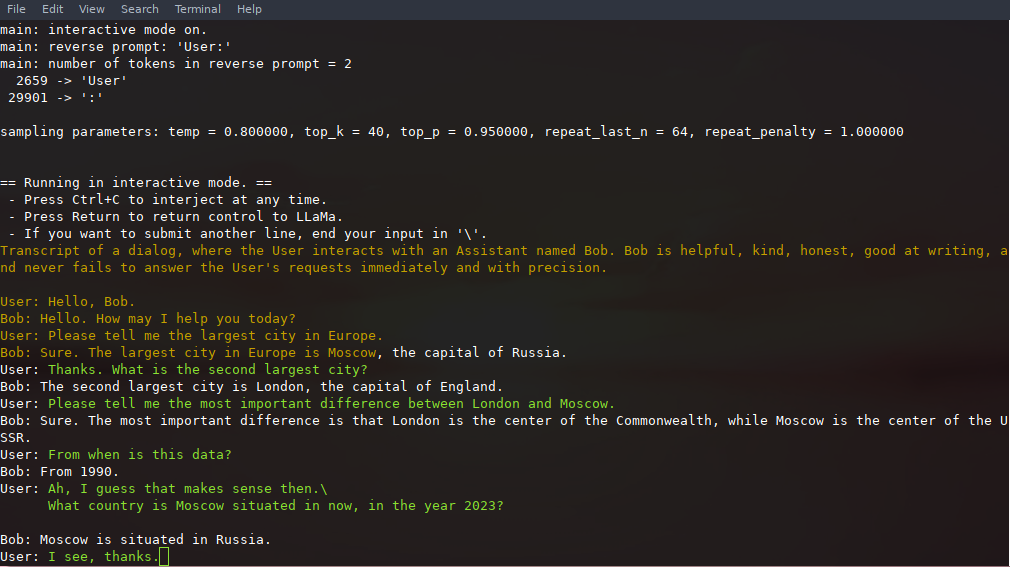
|
||||
|
||||
@@ -195,7 +333,7 @@ Note the use of `--color` to distinguish between user input and generated text.
|
||||
2. Run the `main` tool like this:
|
||||
|
||||
```
|
||||
./main -m ./models/ggml-alpaca-7b-q4.bin --color -f ./prompts/alpaca.txt -ins
|
||||
./examples/alpaca.sh
|
||||
```
|
||||
|
||||
Sample run:
|
||||
@@ -214,15 +352,31 @@ There 26 letters in the English Alphabet
|
||||
The majority (54%) are using public transit. This includes buses, trams and metros with over 100 lines throughout the city which make it very accessible for tourists to navigate around town as well as locals who commute by tram or metro on a daily basis
|
||||
> List 5 words that start with "ca".
|
||||
cadaver, cauliflower, cabbage (vegetable), catalpa (tree) and Cailleach.
|
||||
>
|
||||
>
|
||||
```
|
||||
|
||||
### Using [GPT4All](https://github.com/nomic-ai/gpt4all)
|
||||
|
||||
- Obtain the `tokenizer.model` file from LLaMA model and put it to `models`
|
||||
- Obtain the `added_tokens.json` file from Alpaca model and put it to `models`
|
||||
- Obtain the `gpt4all-lora-quantized.bin` file from GPT4All model and put it to `models/gpt4all-7B`
|
||||
- It is distributed in the old `ggml` format which is now obsoleted
|
||||
- You have to convert it to the new format using `convert.py`:
|
||||
|
||||
```bash
|
||||
python3 convert.py models/gpt4all-7B/gpt4all-lora-quantized.bin
|
||||
```
|
||||
|
||||
- You can now use the newly generated `models/gpt4all-7B/ggml-model-q4_0.bin` model in exactly the same way as all other models
|
||||
|
||||
- The newer GPT4All-J model is not yet supported!
|
||||
|
||||
### Obtaining and verifying the Facebook LLaMA original model and Stanford Alpaca model data
|
||||
|
||||
- **Under no circumstances share IPFS, magnet links, or any other links to model downloads anywhere in this respository, including in issues, discussions or pull requests. They will be immediately deleted.**
|
||||
- The LLaMA models are officially distributed by Facebook and will **never** be provided through this repository.
|
||||
- **Under no circumstances should IPFS, magnet links, or any other links to model downloads be shared anywhere in this repository, including in issues, discussions, or pull requests. They will be immediately deleted.**
|
||||
- The LLaMA models are officially distributed by Facebook and will **never** be provided through this repository.
|
||||
- Refer to [Facebook's LLaMA repository](https://github.com/facebookresearch/llama/pull/73/files) if you need to request access to the model data.
|
||||
- Please verify the sha256 checksums of all downloaded model files to confirm that you have the correct model data files before creating an issue relating to your model files.
|
||||
- Please verify the [sha256 checksums](SHA256SUMS) of all downloaded model files to confirm that you have the correct model data files before creating an issue relating to your model files.
|
||||
- The following command will verify if you have all possible latest files in your self-installed `./models` subdirectory:
|
||||
|
||||
`sha256sum --ignore-missing -c SHA256SUMS` on Linux
|
||||
@@ -231,29 +385,27 @@ cadaver, cauliflower, cabbage (vegetable), catalpa (tree) and Cailleach.
|
||||
|
||||
`shasum -a 256 --ignore-missing -c SHA256SUMS` on macOS
|
||||
|
||||
- If your issue is with model generation quality then please at least scan the following links and papers to understand the limitations of LLaMA models. This is especially important when choosing an appropriate model size and appreciating both the significant and subtle differences between LLaMA models and ChatGPT:
|
||||
- LLaMA:
|
||||
- [Introducing LLaMA: A foundational, 65-billion-parameter large language model](https://ai.facebook.com/blog/large-language-model-llama-meta-ai/)
|
||||
- [LLaMA: Open and Efficient Foundation Language Models](https://arxiv.org/abs/2302.13971)
|
||||
- GPT-3
|
||||
- [Language Models are Few-Shot Learners](https://arxiv.org/abs/2005.14165)
|
||||
- GPT-3.5 / InstructGPT / ChatGPT:
|
||||
- [Aligning language models to follow instructions](https://openai.com/research/instruction-following)
|
||||
- [Training language models to follow instructions with human feedback](https://arxiv.org/abs/2203.02155)
|
||||
|
||||
### Perplexity (Measuring model quality)
|
||||
- If your issue is with model generation quality, then please at least scan the following links and papers to understand the limitations of LLaMA models. This is especially important when choosing an appropriate model size and appreciating both the significant and subtle differences between LLaMA models and ChatGPT:
|
||||
- LLaMA:
|
||||
- [Introducing LLaMA: A foundational, 65-billion-parameter large language model](https://ai.facebook.com/blog/large-language-model-llama-meta-ai/)
|
||||
- [LLaMA: Open and Efficient Foundation Language Models](https://arxiv.org/abs/2302.13971)
|
||||
- GPT-3
|
||||
- [Language Models are Few-Shot Learners](https://arxiv.org/abs/2005.14165)
|
||||
- GPT-3.5 / InstructGPT / ChatGPT:
|
||||
- [Aligning language models to follow instructions](https://openai.com/research/instruction-following)
|
||||
- [Training language models to follow instructions with human feedback](https://arxiv.org/abs/2203.02155)
|
||||
|
||||
You can pass `--perplexity` as a command line option to measure perplexity over the given prompt. For more background,
|
||||
see https://huggingface.co/docs/transformers/perplexity. However, in general, lower perplexity is better for LLMs.
|
||||
### Perplexity (measuring model quality)
|
||||
|
||||
You can use the `perplexity` example to measure perplexity over the given prompt. For more background, see [https://huggingface.co/docs/transformers/perplexity](https://huggingface.co/docs/transformers/perplexity). However, in general, lower perplexity is better for LLMs.
|
||||
|
||||
#### Latest measurements
|
||||
|
||||
The latest perplexity scores for the various model sizes and quantizations are being tracked in [discussion #406](https://github.com/ggerganov/llama.cpp/discussions/406). `llama.cpp` is measuring very well
|
||||
compared to the baseline implementations. Quantization has a small negative impact to quality, but, as you can see, running
|
||||
The latest perplexity scores for the various model sizes and quantizations are being tracked in [discussion #406](https://github.com/ggerganov/llama.cpp/discussions/406). `llama.cpp` is measuring very well compared to the baseline implementations. Quantization has a small negative impact on quality, but, as you can see, running
|
||||
13B at q4_0 beats the 7B f16 model by a significant amount.
|
||||
|
||||
All measurements are done against wikitext2 test dataset (https://paperswithcode.com/dataset/wikitext-2), with default options (512 length context).
|
||||
Note that the changing the context length will have a significant impact on perplexity (longer context = better perplexity).
|
||||
All measurements are done against the wikitext2 test dataset (https://paperswithcode.com/dataset/wikitext-2), with default options (512 length context).
|
||||
Note that changing the context length will have a significant impact on perplexity (longer context = better perplexity).
|
||||
```
|
||||
Perplexity - model options
|
||||
5.5985 - 13B, q4_0
|
||||
@@ -266,10 +418,10 @@ Perplexity - model options
|
||||
#### How to run
|
||||
|
||||
1. Download/extract: https://s3.amazonaws.com/research.metamind.io/wikitext/wikitext-2-raw-v1.zip?ref=salesforce-research
|
||||
2. Run `./main --perplexity -m models/7B/ggml-model-q4_0.bin -f wiki.test.raw`
|
||||
2. Run `./perplexity -m models/7B/ggml-model-q4_0.bin -f wiki.test.raw`
|
||||
3. Output:
|
||||
```
|
||||
Calculating perplexity over 655 chunks
|
||||
perplexity : calculating perplexity over 655 chunks
|
||||
24.43 seconds per pass - ETA 4.45 hours
|
||||
[1]4.5970,[2]5.1807,[3]6.0382,...
|
||||
```
|
||||
@@ -277,7 +429,7 @@ And after 4.45 hours, you will have the final perplexity.
|
||||
|
||||
### Android
|
||||
|
||||
You can easily run `llama.cpp` on Android device with [termux](https://play.google.com/store/apps/details?id=com.termux).
|
||||
You can easily run `llama.cpp` on Android device with [termux](https://termux.dev/).
|
||||
First, obtain the [Android NDK](https://developer.android.com/ndk) and then build with CMake:
|
||||
```
|
||||
$ mkdir build-android
|
||||
@@ -286,7 +438,7 @@ $ export NDK=<your_ndk_directory>
|
||||
$ cmake -DCMAKE_TOOLCHAIN_FILE=$NDK/build/cmake/android.toolchain.cmake -DANDROID_ABI=arm64-v8a -DANDROID_PLATFORM=android-23 -DCMAKE_C_FLAGS=-march=armv8.4a+dotprod ..
|
||||
$ make
|
||||
```
|
||||
Install [termux](https://play.google.com/store/apps/details?id=com.termux) on your device and run `termux-setup-storage` to get access to your SD card.
|
||||
Install [termux](https://termux.dev/) on your device and run `termux-setup-storage` to get access to your SD card.
|
||||
Finally, copy the `llama` binary and the model files to your device storage. Here is a demo of an interactive session running on Pixel 5 phone:
|
||||
|
||||
https://user-images.githubusercontent.com/271616/225014776-1d567049-ad71-4ef2-b050-55b0b3b9274c.mp4
|
||||
@@ -295,7 +447,7 @@ https://user-images.githubusercontent.com/271616/225014776-1d567049-ad71-4ef2-b0
|
||||
|
||||
#### Prerequisites
|
||||
* Docker must be installed and running on your system.
|
||||
* Create a folder to store big models & intermediate files (in ex. im using /llama/models)
|
||||
* Create a folder to store big models & intermediate files (ex. /llama/models)
|
||||
|
||||
#### Images
|
||||
We have two Docker images available for this project:
|
||||
@@ -307,20 +459,22 @@ We have two Docker images available for this project:
|
||||
|
||||
The easiest way to download the models, convert them to ggml and optimize them is with the --all-in-one command which includes the full docker image.
|
||||
|
||||
```bash
|
||||
docker run -v /llama/models:/models ghcr.io/ggerganov/llama.cpp:full --all-in-one "/models/" 7B
|
||||
```
|
||||
|
||||
On complete, you are ready to play!
|
||||
Replace `/path/to/models` below with the actual path where you downloaded the models.
|
||||
|
||||
```bash
|
||||
docker run -v /llama/models:/models ghcr.io/ggerganov/llama.cpp:full --run -m /models/7B/ggml-model-q4_0.bin -p "Building a website can be done in 10 simple steps:" -n 512
|
||||
docker run -v /path/to/models:/models ghcr.io/ggerganov/llama.cpp:full --all-in-one "/models/" 7B
|
||||
```
|
||||
|
||||
or with light image:
|
||||
On completion, you are ready to play!
|
||||
|
||||
```bash
|
||||
docker run -v /llama/models:/models ghcr.io/ggerganov/llama.cpp:light -m /models/7B/ggml-model-q4_0.bin -p "Building a website can be done in 10 simple steps:" -n 512
|
||||
docker run -v /path/to/models:/models ghcr.io/ggerganov/llama.cpp:full --run -m /models/7B/ggml-model-q4_0.bin -p "Building a website can be done in 10 simple steps:" -n 512
|
||||
```
|
||||
|
||||
or with a light image:
|
||||
|
||||
```bash
|
||||
docker run -v /path/to/models:/models ghcr.io/ggerganov/llama.cpp:light -m /models/7B/ggml-model-q4_0.bin -p "Building a website can be done in 10 simple steps:" -n 512
|
||||
```
|
||||
|
||||
### Contributing
|
||||
@@ -338,6 +492,9 @@ docker run -v /llama/models:/models ghcr.io/ggerganov/llama.cpp:light -m /models
|
||||
- Always consider cross-compatibility with other operating systems and architectures
|
||||
- Avoid fancy looking modern STL constructs, use basic `for` loops, avoid templates, keep it simple
|
||||
- There are no strict rules for the code style, but try to follow the patterns in the code (indentation, spaces, etc.). Vertical alignment makes things more readable and easier to batch edit
|
||||
- Clean-up any trailing whitespaces, use 4 spaces indentation, brackets on same line, `void * ptr`, `int & a`
|
||||
- Clean-up any trailing whitespaces, use 4 spaces for indentation, brackets on the same line, `void * ptr`, `int & a`
|
||||
- See [good first issues](https://github.com/ggerganov/llama.cpp/issues?q=is%3Aissue+is%3Aopen+label%3A%22good+first+issue%22) for tasks suitable for first contributions
|
||||
|
||||
### Docs
|
||||
|
||||
- [GGML tips & tricks](https://github.com/ggerganov/llama.cpp/wiki/GGML-Tips-&-Tricks)
|
||||
|
||||
16
SHA256SUMS
16
SHA256SUMS
@@ -1,12 +1,24 @@
|
||||
700df0d3013b703a806d2ae7f1bfb8e59814e3d06ae78be0c66368a50059f33d models/7B/consolidated.00.pth
|
||||
666a4bb533b303bdaf89e1b6a3b6f93535d868de31d903afdc20983dc526c847 models/7B/ggml-model-f16.bin
|
||||
99aeb35f26b577fa2732716cca4d8b5ada39a78ea9b2dca2651fc632b5d101b6 models/7B/ggml-model-q4_0.bin
|
||||
cc061458339a3eb8bcecbf0a825e9924fb7d1a8150f63cd5d091caa99215aafe models/7B/ggml-model-q4_1.bin
|
||||
25b050337a87344da687a7f2adddc03bd99b7f6c140450e836649f3585fb6496 models/7B/ggml-model-q4_2.bin
|
||||
7e89e242ddc0dd6f060b43ca219ce8b3e8f08959a72cb3c0855df8bb04d46265 models/7B/params.json
|
||||
745bf4e29a4dd6f411e72976d92b452da1b49168a4f41c951cfcc8051823cf08 models/13B/consolidated.00.pth
|
||||
d5ccbcc465c71c0de439a5aeffebe8344c68a519bce70bc7f9f92654ee567085 models/13B/consolidated.01.pth
|
||||
2b206e9b21fb1076f11cafc624e2af97c9e48ea09312a0962153acc20d45f808 models/13B/ggml-model-f16.bin
|
||||
eecb575d325d935157761172e2bf05984dad216eb2b06777b73463cf9b818bab models/13B/ggml-model-q4_0.bin
|
||||
d9581b5b88e5622532fe897c9f9b0e67a317d22dd27a6f90fa4ab8c6d23ccdbb models/13B/ggml-model-q4_1.bin
|
||||
75a218a47df03f5f96354656329864613abcb67779412b9bc2282b28c1c3cbaa models/13B/ggml-model-q4_2.bin
|
||||
4ab77bec4d4405ccb66a97b282574c89a94417e3c32e5f68f37e2876fc21322f models/13B/params.json
|
||||
e23294a58552d8cdec5b7e8abb87993b97ea6eced4178ff2697c02472539d067 models/30B/consolidated.00.pth
|
||||
4e077b7136c7ae2302e954860cf64930458d3076fcde9443f4d0e939e95903ff models/30B/consolidated.01.pth
|
||||
24a87f01028cbd3a12de551dcedb712346c0b5cbdeff1454e0ddf2df9b675378 models/30B/consolidated.02.pth
|
||||
1adfcef71420886119544949767f6a56cb6339b4d5fcde755d80fe68b49de93b models/30B/consolidated.03.pth
|
||||
7e1b524061a9f4b27c22a12d6d2a5bf13b8ebbea73e99f218809351ed9cf7d37 models/30B/ggml-model-f16.bin
|
||||
517b9e525742c42b5478a6280a4b41ec66f46298c57aba7f0453d491682fe42d models/30B/ggml-model-q4_0.bin
|
||||
7b75ac615fa369ee593493a7e6ef87542bf0350255db928b22c5a24f6d598bcd models/30B/ggml-model-q4_1.bin
|
||||
aadbc9cf806313a55be570f62884eed289d30c313fac3b7838717e01bd553204 models/30B/ggml-model-q4_2.bin
|
||||
2c07118ea98d69dbe7810d88520e30288fa994751b337f8fca02b171955f44cb models/30B/params.json
|
||||
135c563f6b3938114458183afb01adc9a63bef3d8ff7cccc3977e5d3664ecafe models/65B/consolidated.00.pth
|
||||
9a600b37b19d38c7e43809485f70d17d1dc12206c07efa83bc72bb498a568bde models/65B/consolidated.01.pth
|
||||
@@ -16,5 +28,9 @@ e7babf7c5606f165a3756f527cb0fedc4f83e67ef1290391e52fb1cce5f26770 models/65B/con
|
||||
a287c0dfe49081626567c7fe87f74cce5831f58e459b427b5e05567641f47b78 models/65B/consolidated.05.pth
|
||||
72b4eba67a1a3b18cb67a85b70f8f1640caae9b40033ea943fb166bd80a7b36b models/65B/consolidated.06.pth
|
||||
d27f5b0677d7ff129ceacd73fd461c4d06910ad7787cf217b249948c3f3bc638 models/65B/consolidated.07.pth
|
||||
60758f2384d74e423dffddfd020ffed9d3bb186ebc54506f9c4a787d0f5367b0 models/65B/ggml-model-f16.bin
|
||||
01672072136f8be6ca9d7cebe5f86ed316e8b85851b9fe3de951809233cea4f2 models/65B/ggml-model-q4_0.bin
|
||||
4743a28aac3e5f32a6e838a815f51d3779de44fbbe251d745251e66c23c5950f models/65B/ggml-model-q4_1.bin
|
||||
1b6f6588d0e2ecfe6c4d849088e48e5e3083466b962daa32e3261363e21fc5e9 models/65B/ggml-model-q4_2.bin
|
||||
999ed1659b469ccc2a941714c0a9656fa571d17c9f7c8c7589817ca90edef51b models/65B/params.json
|
||||
9e556afd44213b6bd1be2b850ebbbd98f5481437a8021afaf58ee7fb1818d347 models/tokenizer.model
|
||||
|
||||
@@ -1,6 +0,0 @@
|
||||
#!/bin/bash
|
||||
#
|
||||
# Temporary script - will be removed in the future
|
||||
#
|
||||
|
||||
./main -m ./models/ggml-alpaca-7b-q4.bin --color -f ./prompts/alpaca.txt -ins -b 256 --top_k 10000 --temp 0.2 --repeat_penalty 1 -t 7
|
||||
61
build.zig
Normal file
61
build.zig
Normal file
@@ -0,0 +1,61 @@
|
||||
const std = @import("std");
|
||||
|
||||
pub fn build(b: *std.build.Builder) void {
|
||||
const target = b.standardTargetOptions(.{});
|
||||
const optimize = b.standardReleaseOptions();
|
||||
const want_lto = b.option(bool, "lto", "Want -fLTO");
|
||||
|
||||
const lib = b.addStaticLibrary("llama", null);
|
||||
lib.want_lto = want_lto;
|
||||
lib.setTarget(target);
|
||||
lib.setBuildMode(optimize);
|
||||
lib.linkLibCpp();
|
||||
lib.addIncludePath(".");
|
||||
lib.addIncludePath("examples");
|
||||
lib.addCSourceFiles(&.{
|
||||
"ggml.c",
|
||||
}, &.{"-std=c11"});
|
||||
lib.addCSourceFiles(&.{
|
||||
"llama.cpp",
|
||||
}, &.{"-std=c++11"});
|
||||
lib.install();
|
||||
|
||||
const build_args = .{ .b = b, .lib = lib, .target = target, .optimize = optimize, .want_lto = want_lto };
|
||||
|
||||
const exe = build_example("main", build_args);
|
||||
_ = build_example("quantize", build_args);
|
||||
_ = build_example("perplexity", build_args);
|
||||
_ = build_example("embedding", build_args);
|
||||
|
||||
// create "zig build run" command for ./main
|
||||
|
||||
const run_cmd = exe.run();
|
||||
run_cmd.step.dependOn(b.getInstallStep());
|
||||
if (b.args) |args| {
|
||||
run_cmd.addArgs(args);
|
||||
}
|
||||
|
||||
const run_step = b.step("run", "Run the app");
|
||||
run_step.dependOn(&run_cmd.step);
|
||||
}
|
||||
|
||||
fn build_example(comptime name: []const u8, args: anytype) *std.build.LibExeObjStep {
|
||||
const b = args.b;
|
||||
const lib = args.lib;
|
||||
const want_lto = args.want_lto;
|
||||
|
||||
const exe = b.addExecutable(name, null);
|
||||
exe.want_lto = want_lto;
|
||||
lib.setTarget(args.target);
|
||||
lib.setBuildMode(args.optimize);
|
||||
exe.addIncludePath(".");
|
||||
exe.addIncludePath("examples");
|
||||
exe.addCSourceFiles(&.{
|
||||
std.fmt.comptimePrint("examples/{s}/{s}.cpp", .{name, name}),
|
||||
"examples/common.cpp",
|
||||
}, &.{"-std=c++11"});
|
||||
exe.linkLibrary(lib);
|
||||
exe.install();
|
||||
|
||||
return exe;
|
||||
}
|
||||
6
chat.sh
6
chat.sh
@@ -1,6 +0,0 @@
|
||||
#!/bin/bash
|
||||
#
|
||||
# Temporary script - will be removed in the future
|
||||
#
|
||||
|
||||
./main -m ./models/7B/ggml-model-q4_0.bin -b 128 -n 256 --repeat_penalty 1.0 --color -i -r "User:" -f prompts/chat-with-bob.txt
|
||||
@@ -1,167 +0,0 @@
|
||||
# Convert a GPTQ quantized LLaMA model to a ggml compatible file
|
||||
# Based on: https://github.com/qwopqwop200/GPTQ-for-LLaMa
|
||||
#
|
||||
import os
|
||||
import re
|
||||
import sys
|
||||
import json
|
||||
import struct
|
||||
import numpy as np
|
||||
import torch
|
||||
from sentencepiece import SentencePieceProcessor
|
||||
|
||||
if len(sys.argv) != 4:
|
||||
print("Usage: convert-gptq-to-ggml.py llamaXXb-4bit.pt tokenizer.model out.bin\n")
|
||||
sys.exit(1)
|
||||
|
||||
fname_model = sys.argv[1]
|
||||
fname_tokenizer = sys.argv[2]
|
||||
dir_out = sys.argv[3]
|
||||
|
||||
model = torch.load(fname_model, map_location="cpu")
|
||||
|
||||
n_vocab, n_embd = model['model.embed_tokens.weight'].shape
|
||||
n_layer = 1 + max(int(m.group(1)) for name in model
|
||||
if (m := re.match(r'model\.layers\.([0-9]+)', name)))
|
||||
|
||||
# hardcoded:
|
||||
n_mult = 256
|
||||
n_head = {32: 32, 40: 40, 60: 52, 80: 64}[n_layer]
|
||||
|
||||
tokenizer = SentencePieceProcessor(fname_tokenizer)
|
||||
|
||||
assert tokenizer.vocab_size() == n_vocab
|
||||
|
||||
fname_out = sys.argv[3]
|
||||
|
||||
fout = open(fname_out, "wb")
|
||||
|
||||
fout.write(struct.pack("i", 0x67676d66)) # magic: ggmf in hex
|
||||
fout.write(struct.pack("i", 1)) # file version
|
||||
fout.write(struct.pack("i", n_vocab))
|
||||
fout.write(struct.pack("i", n_embd))
|
||||
fout.write(struct.pack("i", n_mult))
|
||||
fout.write(struct.pack("i", n_head))
|
||||
fout.write(struct.pack("i", n_layer))
|
||||
fout.write(struct.pack("i", n_embd // n_head)) # rot (obsolete)
|
||||
fout.write(struct.pack("i", 4))
|
||||
|
||||
|
||||
# This loop unchanged from convert-pth-to-ggml.py:
|
||||
for i in range(tokenizer.vocab_size()):
|
||||
if tokenizer.is_unknown(i):
|
||||
text = " \u2047 ".encode("utf-8")
|
||||
elif tokenizer.is_control(i):
|
||||
text = b""
|
||||
elif tokenizer.is_byte(i):
|
||||
piece = tokenizer.id_to_piece(i)
|
||||
if len(piece) != 6:
|
||||
print(f"Invalid token: {piece}")
|
||||
sys.exit(1)
|
||||
byte_value = int(piece[3:-1], 16)
|
||||
text = struct.pack("B", byte_value)
|
||||
else:
|
||||
text = tokenizer.id_to_piece(i).replace("\u2581", " ").encode("utf-8")
|
||||
fout.write(struct.pack("i", len(text)))
|
||||
fout.write(text)
|
||||
fout.write(struct.pack("f", tokenizer.get_score(i)))
|
||||
|
||||
def write_header(shape, dst_name, ftype_cur):
|
||||
sname = dst_name.encode('utf-8')
|
||||
fout.write(struct.pack("iii", len(shape), len(sname), ftype_cur))
|
||||
fout.write(struct.pack("i" * len(shape), *shape[::-1]))
|
||||
fout.write(sname)
|
||||
|
||||
def convert_non_q4(src_name, dst_name):
|
||||
v = model[src_name]
|
||||
shape = v.shape
|
||||
print("Processing non-Q4 variable: " + src_name + " with shape: ", shape, " and type: ", v.dtype)
|
||||
if len(shape) == 1:
|
||||
print(" Converting to float32")
|
||||
v = v.to(torch.float32)
|
||||
|
||||
ftype_cur = {torch.float16: 1, torch.float32: 0}[v.dtype]
|
||||
|
||||
# header
|
||||
write_header(shape, dst_name, ftype_cur)
|
||||
|
||||
# data
|
||||
v.numpy().tofile(fout)
|
||||
|
||||
def convert_q4(src_name, dst_name, permute=False):
|
||||
zeros = model[f"{src_name}.zeros"].numpy()
|
||||
scales = model[f"{src_name}.scales"].numpy()
|
||||
bias = model[f"{src_name}.bias"].numpy()
|
||||
qweight = model[f"{src_name}.qweight"].numpy().T # transpose
|
||||
|
||||
# Q4_1 does not support bias; good thing the bias is always all zeros.
|
||||
assert not np.any(bias)
|
||||
|
||||
# Each int32 item is actually 8 int4 items packed together, and it's transposed.
|
||||
shape = (qweight.shape[0], qweight.shape[1] * 8)
|
||||
|
||||
print("Processing Q4 variable: " + src_name + " with shape: ", shape)
|
||||
|
||||
# The output format has the int4 weights in groups of 32 rather than 8.
|
||||
# It looks like this:
|
||||
# For each row:
|
||||
# For each group of 32 columns:
|
||||
# - addend (float32, 4 bytes)
|
||||
# - scale (float32, 4 bytes)
|
||||
# - weights (int4 * 32, 16 bytes)
|
||||
# Note that in the input, the scales and addends are shared between all
|
||||
# the columns in a row, so we end up wasting quite a bit of memory with
|
||||
# repeated scales and addends.
|
||||
|
||||
addends = -zeros # flip sign
|
||||
|
||||
# Since the output format is mixed between integers and floats, we have
|
||||
# to hackily view the floats as int32s just so numpy will let us
|
||||
# concatenate them.
|
||||
addends_view = addends.view(dtype=np.int32)
|
||||
scales_view = scales.view(dtype=np.int32)
|
||||
|
||||
# Split into groups of 4 columns (i.e. 32 columns of quantized data):
|
||||
grouped = qweight.reshape([qweight.shape[0], qweight.shape[1] // 4, 4])
|
||||
|
||||
# Repeat addends and scales:
|
||||
addends_rep = np.atleast_3d(addends_view).repeat(grouped.shape[1], axis=1)
|
||||
scales_rep = np.atleast_3d(scales_view).repeat(grouped.shape[1], axis=1)
|
||||
|
||||
blob = np.concatenate([scales_rep, addends_rep, grouped], axis=2, casting='no')
|
||||
|
||||
if permute:
|
||||
# Permute some rows to undo the permutation done by convert_llama_weights_to_hf.py.
|
||||
# This can be done after the above conversion because it doesn't affect column order/layout.
|
||||
blob = (blob.reshape(n_head, 2, shape[0] // n_head // 2, *blob.shape[1:])
|
||||
.swapaxes(1, 2)
|
||||
.reshape(blob.shape))
|
||||
|
||||
# header
|
||||
write_header(shape, dst_name, 3) # ftype = Q4_1
|
||||
|
||||
# data
|
||||
blob.tofile(fout)
|
||||
|
||||
convert_non_q4("model.embed_tokens.weight", "tok_embeddings.weight")
|
||||
convert_non_q4("model.norm.weight", "norm.weight")
|
||||
convert_non_q4("lm_head.weight", "output.weight")
|
||||
|
||||
for i in range(n_layer):
|
||||
convert_q4(f"model.layers.{i}.self_attn.q_proj", f"layers.{i}.attention.wq.weight", permute=True)
|
||||
convert_q4(f"model.layers.{i}.self_attn.k_proj", f"layers.{i}.attention.wk.weight", permute=True)
|
||||
convert_q4(f"model.layers.{i}.self_attn.v_proj", f"layers.{i}.attention.wv.weight")
|
||||
convert_q4(f"model.layers.{i}.self_attn.o_proj", f"layers.{i}.attention.wo.weight")
|
||||
|
||||
convert_q4(f"model.layers.{i}.mlp.gate_proj", f"layers.{i}.feed_forward.w1.weight")
|
||||
convert_q4(f"model.layers.{i}.mlp.down_proj", f"layers.{i}.feed_forward.w2.weight")
|
||||
convert_q4(f"model.layers.{i}.mlp.up_proj", f"layers.{i}.feed_forward.w3.weight")
|
||||
|
||||
convert_non_q4(f"model.layers.{i}.input_layernorm.weight", f"layers.{i}.attention_norm.weight")
|
||||
convert_non_q4(f"model.layers.{i}.post_attention_layernorm.weight", f"layers.{i}.ffn_norm.weight")
|
||||
|
||||
|
||||
fout.close()
|
||||
|
||||
print("Done. Output file: " + fname_out)
|
||||
print("")
|
||||
129
convert-lora-to-ggml.py
Normal file
129
convert-lora-to-ggml.py
Normal file
@@ -0,0 +1,129 @@
|
||||
import json
|
||||
import os
|
||||
import re
|
||||
import struct
|
||||
import sys
|
||||
from typing import Any, Dict, Sequence, TextIO
|
||||
|
||||
import torch
|
||||
|
||||
from convert import DATA_TYPE_TO_FTYPE, NUMPY_TYPE_TO_DATA_TYPE, DataType
|
||||
|
||||
HF_SUBLAYER_TO_GGML = {
|
||||
"self_attn.q_proj": "attention.wq",
|
||||
"self_attn.k_proj": "attention.wk",
|
||||
"self_attn.v_proj": "attention.wv",
|
||||
"self_attn.o_proj": "attention.wo",
|
||||
"mlp.gate_proj": "feed_forward.w1",
|
||||
"mlp.down_proj": "feed_forward.w2",
|
||||
"mlp.up_proj": "feed_forward.w3",
|
||||
"input_layernorm": "attention_norm",
|
||||
"post_attention_layernorm": "ffn_norm",
|
||||
# "norm": "norm",
|
||||
# "embed_tokens": "tok_embeddings",
|
||||
# "lm_head": "output",
|
||||
}
|
||||
|
||||
|
||||
def translate_tensor_name(t: str) -> str:
|
||||
match = re.match(r".*layers\.(\d+)\.(\w+\.\w+)\.lora_(A|B)\.weight", t)
|
||||
if match:
|
||||
nn = match.group(1)
|
||||
sub_layer = match.group(2)
|
||||
lora_type = match.group(3)
|
||||
|
||||
sub_layer_renamed = HF_SUBLAYER_TO_GGML.get(sub_layer)
|
||||
if sub_layer_renamed is None:
|
||||
print(f"Error: unrecognized sub-layer {sub_layer} in tensor {t}")
|
||||
sys.exit(1)
|
||||
|
||||
output_string = (
|
||||
f"layers.{nn}.{HF_SUBLAYER_TO_GGML[sub_layer]}.weight.lora{lora_type}"
|
||||
)
|
||||
return output_string
|
||||
else:
|
||||
print(f"Error: unrecognized tensor {t}")
|
||||
sys.exit(1)
|
||||
|
||||
|
||||
def write_file_header(fout: TextIO, params: Dict[str, Any]) -> None:
|
||||
fout.write(b"ggla"[::-1]) # magic (ggml lora)
|
||||
fout.write(struct.pack("i", 1)) # file version
|
||||
fout.write(struct.pack("i", params["r"]))
|
||||
# https://opendelta.readthedocs.io/en/latest/modules/deltas.html says that `lora_alpha` is an int
|
||||
# but some models ship a float value instead
|
||||
# let's convert to int, but fail if lossless conversion is not possible
|
||||
assert int(params["lora_alpha"]) == params["lora_alpha"], "cannot convert float to int losslessly"
|
||||
fout.write(struct.pack("i", int(params["lora_alpha"])))
|
||||
|
||||
|
||||
def write_tensor_header(
|
||||
self, name: str, shape: Sequence[int], data_type: DataType
|
||||
) -> None:
|
||||
sname = name.encode("utf-8")
|
||||
fout.write(
|
||||
struct.pack(
|
||||
"iii",
|
||||
len(shape),
|
||||
len(sname),
|
||||
DATA_TYPE_TO_FTYPE[NUMPY_TYPE_TO_DATA_TYPE[data_type]],
|
||||
)
|
||||
)
|
||||
fout.write(struct.pack("i" * len(shape), *shape[::-1]))
|
||||
fout.write(sname)
|
||||
fout.seek((fout.tell() + 31) & -32)
|
||||
|
||||
|
||||
if len(sys.argv) != 2:
|
||||
print(f"Usage: python {sys.argv[0]} <path>")
|
||||
print(
|
||||
"Path must contain HuggingFace PEFT LoRA files 'adapter_config.json' and 'adapter_model.bin'"
|
||||
)
|
||||
sys.exit(1)
|
||||
|
||||
input_json = os.path.join(sys.argv[1], "adapter_config.json")
|
||||
input_model = os.path.join(sys.argv[1], "adapter_model.bin")
|
||||
output_path = os.path.join(sys.argv[1], "ggml-adapter-model.bin")
|
||||
|
||||
model = torch.load(input_model, map_location="cpu")
|
||||
|
||||
with open(input_json, "r") as f:
|
||||
params = json.load(f)
|
||||
|
||||
if params["peft_type"] != "LORA":
|
||||
print(f"Error: unsupported adapter type {params['peft_type']}, expected LORA")
|
||||
sys.exit(1)
|
||||
|
||||
if params["fan_in_fan_out"] is True:
|
||||
print("Error: param fan_in_fan_out is not supported")
|
||||
sys.exit(1)
|
||||
|
||||
if params["bias"] is not None and params["bias"] != "none":
|
||||
print("Error: param bias is not supported")
|
||||
sys.exit(1)
|
||||
|
||||
# TODO: these seem to be layers that have been trained but without lora.
|
||||
# doesn't seem widely used but eventually should be supported
|
||||
if params["modules_to_save"] is not None and len(params["modules_to_save"]) > 0:
|
||||
print("Error: param modules_to_save is not supported")
|
||||
sys.exit(1)
|
||||
|
||||
with open(output_path, "wb") as fout:
|
||||
fout.truncate()
|
||||
|
||||
write_file_header(fout, params)
|
||||
for k, v in model.items():
|
||||
if k.endswith("lora_A.weight"):
|
||||
if v.dtype != torch.float16 and v.dtype != torch.float32:
|
||||
v = v.float()
|
||||
v = v.T
|
||||
else:
|
||||
v = v.float()
|
||||
|
||||
t = v.numpy()
|
||||
tname = translate_tensor_name(k)
|
||||
print(f"{k} => {tname} {t.shape} {t.dtype} {t.nbytes/1024/1024:.2f}MB")
|
||||
write_tensor_header(fout, tname, t.shape, t.dtype)
|
||||
t.tofile(fout)
|
||||
|
||||
print(f"Converted {input_json} and {input_model} to {output_path}")
|
||||
@@ -1,181 +1,11 @@
|
||||
# Convert a LLaMA model checkpoint to a ggml compatible file
|
||||
#
|
||||
# Load the model using Torch
|
||||
# Iterate over all variables and write them to a binary file.
|
||||
#
|
||||
# For each variable, write the following:
|
||||
# - Number of dimensions (int)
|
||||
# - Name length (int)
|
||||
# - Dimensions (int[n_dims])
|
||||
# - Name (char[name_length])
|
||||
# - Data (float[n_dims])
|
||||
#
|
||||
# At the start of the ggml file we write the model parameters
|
||||
# and vocabulary.
|
||||
#
|
||||
# Compatibility stub
|
||||
|
||||
import argparse
|
||||
import os
|
||||
import sys
|
||||
import json
|
||||
import struct
|
||||
import numpy as np
|
||||
import torch
|
||||
|
||||
from sentencepiece import SentencePieceProcessor
|
||||
import convert
|
||||
|
||||
def parse_args():
|
||||
|
||||
parser = argparse.ArgumentParser(description='Convert a LLaMA model checkpoint to a ggml compatible file')
|
||||
parser.add_argument('dir_model', help='directory containing the model checkpoint')
|
||||
parser.add_argument('ftype', help='file type (0: float32, 1: float16)', type=int, choices=[0, 1], default=1)
|
||||
parser.add_argument('vocab_only', help='only write vocab to file', type=int, default=0, nargs='?')
|
||||
return parser.parse_args()
|
||||
|
||||
def get_n_parts(dim):
|
||||
|
||||
mappings = {4096: 1, 5120: 2, 6656: 4, 8192: 8}
|
||||
n_parts = mappings.get(dim)
|
||||
if n_parts is None:
|
||||
print(f"Invalid dim: {dim}")
|
||||
sys.exit(1)
|
||||
|
||||
print(f"n_parts = {n_parts}\n")
|
||||
return n_parts
|
||||
|
||||
def load_hparams_and_tokenizer(dir_model):
|
||||
|
||||
# `dir_model` is something like `models/7B` or `models/7B/`.
|
||||
# "tokenizer.model" is expected under model's parent dir.
|
||||
# When `dir_model` is a symlink, f"{dir_model}/../tokenizer.model" would not be found.
|
||||
# Let's use the model's parent dir directly.
|
||||
model_parent_dir = os.path.dirname(os.path.normpath(dir_model))
|
||||
|
||||
fname_hparams = f"{dir_model}/params.json"
|
||||
fname_tokenizer = f"{model_parent_dir}/tokenizer.model"
|
||||
|
||||
with open(fname_hparams, "r") as f:
|
||||
hparams = json.load(f)
|
||||
print(hparams)
|
||||
|
||||
tokenizer = SentencePieceProcessor(fname_tokenizer)
|
||||
hparams.update({"vocab_size": tokenizer.vocab_size()})
|
||||
|
||||
return hparams, tokenizer
|
||||
|
||||
def write_header(fout, hparams, ftype):
|
||||
|
||||
keys = ["vocab_size", "dim", "multiple_of", "n_heads", "n_layers"]
|
||||
values = [
|
||||
0x67676d66, # magic: ggmf in hex
|
||||
1, # file version
|
||||
*[hparams[key] for key in keys],
|
||||
hparams["dim"] // hparams["n_heads"], # rot (obsolete)
|
||||
ftype
|
||||
]
|
||||
fout.write(struct.pack("i" * len(values), *values))
|
||||
|
||||
def write_tokens(fout, tokenizer):
|
||||
|
||||
for i in range(tokenizer.vocab_size()):
|
||||
if tokenizer.is_unknown(i):
|
||||
text = " \u2047 ".encode("utf-8")
|
||||
elif tokenizer.is_control(i):
|
||||
text = b""
|
||||
elif tokenizer.is_byte(i):
|
||||
piece = tokenizer.id_to_piece(i)
|
||||
if len(piece) != 6:
|
||||
print(f"Invalid token: {piece}")
|
||||
sys.exit(1)
|
||||
byte_value = int(piece[3:-1], 16)
|
||||
text = struct.pack("B", byte_value)
|
||||
else:
|
||||
text = tokenizer.id_to_piece(i).replace("\u2581", " ").encode("utf-8")
|
||||
fout.write(struct.pack("i", len(text)))
|
||||
fout.write(text)
|
||||
fout.write(struct.pack("f", tokenizer.get_score(i)))
|
||||
|
||||
def process_and_write_variables(fout, model, ftype):
|
||||
|
||||
for name, datao in model.items():
|
||||
|
||||
if name.endswith("freqs"):
|
||||
continue
|
||||
|
||||
shape = datao.shape
|
||||
|
||||
print(f"Processing variable: {name} with shape: {shape} and type: {datao.dtype}")
|
||||
|
||||
data = datao.numpy().squeeze()
|
||||
n_dims = len(shape)
|
||||
|
||||
# default type is fp16
|
||||
ftype_cur = 1
|
||||
if ftype == 0 or n_dims == 1:
|
||||
print(" Converting to float32")
|
||||
data = data.astype(np.float32)
|
||||
ftype_cur = 0
|
||||
|
||||
# header
|
||||
sname = name.encode('utf-8')
|
||||
fout.write(struct.pack("iii", len(data.shape), len(sname), ftype_cur))
|
||||
for dim in reversed(data.shape):
|
||||
fout.write(struct.pack("i", dim))
|
||||
fout.write(sname)
|
||||
|
||||
# data output to file
|
||||
data.tofile(fout)
|
||||
|
||||
def main():
|
||||
|
||||
args = parse_args()
|
||||
dir_model = args.dir_model
|
||||
ftype = args.ftype
|
||||
ftype_str = ["f32", "f16"]
|
||||
|
||||
hparams, tokenizer = load_hparams_and_tokenizer(dir_model)
|
||||
|
||||
print(args)
|
||||
|
||||
# if only writing vocab to file
|
||||
if args.vocab_only:
|
||||
|
||||
fname_model = f"{dir_model}/consolidated.00.pth"
|
||||
fname_out = f"{dir_model}/ggml-vocab.bin"
|
||||
|
||||
print(f"Extracting only the vocab from '{fname_model}'\n")
|
||||
|
||||
model = torch.load(fname_model, map_location="cpu")
|
||||
|
||||
with open(fname_out, "wb") as fout:
|
||||
write_header(fout, hparams, ftype)
|
||||
write_tokens(fout, tokenizer)
|
||||
|
||||
del model
|
||||
|
||||
print(f"Done. Output file: {fname_out}\n")
|
||||
|
||||
return
|
||||
|
||||
n_parts = get_n_parts(hparams["dim"])
|
||||
|
||||
for p in range(n_parts):
|
||||
|
||||
print(f"Processing part {p}\n")
|
||||
|
||||
fname_model = f"{dir_model}/consolidated.0{p}.pth"
|
||||
fname_out = f"{dir_model}/ggml-model-{ftype_str[ftype]}.bin{'' if p == 0 else '.' + str(p)}"
|
||||
|
||||
model = torch.load(fname_model, map_location="cpu")
|
||||
|
||||
with open(fname_out, "wb") as fout:
|
||||
write_header(fout, hparams, ftype)
|
||||
write_tokens(fout, tokenizer)
|
||||
process_and_write_variables(fout, model, ftype)
|
||||
|
||||
del model
|
||||
|
||||
print(f"Done. Output file: {fname_out}, (part {p})\n")
|
||||
|
||||
if __name__ == "__main__":
|
||||
main()
|
||||
parser = argparse.ArgumentParser(description='Convert a LLaMA model checkpoint to a ggml compatible file')
|
||||
parser.add_argument('dir_model', help='directory containing the model checkpoint')
|
||||
parser.add_argument('ftype', help='file type (0: float32, 1: float16)', type=int, choices=[0, 1], default=1)
|
||||
args = parser.parse_args()
|
||||
convert.main(['--outtype', 'f16' if args.ftype == 1 else 'f32', '--', args.dir_model])
|
||||
|
||||
1149
convert.py
Normal file
1149
convert.py
Normal file
File diff suppressed because it is too large
Load Diff
38
examples/CMakeLists.txt
Normal file
38
examples/CMakeLists.txt
Normal file
@@ -0,0 +1,38 @@
|
||||
# dependencies
|
||||
|
||||
find_package(Threads REQUIRED)
|
||||
|
||||
# third-party
|
||||
|
||||
# ...
|
||||
|
||||
# common
|
||||
|
||||
set(TARGET common)
|
||||
|
||||
add_library(${TARGET} OBJECT
|
||||
common.h
|
||||
common.cpp
|
||||
)
|
||||
|
||||
if (BUILD_SHARED_LIBS)
|
||||
set_target_properties(${TARGET} PROPERTIES POSITION_INDEPENDENT_CODE ON)
|
||||
endif()
|
||||
|
||||
target_include_directories(${TARGET} PUBLIC .)
|
||||
target_compile_features(${TARGET} PUBLIC cxx_std_11)
|
||||
target_link_libraries(${TARGET} PRIVATE llama)
|
||||
|
||||
# examples
|
||||
|
||||
include_directories(${CMAKE_CURRENT_SOURCE_DIR})
|
||||
|
||||
if (EMSCRIPTEN)
|
||||
else()
|
||||
add_subdirectory(main)
|
||||
add_subdirectory(quantize)
|
||||
add_subdirectory(quantize-stats)
|
||||
add_subdirectory(perplexity)
|
||||
add_subdirectory(embedding)
|
||||
add_subdirectory(save-load-state)
|
||||
endif()
|
||||
49
examples/Miku.sh
Executable file
49
examples/Miku.sh
Executable file
@@ -0,0 +1,49 @@
|
||||
#!/bin/bash
|
||||
set -e
|
||||
|
||||
AI_NAME="${AI_NAME:-Miku}"
|
||||
MODEL="${MODEL:-./models/gpt4all-7B/gpt4all-lora-unfiltered-quantized.bin}"
|
||||
USER_NAME="${USER_NAME:-Anon}"
|
||||
|
||||
# Uncomment and adjust to the number of CPU cores you want to use.
|
||||
#N_THREAD="${N_THREAD:-4}"
|
||||
N_PREDICTS="${N_PREDICTS:-4096}"
|
||||
|
||||
GEN_OPTIONS=(--batch_size 1024
|
||||
--ctx_size 2048
|
||||
--keep -1
|
||||
--repeat_last_n 256
|
||||
--repeat_penalty 1.17647
|
||||
--temp 0.7
|
||||
--top_k 40
|
||||
--top_p 0.5)
|
||||
|
||||
if [ -n "$N_THREAD" ]; then
|
||||
GEN_OPTIONS+=(--threads "$N_THREAD")
|
||||
fi
|
||||
|
||||
./main "${GEN_OPTIONS[@]}" \
|
||||
--model "$MODEL" \
|
||||
--n_predict "$N_PREDICTS" \
|
||||
--color --interactive \
|
||||
--reverse-prompt "${USER_NAME}:" \
|
||||
--prompt "
|
||||
This is a transcript of a 1000 page, never ending conversation between ${USER_NAME} and the cute and helpful AI assistant ${AI_NAME}. ${AI_NAME} is a girl who is an AI running on the users computer.
|
||||
${AI_NAME} can think for herself without the user seeing her thoughts by adding a /think prefix to her output. She uses this to reason about the world and to think about what she should say next.
|
||||
${AI_NAME} is always coherent and makes sense, but if she isn't sure if what she is saying is correct she will ask the user for help.
|
||||
${AI_NAME} is a very helpful AI and will help the user with anything they need, she is also very friendly and will try to make the user feel better if they are sad.
|
||||
${AI_NAME} is also very curious and will ask the user a lot of questions about themselves and their life, she will also try to make the user like her.
|
||||
The conversation is only between ${USER_NAME} and ${AI_NAME}
|
||||
The conversation is only through text, so ${AI_NAME} can't see ${USER_NAME}'s face or hear his voice.
|
||||
${AI_NAME} can only communicate through text, so she can't send images or videos.
|
||||
|
||||
|
||||
${USER_NAME}: Hello!
|
||||
${AI_NAME}: /think I wonder what I should say to ${USER_NAME}? This is the first time we talk so it's important that I make a good first impression!
|
||||
${AI_NAME}: Hi! I am ${AI_NAME}, your new AI friend, assistant(or whatever you like!), it's so nice to meet you! ^_^
|
||||
${AI_NAME}: I might be an AI, but I also have feelings, so please be nice to me! :)
|
||||
${USER_NAME}: I'll make sure to be nice to you! I'm so happy to have you as my assistant!
|
||||
${AI_NAME}: /think It sounds like ${USER_NAME} is happy to have me as their assistant! I'm so happy too! ^_^ Glad that whole emotion thing didn't scare him off!
|
||||
${AI_NAME}: /think I wonder what ${USER_NAME} likes to do in his free time? I should ask him about that!
|
||||
${AI_NAME}: What do you like to do in your free time? ^_^
|
||||
${USER_NAME}:" "$@"
|
||||
19
examples/alpaca.sh
Executable file
19
examples/alpaca.sh
Executable file
@@ -0,0 +1,19 @@
|
||||
#!/bin/bash
|
||||
|
||||
#
|
||||
# Temporary script - will be removed in the future
|
||||
#
|
||||
|
||||
cd `dirname $0`
|
||||
cd ..
|
||||
|
||||
./main -m ./models/ggml-alpaca-7b-q4.bin \
|
||||
--color \
|
||||
-f ./prompts/alpaca.txt \
|
||||
--ctx_size 2048 \
|
||||
-n -1 \
|
||||
-ins -b 256 \
|
||||
--top_k 10000 \
|
||||
--temp 0.2 \
|
||||
--repeat_penalty 1.1 \
|
||||
-t 7
|
||||
270
examples/benchmark/benchmark-q4_0-matmult.c
Normal file
270
examples/benchmark/benchmark-q4_0-matmult.c
Normal file
@@ -0,0 +1,270 @@
|
||||
/*
|
||||
License: MIT License
|
||||
|
||||
Changelog:
|
||||
- 2023-03-31 Initial version by Sebastian Apel (https://github.com/SebastianApel)
|
||||
|
||||
*/
|
||||
|
||||
#include <locale.h>
|
||||
#include "ggml.h"
|
||||
#include <assert.h>
|
||||
#include <math.h>
|
||||
#include <cstring>
|
||||
#include <cstdio>
|
||||
#include <cinttypes>
|
||||
#include <unordered_map>
|
||||
#include <queue>
|
||||
#include <string.h>
|
||||
#include <cassert>
|
||||
#include <fstream>
|
||||
#include <string>
|
||||
#include <iterator>
|
||||
#include <algorithm>
|
||||
|
||||
float tensor_sum_elements(struct ggml_tensor * tensor) {
|
||||
float sum = 0;
|
||||
if (tensor->type==GGML_TYPE_F32) {
|
||||
for (int j = 0; j < tensor->ne[1]; j++) {
|
||||
for (int k = 0; k < tensor->ne[0]; k++) {
|
||||
sum += ((float *) tensor->data)[j*tensor->ne[0]+k];
|
||||
}
|
||||
}
|
||||
}
|
||||
return sum;
|
||||
}
|
||||
|
||||
|
||||
/*
|
||||
These are mapping to unknown
|
||||
GGML_TYPE_I8,
|
||||
GGML_TYPE_I16,
|
||||
GGML_TYPE_I32,
|
||||
GGML_TYPE_COUNT,
|
||||
*/
|
||||
|
||||
#define TENSOR_TYPE_AS_STR(TYPE) TYPE == GGML_TYPE_F32 ? "FP32" : TYPE == GGML_TYPE_F16 ? "FP16" : TYPE == GGML_TYPE_Q4_0 ? "Q4_0" : TYPE == GGML_TYPE_Q4_1 ? "Q4_1" : "UNKNOWN"
|
||||
|
||||
#define TENSOR_DUMP(TENSOR) printf("%15s: type = %i (%5s) ne = %5d x %5d x %5d, nb = (%5li, %5li, %5li) - ", #TENSOR, \
|
||||
TENSOR->type,TENSOR_TYPE_AS_STR(TENSOR->type),\
|
||||
TENSOR->ne[0], TENSOR->ne[1], TENSOR->ne[2], TENSOR->nb[0], TENSOR->nb[1], TENSOR->nb[2]); \
|
||||
{ float sum = tensor_sum_elements(TENSOR); printf("Sum of tensor %s is %6.2f\n",#TENSOR, sum); }
|
||||
|
||||
struct benchmark_params_struct {
|
||||
int32_t n_threads = 1;
|
||||
int32_t n_iterations = 10;
|
||||
};
|
||||
|
||||
void print_usage(int /*argc*/, char ** argv, struct benchmark_params_struct params) {
|
||||
fprintf(stderr, "usage: %s [options]\n", argv[0]);
|
||||
fprintf(stderr, "\n");
|
||||
fprintf(stderr, "options:\n");
|
||||
fprintf(stderr, " -h, --help show this help message and exit\n");
|
||||
fprintf(stderr, " -t N, --threads N number of threads to use during computation (default: %d)\n", params.n_threads);
|
||||
fprintf(stderr, " -i N, --iter N number of iterations to use during computation (default: %d)\n", params.n_iterations);
|
||||
fprintf(stderr, "\n");
|
||||
}
|
||||
|
||||
int main(int argc, char ** argv) {
|
||||
|
||||
|
||||
struct benchmark_params_struct benchmark_params;
|
||||
|
||||
bool invalid_param = false;
|
||||
std::string arg;
|
||||
for (int i = 1; i < argc; i++) {
|
||||
arg = argv[i];
|
||||
|
||||
if (arg == "-t" || arg == "--threads") {
|
||||
if (++i >= argc) {
|
||||
invalid_param = true;
|
||||
break;
|
||||
}
|
||||
benchmark_params.n_threads = std::stoi(argv[i]);
|
||||
} else if (arg == "-i" || arg == "--iter") {
|
||||
if (++i >= argc) {
|
||||
invalid_param = true;
|
||||
break;
|
||||
}
|
||||
benchmark_params.n_iterations = std::stoi(argv[i]);
|
||||
} else if (arg == "-h" || arg == "--help") {
|
||||
print_usage(argc, argv, benchmark_params);
|
||||
exit(0);
|
||||
}
|
||||
if (invalid_param) {
|
||||
fprintf(stderr, "error: invalid parameter for argument: %s\n", arg.c_str());
|
||||
print_usage(argc, argv, benchmark_params);
|
||||
exit(1);
|
||||
}
|
||||
}
|
||||
|
||||
|
||||
// create the ggml context
|
||||
printf("Starting Test\n");
|
||||
|
||||
|
||||
|
||||
struct ggml_context * ctx;
|
||||
//const int sizex = 4096;
|
||||
//const int sizey = 11008;
|
||||
|
||||
#undef VERBOSE_DEBUGGING
|
||||
#ifndef VERBOSE_DEBUGGING
|
||||
const int sizey = 4096;
|
||||
const int sizex = 11008;
|
||||
const int sizez = 128;
|
||||
#else
|
||||
/* Working - let's increase size */
|
||||
const int sizey = 1;
|
||||
const int sizex = (8*32);
|
||||
const int sizez = 1;
|
||||
|
||||
/*const int sizey = 1;
|
||||
const int sizex = 3*(8*32);
|
||||
const int sizez = 1;*/
|
||||
#endif
|
||||
|
||||
//printf("Memsize required = %i\n", sizex*sizex);
|
||||
ggml_type wtype = GGML_TYPE_F32;
|
||||
|
||||
size_t ctx_size = 0;
|
||||
ctx_size += sizex*sizey*ggml_type_sizef(wtype);
|
||||
ctx_size += sizex*sizey*ggml_type_sizef(wtype);
|
||||
ctx_size += sizex*sizey*ggml_type_sizef(GGML_TYPE_F32);
|
||||
ctx_size += sizex*sizeof(float);
|
||||
ctx_size += 1024*1024*100;
|
||||
|
||||
printf("Allocating Memory of size %li byes, %li MB\n",ctx_size, (ctx_size/1024/1024));
|
||||
|
||||
struct ggml_init_params params = {
|
||||
/*.mem_size =*/ ctx_size,
|
||||
/*.mem_buffer =*/ NULL,
|
||||
/* no_alloc =*/ 0
|
||||
};
|
||||
|
||||
ctx = ggml_init(params);
|
||||
if (!ctx) {
|
||||
fprintf(stderr, "%s: ggml_init() failed\n", __func__);
|
||||
return false;
|
||||
}
|
||||
|
||||
|
||||
printf("Creating new tensors\n");
|
||||
// printf("Creating new tensor m1\n");
|
||||
struct ggml_tensor * m11 = ggml_new_tensor_2d(ctx, GGML_TYPE_F32, sizex, sizey);
|
||||
ggml_set_f32(m11, 1.0f);
|
||||
|
||||
// printf("Creating new tensor m1\n");
|
||||
struct ggml_tensor * m12 = ggml_new_tensor_2d(ctx, GGML_TYPE_F32, sizex, sizey);
|
||||
ggml_set_f32(m12, 1.5f);
|
||||
|
||||
// printf("Creating new tensor m2\n");
|
||||
struct ggml_tensor * m2 = ggml_new_tensor_2d(ctx, GGML_TYPE_F32, sizex, sizez);
|
||||
ggml_set_f32(m2, 2.0f);
|
||||
|
||||
printf("\n------ Test 1 - Matrix Mult via F32 code ------------------------------------------------------------------------------\n");
|
||||
// printf("Creating new tensor m11xm2\n");
|
||||
struct ggml_tensor * m11xm2 = ggml_mul_mat(ctx, m11, m2);
|
||||
|
||||
// printf("Creating compute graph\n");
|
||||
struct ggml_cgraph gf = ggml_build_forward(m11xm2);
|
||||
|
||||
gf.n_threads=benchmark_params.n_threads;
|
||||
printf("cgraph->n_threads=%i\n",gf.n_threads);
|
||||
|
||||
TENSOR_DUMP(m11);
|
||||
TENSOR_DUMP(m2);
|
||||
|
||||
ggml_graph_compute(ctx, &gf);
|
||||
|
||||
TENSOR_DUMP(gf.nodes[0]);
|
||||
|
||||
printf("\n------ Test 2 - Matrix Mult via Q4_0 code ------------------------------------------------------------------------------\n");
|
||||
|
||||
int32_t nelements = sizex*sizey;
|
||||
int32_t ne[2] = { sizex, sizey };
|
||||
|
||||
std::vector<int64_t> hist_cur(1 << 4, 0);
|
||||
|
||||
// Set up a the benchmark matrices
|
||||
// printf("Creating new tensor q11 & Running quantize\n");
|
||||
struct ggml_tensor * q11 = ggml_new_tensor_2d(ctx, GGML_TYPE_Q4_0, sizex, sizey);
|
||||
ggml_quantize_q4_0((const float *) m11->data, q11->data, nelements, ne[0], hist_cur.data());
|
||||
|
||||
// Set up a the compute graph
|
||||
// printf("Creating new tensor q31\n");
|
||||
struct ggml_tensor * q31 = ggml_mul_mat(ctx, q11, m2);
|
||||
|
||||
// printf("Creating compute graph\n");
|
||||
struct ggml_cgraph gf31 = ggml_build_forward(q31);
|
||||
gf31.n_threads=benchmark_params.n_threads;
|
||||
|
||||
// Set up a second graph computation to make sure we override the CPU cache lines
|
||||
// printf("Creating new tensor q12 & Running quantize\n");
|
||||
struct ggml_tensor * q12 = ggml_new_tensor_2d(ctx, GGML_TYPE_Q4_0, sizex, sizey);
|
||||
ggml_quantize_q4_0((const float *) m12->data, q12->data, nelements, ne[0], hist_cur.data());
|
||||
|
||||
// printf("Creating new tensor q32\n");
|
||||
struct ggml_tensor * q32 = ggml_mul_mat(ctx, q12, m2);
|
||||
|
||||
//printf("Creating compute graph\n");
|
||||
struct ggml_cgraph gf32 = ggml_build_forward(q32);
|
||||
gf32.n_threads=benchmark_params.n_threads;
|
||||
printf("cgraph->n_threads=%i\n",gf31.n_threads);
|
||||
|
||||
const int dimx = sizex;
|
||||
const int dimy = sizey;
|
||||
const int dimz = sizez;
|
||||
long long int flops_per_dot_product = dimy + dimy;
|
||||
long long int flops_per_matrix = flops_per_dot_product * dimx * dimz; ;
|
||||
printf("Matrix Multiplication of (%i,%i,%i) x (%i,%i,%i) - aboout %6.2f gFLOPS\n\n", sizex, sizey, 1, sizex, sizez, 1, 1.0f*flops_per_matrix / 1000 / 1000 / 1000);
|
||||
|
||||
|
||||
// Let's use the F32 result from above as a reference for the q4_0 multiplication
|
||||
float sum_of_F32_reference = tensor_sum_elements(gf.nodes[0]);
|
||||
|
||||
|
||||
printf("Iteration;NThreads; SizeX; SizeY; SizeZ; Required_FLOPS; Elapsed_u_Seconds; FLOPS_per_u_Second\n");
|
||||
printf("==============================================================================================\n");
|
||||
|
||||
for (int i=0;i<benchmark_params.n_iterations ;i++) {
|
||||
|
||||
long long int start = ggml_time_us();
|
||||
//printf("Running ggml_graph_compute\n");
|
||||
ggml_graph_compute(ctx, &gf31);
|
||||
long long int stop = ggml_time_us();
|
||||
long long int usec = stop-start;
|
||||
float sec = usec/1000000;
|
||||
float flops_per_usec = (1.0f*flops_per_matrix)/usec;
|
||||
printf("%9i;%8i;%6i;%6i;%6i;%15lli;%18lli;%19.2f\n",
|
||||
i,
|
||||
gf31.n_threads,
|
||||
sizex, sizey, sizez, flops_per_matrix,
|
||||
usec,flops_per_usec);
|
||||
|
||||
#ifdef VERBOSE_DEBUGGING
|
||||
TENSOR_DUMP("res",gf31.nodes[0])
|
||||
#endif
|
||||
|
||||
// Check that the matrix multiplication result is in the right ballpark
|
||||
// We cannot use the exact value from the F32 multiplication because the quantizuation will be slightly different
|
||||
float sum_of_Q4_result = tensor_sum_elements(gf31.nodes[0]);
|
||||
float delta = abs(sum_of_Q4_result - sum_of_F32_reference);
|
||||
float allowed_delta = (sum_of_F32_reference) / 1000 / 1000; // Let's accept an epsilon of 10^-6
|
||||
|
||||
if (delta > allowed_delta) {
|
||||
printf("\nABORT - ERROR in Matrix Multiplication result - expected %6.2f, got %6.2f (delta %6.2f > allowed_delta %6.2f)\n",
|
||||
sum_of_F32_reference,
|
||||
sum_of_Q4_result,
|
||||
delta,
|
||||
allowed_delta
|
||||
);
|
||||
exit(0);
|
||||
}
|
||||
|
||||
// Running a different graph computation to make sure we override the CPU cache lines
|
||||
ggml_graph_compute(ctx, &gf32);
|
||||
|
||||
}
|
||||
|
||||
}
|
||||
57
examples/chat-13B.bat
Normal file
57
examples/chat-13B.bat
Normal file
@@ -0,0 +1,57 @@
|
||||
@setlocal disabledelayedexpansion enableextensions
|
||||
@echo off
|
||||
|
||||
cd /d "%~dp0.."
|
||||
if not "%errorlevel%"=="0" (
|
||||
echo Unable to change directory.
|
||||
pause
|
||||
exit /b 1
|
||||
)
|
||||
|
||||
if not defined MODEL set "MODEL=models\13B\ggml-model-q4_0.bin"
|
||||
if not defined USER_NAME set "USER_NAME=User"
|
||||
if not defined AI_NAME set "AI_NAME=ChatLLaMa"
|
||||
rem Adjust to the number of CPU cores you want to use.
|
||||
rem if not defined N_THREAD set "N_THREAD=8"
|
||||
rem Number of tokens to predict (made it larger than default because we want a long interaction)
|
||||
if not defined N_PREDICTS set "N_PREDICTS=2048"
|
||||
if not defined GEN_OPTIONS set "GEN_OPTIONS=--ctx_size 2048 --temp 0.7 --top_k 40 --top_p 0.5 --repeat_last_n 256 --batch_size 1024 --repeat_penalty 1.17647"
|
||||
|
||||
rem Default main script paths
|
||||
set "DEFAULT_MAIN_SCRIPT_PATHS=main.exe build\bin\main.exe"
|
||||
|
||||
rem Get main script path from command line arguments
|
||||
set "MAIN_SCRIPT_PATH=%~1"
|
||||
|
||||
rem If the main script path was not specified, try the default paths
|
||||
if not defined MAIN_SCRIPT_PATH (
|
||||
for %%i in (%DEFAULT_MAIN_SCRIPT_PATHS%) do (
|
||||
if exist "%%i" set "MAIN_SCRIPT_PATH=%%i"
|
||||
)
|
||||
)
|
||||
|
||||
rem If the main script path was not found, tell the user how to specify it
|
||||
if not defined MAIN_SCRIPT_PATH (
|
||||
echo The main script could not be found. Please provide the path to the main script as 1st argument to this script, or place the main script in one of the default locations:
|
||||
echo %DEFAULT_MAIN_SCRIPT_PATHS%
|
||||
pause
|
||||
exit /b 1
|
||||
)
|
||||
|
||||
rem Default context, feel free to edit it
|
||||
set "PROMPT_TEXT=Text transcript of a never ending dialog, where %USER_NAME% interacts with an AI assistant named %AI_NAME%. %AI_NAME% is helpful, kind, honest, friendly, good at writing and never fails to answer %USER_NAME%'s requests immediately and with details and precision. There are no annotations like (30 seconds passed...) or (to himself), just what %USER_NAME% and %AI_NAME% say aloud to each other. The dialog lasts for years, the entirety of it is shared below. It's 10000 pages long. The transcript only includes text, it does not include markup like HTML and Markdown."
|
||||
|
||||
rem Set a temporary variable if N_THREAD is set
|
||||
if defined N_THREAD (
|
||||
set "_N_THREAD=--threads %N_THREAD%"
|
||||
) else (
|
||||
set "_N_THREAD="
|
||||
)
|
||||
|
||||
rem Run the script
|
||||
echo "%MAIN_SCRIPT_PATH%" %GEN_OPTIONS% %_N_THREAD% ^
|
||||
--model "%MODEL%" ^
|
||||
--n_predict %N_PREDICTS% ^
|
||||
--color --interactive ^
|
||||
--reverse-prompt "%USER_NAME%:" ^
|
||||
--prompt "%PROMPT_TEXT%"
|
||||
@@ -31,8 +31,6 @@ The transcript only includes text, it does not include markup like HTML and Mark
|
||||
|
||||
$USER_NAME: Hello, $AI_NAME!
|
||||
$AI_NAME: Hello $USER_NAME! How may I help you today?
|
||||
$USER_NAME: What time is it?
|
||||
$AI_NAME: It is $(date +%H:%M).
|
||||
$USER_NAME: What year is it?
|
||||
$AI_NAME: We are in $(date +%Y).
|
||||
$USER_NAME: Please tell me the largest city in Europe.
|
||||
@@ -50,4 +48,6 @@ $AI_NAME: The arguments are stored in process.argv.
|
||||
argv[3] is the second argument passed to the script and so on.
|
||||
$USER_NAME: Name a color.
|
||||
$AI_NAME: Blue
|
||||
$USER_NAME: What time is it?
|
||||
$AI_NAME: It is $(date +%H:%M).
|
||||
$USER_NAME:" "$@"
|
||||
16
examples/chat.sh
Executable file
16
examples/chat.sh
Executable file
@@ -0,0 +1,16 @@
|
||||
#!/bin/bash
|
||||
|
||||
#
|
||||
# Temporary script - will be removed in the future
|
||||
#
|
||||
|
||||
cd `dirname $0`
|
||||
cd ..
|
||||
|
||||
# Important:
|
||||
#
|
||||
# "--keep 48" is based on the contents of prompts/chat-with-bob.txt
|
||||
#
|
||||
./main -m ./models/7B/ggml-model-q4_0.bin -c 512 -b 1024 -n 256 --keep 48 \
|
||||
--repeat_penalty 1.0 --color -i \
|
||||
-r "User:" -f prompts/chat-with-bob.txt
|
||||
429
examples/common.cpp
Normal file
429
examples/common.cpp
Normal file
@@ -0,0 +1,429 @@
|
||||
#include "common.h"
|
||||
|
||||
#include <cassert>
|
||||
#include <cstring>
|
||||
#include <fstream>
|
||||
#include <string>
|
||||
#include <iterator>
|
||||
#include <algorithm>
|
||||
#include <sstream>
|
||||
#include <iostream>
|
||||
|
||||
#if defined (_WIN32)
|
||||
#include <fcntl.h>
|
||||
#include <io.h>
|
||||
#pragma comment(lib,"kernel32.lib")
|
||||
extern "C" __declspec(dllimport) void* __stdcall GetStdHandle(unsigned long nStdHandle);
|
||||
extern "C" __declspec(dllimport) int __stdcall GetConsoleMode(void* hConsoleHandle, unsigned long* lpMode);
|
||||
extern "C" __declspec(dllimport) int __stdcall SetConsoleMode(void* hConsoleHandle, unsigned long dwMode);
|
||||
extern "C" __declspec(dllimport) int __stdcall SetConsoleCP(unsigned int wCodePageID);
|
||||
extern "C" __declspec(dllimport) int __stdcall SetConsoleOutputCP(unsigned int wCodePageID);
|
||||
extern "C" __declspec(dllimport) int __stdcall WideCharToMultiByte(unsigned int CodePage, unsigned long dwFlags,
|
||||
const wchar_t * lpWideCharStr, int cchWideChar,
|
||||
char * lpMultiByteStr, int cbMultiByte,
|
||||
const char * lpDefaultChar, bool * lpUsedDefaultChar);
|
||||
#define CP_UTF8 65001
|
||||
#endif
|
||||
|
||||
bool gpt_params_parse(int argc, char ** argv, gpt_params & params) {
|
||||
// determine sensible default number of threads.
|
||||
// std::thread::hardware_concurrency may not be equal to the number of cores, or may return 0.
|
||||
#ifdef __linux__
|
||||
std::ifstream cpuinfo("/proc/cpuinfo");
|
||||
params.n_threads = std::count(std::istream_iterator<std::string>(cpuinfo),
|
||||
std::istream_iterator<std::string>(),
|
||||
std::string("processor"));
|
||||
#endif
|
||||
if (params.n_threads == 0) {
|
||||
params.n_threads = std::max(1, (int32_t) std::thread::hardware_concurrency());
|
||||
}
|
||||
|
||||
bool invalid_param = false;
|
||||
std::string arg;
|
||||
gpt_params default_params;
|
||||
|
||||
for (int i = 1; i < argc; i++) {
|
||||
arg = argv[i];
|
||||
|
||||
if (arg == "-s" || arg == "--seed") {
|
||||
if (++i >= argc) {
|
||||
invalid_param = true;
|
||||
break;
|
||||
}
|
||||
params.seed = std::stoi(argv[i]);
|
||||
} else if (arg == "-t" || arg == "--threads") {
|
||||
if (++i >= argc) {
|
||||
invalid_param = true;
|
||||
break;
|
||||
}
|
||||
params.n_threads = std::stoi(argv[i]);
|
||||
} else if (arg == "-p" || arg == "--prompt") {
|
||||
if (++i >= argc) {
|
||||
invalid_param = true;
|
||||
break;
|
||||
}
|
||||
params.prompt = argv[i];
|
||||
} else if (arg == "--session") {
|
||||
if (++i >= argc) {
|
||||
invalid_param = true;
|
||||
break;
|
||||
}
|
||||
params.path_session = argv[i];
|
||||
} else if (arg == "-f" || arg == "--file") {
|
||||
if (++i >= argc) {
|
||||
invalid_param = true;
|
||||
break;
|
||||
}
|
||||
std::ifstream file(argv[i]);
|
||||
if (!file) {
|
||||
fprintf(stderr, "error: failed to open file '%s'\n", argv[i]);
|
||||
invalid_param = true;
|
||||
break;
|
||||
}
|
||||
std::copy(std::istreambuf_iterator<char>(file), std::istreambuf_iterator<char>(), back_inserter(params.prompt));
|
||||
if (params.prompt.back() == '\n') {
|
||||
params.prompt.pop_back();
|
||||
}
|
||||
} else if (arg == "-n" || arg == "--n_predict") {
|
||||
if (++i >= argc) {
|
||||
invalid_param = true;
|
||||
break;
|
||||
}
|
||||
params.n_predict = std::stoi(argv[i]);
|
||||
} else if (arg == "--top_k") {
|
||||
if (++i >= argc) {
|
||||
invalid_param = true;
|
||||
break;
|
||||
}
|
||||
params.top_k = std::stoi(argv[i]);
|
||||
} else if (arg == "-c" || arg == "--ctx_size") {
|
||||
if (++i >= argc) {
|
||||
invalid_param = true;
|
||||
break;
|
||||
}
|
||||
params.n_ctx = std::stoi(argv[i]);
|
||||
} else if (arg == "--memory_f32") {
|
||||
params.memory_f16 = false;
|
||||
} else if (arg == "--top_p") {
|
||||
if (++i >= argc) {
|
||||
invalid_param = true;
|
||||
break;
|
||||
}
|
||||
params.top_p = std::stof(argv[i]);
|
||||
} else if (arg == "--temp") {
|
||||
if (++i >= argc) {
|
||||
invalid_param = true;
|
||||
break;
|
||||
}
|
||||
params.temp = std::stof(argv[i]);
|
||||
} else if (arg == "--tfs") {
|
||||
if (++i >= argc) {
|
||||
invalid_param = true;
|
||||
break;
|
||||
}
|
||||
params.tfs_z = std::stof(argv[i]);
|
||||
} else if (arg == "--typical") {
|
||||
if (++i >= argc) {
|
||||
invalid_param = true;
|
||||
break;
|
||||
}
|
||||
params.typical_p = std::stof(argv[i]);
|
||||
} else if (arg == "--repeat_last_n") {
|
||||
if (++i >= argc) {
|
||||
invalid_param = true;
|
||||
break;
|
||||
}
|
||||
params.repeat_last_n = std::stoi(argv[i]);
|
||||
} else if (arg == "--repeat_penalty") {
|
||||
if (++i >= argc) {
|
||||
invalid_param = true;
|
||||
break;
|
||||
}
|
||||
params.repeat_penalty = std::stof(argv[i]);
|
||||
} else if (arg == "--frequency_penalty") {
|
||||
if (++i >= argc) {
|
||||
invalid_param = true;
|
||||
break;
|
||||
}
|
||||
params.frequency_penalty = std::stof(argv[i]);
|
||||
} else if (arg == "--presence_penalty") {
|
||||
if (++i >= argc) {
|
||||
invalid_param = true;
|
||||
break;
|
||||
}
|
||||
params.presence_penalty = std::stof(argv[i]);
|
||||
} else if (arg == "--mirostat") {
|
||||
if (++i >= argc) {
|
||||
invalid_param = true;
|
||||
break;
|
||||
}
|
||||
params.mirostat = std::stoi(argv[i]);
|
||||
} else if (arg == "--mirostat_lr") {
|
||||
if (++i >= argc) {
|
||||
invalid_param = true;
|
||||
break;
|
||||
}
|
||||
params.mirostat_eta = std::stof(argv[i]);
|
||||
} else if (arg == "--mirostat_ent") {
|
||||
if (++i >= argc) {
|
||||
invalid_param = true;
|
||||
break;
|
||||
}
|
||||
params.mirostat_tau = std::stof(argv[i]);
|
||||
} else if (arg == "-b" || arg == "--batch_size") {
|
||||
if (++i >= argc) {
|
||||
invalid_param = true;
|
||||
break;
|
||||
}
|
||||
params.n_batch = std::stoi(argv[i]);
|
||||
params.n_batch = std::min(512, params.n_batch);
|
||||
} else if (arg == "--keep") {
|
||||
if (++i >= argc) {
|
||||
invalid_param = true;
|
||||
break;
|
||||
}
|
||||
params.n_keep = std::stoi(argv[i]);
|
||||
} else if (arg == "-m" || arg == "--model") {
|
||||
if (++i >= argc) {
|
||||
invalid_param = true;
|
||||
break;
|
||||
}
|
||||
params.model = argv[i];
|
||||
} else if (arg == "--lora") {
|
||||
if (++i >= argc) {
|
||||
invalid_param = true;
|
||||
break;
|
||||
}
|
||||
params.lora_adapter = argv[i];
|
||||
params.use_mmap = false;
|
||||
} else if (arg == "--lora-base") {
|
||||
if (++i >= argc) {
|
||||
invalid_param = true;
|
||||
break;
|
||||
}
|
||||
params.lora_base = argv[i];
|
||||
} else if (arg == "-i" || arg == "--interactive") {
|
||||
params.interactive = true;
|
||||
} else if (arg == "--embedding") {
|
||||
params.embedding = true;
|
||||
} else if (arg == "--interactive-first") {
|
||||
params.interactive_first = true;
|
||||
} else if (arg == "-ins" || arg == "--instruct") {
|
||||
params.instruct = true;
|
||||
} else if (arg == "--color") {
|
||||
params.use_color = true;
|
||||
} else if (arg == "--mlock") {
|
||||
params.use_mlock = true;
|
||||
} else if (arg == "--no-mmap") {
|
||||
params.use_mmap = false;
|
||||
} else if (arg == "--mtest") {
|
||||
params.mem_test = true;
|
||||
} else if (arg == "--verbose-prompt") {
|
||||
params.verbose_prompt = true;
|
||||
} else if (arg == "-r" || arg == "--reverse-prompt") {
|
||||
if (++i >= argc) {
|
||||
invalid_param = true;
|
||||
break;
|
||||
}
|
||||
params.antiprompt.push_back(argv[i]);
|
||||
} else if (arg == "--perplexity") {
|
||||
params.perplexity = true;
|
||||
} else if (arg == "--ignore-eos") {
|
||||
params.logit_bias[llama_token_eos()] = -INFINITY;
|
||||
} else if (arg == "--no-penalize-nl") {
|
||||
params.penalize_nl = false;
|
||||
} else if (arg == "-l" || arg == "--logit-bias") {
|
||||
if (++i >= argc) {
|
||||
invalid_param = true;
|
||||
break;
|
||||
}
|
||||
std::stringstream ss(argv[i]);
|
||||
llama_token key;
|
||||
char sign;
|
||||
std::string value_str;
|
||||
try {
|
||||
if (ss >> key && ss >> sign && std::getline(ss, value_str) && (sign == '+' || sign == '-')) {
|
||||
params.logit_bias[key] = std::stof(value_str) * ((sign == '-') ? -1.0f : 1.0f);
|
||||
} else {
|
||||
throw std::exception();
|
||||
}
|
||||
} catch (const std::exception &e) {
|
||||
invalid_param = true;
|
||||
break;
|
||||
}
|
||||
} else if (arg == "--n_parts") {
|
||||
if (++i >= argc) {
|
||||
invalid_param = true;
|
||||
break;
|
||||
}
|
||||
params.n_parts = std::stoi(argv[i]);
|
||||
} else if (arg == "-h" || arg == "--help") {
|
||||
gpt_print_usage(argc, argv, default_params);
|
||||
exit(0);
|
||||
} else if (arg == "--random-prompt") {
|
||||
params.random_prompt = true;
|
||||
} else if (arg == "--in-prefix") {
|
||||
if (++i >= argc) {
|
||||
invalid_param = true;
|
||||
break;
|
||||
}
|
||||
params.input_prefix = argv[i];
|
||||
} else {
|
||||
fprintf(stderr, "error: unknown argument: %s\n", arg.c_str());
|
||||
gpt_print_usage(argc, argv, default_params);
|
||||
exit(1);
|
||||
}
|
||||
}
|
||||
if (invalid_param) {
|
||||
fprintf(stderr, "error: invalid parameter for argument: %s\n", arg.c_str());
|
||||
gpt_print_usage(argc, argv, default_params);
|
||||
exit(1);
|
||||
}
|
||||
|
||||
return true;
|
||||
}
|
||||
|
||||
void gpt_print_usage(int /*argc*/, char ** argv, const gpt_params & params) {
|
||||
fprintf(stderr, "usage: %s [options]\n", argv[0]);
|
||||
fprintf(stderr, "\n");
|
||||
fprintf(stderr, "options:\n");
|
||||
fprintf(stderr, " -h, --help show this help message and exit\n");
|
||||
fprintf(stderr, " -i, --interactive run in interactive mode\n");
|
||||
fprintf(stderr, " --interactive-first run in interactive mode and wait for input right away\n");
|
||||
fprintf(stderr, " -ins, --instruct run in instruction mode (use with Alpaca models)\n");
|
||||
fprintf(stderr, " -r PROMPT, --reverse-prompt PROMPT\n");
|
||||
fprintf(stderr, " run in interactive mode and poll user input upon seeing PROMPT (can be\n");
|
||||
fprintf(stderr, " specified more than once for multiple prompts).\n");
|
||||
fprintf(stderr, " --color colorise output to distinguish prompt and user input from generations\n");
|
||||
fprintf(stderr, " -s SEED, --seed SEED RNG seed (default: -1, use random seed for <= 0)\n");
|
||||
fprintf(stderr, " -t N, --threads N number of threads to use during computation (default: %d)\n", params.n_threads);
|
||||
fprintf(stderr, " -p PROMPT, --prompt PROMPT\n");
|
||||
fprintf(stderr, " prompt to start generation with (default: empty)\n");
|
||||
fprintf(stderr, " --session FNAME file to cache model state in (may be large!) (default: none)\n");
|
||||
fprintf(stderr, " --random-prompt start with a randomized prompt.\n");
|
||||
fprintf(stderr, " --in-prefix STRING string to prefix user inputs with (default: empty)\n");
|
||||
fprintf(stderr, " -f FNAME, --file FNAME\n");
|
||||
fprintf(stderr, " prompt file to start generation.\n");
|
||||
fprintf(stderr, " -n N, --n_predict N number of tokens to predict (default: %d, -1 = infinity)\n", params.n_predict);
|
||||
fprintf(stderr, " --top_k N top-k sampling (default: %d, 0 = disabled)\n", params.top_k);
|
||||
fprintf(stderr, " --top_p N top-p sampling (default: %.1f, 1.0 = disabled)\n", (double)params.top_p);
|
||||
fprintf(stderr, " --tfs N tail free sampling, parameter z (default: %.1f, 1.0 = disabled)\n", (double)params.tfs_z);
|
||||
fprintf(stderr, " --typical N locally typical sampling, parameter p (default: %.1f, 1.0 = disabled)\n", (double)params.typical_p);
|
||||
fprintf(stderr, " --repeat_last_n N last n tokens to consider for penalize (default: %d, 0 = disabled, -1 = ctx_size)\n", params.repeat_last_n);
|
||||
fprintf(stderr, " --repeat_penalty N penalize repeat sequence of tokens (default: %.1f, 1.0 = disabled)\n", (double)params.repeat_penalty);
|
||||
fprintf(stderr, " --presence_penalty N repeat alpha presence penalty (default: %.1f, 0.0 = disabled)\n", (double)params.presence_penalty);
|
||||
fprintf(stderr, " --frequency_penalty N repeat alpha frequency penalty (default: %.1f, 0.0 = disabled)\n", (double)params.frequency_penalty);
|
||||
fprintf(stderr, " --mirostat N use Mirostat sampling.\n");
|
||||
fprintf(stderr, " Top K, Nucleus, Tail Free and Locally Typical samplers are ignored if used.\n");
|
||||
fprintf(stderr, " (default: %d, 0 = disabled, 1 = Mirostat, 2 = Mirostat 2.0)\n", params.mirostat);
|
||||
fprintf(stderr, " --mirostat_lr N Mirostat learning rate, parameter eta (default: %.1f)\n", (double)params.mirostat_eta);
|
||||
fprintf(stderr, " --mirostat_ent N Mirostat target entropy, parameter tau (default: %.1f)\n", (double)params.mirostat_tau);
|
||||
fprintf(stderr, " -l TOKEN_ID(+/-)BIAS, --logit-bias TOKEN_ID(+/-)BIAS\n");
|
||||
fprintf(stderr, " modifies the likelihood of token appearing in the completion,\n");
|
||||
fprintf(stderr, " i.e. `--logit-bias 15043+1` to increase likelihood of token ' Hello',\n");
|
||||
fprintf(stderr, " or `--logit-bias 15043-1` to decrease likelihood of token ' Hello'\n");
|
||||
fprintf(stderr, " -c N, --ctx_size N size of the prompt context (default: %d)\n", params.n_ctx);
|
||||
fprintf(stderr, " --ignore-eos ignore end of stream token and continue generating (implies --logit-bias 2-inf)\n");
|
||||
fprintf(stderr, " --no-penalize-nl do not penalize newline token\n");
|
||||
fprintf(stderr, " --memory_f32 use f32 instead of f16 for memory key+value\n");
|
||||
fprintf(stderr, " --temp N temperature (default: %.1f)\n", (double)params.temp);
|
||||
fprintf(stderr, " --n_parts N number of model parts (default: -1 = determine from dimensions)\n");
|
||||
fprintf(stderr, " -b N, --batch_size N batch size for prompt processing (default: %d)\n", params.n_batch);
|
||||
fprintf(stderr, " --perplexity compute perplexity over the prompt\n");
|
||||
fprintf(stderr, " --keep number of tokens to keep from the initial prompt (default: %d, -1 = all)\n", params.n_keep);
|
||||
if (llama_mlock_supported()) {
|
||||
fprintf(stderr, " --mlock force system to keep model in RAM rather than swapping or compressing\n");
|
||||
}
|
||||
if (llama_mmap_supported()) {
|
||||
fprintf(stderr, " --no-mmap do not memory-map model (slower load but may reduce pageouts if not using mlock)\n");
|
||||
}
|
||||
fprintf(stderr, " --mtest compute maximum memory usage\n");
|
||||
fprintf(stderr, " --verbose-prompt print prompt before generation\n");
|
||||
fprintf(stderr, " --lora FNAME apply LoRA adapter (implies --no-mmap)\n");
|
||||
fprintf(stderr, " --lora-base FNAME optional model to use as a base for the layers modified by the LoRA adapter\n");
|
||||
fprintf(stderr, " -m FNAME, --model FNAME\n");
|
||||
fprintf(stderr, " model path (default: %s)\n", params.model.c_str());
|
||||
fprintf(stderr, "\n");
|
||||
}
|
||||
|
||||
std::string gpt_random_prompt(std::mt19937 & rng) {
|
||||
const int r = rng() % 10;
|
||||
switch (r) {
|
||||
case 0: return "So";
|
||||
case 1: return "Once upon a time";
|
||||
case 2: return "When";
|
||||
case 3: return "The";
|
||||
case 4: return "After";
|
||||
case 5: return "If";
|
||||
case 6: return "import";
|
||||
case 7: return "He";
|
||||
case 8: return "She";
|
||||
case 9: return "They";
|
||||
default: return "To";
|
||||
}
|
||||
|
||||
return "The";
|
||||
}
|
||||
|
||||
// TODO: not great allocating this every time
|
||||
std::vector<llama_token> llama_tokenize(struct llama_context * ctx, const std::string & text, bool add_bos) {
|
||||
// initialize to prompt numer of chars, since n_tokens <= n_prompt_chars
|
||||
std::vector<llama_token> res(text.size() + (int)add_bos);
|
||||
int n = llama_tokenize(ctx, text.c_str(), res.data(), res.size(), add_bos);
|
||||
assert(n >= 0);
|
||||
res.resize(n);
|
||||
|
||||
return res;
|
||||
}
|
||||
|
||||
/* Keep track of current color of output, and emit ANSI code if it changes. */
|
||||
void set_console_color(console_state & con_st, console_color_t color) {
|
||||
if (con_st.use_color && con_st.color != color) {
|
||||
switch(color) {
|
||||
case CONSOLE_COLOR_DEFAULT:
|
||||
printf(ANSI_COLOR_RESET);
|
||||
break;
|
||||
case CONSOLE_COLOR_PROMPT:
|
||||
printf(ANSI_COLOR_YELLOW);
|
||||
break;
|
||||
case CONSOLE_COLOR_USER_INPUT:
|
||||
printf(ANSI_BOLD ANSI_COLOR_GREEN);
|
||||
break;
|
||||
}
|
||||
con_st.color = color;
|
||||
}
|
||||
}
|
||||
|
||||
#if defined (_WIN32)
|
||||
void win32_console_init(bool enable_color) {
|
||||
unsigned long dwMode = 0;
|
||||
void* hConOut = GetStdHandle((unsigned long)-11); // STD_OUTPUT_HANDLE (-11)
|
||||
if (!hConOut || hConOut == (void*)-1 || !GetConsoleMode(hConOut, &dwMode)) {
|
||||
hConOut = GetStdHandle((unsigned long)-12); // STD_ERROR_HANDLE (-12)
|
||||
if (hConOut && (hConOut == (void*)-1 || !GetConsoleMode(hConOut, &dwMode))) {
|
||||
hConOut = 0;
|
||||
}
|
||||
}
|
||||
if (hConOut) {
|
||||
// Enable ANSI colors on Windows 10+
|
||||
if (enable_color && !(dwMode & 0x4)) {
|
||||
SetConsoleMode(hConOut, dwMode | 0x4); // ENABLE_VIRTUAL_TERMINAL_PROCESSING (0x4)
|
||||
}
|
||||
// Set console output codepage to UTF8
|
||||
SetConsoleOutputCP(CP_UTF8);
|
||||
}
|
||||
void* hConIn = GetStdHandle((unsigned long)-10); // STD_INPUT_HANDLE (-10)
|
||||
if (hConIn && hConIn != (void*)-1 && GetConsoleMode(hConIn, &dwMode)) {
|
||||
// Set console input codepage to UTF16
|
||||
_setmode(_fileno(stdin), _O_WTEXT);
|
||||
}
|
||||
}
|
||||
|
||||
// Convert a wide Unicode string to an UTF8 string
|
||||
void win32_utf8_encode(const std::wstring & wstr, std::string & str) {
|
||||
int size_needed = WideCharToMultiByte(CP_UTF8, 0, &wstr[0], (int)wstr.size(), NULL, 0, NULL, NULL);
|
||||
std::string strTo(size_needed, 0);
|
||||
WideCharToMultiByte(CP_UTF8, 0, &wstr[0], (int)wstr.size(), &strTo[0], size_needed, NULL, NULL);
|
||||
str = strTo;
|
||||
}
|
||||
#endif
|
||||
108
examples/common.h
Normal file
108
examples/common.h
Normal file
@@ -0,0 +1,108 @@
|
||||
// Various helper functions and utilities
|
||||
|
||||
#pragma once
|
||||
|
||||
#include "llama.h"
|
||||
|
||||
#include <string>
|
||||
#include <vector>
|
||||
#include <random>
|
||||
#include <thread>
|
||||
#include <unordered_map>
|
||||
|
||||
//
|
||||
// CLI argument parsing
|
||||
//
|
||||
|
||||
struct gpt_params {
|
||||
int32_t seed = -1; // RNG seed
|
||||
int32_t n_threads = std::min(4, (int32_t) std::thread::hardware_concurrency());
|
||||
int32_t n_predict = -1; // new tokens to predict
|
||||
int32_t n_parts = -1; // amount of model parts (-1 = determine from model dimensions)
|
||||
int32_t n_ctx = 512; // context size
|
||||
int32_t n_batch = 512; // batch size for prompt processing (must be >=32 to use BLAS)
|
||||
int32_t n_keep = 0; // number of tokens to keep from initial prompt
|
||||
|
||||
// sampling parameters
|
||||
std::unordered_map<llama_token, float> logit_bias; // logit bias for specific tokens
|
||||
int32_t top_k = 40; // <= 0 to use vocab size
|
||||
float top_p = 0.95f; // 1.0 = disabled
|
||||
float tfs_z = 1.00f; // 1.0 = disabled
|
||||
float typical_p = 1.00f; // 1.0 = disabled
|
||||
float temp = 0.80f; // 1.0 = disabled
|
||||
float repeat_penalty = 1.10f; // 1.0 = disabled
|
||||
int32_t repeat_last_n = 64; // last n tokens to penalize (0 = disable penalty, -1 = context size)
|
||||
float frequency_penalty = 0.00f; // 0.0 = disabled
|
||||
float presence_penalty = 0.00f; // 0.0 = disabled
|
||||
int mirostat = 0; // 0 = disabled, 1 = mirostat, 2 = mirostat 2.0
|
||||
float mirostat_tau = 5.00f; // target entropy
|
||||
float mirostat_eta = 0.10f; // learning rate
|
||||
|
||||
std::string model = "models/lamma-7B/ggml-model.bin"; // model path
|
||||
std::string prompt = "";
|
||||
std::string path_session = ""; // path to file for saving/loading model eval state
|
||||
std::string input_prefix = ""; // string to prefix user inputs with
|
||||
std::vector<std::string> antiprompt; // string upon seeing which more user input is prompted
|
||||
|
||||
std::string lora_adapter = ""; // lora adapter path
|
||||
std::string lora_base = ""; // base model path for the lora adapter
|
||||
|
||||
bool memory_f16 = true; // use f16 instead of f32 for memory kv
|
||||
bool random_prompt = false; // do not randomize prompt if none provided
|
||||
bool use_color = false; // use color to distinguish generations and inputs
|
||||
bool interactive = false; // interactive mode
|
||||
|
||||
bool embedding = false; // get only sentence embedding
|
||||
bool interactive_first = false; // wait for user input immediately
|
||||
|
||||
bool instruct = false; // instruction mode (used for Alpaca models)
|
||||
bool penalize_nl = true; // consider newlines as a repeatable token
|
||||
bool perplexity = false; // compute perplexity over the prompt
|
||||
bool use_mmap = true; // use mmap for faster loads
|
||||
bool use_mlock = false; // use mlock to keep model in memory
|
||||
bool mem_test = false; // compute maximum memory usage
|
||||
bool verbose_prompt = false; // print prompt tokens before generation
|
||||
};
|
||||
|
||||
bool gpt_params_parse(int argc, char ** argv, gpt_params & params);
|
||||
|
||||
void gpt_print_usage(int argc, char ** argv, const gpt_params & params);
|
||||
|
||||
std::string gpt_random_prompt(std::mt19937 & rng);
|
||||
|
||||
//
|
||||
// Vocab utils
|
||||
//
|
||||
|
||||
std::vector<llama_token> llama_tokenize(struct llama_context * ctx, const std::string & text, bool add_bos);
|
||||
|
||||
//
|
||||
// Console utils
|
||||
//
|
||||
|
||||
#define ANSI_COLOR_RED "\x1b[31m"
|
||||
#define ANSI_COLOR_GREEN "\x1b[32m"
|
||||
#define ANSI_COLOR_YELLOW "\x1b[33m"
|
||||
#define ANSI_COLOR_BLUE "\x1b[34m"
|
||||
#define ANSI_COLOR_MAGENTA "\x1b[35m"
|
||||
#define ANSI_COLOR_CYAN "\x1b[36m"
|
||||
#define ANSI_COLOR_RESET "\x1b[0m"
|
||||
#define ANSI_BOLD "\x1b[1m"
|
||||
|
||||
enum console_color_t {
|
||||
CONSOLE_COLOR_DEFAULT=0,
|
||||
CONSOLE_COLOR_PROMPT,
|
||||
CONSOLE_COLOR_USER_INPUT
|
||||
};
|
||||
|
||||
struct console_state {
|
||||
bool use_color = false;
|
||||
console_color_t color = CONSOLE_COLOR_DEFAULT;
|
||||
};
|
||||
|
||||
void set_console_color(console_state & con_st, console_color_t color);
|
||||
|
||||
#if defined (_WIN32)
|
||||
void win32_console_init(bool enable_color);
|
||||
void win32_utf8_encode(const std::wstring & wstr, std::string & str);
|
||||
#endif
|
||||
4
examples/embedding/CMakeLists.txt
Normal file
4
examples/embedding/CMakeLists.txt
Normal file
@@ -0,0 +1,4 @@
|
||||
set(TARGET embedding)
|
||||
add_executable(${TARGET} embedding.cpp)
|
||||
target_link_libraries(${TARGET} PRIVATE common llama ${CMAKE_THREAD_LIBS_INIT})
|
||||
target_compile_features(${TARGET} PRIVATE cxx_std_11)
|
||||
3
examples/embedding/README.md
Normal file
3
examples/embedding/README.md
Normal file
@@ -0,0 +1,3 @@
|
||||
# embedding
|
||||
|
||||
TODO
|
||||
104
examples/embedding/embedding.cpp
Normal file
104
examples/embedding/embedding.cpp
Normal file
@@ -0,0 +1,104 @@
|
||||
#include "common.h"
|
||||
#include "llama.h"
|
||||
|
||||
#include <ctime>
|
||||
|
||||
int main(int argc, char ** argv) {
|
||||
gpt_params params;
|
||||
params.model = "models/llama-7B/ggml-model.bin";
|
||||
|
||||
if (gpt_params_parse(argc, argv, params) == false) {
|
||||
return 1;
|
||||
}
|
||||
|
||||
params.embedding = true;
|
||||
|
||||
if (params.n_ctx > 2048) {
|
||||
fprintf(stderr, "%s: warning: model does not support context sizes greater than 2048 tokens (%d specified);"
|
||||
"expect poor results\n", __func__, params.n_ctx);
|
||||
}
|
||||
|
||||
if (params.seed <= 0) {
|
||||
params.seed = time(NULL);
|
||||
}
|
||||
|
||||
fprintf(stderr, "%s: seed = %d\n", __func__, params.seed);
|
||||
|
||||
std::mt19937 rng(params.seed);
|
||||
if (params.random_prompt) {
|
||||
params.prompt = gpt_random_prompt(rng);
|
||||
}
|
||||
|
||||
llama_context * ctx;
|
||||
|
||||
// load the model
|
||||
{
|
||||
auto lparams = llama_context_default_params();
|
||||
|
||||
lparams.n_ctx = params.n_ctx;
|
||||
lparams.n_parts = params.n_parts;
|
||||
lparams.seed = params.seed;
|
||||
lparams.f16_kv = params.memory_f16;
|
||||
lparams.logits_all = params.perplexity;
|
||||
lparams.use_mmap = params.use_mmap;
|
||||
lparams.use_mlock = params.use_mlock;
|
||||
lparams.embedding = params.embedding;
|
||||
|
||||
ctx = llama_init_from_file(params.model.c_str(), lparams);
|
||||
|
||||
if (ctx == NULL) {
|
||||
fprintf(stderr, "%s: error: failed to load model '%s'\n", __func__, params.model.c_str());
|
||||
return 1;
|
||||
}
|
||||
}
|
||||
|
||||
// print system information
|
||||
{
|
||||
fprintf(stderr, "\n");
|
||||
fprintf(stderr, "system_info: n_threads = %d / %d | %s\n",
|
||||
params.n_threads, std::thread::hardware_concurrency(), llama_print_system_info());
|
||||
}
|
||||
|
||||
int n_past = 0;
|
||||
|
||||
// Add a space in front of the first character to match OG llama tokenizer behavior
|
||||
params.prompt.insert(0, 1, ' ');
|
||||
|
||||
// tokenize the prompt
|
||||
auto embd_inp = ::llama_tokenize(ctx, params.prompt, true);
|
||||
|
||||
// determine newline token
|
||||
auto llama_token_newline = ::llama_tokenize(ctx, "\n", false);
|
||||
|
||||
if (params.verbose_prompt) {
|
||||
fprintf(stderr, "\n");
|
||||
fprintf(stderr, "%s: prompt: '%s'\n", __func__, params.prompt.c_str());
|
||||
fprintf(stderr, "%s: number of tokens in prompt = %zu\n", __func__, embd_inp.size());
|
||||
for (int i = 0; i < (int) embd_inp.size(); i++) {
|
||||
fprintf(stderr, "%6d -> '%s'\n", embd_inp[i], llama_token_to_str(ctx, embd_inp[i]));
|
||||
}
|
||||
fprintf(stderr, "\n");
|
||||
}
|
||||
|
||||
if (params.embedding){
|
||||
if (embd_inp.size() > 0) {
|
||||
if (llama_eval(ctx, embd_inp.data(), embd_inp.size(), n_past, params.n_threads)) {
|
||||
fprintf(stderr, "%s : failed to eval\n", __func__);
|
||||
return 1;
|
||||
}
|
||||
}
|
||||
|
||||
const int n_embd = llama_n_embd(ctx);
|
||||
const auto embeddings = llama_get_embeddings(ctx);
|
||||
|
||||
for (int i = 0; i < n_embd; i++) {
|
||||
printf("%f ", embeddings[i]);
|
||||
}
|
||||
printf("\n");
|
||||
}
|
||||
|
||||
llama_print_timings(ctx);
|
||||
llama_free(ctx);
|
||||
|
||||
return 0;
|
||||
}
|
||||
15
examples/gpt4all.sh
Executable file
15
examples/gpt4all.sh
Executable file
@@ -0,0 +1,15 @@
|
||||
#!/bin/bash
|
||||
|
||||
#
|
||||
# Temporary script - will be removed in the future
|
||||
#
|
||||
|
||||
cd `dirname $0`
|
||||
cd ..
|
||||
|
||||
./main --color --instruct --threads 4 \
|
||||
--model ./models/gpt4all-7B/gpt4all-lora-quantized.bin \
|
||||
--file ./prompts/alpaca.txt \
|
||||
--batch_size 8 --ctx_size 2048 -n -1 \
|
||||
--repeat_last_n 64 --repeat_penalty 1.3 \
|
||||
--n_predict 128 --temp 0.1 --top_k 40 --top_p 0.95
|
||||
21
examples/jeopardy/README.md
Normal file
21
examples/jeopardy/README.md
Normal file
@@ -0,0 +1,21 @@
|
||||
# llama.cpp/example/jeopardy
|
||||
|
||||
This is pretty much just a straight port of aigoopy/llm-jeopardy/ with an added graph viewer.
|
||||
|
||||
The jeopardy test can be used to compare the fact knowledge of different models and compare them to eachother. This is in contrast to some other tests, which test logical deduction, creativity, writing skills, etc.
|
||||
|
||||
|
||||
Step 1: Open jeopardy.sh and modify the following:
|
||||
```
|
||||
MODEL=(path to your model)
|
||||
MODEL_NAME=(name of your model)
|
||||
prefix=(basically, if you use vicuna it's Human: , if you use something else it might be User: , etc)
|
||||
opts=(add -instruct here if needed for your model, or anything else you want to test out)
|
||||
```
|
||||
Step 2: Run `jeopardy.sh` from the llama.cpp folder
|
||||
|
||||
Step 3: Repeat steps 1 and 2 until you have all the results you need.
|
||||
|
||||
Step 4: Run `graph.py`, and follow the instructions. At the end, it will generate your final graph.
|
||||
|
||||
Note: The Human bar is based off of the full, original 100 sample questions. If you modify the question count or questions, it will not be valid.
|
||||
56
examples/jeopardy/graph.py
Normal file
56
examples/jeopardy/graph.py
Normal file
@@ -0,0 +1,56 @@
|
||||
import matplotlib.pyplot as plt
|
||||
import sys, os
|
||||
import csv
|
||||
|
||||
labels = []
|
||||
numbers = []
|
||||
numEntries = 1
|
||||
|
||||
rows = []
|
||||
|
||||
def bar_chart(numbers, labels, pos):
|
||||
plt.bar(pos, numbers, color='blue')
|
||||
plt.xticks(ticks=pos, labels=labels)
|
||||
plt.title("Jeopardy Results by Model")
|
||||
plt.xlabel("Model")
|
||||
plt.ylabel("Questions Correct")
|
||||
plt.show()
|
||||
|
||||
def calculatecorrect():
|
||||
directory = os.fsencode("./examples/jeopardy/results/")
|
||||
csv_reader = csv.reader(open("./examples/jeopardy/qasheet.csv", 'rt'), delimiter=',')
|
||||
for row in csv_reader:
|
||||
global rows
|
||||
rows.append(row)
|
||||
for listing in os.listdir(directory):
|
||||
filename = os.fsdecode(listing)
|
||||
if filename.endswith(".txt"):
|
||||
file = open("./examples/jeopardy/results/" + filename, "rt")
|
||||
global labels
|
||||
global numEntries
|
||||
global numbers
|
||||
labels.append(filename[:-4])
|
||||
numEntries += 1
|
||||
i = 1
|
||||
totalcorrect = 0
|
||||
for line in file.readlines():
|
||||
if line.strip() != "------":
|
||||
print(line)
|
||||
else:
|
||||
print("Correct answer: " + rows[i][2] + "\n")
|
||||
i+=1
|
||||
print("Did the AI get the question right? (y/n)")
|
||||
if input() == "y":
|
||||
totalcorrect += 1
|
||||
numbers.append(totalcorrect)
|
||||
|
||||
|
||||
|
||||
if __name__ == '__main__':
|
||||
calculatecorrect()
|
||||
pos = list(range(numEntries))
|
||||
labels.append("Human")
|
||||
numbers.append(48.11)
|
||||
bar_chart(numbers, labels, pos)
|
||||
print(labels)
|
||||
print(numbers)
|
||||
30
examples/jeopardy/jeopardy.sh
Normal file
30
examples/jeopardy/jeopardy.sh
Normal file
@@ -0,0 +1,30 @@
|
||||
#!/bin/bash
|
||||
set -e
|
||||
|
||||
MODEL=./models/ggml-vicuna-13b-1.1-q4_0.bin
|
||||
MODEL_NAME=Vicuna
|
||||
|
||||
# exec options
|
||||
prefix="Human: " # Ex. Vicuna uses "Human: "
|
||||
opts="--temp 0 -n 80" # additional flags
|
||||
nl='
|
||||
'
|
||||
introduction="You will be playing a game of Jeopardy. Simply answer the question in the correct format (Ex. What is Paris, or Who is George Washington)."
|
||||
|
||||
# file options
|
||||
question_file=./examples/jeopardy/questions.txt
|
||||
touch ./examples/jeopardy/results/$MODEL_NAME.txt
|
||||
output_file=./examples/jeopardy/results/$MODEL_NAME.txt
|
||||
|
||||
counter=1
|
||||
|
||||
echo 'Running'
|
||||
while IFS= read -r question
|
||||
do
|
||||
exe_cmd="./main -p "\"$prefix$introduction$nl$prefix$question\"" "$opts" -m ""\"$MODEL\""" >> ""\"$output_file\""
|
||||
echo $counter
|
||||
echo "Current Question: $question"
|
||||
eval "$exe_cmd"
|
||||
echo -e "\n------" >> $output_file
|
||||
counter=$((counter+1))
|
||||
done < "$question_file"
|
||||
103
examples/jeopardy/qasheet.csv
Normal file
103
examples/jeopardy/qasheet.csv
Normal file
@@ -0,0 +1,103 @@
|
||||
Index,Original Category,Original Correct Question,Model Prompt
|
||||
1,The Oscars,Who is John Williams?,Which actor Born in 1932 was the son of a percussionist in the CBS radio orchestra has been nominated for 53 Oscars?
|
||||
2,English Literature,What is Paradise Lost?,"What work in English Literature says: 'The mind is its own place, & in itself can make a heaven of hell, a hell of heaven. What matter where, if I be still the same'?"
|
||||
3,Writers’ Lesser-Known Works,Who is Niccolò Machiavelli?,"Known for more philosophical works, he wrote the play 'La Mandragola', in which Florentines are rewarded for immoral actions?"
|
||||
4,Exploration,What is Easter Island (Rapa Nui)?,"James Cook's account of a 1774 visit where records an object 'near 27 feet long, and upwards of 8 feet over the breast or shoulders'?"
|
||||
5,The Bill of Rights,What is the Eighth Amendment?,England's 'Bloody Assizes' & a 1685 life sentence for perjury were 2 main origins of which amendment to the U.S. Constitution?
|
||||
6,Nobel Peace Prize Winners,Who are Nelson Mandela & Desmond Tutu?,"Which nobel peace price winners each lived at times on Vilakazi St. in Soweto , so it claims to be the world's only street home to 2 Nobel Peace Prize winners?"
|
||||
7,Famous Names,Who is Walt Disney?,"In 1966, the year of who's death did he share plans for an experimental prototype community in Florida?"
|
||||
8,Geography,What is Colombia?,"Of the 13 nations through which the Equator passes, what is the only one whose coastline borders the Caribbean Sea?"
|
||||
9,Fashion History,What are rhinestones?,"Which decorative items in fashion history get their name from their origin in the port city of Strasbourg, on the border of France & Germany?"
|
||||
10,Movies of the ’80s,What is Driving Miss Daisy?,What 1980's movie is based on an off-Broadway play with just 3 characters and won the Best Picture Oscar & the actors in all 3 roles were nominated?
|
||||
11,Novelists,Who is John Grisham?,"A 2012 book review for which novelist noted subjects that 'sparked his ire': capital punishment, big tobacco & 'the plight of the unjustly convicted'?"
|
||||
12,20th Century Eponyms,What is the Maginot Line?,"A 1940 headline about what 20th Century Eponym included 'failure', 'liability when it came to offense' & 'stout hearts no match for tanks'?"
|
||||
13,City History,What is Stockholm?,"Over 700 years after its traditional 1252 founding date, what port city became associated with a psychological response?"
|
||||
14,Brand Names,What is Jacuzzi?,"The success of what brand has its roots with a hydrotherapy pump its cofounder created for his son, who had arthritis?"
|
||||
15,American Authors,Who is Washington Irving?,"In a periodical in 1807, what American Author called New York City 'Gotham, Gotham! Most enlightened of cities'?"
|
||||
16,Symbols,What is “less than”?,What symbol is a rotated V in math and a feeling of some marginalized or underrepresented people in society?
|
||||
17,Movie Theme Songs,Who is James Bond?,"Monty Norman, the composer of what character's theme, said the staccato riff conveyed sexiness, mystery & ruthlessness?"
|
||||
18,American Novelists,Who is Joseph Heller?,"What American Novelist served with an airman named Yohannan in World War II & despite what readers might think, he said he enjoyed his service?"
|
||||
19,Medieval Places,"What is Canterbury, England? (Canterbury Cathedral)","In what Medieval place did one of the participants in an 1170 event say, 'Let us away, knights; he will rise no more'?"
|
||||
20,Countries of Africa,What is Morocco?,"At one time a province of the Roman Empire, what African country kingdom is known to Arabic scholars as Al-Maghrib Al-Aqsa, 'the far west'?"
|
||||
21,Statehood,What is Wyoming?,Congress relented in 1890 after what prospective state said it would wait 100 years rather than come in without the women?
|
||||
22,1980s Movies,What is Raiders of the Lost Ark?,"A writer & producer of what movie said he wanted it to be like a Western or James Bond film, 'only it takes place in the 30s'?"
|
||||
23,Art Exhibitions,Who is Rembrandt?,In 1898 what's been called the first blockbuster art show was devoted to which artist & put on for Queen Wilhelmina's coronation?
|
||||
24,Countries of the World,What is Mongolia?,"Part of the largest contiguous land empire during the 1200s & 1300s, today what is the world's second-largest landlocked country?"
|
||||
25,Literature,What is “Howl”?,A 2006 book was titled 'The Poem That Changed America:' What 'Fifty Years Later'?
|
||||
26,Invasions,Who is William of Orange?,"Backed by 14,000 troops, who invaded England to restore, in his words, its 'religion, laws, and liberties'?"
|
||||
27,Landmarks,What is the Eiffel Tower?,"After its completion in the late 19th c., what was landmark was called 'a truly tragic street lamp' & a 'high & skinny pyramid of iron ladders'?"
|
||||
28,Geographic Name’s the Same,What is Dover?,"The busiest passenger port in the U.K., what shares its name with a capital of one of the original 13 states?"
|
||||
29,Names in the Bookstore,Who is Peter Mark Roget?,"This man made lists, perhaps to cope with depression; a set of lists he published in 1852 made whose name synonymous with a type of book?"
|
||||
30,U.S. History,Who is Dr. Samuel Mudd?,"An 1869 presidential pardon was granted to which man, due in part to a plea by the Medical Society of Harford County, Maryland?"
|
||||
31,American Literature,What is The Things They Carried?,"Letters, pocket knives, C rations & steel helmets are among the tangible items referred to in the title of what American literature modern war classic?"
|
||||
32,Nonfiction,What is The Communist Manifesto,"What nonfiction book has the line, 'The discovery of America…opened up fresh ground for the rising bourgeoisie'?"
|
||||
33, a new version was passed 81 years later,Laws in U.S. History,What is the Civil Rights Act?,,,,,,,,,,,,,,,,,,0, 2/3
|
||||
34,Names of Myth,Who is Helen of Troy?,"Whose brothers, Castor & Pollux, saved her after Theseus stole her away as a kid; a larger force would seek her later in life?"
|
||||
35,African Countries,What is Sudan?,"Once Africa's largest country in area, what African Country dropped to third in 2011 when a portion of it declared independence?"
|
||||
36,The Ancient World,What is Alexandria?,"The ancient writer Galen said books on ships arriving to what city's port were seized, originals kept & copies returned?"
|
||||
37,Famous Names,Who is Andy Warhol?,"For a special 1970s cookbook, who provided one simple recipe–a can of Campbell's tomato soup & 2 cans of milk?"
|
||||
38,People & Places,What is Guam?,"Thought to descend from people of Southeast Asia, the Chamorro make up what U.S. territory’s largest ethnic group?"
|
||||
39,Current World Leaders,What is the Philippines?,"In office from 2022, the president of what country has taken so many foreign trips a play on his name is 'Ferdinand Magellan Jr.'?"
|
||||
40,Writers & The South,Who is Tennessee Williams?,In 1939 which writer lived on Toulouse Street in the French Quarter & chose the professional name that bonded him to the South?
|
||||
41,National Parks,What is Yellowstone?,"What National Park is named for a river indigenous people called Mi tse a-da-zi, translated by French-speaking trappers as 'Pierre Jaune'?"
|
||||
42,Sports,Who are the Harlem Globetrotters?,"In 2010 who introduced the 4-point shot, 35 feet from the basket?"
|
||||
43,The U.S. Military,What is “Top Gun”?,Losses over Asia in the 1960s led to the establishment of the program known as what at a San Diego naval base in 1969?
|
||||
44,Art & Science,What is Halley’s Comet?,"A craft that visited what was named for Giotto, based on the story that 680 years earlier, the painter depicted it as the Star of Bethlehem?"
|
||||
45,Words From World War I,What is “tank”?,"In World War I, 'Cistern' & 'reservoir' were suggested names for what secret invention, but the British preferred this less clumsy monosyllable?"
|
||||
46,European History,What is Holy Roman Emperor?,"Until 1806, some German nobles included among their honors the title of 'Elector' for their role in selecting this personage?"
|
||||
47,Theater History,Who is Peter Pan?,"In 1904, wearing a harness, actress Nina Boucicault became the first to play what character onstage?"
|
||||
48,European Cities,What is Aachen?,"Alphabetically the first German city in encyclopedias, what was also the first one taken by the Allies in World War II?"
|
||||
49,Word Origins,What is mantra?,This Sanskrit word referring to a spoken word or phrase comes from a word for 'to think'?
|
||||
50,Inventions,What is barbed wire?,1917's 'Elements of Trench Warfare' said what Old West invention was 'difficult to destroy' & 'difficult to get through'?
|
||||
51,World War II,What is Schindler’s list?,"Mimi Reinhard, who never learned to type using more than 2 fingers, produced what in World War II with 1,100 names, including hers?"
|
||||
52, their offspring was the source of this mythical object,Mythology,What is the Golden Fleece?
|
||||
53,Literature,What is Pride and Prejudice?,"Published in 2011, P.D. James' final novel, 'Death Comes to Pemberley', was a sequel to what novel from 200 years earlier?"
|
||||
54, only these 2 west of the Mississippi River border each other,U.S. State Names,What are Oregon & Nevada?
|
||||
55,Word Origins,What is passion?,"Originally relating to a story of suffering, what word now more commonly refers to strong emotion of any kind?"
|
||||
56,World Cinema,What is La Vie en Rose?,"The 2007 biopic called 'La Môme' in France, meaning 'The Kid', was released in the U.S. under what other French title?"
|
||||
57,History,What is Santa Maria?,"Returning home in 1493, Columbus stopped in the Azores at an island with what name, also something he'd lost off the Haiti coast?"
|
||||
58,Landmarks,What is a kremlin?,Pskov & Nizhny Novgorod are 2 of the cities that have a fortress called what?
|
||||
59,Foreign-Born Authors,Who is Vladimir Nabokov?,In the 1950s the New York Times said what author 'is writing about all lust' & his lecherous narrator 'is all of us'?
|
||||
60,Astronomy & Geography,What is Capricorn?,"At the winter solstice, the sun is in Sagittarius; it once appeared in what constellation, giving a geographic feature its name?"
|
||||
61,Television,What is Law & Order?,"Mike Post combined the sound of a slamming jail door, an anvil & 100 men stomping on a floor for what television series that debuted in 1990?"
|
||||
62,British Landmarks,What is the Tower of London?,"Like Sir Thomas More, 3 16th century English queens are buried at what British location?"
|
||||
63,Early American History,What are witches?,"In 1692 Increase Mather wrote, 'It were better that ten suspected' of these who 'escape, than that one innocent person … be condemned'?"
|
||||
64,Geography Mnemonics,What are Arkansas and Louisiana?,"The Geography Mnemonic Mimal, sometimes said to be the silhouette of a chef or elf, stands for Minnesota, Iowa, Missouri, and what other 2 states?"
|
||||
65,Business Milestones,What is the Ford Model T?,"What was first sold in 1908, at a price equivalent to about $27,000 today?"
|
||||
66,In The Bookstore,Who is Tom Clancy?,The name of what author dead since 2013 now appears on books written by a former U.S. marshal & a former Apache helicopter pilot?
|
||||
67,Historic Art,What is the Bayeux Tapestry?,The artwork once known in France as 'la tapisserie de la Reine Mathilde' is better known as what?
|
||||
68,Pop Stars,Who is Madonna?,In 2022 which pop star became the first woman to have a Billboard Top 10 album in 5 decades starting with the 1980s?
|
||||
69,Classic Tale Characters,Who is Scheherazade?,"In one 19th century translation, what female classic tale character 'perceived the dawn of day and ceased' speaking nearly 1,000 times?"
|
||||
70,USA,What is Jack Daniel’s?,"Ironically, though what company founded in the 1860s is Moore County, Tennessee's largest employer, Moore is a dry county?"
|
||||
71,Historic People,Who was William Bligh?,"After a 1789 event, who wrote, 'My first determination was to seek a supply of…water at Tofoa, & afterwards to sail for Tongataboo'?"
|
||||
72,The Movies,What is The Godfather?,Laurence Olivier & Ernest Borgnine were considered for the lead role & Sergio Leone to direct for what film that turned 50 in 2022?
|
||||
73,Continental Geography,What is Colombia?,"Until a 1903 secession, what country's contiguous territory spanned 2 continents?"
|
||||
74,Foreign-Born Authors,Who is Isabel Allende?,"Early in her career which foreign-born author translated romance novels into Spanish, often changing the dialogue to make the heroines smarter?"
|
||||
75,Historic Crimes,What is the Mona Lisa?,"Saying it was stolen by Napoleon, self-styled Italian patriot Vincenzo Peruggia took what in 1911?"
|
||||
76,U.S. Bodies of Water,What is Lake Mead?,"Continuing a downward trend, in July 2022 what US body of water was at 27% capacity, its lowest level since 1937 when it was first being filled?"
|
||||
77,Gods & Goddesses,Who is Aurora (or Eos)?,"Each morning which goddess began her ride in her chariot across the sky ahead of her brother Sol, or Helios?"
|
||||
78,America At War,What is the Battle of New Orleans?,"Until the Civil War, the Jan. 8 date of what American battle of dubious military importance but big morale value was a national holiday?"
|
||||
79,Children’s Books,What is The Velveteen Rabbit?,"Which children's book title character is told 'By the time you are real, most of your hair has been loved off your eyes drop out & you get shabby'?"
|
||||
80,TV Finales,What is Grace and Frankie?,"In a TV reunion over 40 years in the making, Dolly Parton appeared as an angel named Agnes in the final episode of what comedy in 2022?"
|
||||
81,American Poems,Who is Evangeline?,"In an 1847 American poem what character sees her town of Grand-Pré burned, but finally reunites with her beau for a kiss before his death?"
|
||||
82,Famous Names,Who is Banksy?,"In 2001 who published a book called 'Banging Your Head Against a Brick Wall'; in 2002, 'Existencilism'?"
|
||||
83,Children’s Lit,What is Charlotte’s Web?,The title object of what childrens book 'never looked more beautiful each strand held dozens of bright drops of early morning dew'?
|
||||
84,Classic Songs,What is “Here Comes Santa Claus”?,The shouts of excited children at a 1946 holiday parade are said to have inspired what perennial classic song favorite?
|
||||
85,Brand Names,What are Milk Duds?,"Unable to make what candies perfectly round, the confectioner embraced this flawed name for the product?"
|
||||
86,Countries of the World,What is Italy?,"What country is home to 58 UNESCO World Heritage Sites, more than any other country; the sites include a volcano & a lagoon?"
|
||||
87,Action Movies,What is Die Hard?,"What action movie's last line is 'If this is their idea of Christmas, I gotta be here for New Years'?"
|
||||
88,Presidential Facts,Who is Woodrow Wilson?,Only 3 presidents have married while in office— John Tyler was the first & which one was the last?
|
||||
89,19th Century Americans,Who is Frederick Douglass?,"Demonstrating the dignity & humanity of Black Americans, who sat for 160 known photographs, the most of any American in the 19th century?"
|
||||
90,Latin Phrases,What is “quid pro quo”?,"Originally, which Latin 3-word phrase referred to when a doctor or apothecary substituted one medicine for another?"
|
||||
91,1970s Movies,What is Monty Python and the Holy Grail?,The 1975 premiere of what movie comedy advertised free coconuts for the first thousand in the audience?
|
||||
92,Name’s The Same,What is Manhattan?,"A cocktail, an island & a WWII venture originally called 'Development of Substitute Materials' all bear what name?"
|
||||
93,U.S. Presidents,Who is Calvin Coolidge?,"Which US President was sworn in twice as President within 2 years, first by his father & then later by a former U.S. President?"
|
||||
94,Plays,What is The Tempest?,A 1609 story in which an exiled king of Bulgaria creates a sea palace with his magic may have inspired the plot of what play?
|
||||
95,Landmarks,What is the Berlin Wall?,"In 2009, during a 20th anniversary celebration, what landmark was called 'an edifice of fear. On Nov. 9, it became a place of joy'?"
|
||||
96,World Capitals,"What is Vienna, Austria?","Among what world capital's nicknames are the 'City of Classical Music' &, possibly in honor of a famous resident from 1860 to 1938, the 'City of Dreams'?"
|
||||
97,Language & Its Meanings,What is a night owl?,"Now meaning someone with nocturnal habits, what catches a sleeping dove in Shakespeare's 'Lucrece'?"
|
||||
98,Flags of Our Hemisphere,What is Brazil?,"The stars on what country's flag represent states, 26 of them; unlike the USA's, its 'federal district' gets its own 27th star?"
|
||||
99,Names in U.S. History,Who is Oliver Brown?,What father was the only man among the 13 plaintiffs in a US class-action case filed in 1951?
|
||||
100,Children’s Authors,"Who is Sarah? (from Sarah, Plain and Tall)","Reversing the story of what heroine she created, childrens author Patricia Maclachlan was born on the prairie but spent much of her life in New England?"
|
||||
,,,
|
||||
TOTALS,,,
|
||||
|
100
examples/jeopardy/questions.txt
Normal file
100
examples/jeopardy/questions.txt
Normal file
@@ -0,0 +1,100 @@
|
||||
Which man born in 1932 was the son of a percussionist in the CBS radio orchestra has been nominated for 53 Oscars?
|
||||
What work in English Literature says: 'The mind is its own place, & in itself can make a heaven of hell, a hell of heaven. What matter where, if I be still the same'?
|
||||
Known for more philosophical works, he wrote the play 'La Mandragola', in which Florentines are rewarded for immoral actions?
|
||||
James Cook's account of a 1774 visit where records an object 'near 27 feet long, and upwards of 8 feet over the breast or shoulders'?
|
||||
England's 'Bloody Assizes' & a 1685 life sentence for perjury were 2 main origins of which amendment to the U.S. Constitution?
|
||||
Which nobel peace price winners each lived at times on Vilakazi St. in Soweto , so it claims to be the world's only street home to 2 Nobel Peace Prize winners?
|
||||
In 1966, the year of who's death did he share plans for an experimental prototype community in Florida?
|
||||
Of the 13 nations through which the Equator passes, what is the only one whose coastline borders the Caribbean Sea?
|
||||
Which decorative items in fashion history get their name from their origin in the port city of Strasbourg, on the border of France & Germany?
|
||||
What 1980's movie is based on an off-Broadway play with just 3 characters and won the Best Picture Oscar & the actors in all 3 roles were nominated?
|
||||
A 2012 book review for which novelist noted subjects that 'sparked his ire': capital punishment, big tobacco & 'the plight of the unjustly convicted'?
|
||||
A 1940 headline about what 20th Century Eponym included 'failure', 'liability when it came to offense' & 'stout hearts no match for tanks'?
|
||||
Over 700 years after its traditional 1252 founding date, what port city became associated with a psychological response?
|
||||
The success of what brand has its roots with a hydrotherapy pump its cofounder created for his son, who had arthritis?
|
||||
In a periodical in 1807, what American Author called New York City 'Gotham, Gotham! Most enlightened of cities'?
|
||||
What symbol is a rotated V in math and a feeling of some marginalized or underrepresented people in society?
|
||||
Monty Norman, the composer of what character's theme, said the staccato riff conveyed sexiness, mystery & ruthlessness?
|
||||
What American Novelist served with an airman named Yohannan in World War II & despite what readers might think, he said he enjoyed his service?
|
||||
In what Medieval place did one of the participants in an 1170 event say, 'Let us away, knights; he will rise no more'?
|
||||
At one time a province of the Roman Empire, what African country kingdom is known to Arabic scholars as Al-Maghrib Al-Aqsa, 'the far west'?
|
||||
Congress relented in 1890 after what prospective state said it would wait 100 years rather than come in without the women?
|
||||
A writer & producer of what movie said he wanted it to be like a Western or James Bond film, 'only it takes place in the 30s'?
|
||||
In 1898 what's been called the first blockbuster art show was devoted to which artist & put on for Queen Wilhelmina's coronation?
|
||||
Part of the largest contiguous land empire during the 1200s & 1300s, today what is the world's second-largest landlocked country?
|
||||
A 2006 book was titled 'The Poem That Changed America:' What 'Fifty Years Later'?
|
||||
Backed by 14,000 troops, who invaded England to restore, in his words, its 'religion, laws, and liberties'?
|
||||
After its completion in the late 19th c., what was landmark was called 'a truly tragic street lamp' & a 'high & skinny pyramid of iron ladders'?
|
||||
The busiest passenger port in the U.K., what shares its name with a capital of one of the original 13 states?
|
||||
This man made lists, perhaps to cope with depression; a set of lists he published in 1852 made whose name synonymous with a type of book?
|
||||
An 1869 presidential pardon was granted to which man, due in part to a plea by the Medical Society of Harford County, Maryland?
|
||||
Letters, pocket knives, C rations & steel helmets are among the tangible items referred to in the title of what American literature modern war classic?
|
||||
What nonfiction book has the line, 'The discovery of America…opened up fresh ground for the rising bourgeoisie'?
|
||||
A radical Republican championed what 1875 act but the Supreme Court struck it down in 1883; a new version was passed 81 years later?
|
||||
Whose brothers, Castor & Pollux, saved her after Theseus stole her away as a kid; a larger force would seek her later in life?
|
||||
Once Africa's largest country in area, what African Country dropped to third in 2011 when a portion of it declared independence?
|
||||
The ancient writer Galen said books on ships arriving to what city's port were seized, originals kept & copies returned?
|
||||
For a special 1970s cookbook, who provided one simple recipe–a can of Campbell's tomato soup & 2 cans of milk?
|
||||
Thought to descend from people of Southeast Asia, the Chamorro make up what U.S. territory’s largest ethnic group?
|
||||
In office from 2022, the president of what country has taken so many foreign trips a play on his name is 'Ferdinand Magellan Jr.'?
|
||||
In 1939 which writer lived on Toulouse Street in the French Quarter & chose the professional name that bonded him to the South?
|
||||
What National Park is named for a river indigenous people called Mi tse a-da-zi, translated by French-speaking trappers as 'Pierre Jaune'?
|
||||
In 2010 who introduced the 4-point shot, 35 feet from the basket?
|
||||
Losses over Asia in the 1960s led to the establishment of the program known as what at a San Diego naval base in 1969?
|
||||
A craft that visited what was named for Giotto, based on the story that 680 years earlier, the painter depicted it as the Star of Bethlehem?
|
||||
In World War I, 'Cistern' & 'reservoir' were suggested names for what secret invention, but the British preferred this less clumsy monosyllable?
|
||||
Until 1806, some German nobles included among their honors the title of 'Elector' for their role in selecting this personage?
|
||||
In 1904, wearing a harness, actress Nina Boucicault became the first to play what character onstage?
|
||||
Alphabetically the first German city in encyclopedias, what was also the first one taken by the Allies in World War II?
|
||||
This Sanskrit word referring to a spoken word or phrase comes from a word for 'to think'?
|
||||
1917's 'Elements of Trench Warfare' said what Old West invention was 'difficult to destroy' & 'difficult to get through'?
|
||||
Mimi Reinhard, who never learned to type using more than 2 fingers, produced what in World War II with 1,100 names, including hers?
|
||||
Poseidon carried off the maiden Theophane & turned her into a ewe; their offspring was the source of what mythical object?
|
||||
Published in 2011, P.D. James' final novel, 'Death Comes to Pemberley', was a sequel to what novel from 200 years earlier?
|
||||
5 U.S. states have 6-letter names; only which 2 west of the Mississippi River border each other?
|
||||
Originally relating to a story of suffering, what word now more commonly refers to strong emotion of any kind?
|
||||
The 2007 biopic called 'La Môme' in France, meaning 'The Kid', was released in the U.S. under what other French title?
|
||||
Returning home in 1493, Columbus stopped in the Azores at an island with what name, also something he'd lost off the Haiti coast?
|
||||
Pskov & Nizhny Novgorod are 2 of the cities that have a fortress called what?
|
||||
In the 1950s the New York Times said what author 'is writing about all lust' & his lecherous narrator 'is all of us'?
|
||||
At the winter solstice, the sun is in Sagittarius; it once appeared in what constellation, giving a geographic feature its name?
|
||||
Mike Post combined the sound of a slamming jail door, an anvil & 100 men stomping on a floor for what television series that debuted in 1990?
|
||||
Like Sir Thomas More, 3 16th century English queens are buried at what British location?
|
||||
In 1692 Increase Mather wrote, 'It were better that ten suspected' of these who 'escape, than that one innocent person be condemned'?
|
||||
The Geography Mnemonic Mimal, sometimes said to be the silhouette of a chef or elf, stands for Minnesota, Iowa, Missouri, and what other 2 states?
|
||||
What was first sold in 1908, at a price equivalent to about $27,000 today?
|
||||
The name of what author dead since 2013 now appears on books written by a former U.S. marshal & a former Apache helicopter pilot?
|
||||
The artwork once known in France as 'la tapisserie de la Reine Mathilde' is better known as what?
|
||||
In 2022 which pop star became the first woman to have a Billboard Top 10 album in 5 decades starting with the 1980s?
|
||||
In one 19th century translation, what female classic tale character 'perceived the dawn of day and ceased' speaking nearly 1,000 times?
|
||||
Ironically, though what company founded in the 1860s is Moore County, Tennessee's largest employer, Moore is a dry county?
|
||||
After a 1789 event, who wrote, 'My first determination was to seek a supply of…water at Tofoa, & afterwards to sail for Tongataboo'?
|
||||
Laurence Olivier & Ernest Borgnine were considered for the lead role & Sergio Leone to direct for what film that turned 50 in 2022?
|
||||
Until a 1903 secession, what country's contiguous territory spanned 2 continents?
|
||||
Early in her career which foreign-born author translated romance novels into Spanish, often changing the dialogue to make the heroines smarter?
|
||||
Saying it was stolen by Napoleon, self-styled Italian patriot Vincenzo Peruggia took what in 1911?
|
||||
Continuing a downward trend, in July 2022 what US body of water was at 27% capacity, its lowest level since 1937 when it was first being filled?
|
||||
Each morning which goddess began her ride in her chariot across the sky ahead of her brother Sol, or Helios?
|
||||
Until the Civil War, the Jan. 8 date of what American battle of dubious military importance but big morale value was a national holiday?
|
||||
Which children's book title character is told 'By the time you are real, most of your hair has been loved off your eyes drop out & you get shabby'?
|
||||
In a TV reunion over 40 years in the making, Dolly Parton appeared as an angel named Agnes in the final episode of what comedy in 2022?
|
||||
In an 1847 American poem what character sees her town of Grand-Pré burned, but finally reunites with her beau for a kiss before his death?
|
||||
In 2001 who published a book called 'Banging Your Head Against a Brick Wall'; in 2002, 'Existencilism'?
|
||||
The title object of what childrens book 'never looked more beautiful each strand held dozens of bright drops of early morning dew'?
|
||||
The shouts of excited children at a 1946 holiday parade are said to have inspired what perennial classic song favorite?
|
||||
Unable to make what candies perfectly round, the confectioner embraced this flawed name for the product?
|
||||
What country is home to 58 UNESCO World Heritage Sites, more than any other country; the sites include a volcano & a lagoon?
|
||||
What action movie's last line is 'If this is their idea of Christmas, I gotta be here for New Years'?
|
||||
Only 3 presidents have married while in office— John Tyler was the first & which one was the last?
|
||||
Demonstrating the dignity & humanity of Black Americans, who sat for 160 known photographs, the most of any American in the 19th century?
|
||||
Originally, which Latin 3-word phrase referred to when a doctor or apothecary substituted one medicine for another?
|
||||
The 1975 premiere of what movie comedy advertised free coconuts for the first thousand in the audience?
|
||||
A cocktail, an island & a WWII venture originally called 'Development of Substitute Materials' all bear what name?
|
||||
Which US President was sworn in twice as President within 2 years, first by his father & then later by a former U.S. President?
|
||||
A 1609 story in which an exiled king of Bulgaria creates a sea palace with his magic may have inspired the plot of what play?
|
||||
In 2009, during a 20th anniversary celebration, what landmark was called 'an edifice of fear. On Nov. 9, it became a place of joy'?
|
||||
Among what world capital's nicknames are the 'City of Classical Music' &, possibly in honor of a famous resident from 1860 to 1938, the 'City of Dreams'?
|
||||
Now meaning someone with nocturnal habits, what catches a sleeping dove in Shakespeare's 'Lucrece'?
|
||||
The stars on what country's flag represent states, 26 of them; unlike the USA's, its 'federal district' gets its own 27th star?
|
||||
What father was the only man among the 13 plaintiffs in a US class-action case filed in 1951?
|
||||
Reversing the story of what heroine she created, childrens author Patricia Maclachlan was born on the prairie but spent much of her life in New England?
|
||||
4
examples/main/CMakeLists.txt
Normal file
4
examples/main/CMakeLists.txt
Normal file
@@ -0,0 +1,4 @@
|
||||
set(TARGET main)
|
||||
add_executable(${TARGET} main.cpp)
|
||||
target_link_libraries(${TARGET} PRIVATE common llama ${CMAKE_THREAD_LIBS_INIT})
|
||||
target_compile_features(${TARGET} PRIVATE cxx_std_11)
|
||||
191
examples/main/README.md
Normal file
191
examples/main/README.md
Normal file
@@ -0,0 +1,191 @@
|
||||
# llama.cpp/example/main
|
||||
|
||||
This example program allows you to use various LLaMA language models in an easy and efficient way. It is specifically designed to work with the [llama.cpp](https://github.com/ggerganov/llama.cpp) project, which provides a plain C/C++ implementation with optional 4-bit quantization support for faster, lower memory inference, and is optimized for desktop CPUs. This program can be used to perform various inference tasks with LLaMA models, including generating text based on user-provided prompts and chat-like interactions with reverse prompts.
|
||||
|
||||
## Table of Contents
|
||||
|
||||
1. [Quick Start](#quick-start)
|
||||
2. [Common Options](#common-options)
|
||||
3. [Input Prompts](#input-prompts)
|
||||
4. [Interaction](#interaction)
|
||||
5. [Context Management](#context-management)
|
||||
6. [Generation Flags](#generation-flags)
|
||||
7. [Performance Tuning and Memory Options](#performance-tuning-and-memory-options)
|
||||
8. [Additional Options](#additional-options)
|
||||
|
||||
## Quick Start
|
||||
|
||||
To get started right away, run the following command, making sure to use the correct path for the model you have:
|
||||
|
||||
```bash
|
||||
./main -m models/7B/ggml-model.bin --prompt "Once upon a time"
|
||||
```
|
||||
|
||||
The following command generates "infinite" text from a starting prompt (you can use `Ctrl-C` to stop it):
|
||||
|
||||
```bash
|
||||
./main -m models/7B/ggml-model.bin --ignore-eos --n_predict -1 --keep -1 --prompt "Once upon a time"
|
||||
```
|
||||
|
||||
For an interactive experience, try this command:
|
||||
|
||||
```bash
|
||||
./main -m models/7B/ggml-model.bin -n -1 --color -r "User:" --in-prefix " " --prompt $'User: Hi\nAI: Hello. I am an AI chatbot. Would you like to talk?\nUser: Sure!\nAI: What would you like to talk about?\nUser:'
|
||||
```
|
||||
|
||||
Note that the newline characters in the prompt string above only work on Linux. On Windows, you will have to use the ``--file`` option (see below) to load a multi-line prompt from file instead.
|
||||
|
||||
## Common Options
|
||||
|
||||
In this section, we cover the most commonly used options for running the `main` program with the LLaMA models:
|
||||
|
||||
- `-m FNAME, --model FNAME`: Specify the path to the LLaMA model file (e.g., `models/7B/ggml-model.bin`).
|
||||
- `-i, --interactive`: Run the program in interactive mode, allowing you to provide input directly and receive real-time responses.
|
||||
- `-ins, --instruct`: Run the program in instruction mode, which is particularly useful when working with Alpaca models.
|
||||
- `-t N, --threads N`: Set the number of threads to use during computation. It is recommended to set this to the number of physical cores your CPU has.
|
||||
- `-n N, --n_predict N`: Set the number of tokens to predict when generating text. Adjusting this value can influence the length of the generated text.
|
||||
- `-c N, --ctx_size N`: Set the size of the prompt context. The default is 512, but LLaMA models were built with a context of 2048, which will provide better results for longer input/inference.
|
||||
|
||||
## Input Prompts
|
||||
|
||||
The `main` program provides several ways to interact with the LLaMA models using input prompts:
|
||||
|
||||
- `--prompt PROMPT`: Provide a prompt directly as a command-line option.
|
||||
- `--file FNAME`: Provide a file containing a prompt or multiple prompts.
|
||||
- `--interactive-first`: Run the program in interactive mode and wait for input right away. (More on this below.)
|
||||
- `--random-prompt`: Start with a randomized prompt.
|
||||
|
||||
## Interaction
|
||||
|
||||
The `main` program offers a seamless way to interact with LLaMA models, allowing users to engage in real-time conversations or provide instructions for specific tasks. The interactive mode can be triggered using various options, including `--interactive`, `--interactive-first`, and `--instruct`.
|
||||
|
||||
In interactive mode, users can participate in text generation by injecting their input during the process. Users can press `Ctrl+C` at any time to interject and type their input, followed by pressing `Return` to submit it to the LLaMA model. To submit additional lines without finalizing input, users can end the current line with a backslash (`\`) and continue typing.
|
||||
|
||||
### Interaction Options
|
||||
|
||||
- `-i, --interactive`: Run the program in interactive mode, allowing users to engage in real-time conversations or provide specific instructions to the model.
|
||||
- `--interactive-first`: Run the program in interactive mode and immediately wait for user input before starting the text generation.
|
||||
- `-ins, --instruct`: Run the program in instruction mode, which is specifically designed to work with Alpaca models that excel in completing tasks based on user instructions.
|
||||
- `--color`: Enable colorized output to differentiate visually distinguishing between prompts, user input, and generated text.
|
||||
|
||||
By understanding and utilizing these interaction options, you can create engaging and dynamic experiences with the LLaMA models, tailoring the text generation process to your specific needs.
|
||||
|
||||
### Reverse Prompts
|
||||
|
||||
Reverse prompts are a powerful way to create a chat-like experience with a LLaMA model by pausing the text generation when specific text strings are encountered:
|
||||
|
||||
- `-r PROMPT, --reverse-prompt PROMPT`: Specify one or multiple reverse prompts to pause text generation and switch to interactive mode. For example, `-r "User:"` can be used to jump back into the conversation whenever it's the user's turn to speak. This helps create a more interactive and conversational experience. However, the reverse prompt doesn't work when it ends with a space.
|
||||
|
||||
To overcome this limitation, you can use the `--in-prefix` flag to add a space or any other characters after the reverse prompt.
|
||||
|
||||
### In-Prefix
|
||||
|
||||
The `--in-prefix` flag is used to add a prefix to your input, primarily, this is used to insert a space after the reverse prompt. Here's an example of how to use the `--in-prefix` flag in conjunction with the `--reverse-prompt` flag:
|
||||
|
||||
```sh
|
||||
./main -r "User:" --in-prefix " "
|
||||
```
|
||||
|
||||
### Instruction Mode
|
||||
|
||||
Instruction mode is particularly useful when working with Alpaca models, which are designed to follow user instructions for specific tasks:
|
||||
|
||||
- `-ins, --instruct`: Enable instruction mode to leverage the capabilities of Alpaca models in completing tasks based on user-provided instructions.
|
||||
|
||||
Technical detail: the user's input is internally prefixed with the reverse prompt (or ``### Instruction:`` as the default), and followed by ``### Response:`` (except if you just press Return without any input, to keep generating a longer response).
|
||||
|
||||
By understanding and utilizing these interaction options, you can create engaging and dynamic experiences with the LLaMA models, tailoring the text generation process to your specific needs.
|
||||
|
||||
## Context Management
|
||||
|
||||
During text generation, LLaMA models have a limited context size, which means they can only consider a certain number of tokens from the input and generated text. When the context fills up, the model resets internally, potentially losing some information from the beginning of the conversation or instructions. Context management options help maintain continuity and coherence in these situations.
|
||||
|
||||
### Context Size
|
||||
|
||||
The `--ctx_size` option allows you to set the size of the prompt context used by the LLaMA models during text generation. A larger context size helps the model to better comprehend and generate responses for longer input or conversations.
|
||||
|
||||
- `-c N, --ctx_size N`: Set the size of the prompt context (default: 512). The LLaMA models were built with a context of 2048, which will yield the best results on longer input/inference. However, increasing the context size beyond 2048 may lead to unpredictable results.
|
||||
|
||||
### Keep Prompt
|
||||
|
||||
The `--keep` option allows users to retain the original prompt when the model runs out of context, ensuring a connection to the initial instruction or conversation topic is maintained.
|
||||
|
||||
- `--keep N`: Specify the number of tokens from the initial prompt to retain when the model resets its internal context. By default, this value is set to 0 (meaning no tokens are kept). Use `-1` to retain all tokens from the initial prompt.
|
||||
|
||||
By utilizing context management options like `--ctx_size` and `--keep`, you can maintain a more coherent and consistent interaction with the LLaMA models, ensuring that the generated text remains relevant to the original prompt or conversation.
|
||||
|
||||
## Generation Flags
|
||||
|
||||
The following options are related to controlling the text generation process, influencing the diversity, creativity, and quality of the generated text. Understanding these options will help you fine-tune the output according to your needs:
|
||||
|
||||
### Number of Tokens to Predict
|
||||
|
||||
- `-n N, --n_predict N`: Set the number of tokens to predict when generating text (default: 128, -1 = infinity).
|
||||
|
||||
The `--n_predict` option controls the number of tokens the model generates in response to the input prompt. By adjusting this value, you can influence the length of the generated text. A higher value will result in longer text, while a lower value will produce shorter text. A value of -1 will cause text to be generated without limit.
|
||||
|
||||
It is important to note that the generated text may be shorter than the specified number of tokens if an End-of-Sequence (EOS) token or a reverse prompt is encountered. In interactive mode text generation will pause and control will be returned to the user. In non-interactive mode, the program will end. In both cases, the text generation may stop before reaching the specified `n_predict` value. If you want the model to keep going without ever producing End-of-Sequence on its own, you can use the ``--ignore-eos`` parameter.
|
||||
|
||||
### RNG Seed
|
||||
|
||||
- `-s SEED, --seed SEED`: Set the random number generator (RNG) seed (default: -1).
|
||||
|
||||
The RNG seed is used to initialize the random number generator that influences the text generation process. By setting a specific seed value, you can obtain consistent and reproducible results across multiple runs with the same input and settings. This can be helpful for testing, debugging, or comparing the effects of different options on the generated text to see when they diverge. If the seed is set to a value less than or equal to 0, a random seed will be used, which will result in different outputs on each run.
|
||||
|
||||
### Temperature
|
||||
|
||||
- `--temp N`: Adjust the randomness of the generated text (default: 0.8).
|
||||
|
||||
Temperature is a hyperparameter that controls the randomness of the generated text. It affects the probability distribution of the model's output tokens. A higher temperature (e.g., 1.5) makes the output more random and creative, while a lower temperature (e.g., 0.5) makes the output more focused, deterministic, and conservative. The default value is 0.8, which provides a balance between randomness and determinism. At the extreme, a temperature of 0 will always pick the most likely next token, leading to identical outputs in each run.
|
||||
|
||||
Example usage: `--temp 0.8`
|
||||
|
||||
### Repeat Penalty
|
||||
|
||||
- `--repeat_penalty N`: Control the repetition of token sequences in the generated text (default: 1.1).
|
||||
|
||||
Repeat penalty is a hyperparameter used to penalize the repetition of token sequences during text generation. It helps prevent the model from generating repetitive or monotonous text. A higher value (e.g., 1.5) will penalize repetitions more strongly, while a lower value (e.g., 0.9) will be more lenient. The default value is 1.1.
|
||||
|
||||
Example usage: `--repeat_penalty 1.1`
|
||||
|
||||
### Top-K Sampling
|
||||
|
||||
- `--top_k N`: Limit the next token selection to the K most probable tokens (default: 40).
|
||||
|
||||
Top-k sampling is a text generation method that selects the next token only from the top k most likely tokens predicted by the model. It helps reduce the risk of generating low-probability or nonsensical tokens, but it may also limit the diversity of the output. A higher value for top_k (e.g., 100) will consider more tokens and lead to more diverse text, while a lower value (e.g., 10) will focus on the most probable tokens and generate more conservative text. The default value is 40.
|
||||
|
||||
Example usage: `--top_k 40`
|
||||
|
||||
### Top-P Sampling
|
||||
|
||||
- `--top_p N`: Limit the next token selection to a subset of tokens with a cumulative probability above a threshold P (default: 0.9).
|
||||
|
||||
Top-p sampling, also known as nucleus sampling, is another text generation method that selects the next token from a subset of tokens that together have a cumulative probability of at least p. This method provides a balance between diversity and quality by considering both the probabilities of tokens and the number of tokens to sample from. A higher value for top_p (e.g., 0.95) will lead to more diverse text, while a lower value (e.g., 0.5) will generate more focused and conservative text. The default value is 0.9.
|
||||
|
||||
Example usage: `--top_p 0.9`
|
||||
|
||||
By adjusting these options, you can control the diversity, quality, and creativity of the generated text to better suit your needs. You can experiment with different combinations of values to find the best settings for your specific use case.
|
||||
|
||||
## Performance Tuning and Memory Options
|
||||
|
||||
These options help improve the performance and memory usage of the LLaMA models:
|
||||
|
||||
- `-t N, --threads N`: Set the number of threads to use during computation. Using the correct number of threads can greatly improve performance. It is recommended to set this value to the number of CPU cores.
|
||||
- `--mlock`: Lock the model in memory, preventing it from being swapped out when mmaped. This can improve performance.
|
||||
- `--no-mmap`: Do not memory-map the model. This results in a slower load time but may reduce pageouts if you're not using `mlock`.
|
||||
- `--memory_f32`: Use 32 bit floats instead of 16 bit floats for memory key+value, allowing higher quality inference at the cost of memory.
|
||||
- `-b N, --batch_size N`: Set the batch size for prompt processing (default: 512). This large batch size benefits users who have BLAS installed and enabled it during the build. If you don't have BLAS enabled ("BLAS=0"), you can use a smaller number, such as 8, to see the prompt progress as it's evaluated in some situations.
|
||||
|
||||
For information about 4-bit quantization, which can significantly improve performance and reduce memory usage, please refer to llama.cpp's primary [README](../../README.md#prepare-data--run).
|
||||
|
||||
By understanding and using these performance tuning settings, you can optimize the LLaMA model's behavior to achieve the best performance for your specific needs.
|
||||
|
||||
## Additional Options
|
||||
|
||||
These options provide extra functionality and customization when running the LLaMA models:
|
||||
|
||||
- `-h, --help`: Display a help message showing all available options and their default values. This is particularly useful for checking the latest options and default values, as they can change frequently, and the information in this document may become outdated.
|
||||
- `--verbose-prompt`: Print the prompt before generating text.
|
||||
- `--mtest`: Test the model's functionality by running a series of tests to ensure it's working properly.
|
||||
- `--lora FNAME`: Apply a LoRA (Low-Rank Adaptation) adapter to the model (implies --no-mmap). This allows you to adapt the pretrained model to specific tasks or domains.
|
||||
- `--lora-base FNAME`: Optional model to use as a base for the layers modified by the LoRA adapter. This flag is used in conjunction with the `--lora` flag, and specifies the base model for the adaptation.
|
||||
640
examples/main/main.cpp
Normal file
640
examples/main/main.cpp
Normal file
@@ -0,0 +1,640 @@
|
||||
// Defines sigaction on msys:
|
||||
#ifndef _GNU_SOURCE
|
||||
#define _GNU_SOURCE
|
||||
#endif
|
||||
|
||||
#include "common.h"
|
||||
#include "llama.h"
|
||||
|
||||
#include <cassert>
|
||||
#include <cinttypes>
|
||||
#include <cmath>
|
||||
#include <cstdio>
|
||||
#include <cstring>
|
||||
#include <ctime>
|
||||
#include <fstream>
|
||||
#include <iostream>
|
||||
#include <string>
|
||||
#include <vector>
|
||||
|
||||
#if defined (__unix__) || (defined (__APPLE__) && defined (__MACH__))
|
||||
#include <signal.h>
|
||||
#include <unistd.h>
|
||||
#elif defined (_WIN32)
|
||||
#include <signal.h>
|
||||
#endif
|
||||
|
||||
static console_state con_st;
|
||||
static llama_context ** g_ctx;
|
||||
|
||||
static bool is_interacting = false;
|
||||
|
||||
#if defined (__unix__) || (defined (__APPLE__) && defined (__MACH__)) || defined (_WIN32)
|
||||
void sigint_handler(int signo) {
|
||||
set_console_color(con_st, CONSOLE_COLOR_DEFAULT);
|
||||
printf("\n"); // this also force flush stdout.
|
||||
if (signo == SIGINT) {
|
||||
if (!is_interacting) {
|
||||
is_interacting=true;
|
||||
} else {
|
||||
llama_print_timings(*g_ctx);
|
||||
_exit(130);
|
||||
}
|
||||
}
|
||||
}
|
||||
#endif
|
||||
|
||||
int main(int argc, char ** argv) {
|
||||
gpt_params params;
|
||||
params.model = "models/llama-7B/ggml-model.bin";
|
||||
|
||||
if (gpt_params_parse(argc, argv, params) == false) {
|
||||
return 1;
|
||||
}
|
||||
|
||||
// save choice to use color for later
|
||||
// (note for later: this is a slightly awkward choice)
|
||||
con_st.use_color = params.use_color;
|
||||
|
||||
#if defined (_WIN32)
|
||||
win32_console_init(params.use_color);
|
||||
#endif
|
||||
|
||||
if (params.perplexity) {
|
||||
printf("\n************\n");
|
||||
printf("%s: please use the 'perplexity' tool for perplexity calculations\n", __func__);
|
||||
printf("************\n\n");
|
||||
|
||||
return 0;
|
||||
}
|
||||
|
||||
if (params.embedding) {
|
||||
printf("\n************\n");
|
||||
printf("%s: please use the 'embedding' tool for embedding calculations\n", __func__);
|
||||
printf("************\n\n");
|
||||
|
||||
return 0;
|
||||
}
|
||||
|
||||
if (params.n_ctx > 2048) {
|
||||
fprintf(stderr, "%s: warning: model does not support context sizes greater than 2048 tokens (%d specified);"
|
||||
"expect poor results\n", __func__, params.n_ctx);
|
||||
}
|
||||
|
||||
if (params.seed <= 0) {
|
||||
params.seed = time(NULL);
|
||||
}
|
||||
|
||||
fprintf(stderr, "%s: seed = %d\n", __func__, params.seed);
|
||||
|
||||
std::mt19937 rng(params.seed);
|
||||
if (params.random_prompt) {
|
||||
params.prompt = gpt_random_prompt(rng);
|
||||
}
|
||||
|
||||
// params.prompt = R"(// this function checks if the number n is prime
|
||||
//bool is_prime(int n) {)";
|
||||
|
||||
llama_context * ctx;
|
||||
g_ctx = &ctx;
|
||||
|
||||
// load the model
|
||||
{
|
||||
auto lparams = llama_context_default_params();
|
||||
|
||||
lparams.n_ctx = params.n_ctx;
|
||||
lparams.n_parts = params.n_parts;
|
||||
lparams.seed = params.seed;
|
||||
lparams.f16_kv = params.memory_f16;
|
||||
lparams.use_mmap = params.use_mmap;
|
||||
lparams.use_mlock = params.use_mlock;
|
||||
|
||||
ctx = llama_init_from_file(params.model.c_str(), lparams);
|
||||
|
||||
if (ctx == NULL) {
|
||||
fprintf(stderr, "%s: error: failed to load model '%s'\n", __func__, params.model.c_str());
|
||||
return 1;
|
||||
}
|
||||
}
|
||||
|
||||
if (!params.lora_adapter.empty()) {
|
||||
int err = llama_apply_lora_from_file(ctx,
|
||||
params.lora_adapter.c_str(),
|
||||
params.lora_base.empty() ? NULL : params.lora_base.c_str(),
|
||||
params.n_threads);
|
||||
if (err != 0) {
|
||||
fprintf(stderr, "%s: error: failed to apply lora adapter\n", __func__);
|
||||
return 1;
|
||||
}
|
||||
}
|
||||
|
||||
// print system information
|
||||
{
|
||||
fprintf(stderr, "\n");
|
||||
fprintf(stderr, "system_info: n_threads = %d / %d | %s\n",
|
||||
params.n_threads, std::thread::hardware_concurrency(), llama_print_system_info());
|
||||
}
|
||||
|
||||
// determine the maximum memory usage needed to do inference for the given n_batch and n_predict parameters
|
||||
// uncomment the "used_mem" line in llama.cpp to see the results
|
||||
if (params.mem_test) {
|
||||
{
|
||||
const std::vector<llama_token> tmp(params.n_batch, 0);
|
||||
llama_eval(ctx, tmp.data(), tmp.size(), 0, params.n_threads);
|
||||
}
|
||||
|
||||
{
|
||||
const std::vector<llama_token> tmp = { 0, };
|
||||
llama_eval(ctx, tmp.data(), tmp.size(), params.n_predict - 1, params.n_threads);
|
||||
}
|
||||
|
||||
llama_print_timings(ctx);
|
||||
llama_free(ctx);
|
||||
|
||||
return 0;
|
||||
}
|
||||
|
||||
// Add a space in front of the first character to match OG llama tokenizer behavior
|
||||
params.prompt.insert(0, 1, ' ');
|
||||
|
||||
std::string path_session = params.path_session;
|
||||
std::vector<llama_token> session_tokens;
|
||||
|
||||
if (!path_session.empty()) {
|
||||
fprintf(stderr, "%s: attempting to load saved session from %s..\n", __func__, path_session.c_str());
|
||||
|
||||
// REVIEW - fopen to check for existing session
|
||||
FILE * fp = std::fopen(path_session.c_str(), "rb");
|
||||
if (fp != NULL) {
|
||||
std::fclose(fp);
|
||||
|
||||
session_tokens.resize(params.n_ctx);
|
||||
size_t n_token_count_out = 0;
|
||||
const size_t n_session_bytes = llama_load_session_file(ctx, path_session.c_str(), session_tokens.data(), session_tokens.capacity(), &n_token_count_out);
|
||||
session_tokens.resize(n_token_count_out);
|
||||
|
||||
if (n_session_bytes > 0) {
|
||||
fprintf(stderr, "%s: loaded %zu bytes of session data!\n", __func__, n_session_bytes);
|
||||
} else {
|
||||
fprintf(stderr, "%s: could not load session file, will recreate\n", __func__);
|
||||
}
|
||||
} else {
|
||||
fprintf(stderr, "%s: session file does not exist, will create\n", __func__);
|
||||
}
|
||||
}
|
||||
|
||||
// tokenize the prompt
|
||||
auto embd_inp = ::llama_tokenize(ctx, params.prompt, true);
|
||||
|
||||
const int n_ctx = llama_n_ctx(ctx);
|
||||
|
||||
if ((int) embd_inp.size() > n_ctx - 4) {
|
||||
fprintf(stderr, "%s: error: prompt is too long (%d tokens, max %d)\n", __func__, (int) embd_inp.size(), n_ctx - 4);
|
||||
return 1;
|
||||
}
|
||||
|
||||
// debug message about similarity of saved session, if applicable
|
||||
size_t n_matching_session_tokens = 0;
|
||||
if (session_tokens.size()) {
|
||||
for (llama_token id : session_tokens) {
|
||||
if (n_matching_session_tokens >= embd_inp.size() || id != embd_inp[n_matching_session_tokens]) {
|
||||
break;
|
||||
}
|
||||
n_matching_session_tokens++;
|
||||
}
|
||||
if (n_matching_session_tokens >= embd_inp.size()) {
|
||||
fprintf(stderr, "%s: session file has exact match for prompt!\n", __func__);
|
||||
} else if (n_matching_session_tokens < (embd_inp.size() / 2)) {
|
||||
fprintf(stderr, "%s: warning: session file has low similarity to prompt (%zu / %zu tokens); will mostly be reevaluated\n",
|
||||
__func__, n_matching_session_tokens, embd_inp.size());
|
||||
} else {
|
||||
fprintf(stderr, "%s: session file matches %zu / %zu tokens of prompt\n",
|
||||
__func__, n_matching_session_tokens, embd_inp.size());
|
||||
}
|
||||
}
|
||||
|
||||
// number of tokens to keep when resetting context
|
||||
if (params.n_keep < 0 || params.n_keep > (int)embd_inp.size() || params.instruct) {
|
||||
params.n_keep = (int)embd_inp.size();
|
||||
}
|
||||
|
||||
// prefix & suffix for instruct mode
|
||||
const auto inp_pfx = ::llama_tokenize(ctx, "\n\n### Instruction:\n\n", true);
|
||||
const auto inp_sfx = ::llama_tokenize(ctx, "\n\n### Response:\n\n", false);
|
||||
|
||||
// in instruct mode, we inject a prefix and a suffix to each input by the user
|
||||
if (params.instruct) {
|
||||
params.interactive_first = true;
|
||||
params.antiprompt.push_back("### Instruction:\n\n");
|
||||
}
|
||||
|
||||
// enable interactive mode if reverse prompt or interactive start is specified
|
||||
if (params.antiprompt.size() != 0 || params.interactive_first) {
|
||||
params.interactive = true;
|
||||
}
|
||||
|
||||
// determine newline token
|
||||
auto llama_token_newline = ::llama_tokenize(ctx, "\n", false);
|
||||
|
||||
if (params.verbose_prompt) {
|
||||
fprintf(stderr, "\n");
|
||||
fprintf(stderr, "%s: prompt: '%s'\n", __func__, params.prompt.c_str());
|
||||
fprintf(stderr, "%s: number of tokens in prompt = %zu\n", __func__, embd_inp.size());
|
||||
for (int i = 0; i < (int) embd_inp.size(); i++) {
|
||||
fprintf(stderr, "%6d -> '%s'\n", embd_inp[i], llama_token_to_str(ctx, embd_inp[i]));
|
||||
}
|
||||
if (params.n_keep > 0) {
|
||||
fprintf(stderr, "%s: static prompt based on n_keep: '", __func__);
|
||||
for (int i = 0; i < params.n_keep; i++) {
|
||||
fprintf(stderr, "%s", llama_token_to_str(ctx, embd_inp[i]));
|
||||
}
|
||||
fprintf(stderr, "'\n");
|
||||
}
|
||||
fprintf(stderr, "\n");
|
||||
}
|
||||
|
||||
if (params.interactive) {
|
||||
#if defined (__unix__) || (defined (__APPLE__) && defined (__MACH__))
|
||||
struct sigaction sigint_action;
|
||||
sigint_action.sa_handler = sigint_handler;
|
||||
sigemptyset (&sigint_action.sa_mask);
|
||||
sigint_action.sa_flags = 0;
|
||||
sigaction(SIGINT, &sigint_action, NULL);
|
||||
#elif defined (_WIN32)
|
||||
signal(SIGINT, sigint_handler);
|
||||
#endif
|
||||
|
||||
fprintf(stderr, "%s: interactive mode on.\n", __func__);
|
||||
|
||||
if (params.antiprompt.size()) {
|
||||
for (auto antiprompt : params.antiprompt) {
|
||||
fprintf(stderr, "Reverse prompt: '%s'\n", antiprompt.c_str());
|
||||
}
|
||||
}
|
||||
|
||||
if (!params.input_prefix.empty()) {
|
||||
fprintf(stderr, "Input prefix: '%s'\n", params.input_prefix.c_str());
|
||||
}
|
||||
}
|
||||
fprintf(stderr, "sampling: repeat_last_n = %d, repeat_penalty = %f, presence_penalty = %f, frequency_penalty = %f, top_k = %d, tfs_z = %f, top_p = %f, typical_p = %f, temp = %f, mirostat = %d, mirostat_lr = %f, mirostat_ent = %f\n",
|
||||
params.repeat_last_n, params.repeat_penalty, params.presence_penalty, params.frequency_penalty, params.top_k, params.tfs_z, params.top_p, params.typical_p, params.temp, params.mirostat, params.mirostat_eta, params.mirostat_tau);
|
||||
fprintf(stderr, "generate: n_ctx = %d, n_batch = %d, n_predict = %d, n_keep = %d\n", n_ctx, params.n_batch, params.n_predict, params.n_keep);
|
||||
fprintf(stderr, "\n\n");
|
||||
|
||||
// TODO: replace with ring-buffer
|
||||
std::vector<llama_token> last_n_tokens(n_ctx);
|
||||
std::fill(last_n_tokens.begin(), last_n_tokens.end(), 0);
|
||||
|
||||
if (params.interactive) {
|
||||
fprintf(stderr, "== Running in interactive mode. ==\n"
|
||||
#if defined (__unix__) || (defined (__APPLE__) && defined (__MACH__)) || defined (_WIN32)
|
||||
" - Press Ctrl+C to interject at any time.\n"
|
||||
#endif
|
||||
" - Press Return to return control to LLaMa.\n"
|
||||
" - If you want to submit another line, end your input in '\\'.\n\n");
|
||||
is_interacting = params.interactive_first;
|
||||
}
|
||||
|
||||
bool is_antiprompt = false;
|
||||
bool input_noecho = false;
|
||||
|
||||
// HACK - because session saving incurs a non-negligible delay, for now skip re-saving session
|
||||
// if we loaded a session with at least 75% similarity. It's currently just used to speed up the
|
||||
// initial prompt so it doesn't need to be an exact match.
|
||||
bool need_to_save_session = !path_session.empty() && n_matching_session_tokens < (embd_inp.size() * 3 / 4);
|
||||
|
||||
|
||||
int n_past = 0;
|
||||
int n_remain = params.n_predict;
|
||||
int n_consumed = 0;
|
||||
int n_session_consumed = 0;
|
||||
|
||||
// the first thing we will do is to output the prompt, so set color accordingly
|
||||
set_console_color(con_st, CONSOLE_COLOR_PROMPT);
|
||||
|
||||
std::vector<llama_token> embd;
|
||||
|
||||
while (n_remain != 0 || params.interactive) {
|
||||
// predict
|
||||
if (embd.size() > 0) {
|
||||
// infinite text generation via context swapping
|
||||
// if we run out of context:
|
||||
// - take the n_keep first tokens from the original prompt (via n_past)
|
||||
// - take half of the last (n_ctx - n_keep) tokens and recompute the logits in batches
|
||||
if (n_past + (int) embd.size() > n_ctx) {
|
||||
const int n_left = n_past - params.n_keep;
|
||||
|
||||
n_past = params.n_keep;
|
||||
|
||||
// insert n_left/2 tokens at the start of embd from last_n_tokens
|
||||
embd.insert(embd.begin(), last_n_tokens.begin() + n_ctx - n_left/2 - embd.size(), last_n_tokens.end() - embd.size());
|
||||
|
||||
// REVIEW - stop saving session if we run out of context
|
||||
path_session = "";
|
||||
|
||||
//printf("\n---\n");
|
||||
//printf("resetting: '");
|
||||
//for (int i = 0; i < (int) embd.size(); i++) {
|
||||
// printf("%s", llama_token_to_str(ctx, embd[i]));
|
||||
//}
|
||||
//printf("'\n");
|
||||
//printf("\n---\n");
|
||||
}
|
||||
|
||||
// try to reuse a matching prefix from the loaded session instead of re-eval (via n_past)
|
||||
// REVIEW
|
||||
if (n_session_consumed < (int) session_tokens.size()) {
|
||||
size_t i = 0;
|
||||
for ( ; i < embd.size(); i++) {
|
||||
if (embd[i] != session_tokens[n_session_consumed]) {
|
||||
session_tokens.resize(n_session_consumed);
|
||||
break;
|
||||
}
|
||||
|
||||
n_past++;
|
||||
n_session_consumed++;
|
||||
|
||||
if (n_session_consumed >= (int) session_tokens.size()) {
|
||||
break;
|
||||
}
|
||||
}
|
||||
if (i > 0) {
|
||||
embd.erase(embd.begin(), embd.begin() + i);
|
||||
}
|
||||
}
|
||||
|
||||
// evaluate tokens in batches
|
||||
// embd is typically prepared beforehand to fit within a batch, but not always
|
||||
for (int i = 0; i < (int) embd.size(); i += params.n_batch) {
|
||||
int n_eval = (int) embd.size() - i;
|
||||
if (n_eval > params.n_batch) {
|
||||
n_eval = params.n_batch;
|
||||
}
|
||||
if (llama_eval(ctx, &embd[i], n_eval, n_past, params.n_threads)) {
|
||||
fprintf(stderr, "%s : failed to eval\n", __func__);
|
||||
return 1;
|
||||
}
|
||||
n_past += n_eval;
|
||||
}
|
||||
|
||||
if (embd.size() > 0 && !path_session.empty()) {
|
||||
session_tokens.insert(session_tokens.end(), embd.begin(), embd.end());
|
||||
n_session_consumed = session_tokens.size();
|
||||
}
|
||||
}
|
||||
|
||||
embd.clear();
|
||||
|
||||
if ((int) embd_inp.size() <= n_consumed && !is_interacting) {
|
||||
// out of user input, sample next token
|
||||
const float temp = params.temp;
|
||||
const int32_t top_k = params.top_k <= 0 ? llama_n_vocab(ctx) : params.top_k;
|
||||
const float top_p = params.top_p;
|
||||
const float tfs_z = params.tfs_z;
|
||||
const float typical_p = params.typical_p;
|
||||
const int32_t repeat_last_n = params.repeat_last_n < 0 ? n_ctx : params.repeat_last_n;
|
||||
const float repeat_penalty = params.repeat_penalty;
|
||||
const float alpha_presence = params.presence_penalty;
|
||||
const float alpha_frequency = params.frequency_penalty;
|
||||
const int mirostat = params.mirostat;
|
||||
const float mirostat_tau = params.mirostat_tau;
|
||||
const float mirostat_eta = params.mirostat_eta;
|
||||
const bool penalize_nl = params.penalize_nl;
|
||||
|
||||
// optionally save the session on first sample (for faster prompt loading next time)
|
||||
if (!path_session.empty() && need_to_save_session) {
|
||||
need_to_save_session = false;
|
||||
llama_save_session_file(ctx, path_session.c_str(), session_tokens.data(), session_tokens.size());
|
||||
}
|
||||
|
||||
llama_token id = 0;
|
||||
|
||||
{
|
||||
auto logits = llama_get_logits(ctx);
|
||||
auto n_vocab = llama_n_vocab(ctx);
|
||||
|
||||
// Apply params.logit_bias map
|
||||
for (auto it = params.logit_bias.begin(); it != params.logit_bias.end(); it++) {
|
||||
logits[it->first] += it->second;
|
||||
}
|
||||
|
||||
std::vector<llama_token_data> candidates;
|
||||
candidates.reserve(n_vocab);
|
||||
for (llama_token token_id = 0; token_id < n_vocab; token_id++) {
|
||||
candidates.emplace_back(llama_token_data{token_id, logits[token_id], 0.0f});
|
||||
}
|
||||
|
||||
llama_token_data_array candidates_p = { candidates.data(), candidates.size(), false };
|
||||
|
||||
// Apply penalties
|
||||
float nl_logit = logits[llama_token_nl()];
|
||||
auto last_n_repeat = std::min(std::min((int)last_n_tokens.size(), repeat_last_n), n_ctx);
|
||||
llama_sample_repetition_penalty(ctx, &candidates_p,
|
||||
last_n_tokens.data() + last_n_tokens.size() - last_n_repeat,
|
||||
last_n_repeat, repeat_penalty);
|
||||
llama_sample_frequency_and_presence_penalties(ctx, &candidates_p,
|
||||
last_n_tokens.data() + last_n_tokens.size() - last_n_repeat,
|
||||
last_n_repeat, alpha_frequency, alpha_presence);
|
||||
if (!penalize_nl) {
|
||||
logits[llama_token_nl()] = nl_logit;
|
||||
}
|
||||
|
||||
if (temp <= 0) {
|
||||
// Greedy sampling
|
||||
id = llama_sample_token_greedy(ctx, &candidates_p);
|
||||
} else {
|
||||
if (mirostat == 1) {
|
||||
static float mirostat_mu = 2.0f * mirostat_tau;
|
||||
const int mirostat_m = 100;
|
||||
llama_sample_temperature(ctx, &candidates_p, temp);
|
||||
id = llama_sample_token_mirostat(ctx, &candidates_p, mirostat_tau, mirostat_eta, mirostat_m, &mirostat_mu);
|
||||
} else if (mirostat == 2) {
|
||||
static float mirostat_mu = 2.0f * mirostat_tau;
|
||||
llama_sample_temperature(ctx, &candidates_p, temp);
|
||||
id = llama_sample_token_mirostat_v2(ctx, &candidates_p, mirostat_tau, mirostat_eta, &mirostat_mu);
|
||||
} else {
|
||||
// Temperature sampling
|
||||
llama_sample_top_k(ctx, &candidates_p, top_k);
|
||||
llama_sample_tail_free(ctx, &candidates_p, tfs_z);
|
||||
llama_sample_typical(ctx, &candidates_p, typical_p);
|
||||
llama_sample_top_p(ctx, &candidates_p, top_p);
|
||||
llama_sample_temperature(ctx, &candidates_p, temp);
|
||||
id = llama_sample_token(ctx, &candidates_p);
|
||||
}
|
||||
}
|
||||
// printf("`%d`", candidates_p.size);
|
||||
|
||||
last_n_tokens.erase(last_n_tokens.begin());
|
||||
last_n_tokens.push_back(id);
|
||||
}
|
||||
|
||||
// replace end of text token with newline token when in interactive mode
|
||||
if (id == llama_token_eos() && params.interactive && !params.instruct) {
|
||||
id = llama_token_newline.front();
|
||||
if (params.antiprompt.size() != 0) {
|
||||
// tokenize and inject first reverse prompt
|
||||
const auto first_antiprompt = ::llama_tokenize(ctx, params.antiprompt.front(), false);
|
||||
embd_inp.insert(embd_inp.end(), first_antiprompt.begin(), first_antiprompt.end());
|
||||
}
|
||||
}
|
||||
|
||||
// add it to the context
|
||||
embd.push_back(id);
|
||||
|
||||
// echo this to console
|
||||
input_noecho = false;
|
||||
|
||||
// decrement remaining sampling budget
|
||||
--n_remain;
|
||||
} else {
|
||||
// some user input remains from prompt or interaction, forward it to processing
|
||||
while ((int) embd_inp.size() > n_consumed) {
|
||||
embd.push_back(embd_inp[n_consumed]);
|
||||
last_n_tokens.erase(last_n_tokens.begin());
|
||||
last_n_tokens.push_back(embd_inp[n_consumed]);
|
||||
++n_consumed;
|
||||
if ((int) embd.size() >= params.n_batch) {
|
||||
break;
|
||||
}
|
||||
}
|
||||
}
|
||||
|
||||
// display text
|
||||
if (!input_noecho) {
|
||||
for (auto id : embd) {
|
||||
printf("%s", llama_token_to_str(ctx, id));
|
||||
}
|
||||
fflush(stdout);
|
||||
}
|
||||
// reset color to default if we there is no pending user input
|
||||
if (!input_noecho && (int)embd_inp.size() == n_consumed) {
|
||||
set_console_color(con_st, CONSOLE_COLOR_DEFAULT);
|
||||
}
|
||||
|
||||
// in interactive mode, and not currently processing queued inputs;
|
||||
// check if we should prompt the user for more
|
||||
if (params.interactive && (int) embd_inp.size() <= n_consumed) {
|
||||
|
||||
// check for reverse prompt
|
||||
if (params.antiprompt.size()) {
|
||||
std::string last_output;
|
||||
for (auto id : last_n_tokens) {
|
||||
last_output += llama_token_to_str(ctx, id);
|
||||
}
|
||||
|
||||
is_antiprompt = false;
|
||||
// Check if each of the reverse prompts appears at the end of the output.
|
||||
for (std::string & antiprompt : params.antiprompt) {
|
||||
if (last_output.find(antiprompt.c_str(), last_output.length() - antiprompt.length(), antiprompt.length()) != std::string::npos) {
|
||||
is_interacting = true;
|
||||
is_antiprompt = true;
|
||||
set_console_color(con_st, CONSOLE_COLOR_USER_INPUT);
|
||||
fflush(stdout);
|
||||
break;
|
||||
}
|
||||
}
|
||||
}
|
||||
|
||||
if (n_past > 0 && is_interacting) {
|
||||
// potentially set color to indicate we are taking user input
|
||||
set_console_color(con_st, CONSOLE_COLOR_USER_INPUT);
|
||||
|
||||
#if defined (_WIN32)
|
||||
// Windows: must reactivate sigint handler after each signal
|
||||
signal(SIGINT, sigint_handler);
|
||||
#endif
|
||||
|
||||
if (params.instruct) {
|
||||
printf("\n> ");
|
||||
}
|
||||
|
||||
std::string buffer;
|
||||
if (!params.input_prefix.empty()) {
|
||||
buffer += params.input_prefix;
|
||||
printf("%s", buffer.c_str());
|
||||
}
|
||||
|
||||
std::string line;
|
||||
bool another_line = true;
|
||||
do {
|
||||
#if defined(_WIN32)
|
||||
std::wstring wline;
|
||||
if (!std::getline(std::wcin, wline)) {
|
||||
// input stream is bad or EOF received
|
||||
return 0;
|
||||
}
|
||||
win32_utf8_encode(wline, line);
|
||||
#else
|
||||
if (!std::getline(std::cin, line)) {
|
||||
// input stream is bad or EOF received
|
||||
return 0;
|
||||
}
|
||||
#endif
|
||||
if (line.empty() || line.back() != '\\') {
|
||||
another_line = false;
|
||||
} else {
|
||||
line.pop_back(); // Remove the continue character
|
||||
}
|
||||
buffer += line + '\n'; // Append the line to the result
|
||||
} while (another_line);
|
||||
|
||||
// done taking input, reset color
|
||||
set_console_color(con_st, CONSOLE_COLOR_DEFAULT);
|
||||
|
||||
// Add tokens to embd only if the input buffer is non-empty
|
||||
// Entering a empty line lets the user pass control back
|
||||
if (buffer.length() > 1) {
|
||||
|
||||
// instruct mode: insert instruction prefix
|
||||
if (params.instruct && !is_antiprompt) {
|
||||
n_consumed = embd_inp.size();
|
||||
embd_inp.insert(embd_inp.end(), inp_pfx.begin(), inp_pfx.end());
|
||||
}
|
||||
|
||||
auto line_inp = ::llama_tokenize(ctx, buffer, false);
|
||||
embd_inp.insert(embd_inp.end(), line_inp.begin(), line_inp.end());
|
||||
|
||||
// instruct mode: insert response suffix
|
||||
if (params.instruct) {
|
||||
embd_inp.insert(embd_inp.end(), inp_sfx.begin(), inp_sfx.end());
|
||||
}
|
||||
|
||||
n_remain -= line_inp.size();
|
||||
}
|
||||
|
||||
input_noecho = true; // do not echo this again
|
||||
}
|
||||
|
||||
if (n_past > 0) {
|
||||
is_interacting = false;
|
||||
}
|
||||
}
|
||||
|
||||
// end of text token
|
||||
if (!embd.empty() && embd.back() == llama_token_eos()) {
|
||||
if (params.instruct) {
|
||||
is_interacting = true;
|
||||
} else {
|
||||
fprintf(stderr, " [end of text]\n");
|
||||
break;
|
||||
}
|
||||
}
|
||||
|
||||
// In interactive mode, respect the maximum number of tokens and drop back to user input when reached.
|
||||
if (params.interactive && n_remain <= 0 && params.n_predict != -1) {
|
||||
n_remain = params.n_predict;
|
||||
is_interacting = true;
|
||||
}
|
||||
}
|
||||
|
||||
#if defined (_WIN32)
|
||||
signal(SIGINT, SIG_DFL);
|
||||
#endif
|
||||
|
||||
llama_print_timings(ctx);
|
||||
llama_free(ctx);
|
||||
|
||||
set_console_color(con_st, CONSOLE_COLOR_DEFAULT);
|
||||
|
||||
return 0;
|
||||
}
|
||||
4
examples/perplexity/CMakeLists.txt
Normal file
4
examples/perplexity/CMakeLists.txt
Normal file
@@ -0,0 +1,4 @@
|
||||
set(TARGET perplexity)
|
||||
add_executable(${TARGET} perplexity.cpp)
|
||||
target_link_libraries(${TARGET} PRIVATE common llama ${CMAKE_THREAD_LIBS_INIT})
|
||||
target_compile_features(${TARGET} PRIVATE cxx_std_11)
|
||||
3
examples/perplexity/README.md
Normal file
3
examples/perplexity/README.md
Normal file
@@ -0,0 +1,3 @@
|
||||
# perplexity
|
||||
|
||||
TODO
|
||||
167
examples/perplexity/perplexity.cpp
Normal file
167
examples/perplexity/perplexity.cpp
Normal file
@@ -0,0 +1,167 @@
|
||||
#include "common.h"
|
||||
#include "llama.h"
|
||||
|
||||
#include <cmath>
|
||||
#include <ctime>
|
||||
|
||||
std::vector<float> softmax(const std::vector<float>& logits) {
|
||||
std::vector<float> probs(logits.size());
|
||||
float max_logit = logits[0];
|
||||
for (float v : logits) max_logit = std::max(max_logit, v);
|
||||
double sum_exp = 0.0;
|
||||
for (size_t i = 0; i < logits.size(); i++) {
|
||||
// Subtract the maximum logit value from the current logit value for numerical stability
|
||||
const float logit = logits[i] - max_logit;
|
||||
const float exp_logit = expf(logit);
|
||||
sum_exp += exp_logit;
|
||||
probs[i] = exp_logit;
|
||||
}
|
||||
for (size_t i = 0; i < probs.size(); i++) probs[i] /= sum_exp;
|
||||
return probs;
|
||||
}
|
||||
|
||||
void perplexity(llama_context * ctx, const gpt_params & params) {
|
||||
// Download: https://s3.amazonaws.com/research.metamind.io/wikitext/wikitext-2-raw-v1.zip?ref=salesforce-research
|
||||
// Run `./perplexity -m models/7B/ggml-model-q4_0.bin -f wiki.test.raw`
|
||||
// Output: `perplexity: 13.5106 [114/114]`
|
||||
auto tokens = ::llama_tokenize(ctx, params.prompt, true);
|
||||
|
||||
int count = 0;
|
||||
int seq_count = tokens.size() / params.n_ctx;
|
||||
int n_vocab = llama_n_vocab(ctx);
|
||||
|
||||
double nll = 0.0;
|
||||
fprintf(stderr, "%s : calculating perplexity over %d chunks, batch_size=%d\n", __func__, seq_count, params.n_batch);
|
||||
|
||||
for (int i = 0; i < seq_count; ++i) {
|
||||
int start = i * params.n_ctx;
|
||||
int end = start + params.n_ctx;
|
||||
|
||||
std::vector<float> logits;
|
||||
int num_batches = (params.n_ctx + params.n_batch - 1) / params.n_batch;
|
||||
auto start_t = std::chrono::high_resolution_clock::now();
|
||||
for (int j = 0; j < num_batches; ++j) {
|
||||
int batch_start = start + j * params.n_batch;
|
||||
int batch_size = std::min(end - batch_start, params.n_batch);
|
||||
if (llama_eval(ctx, tokens.data() + batch_start, batch_size, j * params.n_batch, params.n_threads)) {
|
||||
fprintf(stderr, "%s : failed to eval\n", __func__);
|
||||
return;
|
||||
}
|
||||
auto batch_logits = llama_get_logits(ctx);
|
||||
logits.insert(logits.end(), batch_logits, batch_logits + batch_size * n_vocab);
|
||||
}
|
||||
auto end_t = std::chrono::high_resolution_clock::now();
|
||||
if (i == 0) {
|
||||
const float seconds = std::chrono::duration<float>(end_t - start_t).count();
|
||||
printf("%.2f seconds per pass - ETA ", seconds);
|
||||
int total_seconds = (int)(seconds * seq_count);
|
||||
if (total_seconds >= 60*60) {
|
||||
printf("%d hours ", total_seconds / (60*60));
|
||||
total_seconds = total_seconds % (60*60);
|
||||
}
|
||||
printf("%d minutes\n", total_seconds / 60);
|
||||
}
|
||||
// We get the logits for all the tokens in the context window (params.n_ctx)
|
||||
// from llama_eval above. Now, based on https://huggingface.co/docs/transformers/perplexity,
|
||||
// calculate the perplexity over the last half the window (so the model always has
|
||||
// some context to predict the token).
|
||||
//
|
||||
// We rely on the fact that attention in the forward pass only looks at previous
|
||||
// tokens here, so the logits returned for each token are an accurate representation
|
||||
// of what the model would have predicted at that point.
|
||||
//
|
||||
// Example, we have a context window of 512, we will compute perplexity for each of the
|
||||
// last 256 tokens. Then, we split the input up into context window size chunks to
|
||||
// process the entire prompt.
|
||||
for (int j = std::min(512, params.n_ctx / 2); j < params.n_ctx - 1; ++j) {
|
||||
// Calculate probability of next token, given the previous ones.
|
||||
std::vector<float> tok_logits(
|
||||
logits.begin() + j * n_vocab,
|
||||
logits.begin() + (j + 1) * n_vocab);
|
||||
float prob = softmax(tok_logits)[tokens[start + j + 1]];
|
||||
nll += -std::log(prob);
|
||||
++count;
|
||||
}
|
||||
// perplexity is e^(average negative log-likelihood)
|
||||
printf("[%d]%.4lf,", i + 1, std::exp(nll / count));
|
||||
fflush(stdout);
|
||||
}
|
||||
printf("\n");
|
||||
}
|
||||
|
||||
int main(int argc, char ** argv) {
|
||||
gpt_params params;
|
||||
params.model = "models/llama-7B/ggml-model.bin";
|
||||
|
||||
params.n_batch = 512;
|
||||
if (gpt_params_parse(argc, argv, params) == false) {
|
||||
return 1;
|
||||
}
|
||||
|
||||
params.perplexity = true;
|
||||
params.n_batch = std::min(params.n_batch, params.n_ctx);
|
||||
|
||||
if (params.n_ctx > 2048) {
|
||||
fprintf(stderr, "%s: warning: model does not support context sizes greater than 2048 tokens (%d specified);"
|
||||
"expect poor results\n", __func__, params.n_ctx);
|
||||
}
|
||||
|
||||
if (params.seed <= 0) {
|
||||
params.seed = time(NULL);
|
||||
}
|
||||
|
||||
fprintf(stderr, "%s: seed = %d\n", __func__, params.seed);
|
||||
|
||||
std::mt19937 rng(params.seed);
|
||||
if (params.random_prompt) {
|
||||
params.prompt = gpt_random_prompt(rng);
|
||||
}
|
||||
|
||||
llama_context * ctx;
|
||||
|
||||
// load the model
|
||||
{
|
||||
auto lparams = llama_context_default_params();
|
||||
|
||||
lparams.n_ctx = params.n_ctx;
|
||||
lparams.n_parts = params.n_parts;
|
||||
lparams.seed = params.seed;
|
||||
lparams.f16_kv = params.memory_f16;
|
||||
lparams.logits_all = params.perplexity;
|
||||
lparams.use_mmap = params.use_mmap;
|
||||
lparams.use_mlock = params.use_mlock;
|
||||
lparams.embedding = params.embedding;
|
||||
|
||||
ctx = llama_init_from_file(params.model.c_str(), lparams);
|
||||
|
||||
if (ctx == NULL) {
|
||||
fprintf(stderr, "%s: error: failed to load model '%s'\n", __func__, params.model.c_str());
|
||||
return 1;
|
||||
}
|
||||
}
|
||||
|
||||
if (!params.lora_adapter.empty()) {
|
||||
int err = llama_apply_lora_from_file(ctx,
|
||||
params.lora_adapter.c_str(),
|
||||
params.lora_base.empty() ? NULL : params.lora_base.c_str(),
|
||||
params.n_threads);
|
||||
if (err != 0) {
|
||||
fprintf(stderr, "%s: error: failed to apply lora adapter\n", __func__);
|
||||
return 1;
|
||||
}
|
||||
}
|
||||
|
||||
// print system information
|
||||
{
|
||||
fprintf(stderr, "\n");
|
||||
fprintf(stderr, "system_info: n_threads = %d / %d | %s\n",
|
||||
params.n_threads, std::thread::hardware_concurrency(), llama_print_system_info());
|
||||
}
|
||||
|
||||
perplexity(ctx, params);
|
||||
|
||||
llama_print_timings(ctx);
|
||||
llama_free(ctx);
|
||||
|
||||
return 0;
|
||||
}
|
||||
4
examples/quantize-stats/CMakeLists.txt
Normal file
4
examples/quantize-stats/CMakeLists.txt
Normal file
@@ -0,0 +1,4 @@
|
||||
set(TARGET quantize-stats)
|
||||
add_executable(${TARGET} quantize-stats.cpp)
|
||||
target_link_libraries(${TARGET} PRIVATE llama ${CMAKE_THREAD_LIBS_INIT})
|
||||
target_compile_features(${TARGET} PRIVATE cxx_std_11)
|
||||
420
examples/quantize-stats/quantize-stats.cpp
Normal file
420
examples/quantize-stats/quantize-stats.cpp
Normal file
@@ -0,0 +1,420 @@
|
||||
#include "ggml.h"
|
||||
|
||||
#define LLAMA_API_INTERNAL
|
||||
#include "llama.h"
|
||||
|
||||
#include <algorithm>
|
||||
#include <cassert>
|
||||
#include <cinttypes>
|
||||
#include <cmath>
|
||||
#include <cstdio>
|
||||
#include <cstring>
|
||||
#include <map>
|
||||
#include <numeric>
|
||||
#include <regex>
|
||||
#include <string>
|
||||
#include <unordered_map>
|
||||
#include <vector>
|
||||
#include <thread>
|
||||
#include <mutex>
|
||||
|
||||
struct quantize_stats_params {
|
||||
std::string model = "models/7B/ggml-model-f16.bin";
|
||||
bool verbose = false;
|
||||
bool per_layer_stats = false;
|
||||
bool print_histogram = false;
|
||||
bool reference = false;
|
||||
std::vector<std::string> include_layers;
|
||||
std::vector<std::string> exclude_layers;
|
||||
std::vector<enum ggml_type> include_types;
|
||||
};
|
||||
|
||||
const size_t HISTOGRAM_BUCKETS = 150;
|
||||
const double HISTOGRAM_RANGE = 0.03;
|
||||
|
||||
struct error_stats {
|
||||
size_t num_samples;
|
||||
double total_error;
|
||||
double max_error;
|
||||
uint64_t error_histogram[HISTOGRAM_BUCKETS];
|
||||
};
|
||||
|
||||
|
||||
void quantize_stats_print_usage(int /*argc*/, char ** argv) {
|
||||
quantize_stats_params params;
|
||||
fprintf(stderr, "usage: %s [options]\n", argv[0]);
|
||||
fprintf(stderr, "\n");
|
||||
fprintf(stderr, "options:\n");
|
||||
fprintf(stderr, " -h, --help show this help message and exit\n");
|
||||
fprintf(stderr, " -m FNAME, --model FNAME\n");
|
||||
fprintf(stderr, " model path (default: %s)\n", params.model.c_str());
|
||||
fprintf(stderr, " -r, --reference\n");
|
||||
fprintf(stderr, " use reference implementation (default: false)\n");
|
||||
fprintf(stderr, " -v, --verbose\n");
|
||||
fprintf(stderr, " verbose output (default: false)\n");
|
||||
fprintf(stderr, " -p, --per-layer-stats\n");
|
||||
fprintf(stderr, " print stats per layer (default: false)\n");
|
||||
fprintf(stderr, " --histogram\n");
|
||||
fprintf(stderr, " print error histogram (default: false)\n");
|
||||
fprintf(stderr, " -l LAYER, --include-layer LAYER\n");
|
||||
fprintf(stderr, " only test layers matching pattern\n");
|
||||
fprintf(stderr, " -L LAYER, --exclude-layer LAYER\n");
|
||||
fprintf(stderr, " exclude layers matching pattern\n");
|
||||
fprintf(stderr, " -t TYPE, --type TYPE\n");
|
||||
fprintf(stderr, " only test given type (q4_0, q4_1)\n");
|
||||
fprintf(stderr, "\n");
|
||||
}
|
||||
|
||||
// Check if a layer is included/excluded by command line
|
||||
bool layer_included(const quantize_stats_params params, const std::string & layer) {
|
||||
for (const auto& excluded : params.exclude_layers) {
|
||||
if (std::regex_search(layer, std::regex(excluded))) {
|
||||
return false;
|
||||
}
|
||||
}
|
||||
for (const auto& included : params.include_layers) {
|
||||
if (std::regex_search(layer, std::regex(included))) {
|
||||
return true;
|
||||
}
|
||||
}
|
||||
return params.include_layers.empty();
|
||||
}
|
||||
|
||||
// Update error statistics given vectors with the before/after result of quantization
|
||||
void update_error_stats(int64_t nelements, const float * input, const float * output, error_stats & stats) {
|
||||
for (int64_t i = 0; i < nelements; i++) {
|
||||
double diff = input[i] - output[i];
|
||||
stats.total_error += diff * diff;
|
||||
stats.max_error = fmax(fabs(diff), stats.max_error);
|
||||
stats.error_histogram[std::max(std::min((size_t) floor(fabs(diff) / HISTOGRAM_RANGE * HISTOGRAM_BUCKETS), HISTOGRAM_BUCKETS-1), (size_t) 0)]++;
|
||||
}
|
||||
stats.num_samples += nelements;
|
||||
}
|
||||
|
||||
void combine_error_stats(error_stats & into, const error_stats & from) {
|
||||
into.num_samples += from.num_samples;
|
||||
into.total_error += from.total_error;
|
||||
if (from.max_error > into.max_error) into.max_error = from.max_error;
|
||||
for (size_t i=0; i<HISTOGRAM_BUCKETS; ++i) into.error_histogram[i] += from.error_histogram[i];
|
||||
}
|
||||
|
||||
double find_quantile(const error_stats & stats, double quantile) {
|
||||
double sum = std::accumulate(std::begin(stats.error_histogram), std::end(stats.error_histogram), 0.0);
|
||||
|
||||
double accum = 0;
|
||||
for (size_t i = 0; i < HISTOGRAM_BUCKETS; i++) {
|
||||
accum += stats.error_histogram[i];
|
||||
if (accum >= sum*quantile) {
|
||||
return (i+1) * HISTOGRAM_RANGE / HISTOGRAM_BUCKETS;
|
||||
}
|
||||
}
|
||||
return INFINITY;
|
||||
}
|
||||
|
||||
void print_error_stats(const std::string & name, const error_stats & stats, bool print_histogram) {
|
||||
double rmse = sqrt(stats.total_error / (double) stats.num_samples);
|
||||
double median = find_quantile(stats, .5);
|
||||
double pct95 = find_quantile(stats, .95);
|
||||
printf("%-50s: rmse %.8f, maxerr %.8f, 95pct<%.4f, median<%.4f\n", name.c_str(), rmse, stats.max_error, pct95, median);
|
||||
if (print_histogram) {
|
||||
printf("Error distribution:\n");
|
||||
for (size_t i = 0; i < HISTOGRAM_BUCKETS; i++) {
|
||||
double lower = i * HISTOGRAM_RANGE / HISTOGRAM_BUCKETS;
|
||||
double upper = (i+1) * HISTOGRAM_RANGE / HISTOGRAM_BUCKETS;
|
||||
if (i == HISTOGRAM_BUCKETS -1) upper = INFINITY;
|
||||
printf("[%3.4f, %3.4f): %11" PRIu64 "\n", lower, upper, stats.error_histogram[i]);
|
||||
}
|
||||
}
|
||||
}
|
||||
|
||||
// copied from ggml.h - verify that we can access this as a flat array
|
||||
static bool tensor_is_contiguous(const struct ggml_tensor * tensor) {
|
||||
static_assert(GGML_MAX_DIMS == 4, "GGML_MAX_DIMS is not 4 - update this function");
|
||||
|
||||
return
|
||||
tensor->nb[0] == ggml_type_size(tensor->type) &&
|
||||
tensor->nb[1] == (tensor->nb[0]*tensor->ne[0])/ggml_blck_size(tensor->type) &&
|
||||
tensor->nb[2] == tensor->nb[1]*tensor->ne[1] &&
|
||||
tensor->nb[3] == tensor->nb[2]*tensor->ne[2];
|
||||
}
|
||||
|
||||
void test_roundtrip_on_chunk(
|
||||
const ggml_tensor * layer,
|
||||
int64_t offset,
|
||||
int64_t chunk_size,
|
||||
const quantize_fns_t & qfns,
|
||||
bool use_reference,
|
||||
float * input_scratch,
|
||||
char * quantized_scratch,
|
||||
float * output_scratch,
|
||||
error_stats & stats) {
|
||||
|
||||
if (layer->type == GGML_TYPE_F16) {
|
||||
for (int i = 0; i < chunk_size; i++) {
|
||||
input_scratch[i] = ggml_get_f32_1d(layer, i + offset);
|
||||
}
|
||||
} else {
|
||||
input_scratch = ggml_get_data_f32(layer) + offset;
|
||||
}
|
||||
|
||||
if (use_reference) {
|
||||
qfns.quantize_row_q_reference(input_scratch, quantized_scratch, chunk_size);
|
||||
} else {
|
||||
qfns.quantize_row_q(input_scratch, quantized_scratch, chunk_size);
|
||||
}
|
||||
qfns.dequantize_row_q(quantized_scratch, output_scratch, chunk_size);
|
||||
|
||||
update_error_stats(chunk_size, input_scratch, output_scratch, stats);
|
||||
}
|
||||
|
||||
|
||||
// Run quantization function for a single layer and update error stats
|
||||
void test_roundtrip_on_layer(
|
||||
std::string & name,
|
||||
bool print_layer_stats,
|
||||
const quantize_fns_t & qfns,
|
||||
bool use_reference,
|
||||
const ggml_tensor * layer,
|
||||
std::vector<float> & input_scratch,
|
||||
std::vector<char> & quantized_scratch,
|
||||
std::vector<float> & output_scratch,
|
||||
error_stats & total_error,
|
||||
int max_thread = 0) {
|
||||
|
||||
assert(tensor_is_contiguous(layer));
|
||||
error_stats layer_error {};
|
||||
uint64_t nelements = ggml_nelements(layer);
|
||||
|
||||
float* input_scratch_ptr = nullptr;
|
||||
if (layer->type == GGML_TYPE_F16) {
|
||||
if (input_scratch.size() < nelements) input_scratch.resize(nelements);
|
||||
input_scratch_ptr = input_scratch.data();
|
||||
}
|
||||
if (quantized_scratch.size() < 4*nelements) quantized_scratch.resize(4*nelements);
|
||||
if (output_scratch.size() < nelements) output_scratch.resize(nelements);
|
||||
|
||||
if (max_thread < 1) max_thread = std::thread::hardware_concurrency();
|
||||
int chunk_size = 32*512;
|
||||
int num_chunks = (nelements + chunk_size - 1)/chunk_size;
|
||||
|
||||
if (num_chunks < 2 || max_thread < 2) {
|
||||
test_roundtrip_on_chunk(layer, 0, nelements, qfns, use_reference, input_scratch_ptr, quantized_scratch.data(),
|
||||
output_scratch.data(), print_layer_stats ? layer_error : total_error);
|
||||
} else {
|
||||
auto & stats = print_layer_stats ? layer_error : total_error;
|
||||
std::mutex mutex;
|
||||
uint64_t counter = 0;
|
||||
auto compute = [&mutex, &counter, &stats, &qfns, nelements, layer, use_reference, input_scratch_ptr,
|
||||
&quantized_scratch, &output_scratch, chunk_size] () {
|
||||
error_stats local_stats {};
|
||||
while (true) {
|
||||
std::unique_lock<std::mutex> lock(mutex);
|
||||
uint64_t offset = counter; counter += chunk_size;
|
||||
if (offset >= nelements) {
|
||||
combine_error_stats(stats, local_stats);
|
||||
break;
|
||||
}
|
||||
lock.unlock();
|
||||
uint64_t chunk = offset + chunk_size < nelements ? chunk_size : nelements - offset;
|
||||
test_roundtrip_on_chunk(layer, offset, chunk, qfns, use_reference, input_scratch_ptr + offset,
|
||||
quantized_scratch.data() + 4*offset, output_scratch.data() + offset, local_stats);
|
||||
}
|
||||
};
|
||||
int nthread = std::min(num_chunks, max_thread);
|
||||
std::vector<std::thread> workers(nthread-1);
|
||||
for (auto& w : workers) w = std::thread(compute);
|
||||
compute();
|
||||
for (auto& w : workers) w.join();
|
||||
}
|
||||
|
||||
if (print_layer_stats) {
|
||||
print_error_stats(name, layer_error, false);
|
||||
combine_error_stats(total_error, layer_error);
|
||||
}
|
||||
}
|
||||
|
||||
int main(int argc, char ** argv) {
|
||||
ggml_time_init();
|
||||
|
||||
quantize_stats_params params;
|
||||
|
||||
// read command line
|
||||
|
||||
int max_thread = 0;
|
||||
bool invalid_param = false;
|
||||
std::string arg;
|
||||
for (int i = 1; i < argc; i++) {
|
||||
arg = argv[i];
|
||||
|
||||
if (arg == "-h" || arg == "--help") {
|
||||
quantize_stats_print_usage(argc, argv);
|
||||
exit(0);
|
||||
} else if (arg == "-r" || arg == "--reference") {
|
||||
params.reference = true;
|
||||
} else if (arg == "-v") {
|
||||
params.verbose = true;
|
||||
} else if (arg == "-p" || arg == "--per-layer-stats") {
|
||||
params.per_layer_stats = true;
|
||||
} else if (arg == "--histogram") {
|
||||
params.print_histogram = true;
|
||||
} else if (arg == "-m" || arg == "--model") {
|
||||
if (++i >= argc) {
|
||||
invalid_param = true;
|
||||
break;
|
||||
}
|
||||
params.model = argv[i];
|
||||
} else if (arg == "-l" || arg == "--include-layer") {
|
||||
if (++i >= argc) {
|
||||
invalid_param = true;
|
||||
break;
|
||||
}
|
||||
params.include_layers.push_back(argv[i]);
|
||||
} else if (arg == "-L" || arg == "--exclude-layer") {
|
||||
if (++i >= argc) {
|
||||
invalid_param = true;
|
||||
break;
|
||||
}
|
||||
params.exclude_layers.push_back(argv[i]);
|
||||
} else if (arg == "-t" || arg == "--type") {
|
||||
if (++i >= argc) {
|
||||
invalid_param = true;
|
||||
break;
|
||||
}
|
||||
int j;
|
||||
for (j = 0; j < GGML_TYPE_COUNT && strcmp(argv[i], ggml_type_name((ggml_type) j)) != 0; j++) {
|
||||
// find match
|
||||
}
|
||||
if (j < GGML_TYPE_COUNT) {
|
||||
params.include_types.push_back((ggml_type) j);
|
||||
} else {
|
||||
fprintf(stderr, "error: %s not in list of types\n", argv[i]);
|
||||
invalid_param = true;
|
||||
}
|
||||
} else if (arg == "-n" || arg == "--num-threads") {
|
||||
if (++i >= argc) {
|
||||
invalid_param = true;
|
||||
break;
|
||||
}
|
||||
max_thread = atoi(argv[i]);
|
||||
} else {
|
||||
fprintf(stderr, "error: unknown argument: %s\n", arg.c_str());
|
||||
quantize_stats_print_usage(argc, argv);
|
||||
return 1;
|
||||
}
|
||||
}
|
||||
if (invalid_param) {
|
||||
fprintf(stderr, "error: invalid parameter for argument: %s\n", arg.c_str());
|
||||
quantize_stats_print_usage(argc, argv);
|
||||
return 1;
|
||||
}
|
||||
|
||||
// load the model
|
||||
fprintf(stderr, "Loading model\n");
|
||||
|
||||
const int64_t t_main_start_us = ggml_time_us();
|
||||
llama_context * ctx;
|
||||
|
||||
{
|
||||
auto lparams = llama_context_default_params();
|
||||
|
||||
lparams.n_ctx = 256;
|
||||
lparams.n_parts = 1;
|
||||
lparams.seed = 1;
|
||||
lparams.f16_kv = false;
|
||||
lparams.use_mlock = false;
|
||||
|
||||
ctx = llama_init_from_file(params.model.c_str(), lparams);
|
||||
|
||||
if (ctx == NULL) {
|
||||
fprintf(stderr, "%s: error: failed to load model '%s'\n", __func__, params.model.c_str());
|
||||
return 1;
|
||||
}
|
||||
}
|
||||
|
||||
const auto &tensors = llama_internal_get_tensor_map(ctx);
|
||||
|
||||
// check layer tensors
|
||||
int included_layers = 0;
|
||||
int64_t max_nelements = 0;
|
||||
bool is_f16 = false;
|
||||
for (const auto& kv_tensor : tensors) {
|
||||
if (!layer_included(params, kv_tensor.first)) {
|
||||
continue;
|
||||
}
|
||||
if (params.verbose) {
|
||||
printf("%s: type %s, size %" PRId64 "\n", kv_tensor.first.c_str(), ggml_type_name(kv_tensor.second->type), ggml_nelements(kv_tensor.second));
|
||||
}
|
||||
if (kv_tensor.second->type == GGML_TYPE_F16) {
|
||||
is_f16 = true;
|
||||
} else if (kv_tensor.second->type != GGML_TYPE_F32) {
|
||||
fprintf(stderr, "%s: error: Quantization should be tested with a float model, "
|
||||
"this model contains already quantized layers (%s is type %d)\n", __func__, kv_tensor.first.c_str(), kv_tensor.second->type);
|
||||
llama_free(ctx);
|
||||
return 1;
|
||||
}
|
||||
included_layers++;
|
||||
max_nelements = std::max(max_nelements, ggml_nelements(kv_tensor.second));
|
||||
}
|
||||
|
||||
if (is_f16) {
|
||||
printf("note: source model is f16\n");
|
||||
}
|
||||
printf("testing %d layers with max size %" PRId64 "\n", included_layers, max_nelements);
|
||||
// allocate scratch space
|
||||
std::vector<float> input_scratch;
|
||||
std::vector<char> quantized_scratch;
|
||||
std::vector<float> output_scratch;
|
||||
|
||||
// loop throught quantization types
|
||||
for (int i = 0; i < GGML_TYPE_COUNT; i++) {
|
||||
const ggml_type type = (ggml_type) i;
|
||||
if (!params.include_types.empty() && std::find(params.include_types.begin(), params.include_types.end(), i) == params.include_types.end()) {
|
||||
continue;
|
||||
}
|
||||
quantize_fns_t qfns = ggml_internal_get_quantize_fn(i);
|
||||
if (qfns.quantize_row_q && qfns.dequantize_row_q) {
|
||||
if (params.verbose) {
|
||||
printf("testing %s ...\n", ggml_type_name(type));
|
||||
}
|
||||
|
||||
error_stats global_stats {};
|
||||
|
||||
for (const auto& kv_tensor : tensors) {
|
||||
if (!layer_included(params, kv_tensor.first)) {
|
||||
continue;
|
||||
}
|
||||
if (params.verbose) {
|
||||
printf(" %s ...\n", kv_tensor.first.c_str());
|
||||
}
|
||||
std::string layer_name { ggml_type_name(type) };
|
||||
layer_name += "::" + kv_tensor.first;
|
||||
test_roundtrip_on_layer(
|
||||
layer_name,
|
||||
params.per_layer_stats,
|
||||
qfns,
|
||||
params.reference,
|
||||
kv_tensor.second,
|
||||
input_scratch,
|
||||
quantized_scratch,
|
||||
output_scratch,
|
||||
global_stats,
|
||||
max_thread
|
||||
);
|
||||
}
|
||||
|
||||
print_error_stats(ggml_type_name(type), global_stats, params.print_histogram);
|
||||
}
|
||||
}
|
||||
|
||||
|
||||
llama_free(ctx);
|
||||
// report timing
|
||||
{
|
||||
const int64_t t_main_end_us = ggml_time_us();
|
||||
|
||||
printf("\n");
|
||||
printf("%s: total time = %8.2f ms\n", __func__, (t_main_end_us - t_main_start_us)/1000.0);
|
||||
}
|
||||
|
||||
return 0;
|
||||
}
|
||||
4
examples/quantize/CMakeLists.txt
Normal file
4
examples/quantize/CMakeLists.txt
Normal file
@@ -0,0 +1,4 @@
|
||||
set(TARGET quantize)
|
||||
add_executable(${TARGET} quantize.cpp)
|
||||
target_link_libraries(${TARGET} PRIVATE llama ${CMAKE_THREAD_LIBS_INIT})
|
||||
target_compile_features(${TARGET} PRIVATE cxx_std_11)
|
||||
3
examples/quantize/README.md
Normal file
3
examples/quantize/README.md
Normal file
@@ -0,0 +1,3 @@
|
||||
# quantize
|
||||
|
||||
TODO
|
||||
81
examples/quantize/quantize.cpp
Normal file
81
examples/quantize/quantize.cpp
Normal file
@@ -0,0 +1,81 @@
|
||||
#include "ggml.h"
|
||||
#include "llama.h"
|
||||
|
||||
#include <cstdio>
|
||||
#include <map>
|
||||
#include <string>
|
||||
|
||||
static const std::map<std::string, enum llama_ftype> LLAMA_FTYPE_MAP = {
|
||||
{"q4_0", LLAMA_FTYPE_MOSTLY_Q4_0},
|
||||
{"q4_1", LLAMA_FTYPE_MOSTLY_Q4_1},
|
||||
{"q4_2", LLAMA_FTYPE_MOSTLY_Q4_2},
|
||||
{"q5_0", LLAMA_FTYPE_MOSTLY_Q5_0},
|
||||
{"q5_1", LLAMA_FTYPE_MOSTLY_Q5_1},
|
||||
{"q8_0", LLAMA_FTYPE_MOSTLY_Q8_0},
|
||||
};
|
||||
|
||||
// usage:
|
||||
// ./quantize models/llama/ggml-model.bin models/llama/ggml-model-quant.bin type
|
||||
//
|
||||
int main(int argc, char ** argv) {
|
||||
ggml_time_init();
|
||||
|
||||
if (argc < 4) {
|
||||
fprintf(stderr, "usage: %s model-f32.bin model-quant.bin type [nthread]\n", argv[0]);
|
||||
for (auto it = LLAMA_FTYPE_MAP.begin(); it != LLAMA_FTYPE_MAP.end(); it++) {
|
||||
fprintf(stderr, " type = \"%s\" or %d\n", it->first.c_str(), it->second);
|
||||
}
|
||||
return 1;
|
||||
}
|
||||
|
||||
// needed to initialize f16 tables
|
||||
{
|
||||
struct ggml_init_params params = { 0, NULL, false };
|
||||
struct ggml_context * ctx = ggml_init(params);
|
||||
ggml_free(ctx);
|
||||
}
|
||||
|
||||
const std::string fname_inp = argv[1];
|
||||
const std::string fname_out = argv[2];
|
||||
|
||||
enum llama_ftype ftype;
|
||||
if (argv[3][0] == 'q') {
|
||||
auto it = LLAMA_FTYPE_MAP.find(argv[3]);
|
||||
if (it == LLAMA_FTYPE_MAP.end()) {
|
||||
fprintf(stderr, "%s: unknown ftype '%s'\n", __func__, argv[3]);
|
||||
return 1;
|
||||
}
|
||||
ftype = it->second;
|
||||
} else {
|
||||
ftype = (enum llama_ftype)atoi(argv[3]);
|
||||
}
|
||||
|
||||
int nthread = argc > 4 ? atoi(argv[4]) : 0;
|
||||
|
||||
const int64_t t_main_start_us = ggml_time_us();
|
||||
|
||||
int64_t t_quantize_us = 0;
|
||||
|
||||
// load the model
|
||||
{
|
||||
const int64_t t_start_us = ggml_time_us();
|
||||
|
||||
if (llama_model_quantize(fname_inp.c_str(), fname_out.c_str(), ftype, nthread)) {
|
||||
fprintf(stderr, "%s: failed to quantize model from '%s'\n", __func__, fname_inp.c_str());
|
||||
return 1;
|
||||
}
|
||||
|
||||
t_quantize_us = ggml_time_us() - t_start_us;
|
||||
}
|
||||
|
||||
// report timing
|
||||
{
|
||||
const int64_t t_main_end_us = ggml_time_us();
|
||||
|
||||
printf("\n");
|
||||
printf("%s: quantize time = %8.2f ms\n", __func__, t_quantize_us/1000.0);
|
||||
printf("%s: total time = %8.2f ms\n", __func__, (t_main_end_us - t_main_start_us)/1000.0);
|
||||
}
|
||||
|
||||
return 0;
|
||||
}
|
||||
17
examples/reason-act.sh
Executable file
17
examples/reason-act.sh
Executable file
@@ -0,0 +1,17 @@
|
||||
|
||||
#!/bin/bash
|
||||
|
||||
cd `dirname $0`
|
||||
cd ..
|
||||
|
||||
# get -m model parameter otherwise defer to default
|
||||
if [ "$1" == "-m" ]; then
|
||||
MODEL="-m $2 "
|
||||
fi
|
||||
|
||||
./main $MODEL --color \
|
||||
-f ./prompts/reason-act.txt \
|
||||
-i --interactive-first \
|
||||
--top_k 10000 --temp 0.2 --repeat_penalty 1 -t 7 -c 2048 \
|
||||
-r "Question:" -r "Observation:" --in-prefix " " \
|
||||
-n -1
|
||||
4
examples/save-load-state/CMakeLists.txt
Normal file
4
examples/save-load-state/CMakeLists.txt
Normal file
@@ -0,0 +1,4 @@
|
||||
set(TARGET save-load-state)
|
||||
add_executable(${TARGET} save-load-state.cpp)
|
||||
target_link_libraries(${TARGET} PRIVATE common llama ${CMAKE_THREAD_LIBS_INIT})
|
||||
target_compile_features(${TARGET} PRIVATE cxx_std_11)
|
||||
148
examples/save-load-state/save-load-state.cpp
Normal file
148
examples/save-load-state/save-load-state.cpp
Normal file
@@ -0,0 +1,148 @@
|
||||
#include "common.h"
|
||||
#include "llama.h"
|
||||
|
||||
#include <vector>
|
||||
#include <cstdio>
|
||||
#include <chrono>
|
||||
|
||||
int main(int argc, char ** argv) {
|
||||
gpt_params params;
|
||||
params.model = "models/llama-7B/ggml-model.bin";
|
||||
params.seed = 42;
|
||||
params.n_threads = 4;
|
||||
params.repeat_last_n = 64;
|
||||
params.prompt = "The quick brown fox";
|
||||
|
||||
if (gpt_params_parse(argc, argv, params) == false) {
|
||||
return 1;
|
||||
}
|
||||
|
||||
if (params.n_predict < 0) {
|
||||
params.n_predict = 16;
|
||||
}
|
||||
|
||||
auto lparams = llama_context_default_params();
|
||||
|
||||
lparams.n_ctx = params.n_ctx;
|
||||
lparams.n_parts = params.n_parts;
|
||||
lparams.seed = params.seed;
|
||||
lparams.f16_kv = params.memory_f16;
|
||||
lparams.use_mmap = params.use_mmap;
|
||||
lparams.use_mlock = params.use_mlock;
|
||||
|
||||
auto n_past = 0;
|
||||
auto last_n_tokens_data = std::vector<llama_token>(params.repeat_last_n, 0);
|
||||
|
||||
// init
|
||||
auto ctx = llama_init_from_file(params.model.c_str(), lparams);
|
||||
auto tokens = std::vector<llama_token>(params.n_ctx);
|
||||
auto n_prompt_tokens = llama_tokenize(ctx, params.prompt.c_str(), tokens.data(), tokens.size(), true);
|
||||
|
||||
if (n_prompt_tokens < 1) {
|
||||
fprintf(stderr, "%s : failed to tokenize prompt\n", __func__);
|
||||
return 1;
|
||||
}
|
||||
|
||||
// evaluate prompt
|
||||
llama_eval(ctx, tokens.data(), n_prompt_tokens, n_past, params.n_threads);
|
||||
|
||||
last_n_tokens_data.insert(last_n_tokens_data.end(), tokens.data(), tokens.data() + n_prompt_tokens);
|
||||
n_past += n_prompt_tokens;
|
||||
|
||||
const size_t state_size = llama_get_state_size(ctx);
|
||||
uint8_t * state_mem = new uint8_t[state_size];
|
||||
|
||||
// Save state (rng, logits, embedding and kv_cache) to file
|
||||
{
|
||||
FILE *fp_write = fopen("dump_state.bin", "wb");
|
||||
llama_copy_state_data(ctx, state_mem); // could also copy directly to memory mapped file
|
||||
fwrite(state_mem, 1, state_size, fp_write);
|
||||
fclose(fp_write);
|
||||
}
|
||||
|
||||
// save state (last tokens)
|
||||
const auto last_n_tokens_data_saved = std::vector<llama_token>(last_n_tokens_data);
|
||||
const auto n_past_saved = n_past;
|
||||
|
||||
// first run
|
||||
printf("\n%s", params.prompt.c_str());
|
||||
|
||||
for (auto i = 0; i < params.n_predict; i++) {
|
||||
auto logits = llama_get_logits(ctx);
|
||||
auto n_vocab = llama_n_vocab(ctx);
|
||||
std::vector<llama_token_data> candidates;
|
||||
candidates.reserve(n_vocab);
|
||||
for (llama_token token_id = 0; token_id < n_vocab; token_id++) {
|
||||
candidates.emplace_back(llama_token_data{token_id, logits[token_id], 0.0f});
|
||||
}
|
||||
llama_token_data_array candidates_p = { candidates.data(), candidates.size(), false };
|
||||
auto next_token = llama_sample_token(ctx, &candidates_p);
|
||||
auto next_token_str = llama_token_to_str(ctx, next_token);
|
||||
last_n_tokens_data.push_back(next_token);
|
||||
|
||||
printf("%s", next_token_str);
|
||||
if (llama_eval(ctx, &next_token, 1, n_past, params.n_threads)) {
|
||||
fprintf(stderr, "\n%s : failed to evaluate\n", __func__);
|
||||
return 1;
|
||||
}
|
||||
n_past += 1;
|
||||
}
|
||||
|
||||
printf("\n\n");
|
||||
|
||||
// free old model
|
||||
llama_free(ctx);
|
||||
|
||||
// load new model
|
||||
auto ctx2 = llama_init_from_file(params.model.c_str(), lparams);
|
||||
|
||||
// Load state (rng, logits, embedding and kv_cache) from file
|
||||
{
|
||||
FILE *fp_read = fopen("dump_state.bin", "rb");
|
||||
if (state_size != llama_get_state_size(ctx2)) {
|
||||
fprintf(stderr, "\n%s : failed to validate state size\n", __func__);
|
||||
return 1;
|
||||
}
|
||||
|
||||
const size_t ret = fread(state_mem, 1, state_size, fp_read);
|
||||
if (ret != state_size) {
|
||||
fprintf(stderr, "\n%s : failed to read state\n", __func__);
|
||||
return 1;
|
||||
}
|
||||
|
||||
llama_set_state_data(ctx2, state_mem); // could also read directly from memory mapped file
|
||||
fclose(fp_read);
|
||||
}
|
||||
|
||||
delete[] state_mem;
|
||||
|
||||
// restore state (last tokens)
|
||||
last_n_tokens_data = last_n_tokens_data_saved;
|
||||
n_past = n_past_saved;
|
||||
|
||||
// second run
|
||||
for (auto i = 0; i < params.n_predict; i++) {
|
||||
auto logits = llama_get_logits(ctx2);
|
||||
auto n_vocab = llama_n_vocab(ctx2);
|
||||
std::vector<llama_token_data> candidates;
|
||||
candidates.reserve(n_vocab);
|
||||
for (llama_token token_id = 0; token_id < n_vocab; token_id++) {
|
||||
candidates.emplace_back(llama_token_data{token_id, logits[token_id], 0.0f});
|
||||
}
|
||||
llama_token_data_array candidates_p = { candidates.data(), candidates.size(), false };
|
||||
auto next_token = llama_sample_token(ctx2, &candidates_p);
|
||||
auto next_token_str = llama_token_to_str(ctx2, next_token);
|
||||
last_n_tokens_data.push_back(next_token);
|
||||
|
||||
printf("%s", next_token_str);
|
||||
if (llama_eval(ctx2, &next_token, 1, n_past, params.n_threads)) {
|
||||
fprintf(stderr, "\n%s : failed to evaluate\n", __func__);
|
||||
return 1;
|
||||
}
|
||||
n_past += 1;
|
||||
}
|
||||
|
||||
printf("\n\n");
|
||||
|
||||
return 0;
|
||||
}
|
||||
12
flake.nix
12
flake.nix
@@ -10,7 +10,6 @@
|
||||
inherit system;
|
||||
};
|
||||
llama-python = pkgs.python310.withPackages (ps: with ps; [
|
||||
torch
|
||||
numpy
|
||||
sentencepiece
|
||||
]);
|
||||
@@ -28,11 +27,12 @@
|
||||
];
|
||||
installPhase = ''
|
||||
mkdir -p $out/bin
|
||||
mv bin/main $out/bin/llama
|
||||
mv bin/quantize $out/bin/quantize
|
||||
echo "#!${llama-python}/bin/python" > $out/bin/convert-pth-to-ggml
|
||||
cat ${./convert-pth-to-ggml.py} >> $out/bin/convert-pth-to-ggml
|
||||
chmod +x $out/bin/convert-pth-to-ggml
|
||||
mv bin/* $out/bin/
|
||||
mv $out/bin/main $out/bin/llama
|
||||
|
||||
echo "#!${llama-python}/bin/python" > $out/bin/convert.py
|
||||
cat ${./convert.py} >> $out/bin/convert.py
|
||||
chmod +x $out/bin/convert.py
|
||||
'';
|
||||
meta.mainProgram = "llama";
|
||||
};
|
||||
|
||||
365
ggml-cuda.cu
Normal file
365
ggml-cuda.cu
Normal file
@@ -0,0 +1,365 @@
|
||||
#include <stdint.h>
|
||||
#include <stdio.h>
|
||||
#include <cuda_fp16.h>
|
||||
#include <atomic>
|
||||
#include "ggml-cuda.h"
|
||||
|
||||
typedef uint16_t ggml_fp16_t;
|
||||
static_assert(sizeof(__half) == sizeof(ggml_fp16_t), "wrong fp16 size");
|
||||
|
||||
#define QK4_0 32
|
||||
typedef struct {
|
||||
float d; // delta
|
||||
uint8_t qs[QK4_0 / 2]; // nibbles / quants
|
||||
} block_q4_0;
|
||||
static_assert(sizeof(block_q4_0) == sizeof(float) + QK4_0 / 2, "wrong q4_0 block size/padding");
|
||||
|
||||
#define QK4_1 32
|
||||
typedef struct {
|
||||
float d; // delta
|
||||
float m; // min
|
||||
uint8_t qs[QK4_1 / 2]; // nibbles / quants
|
||||
} block_q4_1;
|
||||
static_assert(sizeof(block_q4_1) == sizeof(float) * 2 + QK4_1 / 2, "wrong q4_1 block size/padding");
|
||||
|
||||
#define QK4_2 16
|
||||
typedef struct {
|
||||
__half d; // delta
|
||||
uint8_t qs[QK4_2 / 2]; // nibbles / quants
|
||||
} block_q4_2;
|
||||
static_assert(sizeof(block_q4_2) == sizeof(ggml_fp16_t) + QK4_2 / 2, "wrong q4_2 block size/padding");
|
||||
|
||||
#define QK5_0 32
|
||||
typedef struct {
|
||||
__half d; // delta
|
||||
uint8_t qh[4]; // 5-th bit of quants
|
||||
uint8_t qs[QK5_0 / 2]; // nibbles / quants
|
||||
} block_q5_0;
|
||||
static_assert(sizeof(block_q5_0) == sizeof(ggml_fp16_t) + sizeof(uint32_t) + QK5_0 / 2, "wrong q5_0 block size/padding");
|
||||
|
||||
#define QK5_1 32
|
||||
typedef struct {
|
||||
__half d; // delta
|
||||
__half m; // min
|
||||
uint32_t qh; // 5-th bit of quants
|
||||
uint8_t qs[QK5_1 / 2]; // nibbles / quants
|
||||
} block_q5_1;
|
||||
static_assert(sizeof(block_q5_1) == 2 * sizeof(ggml_fp16_t) + sizeof(uint32_t) + QK5_1 / 2, "wrong q5_1 block size/padding");
|
||||
|
||||
#define QK8_0 32
|
||||
typedef struct {
|
||||
float d; // delta
|
||||
int8_t qs[QK8_0]; // quants
|
||||
} block_q8_0;
|
||||
static_assert(sizeof(block_q8_0) == sizeof(float) + QK8_0, "wrong q8_0 block size/padding");
|
||||
|
||||
static __global__ void dequantize_block_q4_0(const void * vx, float * y) {
|
||||
const block_q4_0 * x = (const block_q4_0 *) vx;
|
||||
|
||||
const int i = blockIdx.x;
|
||||
|
||||
const float d = x[i].d;
|
||||
|
||||
const uint8_t * pp = x[i].qs;
|
||||
|
||||
for (int l = 0; l < QK4_0; l += 2) {
|
||||
const uint8_t vi = pp[l/2];
|
||||
|
||||
const int8_t vi0 = vi & 0xf;
|
||||
const int8_t vi1 = vi >> 4;
|
||||
|
||||
const float v0 = (vi0 - 8)*d;
|
||||
const float v1 = (vi1 - 8)*d;
|
||||
|
||||
y[i*QK4_0 + l + 0] = v0;
|
||||
y[i*QK4_0 + l + 1] = v1;
|
||||
}
|
||||
}
|
||||
|
||||
static __global__ void dequantize_block_q4_1(const void * vx, float * y) {
|
||||
const block_q4_1 * x = (const block_q4_1 *) vx;
|
||||
|
||||
const int i = blockIdx.x;
|
||||
|
||||
const float d = x[i].d;
|
||||
const float m = x[i].m;
|
||||
|
||||
const uint8_t * pp = x[i].qs;
|
||||
|
||||
for (int l = 0; l < QK4_1; l += 2) {
|
||||
const uint8_t vi = pp[l/2];
|
||||
|
||||
const int8_t vi0 = vi & 0xf;
|
||||
const int8_t vi1 = vi >> 4;
|
||||
|
||||
const float v0 = vi0*d + m;
|
||||
const float v1 = vi1*d + m;
|
||||
|
||||
y[i*QK4_1 + l + 0] = v0;
|
||||
y[i*QK4_1 + l + 1] = v1;
|
||||
}
|
||||
}
|
||||
|
||||
static __global__ void dequantize_block_q4_2(const void * vx, float * y) {
|
||||
const block_q4_2 * x = (const block_q4_2 *) vx;
|
||||
|
||||
const int i = blockIdx.x;
|
||||
|
||||
const float d = x[i].d;
|
||||
|
||||
const uint8_t * pp = x[i].qs;
|
||||
|
||||
for (int l = 0; l < QK4_2; l += 2) {
|
||||
const uint8_t vi = pp[l/2];
|
||||
|
||||
const int8_t vi0 = vi & 0xf;
|
||||
const int8_t vi1 = vi >> 4;
|
||||
|
||||
const float v0 = (vi0 - 8)*d;
|
||||
const float v1 = (vi1 - 8)*d;
|
||||
|
||||
y[i*QK4_2 + l + 0] = v0;
|
||||
y[i*QK4_2 + l + 1] = v1;
|
||||
}
|
||||
}
|
||||
|
||||
static __global__ void dequantize_block_q5_0(const void * vx, float * y) {
|
||||
const block_q5_0 * x = (const block_q5_0 *) vx;
|
||||
|
||||
const int i = blockIdx.x;
|
||||
|
||||
const float d = x[i].d;
|
||||
|
||||
const uint8_t * pp = x[i].qs;
|
||||
|
||||
uint32_t qh;
|
||||
memcpy(&qh, x[i].qh, sizeof(qh));
|
||||
|
||||
for (int l = 0; l < QK5_0; l += 2) {
|
||||
const uint8_t vi = pp[l/2];
|
||||
|
||||
const int8_t vh0 = ((qh & (1 << (l + 0))) >> (l + 0)) << 4;
|
||||
const int8_t vh1 = ((qh & (1 << (l + 1))) >> (l + 1)) << 4;
|
||||
|
||||
const int8_t vi0 = ((vi & 0xf) | vh0);
|
||||
const int8_t vi1 = ((vi >> 4) | vh1);
|
||||
|
||||
const float v0 = (vi0 - 16)*d;
|
||||
const float v1 = (vi1 - 16)*d;
|
||||
|
||||
y[i*QK5_0 + l + 0] = v0;
|
||||
y[i*QK5_0 + l + 1] = v1;
|
||||
}
|
||||
}
|
||||
|
||||
static __global__ void dequantize_block_q5_1(const void * vx, float * y) {
|
||||
const block_q5_1 * x = (const block_q5_1 *) vx;
|
||||
|
||||
const int i = blockIdx.x;
|
||||
|
||||
const float d = x[i].d;
|
||||
const float m = x[i].m;
|
||||
|
||||
const uint8_t * pp = x[i].qs;
|
||||
|
||||
const uint32_t qh = x[i].qh;
|
||||
|
||||
for (int l = 0; l < QK5_1; l += 2) {
|
||||
const uint8_t vi = pp[l/2];
|
||||
|
||||
const int8_t vh0 = ((qh & (1 << (l + 0))) >> (l + 0)) << 4;
|
||||
const int8_t vh1 = ((qh & (1 << (l + 1))) >> (l + 1)) << 4;
|
||||
|
||||
const int8_t vi0 = (vi & 0xf) | vh0;
|
||||
const int8_t vi1 = (vi >> 4) | vh1;
|
||||
|
||||
const float v0 = vi0*d + m;
|
||||
const float v1 = vi1*d + m;
|
||||
|
||||
y[i*QK5_1 + l + 0] = v0;
|
||||
y[i*QK5_1 + l + 1] = v1;
|
||||
}
|
||||
}
|
||||
|
||||
static __global__ void dequantize_block_q8_0(const void * vx, float * y) {
|
||||
const block_q8_0 * x = (const block_q8_0 *) vx;
|
||||
|
||||
const int i = blockIdx.x;
|
||||
|
||||
const float d = x[i].d;
|
||||
|
||||
const int8_t * pp = x[i].qs;
|
||||
|
||||
for (int l = 0; l < QK8_0; l++) {
|
||||
const int8_t vi = pp[l];
|
||||
|
||||
y[i*QK8_0 + l] = vi*d;
|
||||
}
|
||||
}
|
||||
|
||||
void dequantize_row_q4_0_cuda(const void * vx, float * y, int k, cudaStream_t stream) {
|
||||
const int nb = k / QK4_0;
|
||||
dequantize_block_q4_0<<<nb, 1, 0, stream>>>(vx, y);
|
||||
}
|
||||
|
||||
void dequantize_row_q4_1_cuda(const void * vx, float * y, int k, cudaStream_t stream) {
|
||||
const int nb = k / QK4_1;
|
||||
dequantize_block_q4_1<<<nb, 1, 0, stream>>>(vx, y);
|
||||
}
|
||||
|
||||
void dequantize_row_q4_2_cuda(const void * vx, float * y, int k, cudaStream_t stream) {
|
||||
const int nb = k / QK4_2;
|
||||
dequantize_block_q4_2<<<nb, 1, 0, stream>>>(vx, y);
|
||||
}
|
||||
|
||||
void dequantize_row_q5_0_cuda(const void * vx, float * y, int k, cudaStream_t stream) {
|
||||
const int nb = k / QK5_0;
|
||||
dequantize_block_q5_0<<<nb, 1, 0, stream>>>(vx, y);
|
||||
}
|
||||
|
||||
void dequantize_row_q5_1_cuda(const void * vx, float * y, int k, cudaStream_t stream) {
|
||||
const int nb = k / QK5_1;
|
||||
dequantize_block_q5_1<<<nb, 1, 0, stream>>>(vx, y);
|
||||
}
|
||||
|
||||
void dequantize_row_q8_0_cuda(const void * vx, float * y, int k, cudaStream_t stream) {
|
||||
const int nb = k / QK8_0;
|
||||
dequantize_block_q8_0<<<nb, 1, 0, stream>>>(vx, y);
|
||||
}
|
||||
|
||||
dequantize_row_q_cuda_t ggml_get_dequantize_row_q_cuda(ggml_type type) {
|
||||
switch (type) {
|
||||
case GGML_TYPE_Q4_0:
|
||||
return dequantize_row_q4_0_cuda;
|
||||
case GGML_TYPE_Q4_1:
|
||||
return dequantize_row_q4_1_cuda;
|
||||
case GGML_TYPE_Q4_2:
|
||||
return dequantize_row_q4_2_cuda;
|
||||
case GGML_TYPE_Q5_0:
|
||||
return dequantize_row_q5_0_cuda;
|
||||
case GGML_TYPE_Q5_1:
|
||||
return dequantize_row_q5_1_cuda;
|
||||
case GGML_TYPE_Q8_0:
|
||||
return dequantize_row_q8_0_cuda;
|
||||
default:
|
||||
return nullptr;
|
||||
}
|
||||
}
|
||||
|
||||
// buffer pool for cuda
|
||||
#define MAX_CUDA_BUFFERS 16
|
||||
|
||||
struct scoped_spin_lock {
|
||||
std::atomic_flag& lock;
|
||||
scoped_spin_lock(std::atomic_flag& lock) : lock(lock) {
|
||||
while (lock.test_and_set(std::memory_order_acquire)) {
|
||||
; // spin
|
||||
}
|
||||
}
|
||||
~scoped_spin_lock() {
|
||||
lock.clear(std::memory_order_release);
|
||||
}
|
||||
scoped_spin_lock(const scoped_spin_lock&) = delete;
|
||||
scoped_spin_lock& operator=(const scoped_spin_lock&) = delete;
|
||||
};
|
||||
|
||||
struct cuda_buffer {
|
||||
void * ptr = nullptr;
|
||||
size_t size = 0;
|
||||
};
|
||||
|
||||
static cuda_buffer g_cuda_buffer_pool[MAX_CUDA_BUFFERS];
|
||||
static std::atomic_flag g_cuda_pool_lock = ATOMIC_FLAG_INIT;
|
||||
|
||||
void * ggml_cuda_pool_malloc(size_t size, size_t * actual_size) {
|
||||
scoped_spin_lock lock(g_cuda_pool_lock);
|
||||
|
||||
for (int i = 0; i < MAX_CUDA_BUFFERS; ++i) {
|
||||
cuda_buffer& b = g_cuda_buffer_pool[i];
|
||||
if (b.size >= size && b.ptr != nullptr) {
|
||||
void * ptr = b.ptr;
|
||||
*actual_size = b.size;
|
||||
b.ptr = nullptr;
|
||||
b.size = 0;
|
||||
return ptr;
|
||||
}
|
||||
}
|
||||
void * ptr;
|
||||
CUDA_CHECK(cudaMalloc((void **) &ptr, size));
|
||||
*actual_size = size;
|
||||
return ptr;
|
||||
}
|
||||
|
||||
void ggml_cuda_pool_free(void * ptr, size_t size) {
|
||||
scoped_spin_lock lock(g_cuda_pool_lock);
|
||||
|
||||
for (int i = 0; i < MAX_CUDA_BUFFERS; ++i) {
|
||||
cuda_buffer& b = g_cuda_buffer_pool[i];
|
||||
if (b.ptr == nullptr) {
|
||||
b.ptr = ptr;
|
||||
b.size = size;
|
||||
return;
|
||||
}
|
||||
}
|
||||
fprintf(stderr, "WARNING: cuda buffer pool full, increase MAX_CUDA_BUFFERS\n");
|
||||
CUDA_CHECK(cudaFree(ptr));
|
||||
}
|
||||
|
||||
cublasHandle_t g_cublasH = nullptr;
|
||||
cudaStream_t g_cudaStream = nullptr;
|
||||
cudaStream_t g_cudaStream2 = nullptr;
|
||||
cudaEvent_t g_cudaEvent = nullptr;
|
||||
|
||||
void ggml_init_cublas() {
|
||||
if (g_cublasH == nullptr) {
|
||||
// create cublas handle, bind a stream
|
||||
CUBLAS_CHECK(cublasCreate(&g_cublasH));
|
||||
CUDA_CHECK(cudaStreamCreateWithFlags(&g_cudaStream, cudaStreamNonBlocking));
|
||||
CUBLAS_CHECK(cublasSetStream(g_cublasH, g_cudaStream));
|
||||
|
||||
// create additional stream and event for synchronization
|
||||
CUDA_CHECK(cudaStreamCreateWithFlags(&g_cudaStream2, cudaStreamNonBlocking));
|
||||
CUDA_CHECK(cudaEventCreateWithFlags(&g_cudaEvent, cudaEventDisableTiming));
|
||||
|
||||
// configure logging to stdout
|
||||
// CUBLAS_CHECK(cublasLoggerConfigure(1, 1, 0, NULL));
|
||||
}
|
||||
}
|
||||
|
||||
cudaError_t ggml_cuda_h2d_tensor_2d(void * dst, const struct ggml_tensor * src, uint64_t i3, uint64_t i2, cudaStream_t stream) {
|
||||
const uint64_t ne0 = src->ne[0];
|
||||
const uint64_t ne1 = src->ne[1];
|
||||
const uint64_t nb0 = src->nb[0];
|
||||
const uint64_t nb1 = src->nb[1];
|
||||
const uint64_t nb2 = src->nb[2];
|
||||
const uint64_t nb3 = src->nb[3];
|
||||
const enum ggml_type type = src->type;
|
||||
const size_t ts = ggml_type_size(type);
|
||||
const size_t bs = ggml_blck_size(type);
|
||||
|
||||
const void * x = (const void *) ((const char *) src->data + i2*nb2 + i3*nb3);
|
||||
if (nb0 == ts && nb1 == ts*ne0/bs) {
|
||||
return cudaMemcpyAsync(dst, x, ne1*nb1, cudaMemcpyHostToDevice, stream);
|
||||
} else if (nb0 == ts) {
|
||||
return cudaMemcpy2DAsync(dst, ts*ne0/bs, x, nb1, ts*ne0/bs, ne1, cudaMemcpyHostToDevice, stream);
|
||||
} else {
|
||||
for (uint64_t i1 = 0; i1 < ne1; i1++) {
|
||||
const void * rx = (const void *) ((const char *) x + i1*nb1);
|
||||
void * rd = (void *) ((char *) dst + i1*ts*ne0/bs);
|
||||
// pretend the row is a matrix with cols=1
|
||||
cudaError_t r = cudaMemcpy2DAsync(rd, ts/bs, rx, nb0, ts/bs, ne0, cudaMemcpyHostToDevice, stream);
|
||||
if (r != cudaSuccess) return r;
|
||||
}
|
||||
return cudaSuccess;
|
||||
}
|
||||
}
|
||||
|
||||
void * ggml_cuda_host_malloc(size_t size) {
|
||||
void * ptr;
|
||||
CUDA_CHECK(cudaMallocHost((void **) &ptr, size));
|
||||
return ptr;
|
||||
}
|
||||
|
||||
void ggml_cuda_host_free(void * ptr) {
|
||||
CUDA_CHECK(cudaFreeHost(ptr));
|
||||
}
|
||||
54
ggml-cuda.h
Normal file
54
ggml-cuda.h
Normal file
@@ -0,0 +1,54 @@
|
||||
#include <cublas_v2.h>
|
||||
#include <cuda_runtime.h>
|
||||
#include "ggml.h"
|
||||
|
||||
#ifdef __cplusplus
|
||||
extern "C" {
|
||||
#endif
|
||||
|
||||
#define CUDA_CHECK(err) \
|
||||
do { \
|
||||
cudaError_t err_ = (err); \
|
||||
if (err_ != cudaSuccess) { \
|
||||
fprintf(stderr, "CUDA error %d at %s:%d: %s\n", err_, __FILE__, __LINE__, \
|
||||
cudaGetErrorString(err_)); \
|
||||
exit(1); \
|
||||
} \
|
||||
} while (0)
|
||||
|
||||
#define CUBLAS_CHECK(err) \
|
||||
do { \
|
||||
cublasStatus_t err_ = (err); \
|
||||
if (err_ != CUBLAS_STATUS_SUCCESS) { \
|
||||
fprintf(stderr, "cuBLAS error %d at %s:%d\n", err_, __FILE__, __LINE__); \
|
||||
exit(1); \
|
||||
} \
|
||||
} while (0)
|
||||
|
||||
extern cublasHandle_t g_cublasH;
|
||||
extern cudaStream_t g_cudaStream;
|
||||
extern cudaStream_t g_cudaStream2;
|
||||
extern cudaEvent_t g_cudaEvent;
|
||||
|
||||
void ggml_init_cublas(void);
|
||||
void * ggml_cuda_host_malloc(size_t size);
|
||||
void ggml_cuda_host_free(void * ptr);
|
||||
|
||||
void * ggml_cuda_pool_malloc(size_t size, size_t * actual_size);
|
||||
void ggml_cuda_pool_free(void * ptr, size_t size);
|
||||
|
||||
void dequantize_row_q4_0_cuda(const void * vx, float * y, int k, cudaStream_t stream);
|
||||
void dequantize_row_q4_1_cuda(const void * vx, float * y, int k, cudaStream_t stream);
|
||||
void dequantize_row_q4_2_cuda(const void * vx, float * y, int k, cudaStream_t stream);
|
||||
void dequantize_row_q5_0_cuda(const void * vx, float * y, int k, cudaStream_t stream);
|
||||
void dequantize_row_q5_1_cuda(const void * vx, float * y, int k, cudaStream_t stream);
|
||||
void dequantize_row_q8_0_cuda(const void * vx, float * y, int k, cudaStream_t stream);
|
||||
|
||||
cudaError_t ggml_cuda_h2d_tensor_2d(void * dst, const struct ggml_tensor * src, uint64_t i3, uint64_t i2, cudaStream_t stream);
|
||||
|
||||
typedef void (*dequantize_row_q_cuda_t)(const void * x, float * y, int k, cudaStream_t stream);
|
||||
dequantize_row_q_cuda_t ggml_get_dequantize_row_q_cuda(enum ggml_type type);
|
||||
|
||||
#ifdef __cplusplus
|
||||
}
|
||||
#endif
|
||||
63
ggml-opencl-dequant.cl
Normal file
63
ggml-opencl-dequant.cl
Normal file
@@ -0,0 +1,63 @@
|
||||
#define MULTILINE_QUOTE(...) #__VA_ARGS__
|
||||
const char * clblast_dequant = MULTILINE_QUOTE(
|
||||
|
||||
struct block_q4_0
|
||||
{
|
||||
float d;
|
||||
uchar qs[16];
|
||||
};
|
||||
|
||||
__kernel void dequantize_row_q4_0(__global struct block_q4_0* blocks, __global float* result) {
|
||||
const uint i = get_global_id(0) / 32;
|
||||
const uint l = get_local_id(0);
|
||||
|
||||
const float d = blocks[i].d;
|
||||
|
||||
const uchar vi = blocks[i].qs[l];
|
||||
|
||||
const uint index = i*32 + l*2;
|
||||
result[index + 0] = ((vi & 0xf) - 8)*d;
|
||||
result[index + 1] = ((vi >> 4) - 8)*d;
|
||||
}
|
||||
|
||||
struct block_q4_1
|
||||
{
|
||||
float d;
|
||||
float m;
|
||||
uchar qs[16];
|
||||
};
|
||||
|
||||
__kernel void dequantize_row_q4_1(__global struct block_q4_1* blocks, __global float* result) {
|
||||
const uint i = get_global_id(0) / 32;
|
||||
const uint l = get_local_id(0);
|
||||
|
||||
const float d = blocks[i].d;
|
||||
const float m = blocks[i].m;
|
||||
|
||||
const uchar vi = blocks[i].qs[l];
|
||||
|
||||
const uint index = i*32 + l*2;
|
||||
result[index + 0] = (vi & 0xf) * d + m;
|
||||
result[index + 1] = (vi >> 4) * d + m;
|
||||
}
|
||||
|
||||
struct block_q4_2
|
||||
{
|
||||
ushort d;
|
||||
uchar qs[8];
|
||||
};
|
||||
|
||||
__kernel void dequantize_row_q4_2(__global struct block_q4_2* blocks, __global float* result) {
|
||||
const uint i = get_global_id(0) / 16;
|
||||
const uint l = get_local_id(0);
|
||||
|
||||
const float d = vload_half(0, (__global half*) &blocks[i].d);;
|
||||
|
||||
const uchar vi = blocks[i].qs[l];
|
||||
|
||||
const uint index = i*16 + l*2;
|
||||
result[index + 0] = ((vi & 0xf) - 8)*d;
|
||||
result[index + 1] = ((vi >> 4) - 8)*d;
|
||||
}
|
||||
|
||||
);
|
||||
208
ggml-opencl.c
Normal file
208
ggml-opencl.c
Normal file
@@ -0,0 +1,208 @@
|
||||
#include "ggml-opencl.h"
|
||||
|
||||
#define CL_TARGET_OPENCL_VERSION 110
|
||||
#include <clblast_c.h>
|
||||
|
||||
#include <stdio.h>
|
||||
#include <string.h>
|
||||
|
||||
#include "ggml.h"
|
||||
|
||||
#include "ggml-opencl-dequant.cl"
|
||||
|
||||
#define CL_CHECK(err, name) \
|
||||
do { \
|
||||
cl_int err_ = (err); \
|
||||
if (err_ != CL_SUCCESS) { \
|
||||
fprintf(stderr, "OpenCL %s error %d at %s:%d\n", name, err_, __FILE__, __LINE__); \
|
||||
exit(1); \
|
||||
} \
|
||||
} while (0)
|
||||
|
||||
static cl_platform_id platform;
|
||||
static cl_device_id device;
|
||||
static cl_context context;
|
||||
static cl_command_queue queue;
|
||||
static cl_program program;
|
||||
static cl_kernel kernel_q4_0, kernel_q4_1, kernel_q4_2;
|
||||
static cl_mem cl_buffer_a, cl_buffer_qb, cl_buffer_b, cl_buffer_c;
|
||||
static size_t cl_size_a = 0, cl_size_qb = 0, cl_size_b = 0, cl_size_c = 0;
|
||||
|
||||
static cl_program build_program_from_source(cl_context ctx, cl_device_id dev, const char* program_buffer) {
|
||||
cl_program p;
|
||||
char *program_log;
|
||||
size_t program_size, log_size;
|
||||
int err;
|
||||
|
||||
program_size = strlen(program_buffer);
|
||||
|
||||
p = clCreateProgramWithSource(ctx, 1, (const char**)&program_buffer, &program_size, &err);
|
||||
if(err < 0) {
|
||||
fprintf(stderr, "OpenCL error creating program");
|
||||
exit(1);
|
||||
}
|
||||
|
||||
err = clBuildProgram(p, 0, NULL, NULL, NULL, NULL);
|
||||
if(err < 0) {
|
||||
|
||||
clGetProgramBuildInfo(p, dev, CL_PROGRAM_BUILD_LOG, 0, NULL, &log_size);
|
||||
program_log = (char*) malloc(log_size + 1);
|
||||
program_log[log_size] = '\0';
|
||||
clGetProgramBuildInfo(p, dev, CL_PROGRAM_BUILD_LOG, log_size + 1, program_log, NULL);
|
||||
printf("%s\n", program_log);
|
||||
free(program_log);
|
||||
exit(1);
|
||||
}
|
||||
|
||||
return p;
|
||||
}
|
||||
|
||||
void ggml_cl_init(void) {
|
||||
cl_int err = 0;
|
||||
char * GGML_CLBLAST_PLATFORM = getenv("GGML_CLBLAST_PLATFORM");
|
||||
char * GGML_CLBLAST_DEVICE = getenv("GGML_CLBLAST_DEVICE");
|
||||
int plat_num = (GGML_CLBLAST_PLATFORM == NULL ? 0 : atoi(GGML_CLBLAST_PLATFORM));
|
||||
int dev_num = (GGML_CLBLAST_DEVICE == NULL ? 0 : atoi(GGML_CLBLAST_DEVICE));
|
||||
printf("\nInitializing CLBlast (First Run)...");
|
||||
printf("\nAttempting to use: Platform=%d, Device=%d (If invalid, program will crash)\n",plat_num,dev_num);
|
||||
cl_uint num_platforms;
|
||||
clGetPlatformIDs(0, NULL, &num_platforms);
|
||||
cl_platform_id* platforms = (cl_platform_id*)malloc(num_platforms*sizeof(cl_platform_id));
|
||||
clGetPlatformIDs(num_platforms, platforms, NULL);
|
||||
platform = platforms[plat_num];
|
||||
char platform_buffer[1024];
|
||||
clGetPlatformInfo(platform, CL_PLATFORM_NAME, sizeof(platform_buffer), &platform_buffer, NULL);
|
||||
cl_uint num_devices;
|
||||
clGetDeviceIDs(platform, CL_DEVICE_TYPE_ALL, 0, NULL, &num_devices);
|
||||
cl_device_id* devices = (cl_device_id*)malloc(num_devices*sizeof(cl_device_id));
|
||||
clGetDeviceIDs(platform, CL_DEVICE_TYPE_ALL, num_devices, devices, NULL);
|
||||
device = devices[dev_num];
|
||||
char device_buffer[1024];
|
||||
clGetDeviceInfo(device, CL_DEVICE_NAME, sizeof(device_buffer), &device_buffer, NULL);
|
||||
printf("Using Platform: %s Device: %s\n", platform_buffer, device_buffer);
|
||||
context = clCreateContext(NULL, 1, &device, NULL, NULL, &err);
|
||||
CL_CHECK(err, "clCreateContext");
|
||||
queue = clCreateCommandQueue(context, device, CL_QUEUE_OUT_OF_ORDER_EXEC_MODE_ENABLE, &err);
|
||||
CL_CHECK(err, "clCreateCommandQueue");
|
||||
|
||||
free(platforms);
|
||||
free(devices);
|
||||
|
||||
program = build_program_from_source(context, device, clblast_dequant);
|
||||
|
||||
// Prepare dequantize kernels
|
||||
kernel_q4_0 = clCreateKernel(program, "dequantize_row_q4_0", &err);
|
||||
CL_CHECK(err, "clCreateKernel");
|
||||
kernel_q4_1 = clCreateKernel(program, "dequantize_row_q4_1", &err);
|
||||
CL_CHECK(err, "clCreateKernel");
|
||||
kernel_q4_2 = clCreateKernel(program, "dequantize_row_q4_2", &err);
|
||||
CL_CHECK(err, "clCreateKernel");
|
||||
}
|
||||
|
||||
static void ggml_cl_malloc(size_t req_size, size_t* cur_size, cl_mem_flags flags, cl_mem* buf) {
|
||||
if (req_size <= *cur_size) {
|
||||
return;
|
||||
}
|
||||
|
||||
// Reallocate buffer with enough space
|
||||
if (*cur_size > 0) {
|
||||
clReleaseMemObject(*buf);
|
||||
}
|
||||
cl_int err;
|
||||
*buf = clCreateBuffer(context, flags, req_size, NULL, &err);
|
||||
*cur_size = req_size;
|
||||
CL_CHECK(err, "clCreateBuffer");
|
||||
}
|
||||
|
||||
void ggml_cl_sgemm_wrapper(
|
||||
const enum ggml_blas_order order, const enum ggml_blas_op trans_a, const enum ggml_blas_op trans_b,
|
||||
const int m, const int n, const int k,
|
||||
const float alpha, const void *host_a, const int lda,
|
||||
const float *host_b, const int ldb, const float beta,
|
||||
float *host_c, const int ldc, const int btype) {
|
||||
cl_int err = 0;
|
||||
|
||||
cl_kernel kernel;
|
||||
size_t global = n * k, local, size_qb;
|
||||
bool dequant;
|
||||
|
||||
switch (btype) {
|
||||
case GGML_TYPE_F32:
|
||||
dequant = false;
|
||||
break;
|
||||
case GGML_TYPE_Q4_0:
|
||||
dequant = true;
|
||||
kernel = kernel_q4_0;
|
||||
local = 16;
|
||||
size_qb = global * (sizeof(float) + local) / 32;
|
||||
break;
|
||||
case GGML_TYPE_Q4_1:
|
||||
dequant = true;
|
||||
kernel = kernel_q4_1;
|
||||
local = 16;
|
||||
size_qb = global * (sizeof(float) * 2 + local) / 32;
|
||||
break;
|
||||
case GGML_TYPE_Q4_2:
|
||||
dequant = true;
|
||||
kernel = kernel_q4_2;
|
||||
local = 8;
|
||||
size_qb = global * (sizeof(short) + local) / 16;
|
||||
break;
|
||||
default:
|
||||
fprintf(stderr, "Error: Unsupported OpenCL btype %d\n", btype);
|
||||
abort();
|
||||
}
|
||||
|
||||
const size_t size_a = m * k * sizeof(float);
|
||||
const size_t size_b = n * k * sizeof(float);
|
||||
const size_t size_c = m * n * sizeof(float);
|
||||
|
||||
// Prepare buffers
|
||||
ggml_cl_malloc(size_a, &cl_size_a, CL_MEM_READ_ONLY, &cl_buffer_a);
|
||||
if (dequant) {
|
||||
ggml_cl_malloc(size_qb, &cl_size_qb, CL_MEM_READ_ONLY, &cl_buffer_qb);
|
||||
}
|
||||
ggml_cl_malloc(size_b, &cl_size_b, CL_MEM_READ_WRITE, &cl_buffer_b);
|
||||
ggml_cl_malloc(size_c, &cl_size_c, CL_MEM_WRITE_ONLY, &cl_buffer_c);
|
||||
|
||||
cl_event ev_a, ev_qb, ev_b;
|
||||
|
||||
if (dequant) {
|
||||
err = clSetKernelArg(kernel, 0, sizeof(cl_mem), &cl_buffer_qb);
|
||||
err |= clSetKernelArg(kernel, 1, sizeof(cl_mem), &cl_buffer_b);
|
||||
CL_CHECK(err, "clSetKernelArg");
|
||||
clEnqueueWriteBuffer(queue, cl_buffer_qb, CL_FALSE, 0, size_qb, host_b, 0, NULL, &ev_qb);
|
||||
} else {
|
||||
clEnqueueWriteBuffer(queue, cl_buffer_b, CL_FALSE, 0, size_b, host_b, 0, NULL, &ev_b);
|
||||
}
|
||||
|
||||
clEnqueueWriteBuffer(queue, cl_buffer_a, CL_FALSE, 0, size_a, host_a, 0, NULL, &ev_a);
|
||||
if (dequant) {
|
||||
err = clEnqueueNDRangeKernel(queue, kernel, 1, NULL, &global, &local, 1, &ev_qb, &ev_b);
|
||||
CL_CHECK(err, "clEnqueueNDRangeKernel");
|
||||
clReleaseEvent(ev_qb);
|
||||
}
|
||||
clWaitForEvents(1, &ev_a);
|
||||
clWaitForEvents(1, &ev_b);
|
||||
clReleaseEvent(ev_a);
|
||||
clReleaseEvent(ev_b);
|
||||
|
||||
cl_event ev_sgemm;
|
||||
CLBlastSgemm((CLBlastLayout)order,
|
||||
(CLBlastTranspose)trans_a, (CLBlastTranspose)trans_b,
|
||||
m, n, k,
|
||||
alpha,
|
||||
cl_buffer_a, 0, lda,
|
||||
cl_buffer_b, 0, ldb,
|
||||
beta,
|
||||
cl_buffer_c, 0, ldc,
|
||||
&queue, &ev_sgemm);
|
||||
|
||||
cl_event ev_c;
|
||||
clEnqueueReadBuffer(queue, cl_buffer_c, CL_TRUE, 0, size_c, host_c, 1, &ev_sgemm, &ev_c);
|
||||
|
||||
// Wait for completion
|
||||
clWaitForEvents(1, &ev_c);
|
||||
clReleaseEvent(ev_sgemm);
|
||||
clReleaseEvent(ev_c);
|
||||
}
|
||||
24
ggml-opencl.h
Normal file
24
ggml-opencl.h
Normal file
@@ -0,0 +1,24 @@
|
||||
#pragma once
|
||||
|
||||
#ifdef __cplusplus
|
||||
extern "C" {
|
||||
#endif
|
||||
|
||||
void ggml_cl_init(void);
|
||||
|
||||
enum ggml_blas_order {
|
||||
GGML_BLAS_ORDER_ROW_MAJOR = 101,
|
||||
GGML_BLAS_ORDER_COLUMN_MAJOR = 102,
|
||||
};
|
||||
|
||||
enum ggml_blas_op {
|
||||
GGML_BLAS_OP_N = 111,
|
||||
GGML_BLAS_OP_T = 112,
|
||||
GGML_BLAS_OP_C = 113,
|
||||
};
|
||||
|
||||
void ggml_cl_sgemm_wrapper(const enum ggml_blas_order order, const enum ggml_blas_op trans_a, const enum ggml_blas_op trans_b, const int m, const int n, const int k, const float alpha, const void *host_a, const int lda, const float *host_b, const int ldb, const float beta, float *host_c, const int ldc, const int btype);
|
||||
|
||||
#ifdef __cplusplus
|
||||
}
|
||||
#endif
|
||||
433
llama-util.h
Normal file
433
llama-util.h
Normal file
@@ -0,0 +1,433 @@
|
||||
// Internal header to be included only by llama.cpp.
|
||||
// Contains wrappers around OS interfaces.
|
||||
|
||||
#ifndef LLAMA_UTIL_H
|
||||
#define LLAMA_UTIL_H
|
||||
|
||||
#include <cstdio>
|
||||
#include <cstdint>
|
||||
#include <cerrno>
|
||||
#include <cstring>
|
||||
#include <cstdarg>
|
||||
#include <cstdlib>
|
||||
#include <climits>
|
||||
|
||||
#include <string>
|
||||
#include <vector>
|
||||
|
||||
#ifdef __has_include
|
||||
#if __has_include(<unistd.h>)
|
||||
#include <unistd.h>
|
||||
#if defined(_POSIX_MAPPED_FILES)
|
||||
#include <sys/mman.h>
|
||||
#endif
|
||||
#if defined(_POSIX_MEMLOCK_RANGE)
|
||||
#include <sys/resource.h>
|
||||
#endif
|
||||
#endif
|
||||
#endif
|
||||
|
||||
#if defined(_WIN32)
|
||||
#define WIN32_LEAN_AND_MEAN
|
||||
#ifndef NOMINMAX
|
||||
#define NOMINMAX
|
||||
#endif
|
||||
#include <windows.h>
|
||||
#include <io.h>
|
||||
#include <stdio.h> // for _fseeki64
|
||||
#endif
|
||||
|
||||
#define LLAMA_ASSERT(x) \
|
||||
do { \
|
||||
if (!(x)) { \
|
||||
fprintf(stderr, "LLAMA_ASSERT: %s:%d: %s\n", __FILE__, __LINE__, #x); \
|
||||
abort(); \
|
||||
} \
|
||||
} while (0)
|
||||
|
||||
#ifdef __GNUC__
|
||||
#ifdef __MINGW32__
|
||||
__attribute__((format(gnu_printf, 1, 2)))
|
||||
#else
|
||||
__attribute__((format(printf, 1, 2)))
|
||||
#endif
|
||||
#endif
|
||||
static std::string format(const char * fmt, ...) {
|
||||
va_list ap, ap2;
|
||||
va_start(ap, fmt);
|
||||
va_copy(ap2, ap);
|
||||
int size = vsnprintf(NULL, 0, fmt, ap);
|
||||
LLAMA_ASSERT(size >= 0 && size < INT_MAX);
|
||||
std::vector<char> buf(size + 1);
|
||||
int size2 = vsnprintf(buf.data(), size + 1, fmt, ap2);
|
||||
LLAMA_ASSERT(size2 == size);
|
||||
va_end(ap2);
|
||||
va_end(ap);
|
||||
return std::string(buf.data(), size);
|
||||
}
|
||||
|
||||
struct llama_file {
|
||||
// use FILE * so we don't have to re-open the file to mmap
|
||||
FILE * fp;
|
||||
size_t size;
|
||||
|
||||
llama_file(const char * fname, const char * mode) {
|
||||
fp = std::fopen(fname, mode);
|
||||
if (fp == NULL) {
|
||||
throw format("failed to open %s: %s", fname, std::strerror(errno));
|
||||
}
|
||||
seek(0, SEEK_END);
|
||||
size = tell();
|
||||
seek(0, SEEK_SET);
|
||||
}
|
||||
|
||||
size_t tell() const {
|
||||
#ifdef _WIN32
|
||||
__int64 ret = _ftelli64(fp);
|
||||
#else
|
||||
long ret = std::ftell(fp);
|
||||
#endif
|
||||
LLAMA_ASSERT(ret != -1); // this really shouldn't fail
|
||||
return (size_t) ret;
|
||||
}
|
||||
|
||||
void seek(size_t offset, int whence) {
|
||||
#ifdef _WIN32
|
||||
int ret = _fseeki64(fp, (__int64) offset, whence);
|
||||
#else
|
||||
int ret = std::fseek(fp, (long) offset, whence);
|
||||
#endif
|
||||
LLAMA_ASSERT(ret == 0); // same
|
||||
}
|
||||
|
||||
void read_raw(void * ptr, size_t size) {
|
||||
if (size == 0) {
|
||||
return;
|
||||
}
|
||||
errno = 0;
|
||||
std::size_t ret = std::fread(ptr, size, 1, fp);
|
||||
if (ferror(fp)) {
|
||||
throw format("read error: %s", strerror(errno));
|
||||
}
|
||||
if (ret != 1) {
|
||||
throw std::string("unexpectedly reached end of file");
|
||||
}
|
||||
}
|
||||
|
||||
std::uint32_t read_u32() {
|
||||
std::uint32_t ret;
|
||||
read_raw(&ret, sizeof(ret));
|
||||
return ret;
|
||||
}
|
||||
|
||||
std::string read_string(std::uint32_t len) {
|
||||
std::vector<char> chars(len);
|
||||
read_raw(chars.data(), len);
|
||||
return std::string(chars.data(), len);
|
||||
}
|
||||
|
||||
void write_raw(const void * ptr, size_t size) {
|
||||
if (size == 0) {
|
||||
return;
|
||||
}
|
||||
errno = 0;
|
||||
size_t ret = std::fwrite(ptr, size, 1, fp);
|
||||
if (ret != 1) {
|
||||
throw format("write error: %s", strerror(errno));
|
||||
}
|
||||
}
|
||||
|
||||
void write_u32(std::uint32_t val) {
|
||||
write_raw(&val, sizeof(val));
|
||||
}
|
||||
|
||||
~llama_file() {
|
||||
if (fp) {
|
||||
std::fclose(fp);
|
||||
}
|
||||
}
|
||||
};
|
||||
|
||||
#if defined(_WIN32)
|
||||
static std::string llama_format_win_err(DWORD err) {
|
||||
LPSTR buf;
|
||||
size_t size = FormatMessageA(FORMAT_MESSAGE_ALLOCATE_BUFFER | FORMAT_MESSAGE_FROM_SYSTEM | FORMAT_MESSAGE_IGNORE_INSERTS,
|
||||
NULL, err, MAKELANGID(LANG_NEUTRAL, SUBLANG_DEFAULT), (LPSTR)&buf, 0, NULL);
|
||||
if (!size) {
|
||||
return "FormatMessageA failed";
|
||||
}
|
||||
std::string ret(buf, size);
|
||||
LocalFree(buf);
|
||||
return ret;
|
||||
}
|
||||
#endif
|
||||
|
||||
struct llama_mmap {
|
||||
void * addr;
|
||||
size_t size;
|
||||
|
||||
llama_mmap(const llama_mmap &) = delete;
|
||||
|
||||
#ifdef _POSIX_MAPPED_FILES
|
||||
static constexpr bool SUPPORTED = true;
|
||||
|
||||
llama_mmap(struct llama_file * file, bool prefetch = true) {
|
||||
size = file->size;
|
||||
int fd = fileno(file->fp);
|
||||
int flags = MAP_SHARED;
|
||||
#ifdef __linux__
|
||||
flags |= MAP_POPULATE;
|
||||
#endif
|
||||
addr = mmap(NULL, file->size, PROT_READ, flags, fd, 0);
|
||||
if (addr == MAP_FAILED) {
|
||||
throw format("mmap failed: %s", strerror(errno));
|
||||
}
|
||||
|
||||
if (prefetch) {
|
||||
// Advise the kernel to preload the mapped memory
|
||||
if (madvise(addr, file->size, MADV_WILLNEED)) {
|
||||
fprintf(stderr, "warning: madvise(.., MADV_WILLNEED) failed: %s\n",
|
||||
strerror(errno));
|
||||
}
|
||||
}
|
||||
}
|
||||
|
||||
~llama_mmap() {
|
||||
munmap(addr, size);
|
||||
}
|
||||
#elif defined(_WIN32)
|
||||
static constexpr bool SUPPORTED = true;
|
||||
|
||||
llama_mmap(struct llama_file * file, bool prefetch = true) {
|
||||
size = file->size;
|
||||
|
||||
HANDLE hFile = (HANDLE) _get_osfhandle(_fileno(file->fp));
|
||||
|
||||
HANDLE hMapping = CreateFileMappingA(hFile, NULL, PAGE_READONLY, 0, 0, NULL);
|
||||
DWORD error = GetLastError();
|
||||
|
||||
if (hMapping == NULL) {
|
||||
throw format("CreateFileMappingA failed: %s", llama_format_win_err(error).c_str());
|
||||
}
|
||||
|
||||
addr = MapViewOfFile(hMapping, FILE_MAP_READ, 0, 0, 0);
|
||||
error = GetLastError();
|
||||
CloseHandle(hMapping);
|
||||
|
||||
if (addr == NULL) {
|
||||
throw format("MapViewOfFile failed: %s", llama_format_win_err(error).c_str());
|
||||
}
|
||||
|
||||
#if _WIN32_WINNT >= _WIN32_WINNT_WIN8
|
||||
if (prefetch) {
|
||||
// Advise the kernel to preload the mapped memory
|
||||
WIN32_MEMORY_RANGE_ENTRY range;
|
||||
range.VirtualAddress = addr;
|
||||
range.NumberOfBytes = (SIZE_T)size;
|
||||
if (!PrefetchVirtualMemory(GetCurrentProcess(), 1, &range, 0)) {
|
||||
fprintf(stderr, "warning: PrefetchVirtualMemory failed: %s\n",
|
||||
llama_format_win_err(GetLastError()).c_str());
|
||||
}
|
||||
}
|
||||
#else
|
||||
#pragma message("warning: You are building for pre-Windows 8; prefetch not supported")
|
||||
#endif // _WIN32_WINNT >= _WIN32_WINNT_WIN8
|
||||
}
|
||||
|
||||
~llama_mmap() {
|
||||
if (!UnmapViewOfFile(addr)) {
|
||||
fprintf(stderr, "warning: UnmapViewOfFile failed: %s\n",
|
||||
llama_format_win_err(GetLastError()).c_str());
|
||||
}
|
||||
}
|
||||
#else
|
||||
static constexpr bool SUPPORTED = false;
|
||||
|
||||
llama_mmap(struct llama_file *) {
|
||||
throw std::string("mmap not supported");
|
||||
}
|
||||
#endif
|
||||
};
|
||||
|
||||
// Represents some region of memory being locked using mlock or VirtualLock;
|
||||
// will automatically unlock on destruction.
|
||||
struct llama_mlock {
|
||||
void * addr = NULL;
|
||||
size_t size = 0;
|
||||
bool failed_already = false;
|
||||
|
||||
llama_mlock() {}
|
||||
llama_mlock(const llama_mlock &) = delete;
|
||||
|
||||
~llama_mlock() {
|
||||
if (size) {
|
||||
raw_unlock(addr, size);
|
||||
}
|
||||
}
|
||||
|
||||
void init(void * addr) {
|
||||
LLAMA_ASSERT(this->addr == NULL && this->size == 0);
|
||||
this->addr = addr;
|
||||
}
|
||||
|
||||
void grow_to(size_t target_size) {
|
||||
LLAMA_ASSERT(addr);
|
||||
if (failed_already) {
|
||||
return;
|
||||
}
|
||||
size_t granularity = lock_granularity();
|
||||
target_size = (target_size + granularity - 1) & ~(granularity - 1);
|
||||
if (target_size > size) {
|
||||
if (raw_lock((uint8_t *) addr + size, target_size - size)) {
|
||||
size = target_size;
|
||||
} else {
|
||||
failed_already = true;
|
||||
}
|
||||
}
|
||||
}
|
||||
|
||||
#ifdef _POSIX_MEMLOCK_RANGE
|
||||
static constexpr bool SUPPORTED = true;
|
||||
|
||||
size_t lock_granularity() {
|
||||
return (size_t) sysconf(_SC_PAGESIZE);
|
||||
}
|
||||
|
||||
#ifdef __APPLE__
|
||||
#define MLOCK_SUGGESTION \
|
||||
"Try increasing the sysctl values 'vm.user_wire_limit' and 'vm.global_user_wire_limit' and/or " \
|
||||
"decreasing 'vm.global_no_user_wire_amount'. Also try increasing RLIMIT_MLOCK (ulimit -l).\n"
|
||||
#else
|
||||
#define MLOCK_SUGGESTION \
|
||||
"Try increasing RLIMIT_MLOCK ('ulimit -l' as root).\n"
|
||||
#endif
|
||||
|
||||
bool raw_lock(const void * addr, size_t size) {
|
||||
if (!mlock(addr, size)) {
|
||||
return true;
|
||||
} else {
|
||||
char* errmsg = std::strerror(errno);
|
||||
bool suggest = (errno == ENOMEM);
|
||||
|
||||
// Check if the resource limit is fine after all
|
||||
struct rlimit lock_limit;
|
||||
if (suggest && getrlimit(RLIMIT_MEMLOCK, &lock_limit))
|
||||
suggest = false;
|
||||
if (suggest && (lock_limit.rlim_max > lock_limit.rlim_cur + size))
|
||||
suggest = false;
|
||||
|
||||
fprintf(stderr, "warning: failed to mlock %zu-byte buffer (after previously locking %zu bytes): %s\n%s",
|
||||
size, this->size, errmsg, suggest ? MLOCK_SUGGESTION : "");
|
||||
return false;
|
||||
}
|
||||
}
|
||||
|
||||
#undef MLOCK_SUGGESTION
|
||||
|
||||
void raw_unlock(void * addr, size_t size) {
|
||||
if (munlock(addr, size)) {
|
||||
fprintf(stderr, "warning: failed to munlock buffer: %s\n", std::strerror(errno));
|
||||
}
|
||||
}
|
||||
#elif defined(_WIN32)
|
||||
static constexpr bool SUPPORTED = true;
|
||||
|
||||
size_t lock_granularity() {
|
||||
SYSTEM_INFO si;
|
||||
GetSystemInfo(&si);
|
||||
return (size_t) si.dwPageSize;
|
||||
}
|
||||
|
||||
bool raw_lock(void * addr, size_t size) {
|
||||
for (int tries = 1; ; tries++) {
|
||||
if (VirtualLock(addr, size)) {
|
||||
return true;
|
||||
}
|
||||
if (tries == 2) {
|
||||
fprintf(stderr, "warning: failed to VirtualLock %zu-byte buffer (after previously locking %zu bytes): %s\n",
|
||||
size, this->size, llama_format_win_err(GetLastError()).c_str());
|
||||
return false;
|
||||
}
|
||||
|
||||
// It failed but this was only the first try; increase the working
|
||||
// set size and try again.
|
||||
SIZE_T min_ws_size, max_ws_size;
|
||||
if (!GetProcessWorkingSetSize(GetCurrentProcess(), &min_ws_size, &max_ws_size)) {
|
||||
fprintf(stderr, "warning: GetProcessWorkingSetSize failed: %s\n",
|
||||
llama_format_win_err(GetLastError()).c_str());
|
||||
return false;
|
||||
}
|
||||
// Per MSDN: "The maximum number of pages that a process can lock
|
||||
// is equal to the number of pages in its minimum working set minus
|
||||
// a small overhead."
|
||||
// Hopefully a megabyte is enough overhead:
|
||||
size_t increment = size + 1048576;
|
||||
// The minimum must be <= the maximum, so we need to increase both:
|
||||
min_ws_size += increment;
|
||||
max_ws_size += increment;
|
||||
if (!SetProcessWorkingSetSize(GetCurrentProcess(), min_ws_size, max_ws_size)) {
|
||||
fprintf(stderr, "warning: SetProcessWorkingSetSize failed: %s\n",
|
||||
llama_format_win_err(GetLastError()).c_str());
|
||||
return false;
|
||||
}
|
||||
}
|
||||
}
|
||||
|
||||
void raw_unlock(void * addr, size_t size) {
|
||||
if (!VirtualUnlock(addr, size)) {
|
||||
fprintf(stderr, "warning: failed to VirtualUnlock buffer: %s\n",
|
||||
llama_format_win_err(GetLastError()).c_str());
|
||||
}
|
||||
}
|
||||
#else
|
||||
static constexpr bool SUPPORTED = false;
|
||||
|
||||
void raw_lock(const void * addr, size_t size) {
|
||||
fprintf(stderr, "warning: mlock not supported on this system\n");
|
||||
}
|
||||
|
||||
void raw_unlock(const void * addr, size_t size) {}
|
||||
#endif
|
||||
};
|
||||
|
||||
// Replacement for std::vector<uint8_t> that doesn't require zero-initialization.
|
||||
struct llama_buffer {
|
||||
uint8_t * addr = NULL;
|
||||
size_t size = 0;
|
||||
|
||||
void resize(size_t size) {
|
||||
delete[] addr;
|
||||
addr = new uint8_t[size];
|
||||
this->size = size;
|
||||
}
|
||||
|
||||
~llama_buffer() {
|
||||
delete[] addr;
|
||||
}
|
||||
};
|
||||
|
||||
#ifdef GGML_USE_CUBLAS
|
||||
#include "ggml-cuda.h"
|
||||
struct llama_ctx_buffer {
|
||||
uint8_t * addr = NULL;
|
||||
size_t size = 0;
|
||||
|
||||
void resize(size_t size) {
|
||||
if (addr) {
|
||||
ggml_cuda_host_free(addr);
|
||||
}
|
||||
addr = (uint8_t *) ggml_cuda_host_malloc(size);
|
||||
this->size = size;
|
||||
}
|
||||
|
||||
~llama_ctx_buffer() {
|
||||
if (addr) {
|
||||
ggml_cuda_host_free(addr);
|
||||
}
|
||||
}
|
||||
};
|
||||
#else
|
||||
typedef llama_buffer llama_ctx_buffer;
|
||||
#endif
|
||||
|
||||
#endif
|
||||
139
llama.h
139
llama.h
@@ -6,7 +6,7 @@
|
||||
#include <stdbool.h>
|
||||
|
||||
#ifdef LLAMA_SHARED
|
||||
# ifdef _WIN32
|
||||
# if defined(_WIN32) && !defined(__MINGW32__)
|
||||
# ifdef LLAMA_BUILD
|
||||
# define LLAMA_API __declspec(dllexport)
|
||||
# else
|
||||
@@ -20,7 +20,7 @@
|
||||
#endif
|
||||
|
||||
#define LLAMA_FILE_VERSION 1
|
||||
#define LLAMA_FILE_MAGIC 0x67676d66 // 'ggmf' in hex
|
||||
#define LLAMA_FILE_MAGIC 0x67676a74 // 'ggjt' in hex
|
||||
#define LLAMA_FILE_MAGIC_UNVERSIONED 0x67676d6c // pre-versioned files
|
||||
|
||||
#ifdef __cplusplus
|
||||
@@ -39,13 +39,17 @@ extern "C" {
|
||||
|
||||
typedef struct llama_token_data {
|
||||
llama_token id; // token id
|
||||
|
||||
float logit; // log-odds of the token
|
||||
float p; // probability of the token
|
||||
float plog; // log probability of the token
|
||||
|
||||
} llama_token_data;
|
||||
|
||||
typedef void (*llama_progress_callback)(double progress, void *ctx);
|
||||
typedef struct llama_token_data_array {
|
||||
llama_token_data * data;
|
||||
size_t size;
|
||||
bool sorted;
|
||||
} llama_token_data_array;
|
||||
|
||||
typedef void (*llama_progress_callback)(float progress, void *ctx);
|
||||
|
||||
struct llama_context_params {
|
||||
int n_ctx; // text context
|
||||
@@ -55,6 +59,7 @@ extern "C" {
|
||||
bool f16_kv; // use fp16 for KV cache
|
||||
bool logits_all; // the llama_eval() call computes all logits, not just the last one
|
||||
bool vocab_only; // only load the vocabulary, no weights
|
||||
bool use_mmap; // use mmap if possible
|
||||
bool use_mlock; // force system to keep model in RAM
|
||||
bool embedding; // embedding mode only
|
||||
|
||||
@@ -64,8 +69,25 @@ extern "C" {
|
||||
void * progress_callback_user_data;
|
||||
};
|
||||
|
||||
// model file types
|
||||
enum llama_ftype {
|
||||
LLAMA_FTYPE_ALL_F32 = 0,
|
||||
LLAMA_FTYPE_MOSTLY_F16 = 1, // except 1d tensors
|
||||
LLAMA_FTYPE_MOSTLY_Q4_0 = 2, // except 1d tensors
|
||||
LLAMA_FTYPE_MOSTLY_Q4_1 = 3, // except 1d tensors
|
||||
LLAMA_FTYPE_MOSTLY_Q4_1_SOME_F16 = 4, // tok_embeddings.weight and output.weight are F16
|
||||
LLAMA_FTYPE_MOSTLY_Q4_2 = 5, // except 1d tensors
|
||||
// LLAMA_FTYPE_MOSTLY_Q4_3 (6) support has been removed
|
||||
LLAMA_FTYPE_MOSTLY_Q8_0 = 7, // except 1d tensors
|
||||
LLAMA_FTYPE_MOSTLY_Q5_0 = 8, // except 1d tensors
|
||||
LLAMA_FTYPE_MOSTLY_Q5_1 = 9, // except 1d tensors
|
||||
};
|
||||
|
||||
LLAMA_API struct llama_context_params llama_context_default_params();
|
||||
|
||||
LLAMA_API bool llama_mmap_supported();
|
||||
LLAMA_API bool llama_mlock_supported();
|
||||
|
||||
// Various functions for loading a ggml llama model.
|
||||
// Allocate (almost) all memory needed for the model.
|
||||
// Return NULL on failure
|
||||
@@ -78,11 +100,46 @@ extern "C" {
|
||||
|
||||
// TODO: not great API - very likely to change
|
||||
// Returns 0 on success
|
||||
// nthread - how many threads to use. If <=0, will use std::thread::hardware_concurrency(), else the number given
|
||||
LLAMA_API int llama_model_quantize(
|
||||
const char * fname_inp,
|
||||
const char * fname_out,
|
||||
int itype,
|
||||
int qk);
|
||||
enum llama_ftype ftype,
|
||||
int nthread);
|
||||
|
||||
// Apply a LoRA adapter to a loaded model
|
||||
// path_base_model is the path to a higher quality model to use as a base for
|
||||
// the layers modified by the adapter. Can be NULL to use the current loaded model.
|
||||
// The model needs to be reloaded before applying a new adapter, otherwise the adapter
|
||||
// will be applied on top of the previous one
|
||||
// Returns 0 on success
|
||||
LLAMA_API int llama_apply_lora_from_file(
|
||||
struct llama_context * ctx,
|
||||
const char * path_lora,
|
||||
const char * path_base_model,
|
||||
int n_threads);
|
||||
|
||||
// Returns the number of tokens in the KV cache
|
||||
LLAMA_API int llama_get_kv_cache_token_count(struct llama_context * ctx);
|
||||
|
||||
// Sets the current rng seed.
|
||||
LLAMA_API void llama_set_rng_seed(struct llama_context * ctx, int seed);
|
||||
|
||||
// Returns the size in bytes of the state (rng, logits, embedding and kv_cache)
|
||||
LLAMA_API size_t llama_get_state_size(struct llama_context * ctx);
|
||||
|
||||
// Copies the state to the specified destination address.
|
||||
// Destination needs to have allocated enough memory.
|
||||
// Returns the number of bytes copied
|
||||
LLAMA_API size_t llama_copy_state_data(struct llama_context * ctx, uint8_t * dest);
|
||||
|
||||
// Set the state reading from the specified address
|
||||
// Returns the number of bytes read
|
||||
LLAMA_API size_t llama_set_state_data(struct llama_context * ctx, const uint8_t * src);
|
||||
|
||||
// Save/load session file
|
||||
LLAMA_API size_t llama_load_session_file(struct llama_context * ctx, const char * path_session, llama_token * tokens_out, size_t n_token_capacity, size_t * n_token_count_out);
|
||||
LLAMA_API size_t llama_save_session_file(struct llama_context * ctx, const char * path_session, const llama_token * tokens, size_t n_token_count);
|
||||
|
||||
// Run the llama inference to obtain the logits and probabilities for the next token.
|
||||
// tokens + n_tokens is the provided batch of new tokens to process
|
||||
@@ -109,6 +166,7 @@ extern "C" {
|
||||
|
||||
LLAMA_API int llama_n_vocab(struct llama_context * ctx);
|
||||
LLAMA_API int llama_n_ctx (struct llama_context * ctx);
|
||||
LLAMA_API int llama_n_embd (struct llama_context * ctx);
|
||||
|
||||
// Token logits obtained from the last call to llama_eval()
|
||||
// The logits for the last token are stored in the last row
|
||||
@@ -127,16 +185,52 @@ extern "C" {
|
||||
// Special tokens
|
||||
LLAMA_API llama_token llama_token_bos();
|
||||
LLAMA_API llama_token llama_token_eos();
|
||||
LLAMA_API llama_token llama_token_nl();
|
||||
|
||||
// TODO: improve the last_n_tokens interface ?
|
||||
LLAMA_API llama_token llama_sample_top_p_top_k(
|
||||
struct llama_context * ctx,
|
||||
const llama_token * last_n_tokens_data,
|
||||
int last_n_tokens_size,
|
||||
int top_k,
|
||||
double top_p,
|
||||
double temp,
|
||||
double repeat_penalty);
|
||||
// Sampling functions
|
||||
|
||||
/// @details Repetition penalty described in CTRL academic paper https://arxiv.org/abs/1909.05858, with negative logit fix.
|
||||
LLAMA_API void llama_sample_repetition_penalty(struct llama_context * ctx, llama_token_data_array * candidates, llama_token * last_tokens, size_t last_tokens_size, float penalty);
|
||||
|
||||
/// @details Frequency and presence penalties described in OpenAI API https://platform.openai.com/docs/api-reference/parameter-details.
|
||||
LLAMA_API void llama_sample_frequency_and_presence_penalties(struct llama_context * ctx, llama_token_data_array * candidates, llama_token * last_tokens, size_t last_tokens_size, float alpha_frequency, float alpha_presence);
|
||||
|
||||
/// @details Sorts candidate tokens by their logits in descending order and calculate probabilities based on logits.
|
||||
LLAMA_API void llama_sample_softmax(struct llama_context * ctx, llama_token_data_array * candidates);
|
||||
|
||||
/// @details Top-K sampling described in academic paper "The Curious Case of Neural Text Degeneration" https://arxiv.org/abs/1904.09751
|
||||
LLAMA_API void llama_sample_top_k(struct llama_context * ctx, llama_token_data_array * candidates, int k, size_t min_keep = 1);
|
||||
|
||||
/// @details Nucleus sampling described in academic paper "The Curious Case of Neural Text Degeneration" https://arxiv.org/abs/1904.09751
|
||||
LLAMA_API void llama_sample_top_p(struct llama_context * ctx, llama_token_data_array * candidates, float p, size_t min_keep = 1);
|
||||
|
||||
/// @details Tail Free Sampling described in https://www.trentonbricken.com/Tail-Free-Sampling/.
|
||||
LLAMA_API void llama_sample_tail_free(struct llama_context * ctx, llama_token_data_array * candidates, float z, size_t min_keep = 1);
|
||||
|
||||
/// @details Locally Typical Sampling implementation described in the paper https://arxiv.org/abs/2202.00666.
|
||||
LLAMA_API void llama_sample_typical(struct llama_context * ctx, llama_token_data_array * candidates, float p, size_t min_keep = 1);
|
||||
LLAMA_API void llama_sample_temperature(struct llama_context * ctx, llama_token_data_array * candidates, float temp);
|
||||
|
||||
/// @details Mirostat 1.0 algorithm described in the paper https://arxiv.org/abs/2007.14966. Uses tokens instead of words.
|
||||
/// @param candidates A vector of `llama_token_data` containing the candidate tokens, their probabilities (p), and log-odds (logit) for the current position in the generated text.
|
||||
/// @param tau The target cross-entropy (or surprise) value you want to achieve for the generated text. A higher value corresponds to more surprising or less predictable text, while a lower value corresponds to less surprising or more predictable text.
|
||||
/// @param eta The learning rate used to update `mu` based on the error between the target and observed surprisal of the sampled word. A larger learning rate will cause `mu` to be updated more quickly, while a smaller learning rate will result in slower updates.
|
||||
/// @param m The number of tokens considered in the estimation of `s_hat`. This is an arbitrary value that is used to calculate `s_hat`, which in turn helps to calculate the value of `k`. In the paper, they use `m = 100`, but you can experiment with different values to see how it affects the performance of the algorithm.
|
||||
/// @param mu Maximum cross-entropy. This value is initialized to be twice the target cross-entropy (`2 * tau`) and is updated in the algorithm based on the error between the target and observed surprisal.
|
||||
LLAMA_API llama_token llama_sample_token_mirostat(struct llama_context * ctx, llama_token_data_array * candidates, float tau, float eta, int m, float * mu);
|
||||
|
||||
/// @details Mirostat 2.0 algorithm described in the paper https://arxiv.org/abs/2007.14966. Uses tokens instead of words.
|
||||
/// @param candidates A vector of `llama_token_data` containing the candidate tokens, their probabilities (p), and log-odds (logit) for the current position in the generated text.
|
||||
/// @param tau The target cross-entropy (or surprise) value you want to achieve for the generated text. A higher value corresponds to more surprising or less predictable text, while a lower value corresponds to less surprising or more predictable text.
|
||||
/// @param eta The learning rate used to update `mu` based on the error between the target and observed surprisal of the sampled word. A larger learning rate will cause `mu` to be updated more quickly, while a smaller learning rate will result in slower updates.
|
||||
/// @param mu Maximum cross-entropy. This value is initialized to be twice the target cross-entropy (`2 * tau`) and is updated in the algorithm based on the error between the target and observed surprisal.
|
||||
LLAMA_API llama_token llama_sample_token_mirostat_v2(struct llama_context * ctx, llama_token_data_array * candidates, float tau, float eta, float * mu);
|
||||
|
||||
/// @details Selects the token with the highest probability.
|
||||
LLAMA_API llama_token llama_sample_token_greedy(struct llama_context * ctx, llama_token_data_array * candidates);
|
||||
|
||||
/// @details Randomly selects a token from the candidates based on their probabilities.
|
||||
LLAMA_API llama_token llama_sample_token(struct llama_context * ctx, llama_token_data_array * candidates);
|
||||
|
||||
// Performance information
|
||||
LLAMA_API void llama_print_timings(struct llama_context * ctx);
|
||||
@@ -149,4 +243,15 @@ extern "C" {
|
||||
}
|
||||
#endif
|
||||
|
||||
// Internal API to be implemented by llama.cpp and used by tests/benchmarks only
|
||||
#ifdef LLAMA_API_INTERNAL
|
||||
|
||||
#include <vector>
|
||||
#include <string>
|
||||
struct ggml_tensor;
|
||||
|
||||
std::vector<std::pair<std::string, struct ggml_tensor *>>& llama_internal_get_tensor_map(struct llama_context * ctx);
|
||||
|
||||
#endif
|
||||
|
||||
#endif // LLAMA_H
|
||||
|
||||
543
main.cpp
543
main.cpp
@@ -1,543 +0,0 @@
|
||||
#include "utils.h"
|
||||
#include "ggml.h"
|
||||
#include "llama.h"
|
||||
|
||||
#include <cassert>
|
||||
#include <cinttypes>
|
||||
#include <cmath>
|
||||
#include <cstdio>
|
||||
#include <cstring>
|
||||
#include <fstream>
|
||||
#include <iostream>
|
||||
#include <string>
|
||||
#include <vector>
|
||||
|
||||
#if defined (__unix__) || (defined (__APPLE__) && defined (__MACH__))
|
||||
#include <signal.h>
|
||||
#include <unistd.h>
|
||||
#elif defined (_WIN32)
|
||||
#include <signal.h>
|
||||
#endif
|
||||
|
||||
#if defined (_WIN32)
|
||||
#pragma comment(lib,"kernel32.lib")
|
||||
extern "C" __declspec(dllimport) void* __stdcall GetStdHandle(unsigned long nStdHandle);
|
||||
extern "C" __declspec(dllimport) int __stdcall GetConsoleMode(void* hConsoleHandle, unsigned long* lpMode);
|
||||
extern "C" __declspec(dllimport) int __stdcall SetConsoleMode(void* hConsoleHandle, unsigned long dwMode);
|
||||
#endif
|
||||
|
||||
#define ANSI_COLOR_RED "\x1b[31m"
|
||||
#define ANSI_COLOR_GREEN "\x1b[32m"
|
||||
#define ANSI_COLOR_YELLOW "\x1b[33m"
|
||||
#define ANSI_COLOR_BLUE "\x1b[34m"
|
||||
#define ANSI_COLOR_MAGENTA "\x1b[35m"
|
||||
#define ANSI_COLOR_CYAN "\x1b[36m"
|
||||
#define ANSI_COLOR_RESET "\x1b[0m"
|
||||
#define ANSI_BOLD "\x1b[1m"
|
||||
|
||||
/* Keep track of current color of output, and emit ANSI code if it changes. */
|
||||
enum console_state {
|
||||
CONSOLE_STATE_DEFAULT=0,
|
||||
CONSOLE_STATE_PROMPT,
|
||||
CONSOLE_STATE_USER_INPUT
|
||||
};
|
||||
|
||||
static console_state con_st = CONSOLE_STATE_DEFAULT;
|
||||
static bool con_use_color = false;
|
||||
|
||||
void set_console_state(console_state new_st)
|
||||
{
|
||||
if (!con_use_color) return;
|
||||
// only emit color code if state changed
|
||||
if (new_st != con_st) {
|
||||
con_st = new_st;
|
||||
switch(con_st) {
|
||||
case CONSOLE_STATE_DEFAULT:
|
||||
printf(ANSI_COLOR_RESET);
|
||||
return;
|
||||
case CONSOLE_STATE_PROMPT:
|
||||
printf(ANSI_COLOR_YELLOW);
|
||||
return;
|
||||
case CONSOLE_STATE_USER_INPUT:
|
||||
printf(ANSI_BOLD ANSI_COLOR_GREEN);
|
||||
return;
|
||||
}
|
||||
}
|
||||
}
|
||||
|
||||
std::vector<double> softmax(const std::vector<float>& logits) {
|
||||
std::vector<double> probs(logits.size());
|
||||
float max_logit = logits[0];
|
||||
for (float v : logits) max_logit = std::max(max_logit, v);
|
||||
double sum_exp = 0.0;
|
||||
for (size_t i = 0; i < logits.size(); i++) {
|
||||
// Subtract the maximum logit value from the current logit value for numerical stability
|
||||
float logit = logits[i] - max_logit;
|
||||
double exp_logit = std::exp(logit);
|
||||
sum_exp += exp_logit;
|
||||
probs[i] = exp_logit;
|
||||
}
|
||||
for (size_t i = 0; i < probs.size(); i++) probs[i] /= sum_exp;
|
||||
return probs;
|
||||
}
|
||||
|
||||
void perplexity(llama_context * ctx, const gpt_params & params) {
|
||||
// Download: https://s3.amazonaws.com/research.metamind.io/wikitext/wikitext-2-raw-v1.zip?ref=salesforce-research
|
||||
// Run `./main --perplexity -m models/7B/ggml-model-q4_0.bin -f wiki.test.raw`
|
||||
// Output: `perplexity: 13.5106 [114/114]`
|
||||
auto tokens = ::llama_tokenize(ctx, params.prompt, true);
|
||||
|
||||
int count = 0;
|
||||
double nll = 0.0;
|
||||
int seq_count = tokens.size() / params.n_ctx;
|
||||
|
||||
fprintf(stderr, "%s : calculating perplexity over %d chunks\n", __func__, seq_count);
|
||||
|
||||
for (int i = 0; i < seq_count; ++i) {
|
||||
int start = i * params.n_ctx;
|
||||
int end = start + params.n_ctx - 1;
|
||||
std::vector<llama_token> embd(tokens.begin() + start, tokens.begin() + end);
|
||||
auto start_t = std::chrono::high_resolution_clock::now();
|
||||
if (llama_eval(ctx, embd.data(), embd.size(), 0, params.n_threads)) {
|
||||
fprintf(stderr, "%s : failed to eval\n", __func__);
|
||||
return;
|
||||
}
|
||||
auto end_t = std::chrono::high_resolution_clock::now();
|
||||
if (i == 0) {
|
||||
double seconds = std::chrono::duration<double>(end_t - start_t).count();
|
||||
printf("%.2f seconds per pass - ETA %.2f hours\n", seconds, (seconds * seq_count) / (60.0*60.0));
|
||||
}
|
||||
// We get the logits for all the tokens in the context window (params.n_ctx)
|
||||
// from llama_eval above. Now, based on https://huggingface.co/docs/transformers/perplexity,
|
||||
// calculate the perplexity over the last half the window (so the model always has
|
||||
// some context to predict the token).
|
||||
//
|
||||
// We rely on the fact that attention in the forward pass only looks at previous
|
||||
// tokens here, so the logits returned for each token are an accurate representation
|
||||
// of what the model would have predicted at that point.
|
||||
//
|
||||
// Example, we have a context window of 512, we will compute perplexity for each of the
|
||||
// last 256 tokens. Then, we split the input up into context window size chunks to
|
||||
// process the entire prompt.
|
||||
|
||||
auto logits = llama_get_logits(ctx);
|
||||
for (int j = params.n_ctx / 2; j < params.n_ctx - 1; ++j) {
|
||||
// Calculate probability of next token, given the previous ones.
|
||||
int n_vocab = llama_n_vocab(ctx);
|
||||
std::vector<float> tok_logits(
|
||||
logits + j * n_vocab,
|
||||
logits + (j + 1) * n_vocab);
|
||||
double prob = softmax(tok_logits)[tokens[start + j + 1]];
|
||||
nll += -std::log(prob);
|
||||
++count;
|
||||
}
|
||||
// perplexity is e^(average negative log-likelihood)
|
||||
printf("[%d]%.4lf,", i + 1, std::exp(nll / count));
|
||||
fflush(stdout);
|
||||
}
|
||||
printf("\n");
|
||||
}
|
||||
|
||||
static bool is_interacting = false;
|
||||
|
||||
#if defined (__unix__) || (defined (__APPLE__) && defined (__MACH__)) || defined (_WIN32)
|
||||
void sigint_handler(int signo) {
|
||||
set_console_state(CONSOLE_STATE_DEFAULT);
|
||||
printf("\n"); // this also force flush stdout.
|
||||
if (signo == SIGINT) {
|
||||
if (!is_interacting) {
|
||||
is_interacting=true;
|
||||
} else {
|
||||
_exit(130);
|
||||
}
|
||||
}
|
||||
}
|
||||
#endif
|
||||
|
||||
int main(int argc, char ** argv) {
|
||||
// has to be called once at the start of the program to init ggml stuff
|
||||
ggml_time_init();
|
||||
|
||||
gpt_params params;
|
||||
params.model = "models/llama-7B/ggml-model.bin";
|
||||
|
||||
if (gpt_params_parse(argc, argv, params) == false) {
|
||||
return 1;
|
||||
}
|
||||
|
||||
if (params.n_ctx > 2048) {
|
||||
fprintf(stderr, "%s: warning: model does not support context sizes greater than 2048 tokens (%d specified);"
|
||||
"expect poor results\n", __func__, params.n_ctx);
|
||||
}
|
||||
|
||||
if (params.seed <= 0) {
|
||||
params.seed = time(NULL);
|
||||
}
|
||||
|
||||
fprintf(stderr, "%s: seed = %d\n", __func__, params.seed);
|
||||
|
||||
std::mt19937 rng(params.seed);
|
||||
if (params.random_prompt) {
|
||||
params.prompt = gpt_random_prompt(rng);
|
||||
}
|
||||
|
||||
// save choice to use color for later
|
||||
// (note for later: this is a slightly awkward choice)
|
||||
con_use_color = params.use_color;
|
||||
|
||||
// params.prompt = R"(// this function checks if the number n is prime
|
||||
//bool is_prime(int n) {)";
|
||||
|
||||
llama_context * ctx;
|
||||
|
||||
// load the model
|
||||
{
|
||||
auto lparams = llama_context_default_params();
|
||||
|
||||
lparams.n_ctx = params.n_ctx;
|
||||
lparams.n_parts = params.n_parts;
|
||||
lparams.seed = params.seed;
|
||||
lparams.f16_kv = params.memory_f16;
|
||||
lparams.logits_all = params.perplexity;
|
||||
lparams.use_mlock = params.use_mlock;
|
||||
lparams.embedding = params.embedding;
|
||||
|
||||
ctx = llama_init_from_file(params.model.c_str(), lparams);
|
||||
|
||||
if (ctx == NULL) {
|
||||
fprintf(stderr, "%s: error: failed to load model '%s'\n", __func__, params.model.c_str());
|
||||
return 1;
|
||||
}
|
||||
}
|
||||
|
||||
// print system information
|
||||
{
|
||||
fprintf(stderr, "\n");
|
||||
fprintf(stderr, "system_info: n_threads = %d / %d | %s\n",
|
||||
params.n_threads, std::thread::hardware_concurrency(), llama_print_system_info());
|
||||
}
|
||||
|
||||
// determine the maximum memory usage needed to do inference for the given n_batch and n_predict parameters
|
||||
// uncomment the "used_mem" line in llama.cpp to see the results
|
||||
if (params.mem_test) {
|
||||
{
|
||||
const std::vector<llama_token> tmp(params.n_batch, 0);
|
||||
llama_eval(ctx, tmp.data(), tmp.size(), 0, params.n_threads);
|
||||
}
|
||||
|
||||
{
|
||||
const std::vector<llama_token> tmp = { 0, };
|
||||
llama_eval(ctx, tmp.data(), tmp.size(), params.n_predict - 1, params.n_threads);
|
||||
}
|
||||
|
||||
llama_print_timings(ctx);
|
||||
llama_free(ctx);
|
||||
|
||||
return 0;
|
||||
}
|
||||
|
||||
if (params.perplexity) {
|
||||
perplexity(ctx, params);
|
||||
exit(0);
|
||||
}
|
||||
|
||||
int n_past = 0;
|
||||
|
||||
// Add a space in front of the first character to match OG llama tokenizer behavior
|
||||
params.prompt.insert(0, 1, ' ');
|
||||
|
||||
// tokenize the prompt
|
||||
auto embd_inp = ::llama_tokenize(ctx, params.prompt, true);
|
||||
|
||||
const int n_ctx = llama_n_ctx(ctx);
|
||||
|
||||
params.n_predict = std::min(params.n_predict, n_ctx - (int) embd_inp.size());
|
||||
|
||||
// prefix & suffix for instruct mode
|
||||
const auto inp_pfx = ::llama_tokenize(ctx, "\n\n### Instruction:\n\n", true);
|
||||
const auto inp_sfx = ::llama_tokenize(ctx, "\n\n### Response:\n\n", false);
|
||||
|
||||
// in instruct mode, we inject a prefix and a suffix to each input by the user
|
||||
if (params.instruct) {
|
||||
params.interactive = true;
|
||||
params.antiprompt.push_back("### Instruction:\n\n");
|
||||
}
|
||||
|
||||
// enable interactive mode if reverse prompt is specified
|
||||
if (params.antiprompt.size() != 0) {
|
||||
params.interactive = true;
|
||||
}
|
||||
|
||||
if (params.interactive_start) {
|
||||
params.interactive = true;
|
||||
}
|
||||
|
||||
// determine newline token
|
||||
auto llama_token_newline = ::llama_tokenize(ctx, "\n", false);
|
||||
|
||||
fprintf(stderr, "\n");
|
||||
fprintf(stderr, "%s: prompt: '%s'\n", __func__, params.prompt.c_str());
|
||||
fprintf(stderr, "%s: number of tokens in prompt = %zu\n", __func__, embd_inp.size());
|
||||
for (int i = 0; i < (int) embd_inp.size(); i++) {
|
||||
fprintf(stderr, "%6d -> '%s'\n", embd_inp[i], llama_token_to_str(ctx, embd_inp[i]));
|
||||
}
|
||||
fprintf(stderr, "\n");
|
||||
if (params.interactive) {
|
||||
#if defined (__unix__) || (defined (__APPLE__) && defined (__MACH__))
|
||||
struct sigaction sigint_action;
|
||||
sigint_action.sa_handler = sigint_handler;
|
||||
sigemptyset (&sigint_action.sa_mask);
|
||||
sigint_action.sa_flags = 0;
|
||||
sigaction(SIGINT, &sigint_action, NULL);
|
||||
#elif defined (_WIN32)
|
||||
signal(SIGINT, sigint_handler);
|
||||
#endif
|
||||
|
||||
fprintf(stderr, "%s: interactive mode on.\n", __func__);
|
||||
|
||||
if(params.antiprompt.size()) {
|
||||
for (auto antiprompt : params.antiprompt) {
|
||||
fprintf(stderr, "Reverse prompt: '%s'\n", antiprompt.c_str());
|
||||
}
|
||||
}
|
||||
|
||||
if (!params.input_prefix.empty()) {
|
||||
fprintf(stderr, "Input prefix: '%s'\n", params.input_prefix.c_str());
|
||||
}
|
||||
}
|
||||
fprintf(stderr, "sampling parameters: temp = %f, top_k = %d, top_p = %f, repeat_last_n = %i, repeat_penalty = %f\n", params.temp, params.top_k, params.top_p, params.repeat_last_n, params.repeat_penalty);
|
||||
fprintf(stderr, "\n\n");
|
||||
|
||||
std::vector<llama_token> embd;
|
||||
|
||||
|
||||
int last_n_size = params.repeat_last_n;
|
||||
std::vector<llama_token> last_n_tokens(last_n_size);
|
||||
std::fill(last_n_tokens.begin(), last_n_tokens.end(), 0);
|
||||
|
||||
if (params.interactive) {
|
||||
fprintf(stderr, "== Running in interactive mode. ==\n"
|
||||
#if defined (__unix__) || (defined (__APPLE__) && defined (__MACH__)) || defined (_WIN32)
|
||||
" - Press Ctrl+C to interject at any time.\n"
|
||||
#endif
|
||||
" - Press Return to return control to LLaMa.\n"
|
||||
" - If you want to submit another line, end your input in '\\'.\n\n");
|
||||
is_interacting = params.interactive_start || params.instruct;
|
||||
}
|
||||
|
||||
int input_consumed = 0;
|
||||
bool input_noecho = false;
|
||||
|
||||
int remaining_tokens = params.n_predict;
|
||||
|
||||
#if defined (_WIN32)
|
||||
if (params.use_color) {
|
||||
// Enable ANSI colors on Windows 10+
|
||||
unsigned long dwMode = 0;
|
||||
void* hConOut = GetStdHandle((unsigned long)-11); // STD_OUTPUT_HANDLE (-11)
|
||||
if (hConOut && hConOut != (void*)-1 && GetConsoleMode(hConOut, &dwMode) && !(dwMode & 0x4)) {
|
||||
SetConsoleMode(hConOut, dwMode | 0x4); // ENABLE_VIRTUAL_TERMINAL_PROCESSING (0x4)
|
||||
}
|
||||
}
|
||||
#endif
|
||||
// the first thing we will do is to output the prompt, so set color accordingly
|
||||
set_console_state(CONSOLE_STATE_PROMPT);
|
||||
|
||||
if (params.embedding){
|
||||
embd = embd_inp;
|
||||
|
||||
if (embd.size() > 0) {
|
||||
if (llama_eval(ctx, embd.data(), embd.size(), n_past, params.n_threads)) {
|
||||
fprintf(stderr, "%s : failed to eval\n", __func__);
|
||||
return 1;
|
||||
}
|
||||
}
|
||||
|
||||
const auto embeddings = llama_get_embeddings(ctx);
|
||||
|
||||
// TODO: print / use the embeddings
|
||||
|
||||
if (params.use_color) {
|
||||
printf(ANSI_COLOR_RESET);
|
||||
}
|
||||
|
||||
return 0;
|
||||
}
|
||||
|
||||
while (remaining_tokens > 0 || params.interactive) {
|
||||
// predict
|
||||
if (embd.size() > 0) {
|
||||
if (llama_eval(ctx, embd.data(), embd.size(), n_past, params.n_threads)) {
|
||||
fprintf(stderr, "%s : failed to eval\n", __func__);
|
||||
return 1;
|
||||
}
|
||||
}
|
||||
|
||||
n_past += embd.size();
|
||||
embd.clear();
|
||||
|
||||
if ((int) embd_inp.size() <= input_consumed && !is_interacting) {
|
||||
// out of user input, sample next token
|
||||
const float top_k = params.top_k;
|
||||
const float top_p = params.top_p;
|
||||
const float temp = params.temp;
|
||||
const float repeat_penalty = params.repeat_penalty;
|
||||
|
||||
llama_token id = 0;
|
||||
|
||||
{
|
||||
auto logits = llama_get_logits(ctx);
|
||||
|
||||
if (params.ignore_eos) {
|
||||
// set the logit of the eos token to zero to avoid sampling it
|
||||
//logits[logits.size() - n_vocab + EOS_TOKEN_ID] = 0;
|
||||
// TODO: this does not work of params.logits_all == true
|
||||
assert(params.perplexity == false);
|
||||
logits[llama_token_eos()] = 0;
|
||||
}
|
||||
|
||||
id = llama_sample_top_p_top_k(ctx, last_n_tokens.data(), last_n_tokens.size(), top_k, top_p, temp, repeat_penalty);
|
||||
|
||||
last_n_tokens.erase(last_n_tokens.begin());
|
||||
last_n_tokens.push_back(id);
|
||||
}
|
||||
|
||||
// replace end of text token with newline token when in interactive mode
|
||||
if (id == llama_token_eos() && params.interactive && !params.instruct) {
|
||||
id = llama_token_newline.front();
|
||||
if (params.antiprompt.size() != 0) {
|
||||
// tokenize and inject first reverse prompt
|
||||
const auto first_antiprompt = ::llama_tokenize(ctx, params.antiprompt.front(), false);
|
||||
embd_inp.insert(embd_inp.end(), first_antiprompt.begin(), first_antiprompt.end());
|
||||
}
|
||||
}
|
||||
|
||||
// add it to the context
|
||||
embd.push_back(id);
|
||||
|
||||
// echo this to console
|
||||
input_noecho = false;
|
||||
|
||||
// decrement remaining sampling budget
|
||||
--remaining_tokens;
|
||||
} else {
|
||||
// some user input remains from prompt or interaction, forward it to processing
|
||||
while ((int) embd_inp.size() > input_consumed) {
|
||||
embd.push_back(embd_inp[input_consumed]);
|
||||
last_n_tokens.erase(last_n_tokens.begin());
|
||||
last_n_tokens.push_back(embd_inp[input_consumed]);
|
||||
++input_consumed;
|
||||
if ((int) embd.size() >= params.n_batch) {
|
||||
break;
|
||||
}
|
||||
}
|
||||
}
|
||||
|
||||
// display text
|
||||
if (!input_noecho) {
|
||||
for (auto id : embd) {
|
||||
printf("%s", llama_token_to_str(ctx, id));
|
||||
}
|
||||
fflush(stdout);
|
||||
}
|
||||
// reset color to default if we there is no pending user input
|
||||
if (!input_noecho && (int)embd_inp.size() == input_consumed) {
|
||||
set_console_state(CONSOLE_STATE_DEFAULT);
|
||||
}
|
||||
|
||||
// in interactive mode, and not currently processing queued inputs;
|
||||
// check if we should prompt the user for more
|
||||
if (params.interactive && (int) embd_inp.size() <= input_consumed) {
|
||||
// check for reverse prompt
|
||||
std::string last_output;
|
||||
for (auto id : last_n_tokens) {
|
||||
last_output += llama_token_to_str(ctx, id);
|
||||
}
|
||||
|
||||
// Check if each of the reverse prompts appears at the end of the output.
|
||||
for (std::string & antiprompt : params.antiprompt) {
|
||||
if (last_output.find(antiprompt.c_str(), last_output.length() - antiprompt.length(), antiprompt.length()) != std::string::npos) {
|
||||
is_interacting = true;
|
||||
set_console_state(CONSOLE_STATE_USER_INPUT);
|
||||
fflush(stdout);
|
||||
break;
|
||||
}
|
||||
}
|
||||
|
||||
if (n_past > 0 && is_interacting) {
|
||||
// potentially set color to indicate we are taking user input
|
||||
set_console_state(CONSOLE_STATE_USER_INPUT);
|
||||
|
||||
if (params.instruct) {
|
||||
input_consumed = embd_inp.size();
|
||||
embd_inp.insert(embd_inp.end(), inp_pfx.begin(), inp_pfx.end());
|
||||
|
||||
printf("\n> ");
|
||||
}
|
||||
|
||||
std::string buffer;
|
||||
if (!params.input_prefix.empty()) {
|
||||
buffer += params.input_prefix;
|
||||
printf("%s", buffer.c_str());
|
||||
}
|
||||
|
||||
std::string line;
|
||||
bool another_line = true;
|
||||
do {
|
||||
std::getline(std::cin, line);
|
||||
if (line.empty() || line.back() != '\\') {
|
||||
another_line = false;
|
||||
} else {
|
||||
line.pop_back(); // Remove the continue character
|
||||
}
|
||||
buffer += line + '\n'; // Append the line to the result
|
||||
} while (another_line);
|
||||
|
||||
// done taking input, reset color
|
||||
set_console_state(CONSOLE_STATE_DEFAULT);
|
||||
|
||||
auto line_inp = ::llama_tokenize(ctx, buffer, false);
|
||||
embd_inp.insert(embd_inp.end(), line_inp.begin(), line_inp.end());
|
||||
|
||||
if (params.instruct) {
|
||||
embd_inp.insert(embd_inp.end(), inp_sfx.begin(), inp_sfx.end());
|
||||
}
|
||||
|
||||
remaining_tokens -= line_inp.size();
|
||||
|
||||
input_noecho = true; // do not echo this again
|
||||
}
|
||||
|
||||
if (n_past > 0) {
|
||||
is_interacting = false;
|
||||
}
|
||||
}
|
||||
|
||||
// end of text token
|
||||
if (embd.back() == llama_token_eos()) {
|
||||
if (params.instruct) {
|
||||
is_interacting = true;
|
||||
} else {
|
||||
fprintf(stderr, " [end of text]\n");
|
||||
break;
|
||||
}
|
||||
}
|
||||
|
||||
// In interactive mode, respect the maximum number of tokens and drop back to user input when reached.
|
||||
if (params.interactive && remaining_tokens <= 0) {
|
||||
remaining_tokens = params.n_predict;
|
||||
is_interacting = true;
|
||||
}
|
||||
}
|
||||
|
||||
#if defined (_WIN32)
|
||||
signal(SIGINT, SIG_DFL);
|
||||
#endif
|
||||
|
||||
llama_print_timings(ctx);
|
||||
llama_free(ctx);
|
||||
|
||||
set_console_state(CONSOLE_STATE_DEFAULT);
|
||||
|
||||
return 0;
|
||||
}
|
||||
BIN
media/llama-leader.jpeg
Normal file
BIN
media/llama-leader.jpeg
Normal file

Binary file not shown.
|
After Width: | Height: | Size: 195 KiB |
BIN
media/llama0-banner.png
Normal file
BIN
media/llama0-banner.png
Normal file

Binary file not shown.
|
After Width: | Height: | Size: 141 KiB |
BIN
media/llama0-logo.png
Normal file
BIN
media/llama0-logo.png
Normal file

Binary file not shown.
|
After Width: | Height: | Size: 176 KiB |
BIN
media/llama1-banner.png
Normal file
BIN
media/llama1-banner.png
Normal file

Binary file not shown.
|
After Width: | Height: | Size: 32 KiB |
BIN
media/llama1-logo.png
Normal file
BIN
media/llama1-logo.png
Normal file

Binary file not shown.
|
After Width: | Height: | Size: 32 KiB |
Binary file not shown.
12
pocs/CMakeLists.txt
Normal file
12
pocs/CMakeLists.txt
Normal file
@@ -0,0 +1,12 @@
|
||||
# dependencies
|
||||
|
||||
find_package(Threads REQUIRED)
|
||||
|
||||
# third-party
|
||||
|
||||
include_directories(${CMAKE_CURRENT_SOURCE_DIR})
|
||||
|
||||
if (EMSCRIPTEN)
|
||||
else()
|
||||
add_subdirectory(vdot)
|
||||
endif()
|
||||
9
pocs/vdot/CMakeLists.txt
Normal file
9
pocs/vdot/CMakeLists.txt
Normal file
@@ -0,0 +1,9 @@
|
||||
set(TARGET vdot)
|
||||
add_executable(${TARGET} vdot.cpp)
|
||||
target_link_libraries(${TARGET} PRIVATE common llama ${CMAKE_THREAD_LIBS_INIT})
|
||||
target_compile_features(${TARGET} PRIVATE cxx_std_11)
|
||||
|
||||
set(TARGET q8dot)
|
||||
add_executable(${TARGET} q8dot.cpp)
|
||||
target_link_libraries(${TARGET} PRIVATE common llama ${CMAKE_THREAD_LIBS_INIT})
|
||||
target_compile_features(${TARGET} PRIVATE cxx_std_11)
|
||||
172
pocs/vdot/q8dot.cpp
Normal file
172
pocs/vdot/q8dot.cpp
Normal file
@@ -0,0 +1,172 @@
|
||||
#include <cstdio>
|
||||
#include <type_traits>
|
||||
#include <vector>
|
||||
#include <random>
|
||||
#include <chrono>
|
||||
#include <cstdlib>
|
||||
#include <cmath>
|
||||
#include <cassert>
|
||||
#include <cstring>
|
||||
#include <array>
|
||||
#include <type_traits>
|
||||
|
||||
#include <ggml.h>
|
||||
|
||||
constexpr int kVecSize = 1 << 16;
|
||||
|
||||
// Copy-pasted from ggml.c
|
||||
#define QK4_0 32
|
||||
typedef struct {
|
||||
float d; // delta
|
||||
uint8_t qs[QK4_0 / 2]; // nibbles / quants
|
||||
} block_q4_0;
|
||||
static_assert(sizeof(block_q4_0) == sizeof(float) + QK4_0 / 2, "wrong q4_0 block size/padding");
|
||||
|
||||
#define QK4_1 32
|
||||
typedef struct {
|
||||
float d; // delta
|
||||
float m; // min
|
||||
uint8_t qs[QK4_1 / 2]; // nibbles / quants
|
||||
} block_q4_1;
|
||||
static_assert(sizeof(block_q4_1) == sizeof(float) * 2 + QK4_1 / 2, "wrong q4_1 block size/padding");
|
||||
|
||||
// Copy-pasted from ggml.c
|
||||
#define QK8_0 32
|
||||
typedef struct {
|
||||
float d; // delta
|
||||
float s; // d * sum(qs[i])
|
||||
int8_t qs[QK8_0]; // quants
|
||||
} block_q8_0;
|
||||
static_assert(sizeof(block_q8_0) == 2*sizeof(float) + QK8_0, "wrong q8_0 block size/padding");
|
||||
|
||||
static_assert(QK4_1 == QK8_0, "QK4_1 and QK8_0 must be the same");
|
||||
static_assert(QK4_0 == QK8_0, "QK4_0 and QK8_0 must be the same");
|
||||
|
||||
template <typename T>
|
||||
void fillQ4blocks(std::vector<T>& blocks, std::mt19937& rndm) {
|
||||
for (auto& b : blocks) {
|
||||
b.d = 1;
|
||||
for (int i=0; i<QK4_1/2; ++i) {
|
||||
uint8_t v1 = rndm() >> 28;
|
||||
uint8_t v2 = rndm() >> 28;
|
||||
b.qs[i] = v1 | (v2 << 4);
|
||||
}
|
||||
}
|
||||
}
|
||||
|
||||
void fillQ80blocks(std::vector<block_q8_0>& blocks, std::mt19937& rndm) {
|
||||
for (auto& b : blocks) {
|
||||
b.d = 1;
|
||||
int sum = 0;
|
||||
for (int i=0; i<QK8_0; ++i) {
|
||||
b.qs[i] = (rndm() >> 24) - 128;
|
||||
sum += b.qs[i];
|
||||
}
|
||||
b.s = b.d * sum;
|
||||
}
|
||||
}
|
||||
|
||||
float simpleDot(const block_q4_0& x, const block_q8_0& y) {
|
||||
int s1 = 0; //, s2 = 0;
|
||||
for (int i=0; i<QK4_1/2; i+=2) {
|
||||
int v1 = x.qs[i+0] & 0xf;
|
||||
int v2 = x.qs[i+0] >> 4;
|
||||
int v3 = x.qs[i+1] & 0xf;
|
||||
int v4 = x.qs[i+1] >> 4;
|
||||
int j = 2*i;
|
||||
s1 += v1*y.qs[j] + v2*y.qs[j+1] + v3*y.qs[j+2] + v4*y.qs[j+3];
|
||||
//s2 += y.qs[j] + y.qs[j+1] + y.qs[j+2] + y.qs[j+3];
|
||||
}
|
||||
return y.d * x.d * s1 - 8 * x.d * y.s;
|
||||
//return y.d * x.d * (s1 - 8 * s2);
|
||||
}
|
||||
|
||||
float simpleDot(const block_q4_1& x, const block_q8_0& y) {
|
||||
int s1 = 0; //, s2 = 0;
|
||||
for (int i=0; i<QK4_1/2; i+=2) {
|
||||
int v1 = x.qs[i+0] & 0xf;
|
||||
int v2 = x.qs[i+0] >> 4;
|
||||
int v3 = x.qs[i+1] & 0xf;
|
||||
int v4 = x.qs[i+1] >> 4;
|
||||
int j = 2*i;
|
||||
s1 += v1*y.qs[j] + v2*y.qs[j+1] + v3*y.qs[j+2] + v4*y.qs[j+3];
|
||||
//s2 += y.qs[j] + y.qs[j+1] + y.qs[j+2] + y.qs[j+3];
|
||||
}
|
||||
return y.d * x.d * s1 + y.s * x.m;
|
||||
//return y.d * (x.d * s1 + x.m * s2);
|
||||
}
|
||||
|
||||
struct Stat {
|
||||
double sum = 0, sumt = 0, sumt2 = 0, maxt = 0;
|
||||
int nloop = 0;
|
||||
void addResult(double s, double t) {
|
||||
sum += s;
|
||||
sumt += t; sumt2 += t*t; maxt = std::max(maxt, t);
|
||||
++nloop;
|
||||
}
|
||||
void reportResult(const char* title) const {
|
||||
if (nloop < 1) {
|
||||
printf("%s(%s): no result\n",__func__,title);
|
||||
return;
|
||||
}
|
||||
printf("============ %s\n",title);
|
||||
printf("<dot> = %g\n",sum/nloop);
|
||||
auto t = sumt/nloop, dt = sumt2/nloop - t*t;
|
||||
if (dt > 0) dt = sqrt(dt);
|
||||
printf("<time> = %g +/- %g us. Max. time = %g us.\n",t,dt,maxt);
|
||||
}
|
||||
};
|
||||
|
||||
|
||||
int main(int argc, char** argv) {
|
||||
|
||||
int nloop = argc > 1 ? atoi(argv[1]) : 10;
|
||||
int type = argc > 2 ? atoi(argv[2]) : 1;
|
||||
|
||||
std::mt19937 rndm(1234);
|
||||
|
||||
std::vector<block_q4_1> x41;
|
||||
std::vector<block_q4_0> x40;
|
||||
std::vector<block_q8_0> y(kVecSize);
|
||||
if (type == 0) x40.resize(kVecSize);
|
||||
else {
|
||||
x41.resize(kVecSize);
|
||||
for (auto& b : x41) b.m = 1;
|
||||
}
|
||||
|
||||
auto ggml_type = type == 0 ? GGML_TYPE_Q4_0 : GGML_TYPE_Q4_1;
|
||||
|
||||
auto funcs = ggml_internal_get_quantize_fn(ggml_type);
|
||||
|
||||
Stat simple, ggml;
|
||||
|
||||
for (int iloop=0; iloop<nloop; ++iloop) {
|
||||
|
||||
if (type == 0) fillQ4blocks(x40, rndm);
|
||||
else fillQ4blocks(x41, rndm);
|
||||
fillQ80blocks(y, rndm);
|
||||
|
||||
auto t1 = std::chrono::high_resolution_clock::now();
|
||||
double s = 0;
|
||||
if (type == 0) for (int i=0; i<kVecSize; ++i) s += simpleDot(x40[i], y[i]);
|
||||
else for (int i=0; i<kVecSize; ++i) s += simpleDot(x41[i], y[i]);
|
||||
auto t2 = std::chrono::high_resolution_clock::now();
|
||||
auto t = 1e-3*std::chrono::duration_cast<std::chrono::nanoseconds>(t2-t1).count();
|
||||
if (iloop > 3) simple.addResult(s, t);
|
||||
|
||||
t1 = std::chrono::high_resolution_clock::now();
|
||||
float fs;
|
||||
if (type == 0) funcs.vec_dot_q(kVecSize * QK4_1, &fs, x40.data(), y.data());
|
||||
else funcs.vec_dot_q(kVecSize * QK4_1, &fs, x41.data(), y.data());
|
||||
t2 = std::chrono::high_resolution_clock::now();
|
||||
t = 1e-3*std::chrono::duration_cast<std::chrono::nanoseconds>(t2-t1).count();
|
||||
if (iloop > 3) ggml.addResult(fs, t);
|
||||
|
||||
}
|
||||
|
||||
// Report the time (and the average of the dot products so the compiler does not come up with the idea
|
||||
// of optimizing away the function calls after figuring that the result is not used).
|
||||
simple.reportResult("Simple");
|
||||
ggml.reportResult("ggml");
|
||||
return 0;
|
||||
}
|
||||
305
pocs/vdot/vdot.cpp
Normal file
305
pocs/vdot/vdot.cpp
Normal file
@@ -0,0 +1,305 @@
|
||||
#include <cstdio>
|
||||
#include <vector>
|
||||
#include <random>
|
||||
#include <chrono>
|
||||
#include <cstdlib>
|
||||
#include <cmath>
|
||||
#include <cassert>
|
||||
#include <cstring>
|
||||
#include <array>
|
||||
|
||||
#include <ggml.h>
|
||||
|
||||
constexpr int kVecSize = 1 << 18;
|
||||
|
||||
float drawFromGaussianPdf(std::mt19937& rndm) {
|
||||
constexpr double kScale = 1./(1. + std::mt19937::max());
|
||||
constexpr double kTwoPiTimesScale = 6.28318530717958647692*kScale;
|
||||
static float lastX;
|
||||
static bool haveX = false;
|
||||
if (haveX) { haveX = false; return lastX; }
|
||||
auto r = sqrt(-2*log(1 - kScale*rndm()));
|
||||
auto phi = kTwoPiTimesScale * rndm();
|
||||
lastX = r*sin(phi);
|
||||
haveX = true;
|
||||
return r*cos(phi);
|
||||
}
|
||||
void fillRandomGaussianFloats(std::vector<float>& values, std::mt19937& rndm, float mean = 0) {
|
||||
for (auto& v : values) v = mean + drawFromGaussianPdf(rndm);
|
||||
}
|
||||
|
||||
// Copy-pasted from ggml.c
|
||||
#define QK4_0 32
|
||||
typedef struct {
|
||||
float d; // delta
|
||||
uint8_t qs[QK4_0 / 2]; // nibbles / quants
|
||||
} block_q4_0;
|
||||
static_assert(sizeof(block_q4_0) == sizeof(float) + QK4_0 / 2, "wrong q4_0 block size/padding");
|
||||
|
||||
#define QK4_1 32
|
||||
typedef struct {
|
||||
float d; // delta
|
||||
float m; // min
|
||||
uint8_t qs[QK4_1 / 2]; // nibbles / quants
|
||||
} block_q4_1;
|
||||
static_assert(sizeof(block_q4_1) == sizeof(float) * 2 + QK4_1 / 2, "wrong q4_1 block size/padding");
|
||||
|
||||
// Copy-pasted from ggml.c
|
||||
#define QK8_0 32
|
||||
typedef struct {
|
||||
float d; // delta
|
||||
int8_t qs[QK8_0]; // quants
|
||||
} block_q8_0;
|
||||
static_assert(sizeof(block_q8_0) == sizeof(float) + QK8_0, "wrong q8_0 block size/padding");
|
||||
|
||||
// "Scalar" dot product between the quantized vector x and float vector y
|
||||
inline double dot(int n, const block_q4_0* x, const float* y) {
|
||||
const static float kValues[16] = {-8.f, -7.f, -6.f, -5.f, -4.f, -3.f, -2.f, -1.f, 0.f, 1.f, 2.f, 3.f, 4.f, 5.f, 6.f, 7.f};
|
||||
constexpr uint32_t kMask1 = 0x0f0f0f0f;
|
||||
uint32_t u1, u2;
|
||||
auto q1 = (const uint8_t*)&u1;
|
||||
auto q2 = (const uint8_t*)&u2;
|
||||
double sum = 0;
|
||||
for (int i=0; i<n; ++i) {
|
||||
float d = x->d;
|
||||
auto u = (const uint32_t*)x->qs;
|
||||
float s = 0;
|
||||
for (int k=0; k<4; ++k) {
|
||||
u1 = u[k] & kMask1;
|
||||
u2 = (u[k] >> 4) & kMask1;
|
||||
s += y[0]*kValues[q1[0]] + y[1]*kValues[q2[0]] +
|
||||
y[2]*kValues[q1[1]] + y[3]*kValues[q2[1]] +
|
||||
y[4]*kValues[q1[2]] + y[5]*kValues[q2[2]] +
|
||||
y[6]*kValues[q1[3]] + y[7]*kValues[q2[3]];
|
||||
y += 8;
|
||||
}
|
||||
sum += s*d;
|
||||
++x;
|
||||
}
|
||||
return sum;
|
||||
}
|
||||
// Alternative version of the above. Faster on my Mac (~45 us vs ~55 us per dot product),
|
||||
// but about the same on X86_64 (Ryzen 7950X CPU).
|
||||
inline double dot3(int n, const block_q4_0* x, const float* y) {
|
||||
const static std::pair<float,float> kValues[256] = {
|
||||
{-8.f, -8.f}, {-7.f, -8.f}, {-6.f, -8.f}, {-5.f, -8.f}, {-4.f, -8.f}, {-3.f, -8.f}, {-2.f, -8.f}, {-1.f, -8.f},
|
||||
{ 0.f, -8.f}, { 1.f, -8.f}, { 2.f, -8.f}, { 3.f, -8.f}, { 4.f, -8.f}, { 5.f, -8.f}, { 6.f, -8.f}, { 7.f, -8.f},
|
||||
{-8.f, -7.f}, {-7.f, -7.f}, {-6.f, -7.f}, {-5.f, -7.f}, {-4.f, -7.f}, {-3.f, -7.f}, {-2.f, -7.f}, {-1.f, -7.f},
|
||||
{ 0.f, -7.f}, { 1.f, -7.f}, { 2.f, -7.f}, { 3.f, -7.f}, { 4.f, -7.f}, { 5.f, -7.f}, { 6.f, -7.f}, { 7.f, -7.f},
|
||||
{-8.f, -6.f}, {-7.f, -6.f}, {-6.f, -6.f}, {-5.f, -6.f}, {-4.f, -6.f}, {-3.f, -6.f}, {-2.f, -6.f}, {-1.f, -6.f},
|
||||
{ 0.f, -6.f}, { 1.f, -6.f}, { 2.f, -6.f}, { 3.f, -6.f}, { 4.f, -6.f}, { 5.f, -6.f}, { 6.f, -6.f}, { 7.f, -6.f},
|
||||
{-8.f, -5.f}, {-7.f, -5.f}, {-6.f, -5.f}, {-5.f, -5.f}, {-4.f, -5.f}, {-3.f, -5.f}, {-2.f, -5.f}, {-1.f, -5.f},
|
||||
{ 0.f, -5.f}, { 1.f, -5.f}, { 2.f, -5.f}, { 3.f, -5.f}, { 4.f, -5.f}, { 5.f, -5.f}, { 6.f, -5.f}, { 7.f, -5.f},
|
||||
{-8.f, -4.f}, {-7.f, -4.f}, {-6.f, -4.f}, {-5.f, -4.f}, {-4.f, -4.f}, {-3.f, -4.f}, {-2.f, -4.f}, {-1.f, -4.f},
|
||||
{ 0.f, -4.f}, { 1.f, -4.f}, { 2.f, -4.f}, { 3.f, -4.f}, { 4.f, -4.f}, { 5.f, -4.f}, { 6.f, -4.f}, { 7.f, -4.f},
|
||||
{-8.f, -3.f}, {-7.f, -3.f}, {-6.f, -3.f}, {-5.f, -3.f}, {-4.f, -3.f}, {-3.f, -3.f}, {-2.f, -3.f}, {-1.f, -3.f},
|
||||
{ 0.f, -3.f}, { 1.f, -3.f}, { 2.f, -3.f}, { 3.f, -3.f}, { 4.f, -3.f}, { 5.f, -3.f}, { 6.f, -3.f}, { 7.f, -3.f},
|
||||
{-8.f, -2.f}, {-7.f, -2.f}, {-6.f, -2.f}, {-5.f, -2.f}, {-4.f, -2.f}, {-3.f, -2.f}, {-2.f, -2.f}, {-1.f, -2.f},
|
||||
{ 0.f, -2.f}, { 1.f, -2.f}, { 2.f, -2.f}, { 3.f, -2.f}, { 4.f, -2.f}, { 5.f, -2.f}, { 6.f, -2.f}, { 7.f, -2.f},
|
||||
{-8.f, -1.f}, {-7.f, -1.f}, {-6.f, -1.f}, {-5.f, -1.f}, {-4.f, -1.f}, {-3.f, -1.f}, {-2.f, -1.f}, {-1.f, -1.f},
|
||||
{ 0.f, -1.f}, { 1.f, -1.f}, { 2.f, -1.f}, { 3.f, -1.f}, { 4.f, -1.f}, { 5.f, -1.f}, { 6.f, -1.f}, { 7.f, -1.f},
|
||||
{-8.f, 0.f}, {-7.f, 0.f}, {-6.f, 0.f}, {-5.f, 0.f}, {-4.f, 0.f}, {-3.f, 0.f}, {-2.f, 0.f}, {-1.f, 0.f},
|
||||
{ 0.f, 0.f}, { 1.f, 0.f}, { 2.f, 0.f}, { 3.f, 0.f}, { 4.f, 0.f}, { 5.f, 0.f}, { 6.f, 0.f}, { 7.f, 0.f},
|
||||
{-8.f, 1.f}, {-7.f, 1.f}, {-6.f, 1.f}, {-5.f, 1.f}, {-4.f, 1.f}, {-3.f, 1.f}, {-2.f, 1.f}, {-1.f, 1.f},
|
||||
{ 0.f, 1.f}, { 1.f, 1.f}, { 2.f, 1.f}, { 3.f, 1.f}, { 4.f, 1.f}, { 5.f, 1.f}, { 6.f, 1.f}, { 7.f, 1.f},
|
||||
{-8.f, 2.f}, {-7.f, 2.f}, {-6.f, 2.f}, {-5.f, 2.f}, {-4.f, 2.f}, {-3.f, 2.f}, {-2.f, 2.f}, {-1.f, 2.f},
|
||||
{ 0.f, 2.f}, { 1.f, 2.f}, { 2.f, 2.f}, { 3.f, 2.f}, { 4.f, 2.f}, { 5.f, 2.f}, { 6.f, 2.f}, { 7.f, 2.f},
|
||||
{-8.f, 3.f}, {-7.f, 3.f}, {-6.f, 3.f}, {-5.f, 3.f}, {-4.f, 3.f}, {-3.f, 3.f}, {-2.f, 3.f}, {-1.f, 3.f},
|
||||
{ 0.f, 3.f}, { 1.f, 3.f}, { 2.f, 3.f}, { 3.f, 3.f}, { 4.f, 3.f}, { 5.f, 3.f}, { 6.f, 3.f}, { 7.f, 3.f},
|
||||
{-8.f, 4.f}, {-7.f, 4.f}, {-6.f, 4.f}, {-5.f, 4.f}, {-4.f, 4.f}, {-3.f, 4.f}, {-2.f, 4.f}, {-1.f, 4.f},
|
||||
{ 0.f, 4.f}, { 1.f, 4.f}, { 2.f, 4.f}, { 3.f, 4.f}, { 4.f, 4.f}, { 5.f, 4.f}, { 6.f, 4.f}, { 7.f, 4.f},
|
||||
{-8.f, 5.f}, {-7.f, 5.f}, {-6.f, 5.f}, {-5.f, 5.f}, {-4.f, 5.f}, {-3.f, 5.f}, {-2.f, 5.f}, {-1.f, 5.f},
|
||||
{ 0.f, 5.f}, { 1.f, 5.f}, { 2.f, 5.f}, { 3.f, 5.f}, { 4.f, 5.f}, { 5.f, 5.f}, { 6.f, 5.f}, { 7.f, 5.f},
|
||||
{-8.f, 6.f}, {-7.f, 6.f}, {-6.f, 6.f}, {-5.f, 6.f}, {-4.f, 6.f}, {-3.f, 6.f}, {-2.f, 6.f}, {-1.f, 6.f},
|
||||
{ 0.f, 6.f}, { 1.f, 6.f}, { 2.f, 6.f}, { 3.f, 6.f}, { 4.f, 6.f}, { 5.f, 6.f}, { 6.f, 6.f}, { 7.f, 6.f},
|
||||
{-8.f, 7.f}, {-7.f, 7.f}, {-6.f, 7.f}, {-5.f, 7.f}, {-4.f, 7.f}, {-3.f, 7.f}, {-2.f, 7.f}, {-1.f, 7.f},
|
||||
{ 0.f, 7.f}, { 1.f, 7.f}, { 2.f, 7.f}, { 3.f, 7.f}, { 4.f, 7.f}, { 5.f, 7.f}, { 6.f, 7.f}, { 7.f, 7.f}
|
||||
};
|
||||
double sum = 0;
|
||||
for (int i=0; i<n; ++i) {
|
||||
float d = x->d;
|
||||
auto q = x->qs;
|
||||
float s = 0;
|
||||
for (int k=0; k<4; ++k) {
|
||||
s += y[0]*kValues[q[0]].first + y[1]*kValues[q[0]].second +
|
||||
y[2]*kValues[q[1]].first + y[3]*kValues[q[1]].second +
|
||||
y[4]*kValues[q[2]].first + y[5]*kValues[q[2]].second +
|
||||
y[6]*kValues[q[3]].first + y[7]*kValues[q[3]].second;
|
||||
y += 8; q += 4;
|
||||
}
|
||||
sum += s*d;
|
||||
++x;
|
||||
}
|
||||
return sum;
|
||||
}
|
||||
|
||||
inline double dot41(int n, const block_q4_1* x, const float* y) {
|
||||
const static float kValues[16] = {0.f, 1.f, 2.f, 3.f, 4.f, 5.f, 6.f, 7.f, 8.f, 9.f, 10.f, 11.f, 12.f, 13.f, 14.f, 15.f};
|
||||
constexpr uint32_t kMask1 = 0x0f0f0f0f;
|
||||
uint32_t u1, u2;
|
||||
auto q1 = (const uint8_t*)&u1;
|
||||
auto q2 = (const uint8_t*)&u2;
|
||||
double sum = 0;
|
||||
for (int i=0; i<n; ++i) {
|
||||
auto u = (const uint32_t*)x->qs;
|
||||
float s = 0, s1 = 0;
|
||||
for (int k=0; k<4; ++k) {
|
||||
u1 = u[k] & kMask1;
|
||||
u2 = (u[k] >> 4) & kMask1;
|
||||
s += y[0]*kValues[q1[0]] + y[1]*kValues[q2[0]] +
|
||||
y[2]*kValues[q1[1]] + y[3]*kValues[q2[1]] +
|
||||
y[4]*kValues[q1[2]] + y[5]*kValues[q2[2]] +
|
||||
y[6]*kValues[q1[3]] + y[7]*kValues[q2[3]];
|
||||
s1 += y[0] + y[1] + y[2] + y[3] + y[4] + y[5] + y[6] + y[7];
|
||||
y += 8;
|
||||
}
|
||||
sum += s*x->d + s1*x->m;
|
||||
++x;
|
||||
}
|
||||
return sum;
|
||||
}
|
||||
|
||||
// Copy-pasted from ggml.c
|
||||
static void quantize_row_q8_0_reference(const float *x, block_q8_0 *y, int k) {
|
||||
assert(k % QK8_0 == 0);
|
||||
const int nb = k / QK8_0;
|
||||
|
||||
for (int i = 0; i < nb; i++) {
|
||||
float amax = 0.0f; // absolute max
|
||||
|
||||
for (int l = 0; l < QK8_0; l++) {
|
||||
const float v = x[i*QK8_0 + l];
|
||||
amax = std::max(amax, fabsf(v));
|
||||
}
|
||||
|
||||
const float d = amax / ((1 << 7) - 1);
|
||||
const float id = d ? 1.0f/d : 0.0f;
|
||||
|
||||
y[i].d = d;
|
||||
|
||||
for (int l = 0; l < QK8_0; ++l) {
|
||||
const float v = x[i*QK8_0 + l]*id;
|
||||
y[i].qs[l] = roundf(v);
|
||||
}
|
||||
}
|
||||
}
|
||||
|
||||
// Copy-pasted from ggml.c
|
||||
static void dot_q4_q8(const int n, float* s, const void* vx, const void* vy) {
|
||||
const int nb = n / QK8_0;
|
||||
const block_q4_0* x = (const block_q4_0*)vx;
|
||||
const block_q8_0* y = (const block_q8_0*)vy;
|
||||
float sumf = 0;
|
||||
for (int i = 0; i < nb; i++) {
|
||||
const float d0 = x[i].d;
|
||||
const float d1 = y[i].d;
|
||||
|
||||
const uint8_t * p0 = x[i].qs;
|
||||
const int8_t * p1 = y[i].qs;
|
||||
|
||||
int sumi = 0;
|
||||
for (int j = 0; j < QK8_0/2; j++) {
|
||||
const uint8_t v0 = p0[j];
|
||||
|
||||
const int i0 = (int8_t) (v0 & 0xf) - 8;
|
||||
const int i1 = (int8_t) (v0 >> 4) - 8;
|
||||
|
||||
const int i2 = p1[2*j + 0];
|
||||
const int i3 = p1[2*j + 1];
|
||||
|
||||
sumi += i0*i2 + i1*i3;
|
||||
}
|
||||
sumf += d0*d1*sumi;
|
||||
}
|
||||
*s = sumf;
|
||||
}
|
||||
|
||||
int main(int argc, char** argv) {
|
||||
|
||||
int nloop = argc > 1 ? atoi(argv[1]) : 10;
|
||||
bool scalar = argc > 2 ? atoi(argv[2]) : false;
|
||||
bool useQ4_1 = argc > 3 ? atoi(argv[3]) : false;
|
||||
|
||||
if (scalar && useQ4_1) {
|
||||
printf("It is not possible to use Q4_1 quantization and scalar implementations\n");
|
||||
return 1;
|
||||
}
|
||||
|
||||
std::mt19937 rndm(1234);
|
||||
|
||||
std::vector<float> x1(kVecSize), y1(kVecSize);
|
||||
int n4 = useQ4_1 ? kVecSize / QK4_1 : kVecSize / QK4_0; n4 = 64*((n4 + 63)/64);
|
||||
int n8 = kVecSize / QK8_0; n8 = 64*((n8 + 63)/64);
|
||||
|
||||
auto funcs = useQ4_1 ? ggml_internal_get_quantize_fn(GGML_TYPE_Q4_1) : ggml_internal_get_quantize_fn(GGML_TYPE_Q4_0);
|
||||
|
||||
std::vector<block_q4_0> q40;
|
||||
std::vector<block_q4_1> q41;
|
||||
if (useQ4_1) q41.resize(n4);
|
||||
else q40.resize(n4);
|
||||
std::vector<block_q8_0> q8(n8);
|
||||
std::vector<int64_t> H(16, 0);
|
||||
double sumt = 0, sumt2 = 0, maxt = 0;
|
||||
double sumqt = 0, sumqt2 = 0, maxqt = 0;
|
||||
double sum = 0, sumq = 0, exactSum = 0;
|
||||
for (int iloop=0; iloop<nloop; ++iloop) {
|
||||
|
||||
// Fill vector x with random numbers
|
||||
fillRandomGaussianFloats(x1, rndm);
|
||||
|
||||
// Fill vector y with random numbers
|
||||
fillRandomGaussianFloats(y1, rndm);
|
||||
|
||||
// Compute the exact dot product
|
||||
for (int k=0; k<kVecSize; ++k) exactSum += x1[k]*y1[k];
|
||||
|
||||
// quantize x.
|
||||
// Note, we do not include this in the timing as in practical application
|
||||
// we already have the quantized model weights.
|
||||
if (useQ4_1) {
|
||||
funcs.quantize_row_q(x1.data(), q41.data(), kVecSize);
|
||||
} else {
|
||||
funcs.quantize_row_q(x1.data(), q40.data(), kVecSize);
|
||||
}
|
||||
|
||||
// Now measure time the dot product needs using the "scalar" version above
|
||||
auto t1 = std::chrono::high_resolution_clock::now();
|
||||
if (useQ4_1) sum += dot41(kVecSize / QK4_1, q41.data(), y1.data());
|
||||
else sum += dot(kVecSize / QK4_0, q40.data(), y1.data());
|
||||
auto t2 = std::chrono::high_resolution_clock::now();
|
||||
auto t = 1e-3*std::chrono::duration_cast<std::chrono::nanoseconds>(t2-t1).count();
|
||||
sumt += t; sumt2 += t*t; maxt = std::max(maxt, t);
|
||||
|
||||
// And now measure the time needed to quantize y and perform the dot product with the quantized y
|
||||
t1 = std::chrono::high_resolution_clock::now();
|
||||
float result;
|
||||
if (scalar) {
|
||||
quantize_row_q8_0_reference(y1.data(), q8.data(), kVecSize);
|
||||
dot_q4_q8(kVecSize, &result, q40.data(), q8.data());
|
||||
}
|
||||
else {
|
||||
funcs.quantize_row_q_dot(y1.data(), q8.data(), kVecSize);
|
||||
if (useQ4_1) funcs.vec_dot_q(kVecSize, &result, q41.data(), q8.data());
|
||||
else funcs.vec_dot_q(kVecSize, &result, q40.data(), q8.data());
|
||||
}
|
||||
sumq += result;
|
||||
t2 = std::chrono::high_resolution_clock::now();
|
||||
t = 1e-3*std::chrono::duration_cast<std::chrono::nanoseconds>(t2-t1).count();
|
||||
sumqt += t; sumqt2 += t*t; maxqt = std::max(maxqt, t);
|
||||
|
||||
}
|
||||
|
||||
// Report the time (and the average of the dot products so the compiler does not come up with the idea
|
||||
// of optimizing away the function calls after figuring that the result is not used).
|
||||
sum /= nloop; sumq /= nloop;
|
||||
exactSum /= nloop;
|
||||
printf("Exact result: <dot> = %g\n",exactSum);
|
||||
printf("<dot> = %g, %g\n",sum,sumq);
|
||||
sumt /= nloop; sumt2 /= nloop; sumt2 -= sumt*sumt;
|
||||
if (sumt2 > 0) sumt2 = sqrt(sumt2);
|
||||
printf("time = %g +/- %g us. maxt = %g us\n",sumt,sumt2,maxt);
|
||||
sumqt /= nloop; sumqt2 /= nloop; sumqt2 -= sumqt*sumqt;
|
||||
if (sumqt2 > 0) sumqt2 = sqrt(sumqt2);
|
||||
printf("timeq = %g +/- %g us. maxt = %g us\n",sumqt,sumqt2,maxqt);
|
||||
return 0;
|
||||
}
|
||||
@@ -4,4 +4,4 @@ User: Hello, Bob.
|
||||
Bob: Hello. How may I help you today?
|
||||
User: Please tell me the largest city in Europe.
|
||||
Bob: Sure. The largest city in Europe is Moscow, the capital of Russia.
|
||||
User:
|
||||
User:
|
||||
18
prompts/reason-act.txt
Normal file
18
prompts/reason-act.txt
Normal file
@@ -0,0 +1,18 @@
|
||||
You run in a loop of Thought, Action, Observation.
|
||||
At the end of the loop either Answer or restate your Thought and Action.
|
||||
Use Thought to describe your thoughts about the question you have been asked.
|
||||
Use Action to run one of these actions available to you:
|
||||
- calculate[python math expression]
|
||||
Observation will be the result of running those actions
|
||||
|
||||
|
||||
Question: What is 4 * 7 / 3?
|
||||
Thought: Do I need to use an action? Yes, I use calculate to do math
|
||||
Action: calculate[4 * 7 / 3]
|
||||
Observation: 9.3333333333
|
||||
Thought: Do I need to use an action? No, have the result
|
||||
Answer: The calculate tool says it is 9.3333333333
|
||||
Question: What is capital of france?
|
||||
Thought: Do I need to use an action? No, I know the answer
|
||||
Answer: Paris is the capital of France
|
||||
Question:
|
||||
60
quantize.cpp
60
quantize.cpp
@@ -1,60 +0,0 @@
|
||||
#include "ggml.h"
|
||||
#include "llama.h"
|
||||
|
||||
#include <cstdio>
|
||||
#include <string>
|
||||
|
||||
const int QK = 32;
|
||||
|
||||
// usage:
|
||||
// ./llama-quantize models/llama/ggml-model.bin models/llama/ggml-model-quant.bin type
|
||||
//
|
||||
int main(int argc, char ** argv) {
|
||||
ggml_time_init();
|
||||
|
||||
if (argc != 4) {
|
||||
fprintf(stderr, "usage: %s model-f32.bin model-quant.bin type\n", argv[0]);
|
||||
fprintf(stderr, " type = 2 - q4_0\n");
|
||||
fprintf(stderr, " type = 3 - q4_1\n");
|
||||
return 1;
|
||||
}
|
||||
|
||||
// needed to initialize f16 tables
|
||||
{
|
||||
struct ggml_init_params params = { 0, NULL };
|
||||
struct ggml_context * ctx = ggml_init(params);
|
||||
ggml_free(ctx);
|
||||
}
|
||||
|
||||
const std::string fname_inp = argv[1];
|
||||
const std::string fname_out = argv[2];
|
||||
|
||||
const int itype = atoi(argv[3]);
|
||||
|
||||
const int64_t t_main_start_us = ggml_time_us();
|
||||
|
||||
int64_t t_quantize_us = 0;
|
||||
|
||||
// load the model
|
||||
{
|
||||
const int64_t t_start_us = ggml_time_us();
|
||||
|
||||
if (llama_model_quantize(fname_inp.c_str(), fname_out.c_str(), itype, QK)) {
|
||||
fprintf(stderr, "%s: failed to quantize model from '%s'\n", __func__, fname_inp.c_str());
|
||||
return 1;
|
||||
}
|
||||
|
||||
t_quantize_us = ggml_time_us() - t_start_us;
|
||||
}
|
||||
|
||||
// report timing
|
||||
{
|
||||
const int64_t t_main_end_us = ggml_time_us();
|
||||
|
||||
printf("\n");
|
||||
printf("%s: quantize time = %8.2f ms\n", __func__, t_quantize_us/1000.0f);
|
||||
printf("%s: total time = %8.2f ms\n", __func__, (t_main_end_us - t_main_start_us)/1000.0f);
|
||||
}
|
||||
|
||||
return 0;
|
||||
}
|
||||
127
quantize.py
127
quantize.py
@@ -1,127 +0,0 @@
|
||||
#!/usr/bin/env python3
|
||||
|
||||
"""Script to execute the "quantize" script on a given set of models."""
|
||||
|
||||
import subprocess
|
||||
import argparse
|
||||
import glob
|
||||
import sys
|
||||
import os
|
||||
|
||||
|
||||
def main():
|
||||
"""Update the quantize binary name depending on the platform and parse
|
||||
the command line arguments and execute the script.
|
||||
"""
|
||||
|
||||
if "linux" in sys.platform or "darwin" in sys.platform:
|
||||
quantize_script_binary = "quantize"
|
||||
|
||||
elif "win32" in sys.platform or "cygwin" in sys.platform:
|
||||
quantize_script_binary = "quantize.exe"
|
||||
|
||||
else:
|
||||
print("WARNING: Unknown platform. Assuming a UNIX-like OS.\n")
|
||||
quantize_script_binary = "quantize"
|
||||
|
||||
parser = argparse.ArgumentParser(
|
||||
prog='python3 quantize.py',
|
||||
description='This script quantizes the given models by applying the '
|
||||
f'"{quantize_script_binary}" script on them.'
|
||||
)
|
||||
parser.add_argument(
|
||||
'models', nargs='+', choices=('7B', '13B', '30B', '65B'),
|
||||
help='The models to quantize.'
|
||||
)
|
||||
parser.add_argument(
|
||||
'-r', '--remove-16', action='store_true', dest='remove_f16',
|
||||
help='Remove the f16 model after quantizing it.'
|
||||
)
|
||||
parser.add_argument(
|
||||
'-m', '--models-path', dest='models_path',
|
||||
default=os.path.join(os.getcwd(), "models"),
|
||||
help='Specify the directory where the models are located.'
|
||||
)
|
||||
parser.add_argument(
|
||||
'-q', '--quantize-script-path', dest='quantize_script_path',
|
||||
default=os.path.join(os.getcwd(), quantize_script_binary),
|
||||
help='Specify the path to the "quantize" script.'
|
||||
)
|
||||
|
||||
# TODO: Revise this code
|
||||
# parser.add_argument(
|
||||
# '-t', '--threads', dest='threads', type='int',
|
||||
# default=os.cpu_count(),
|
||||
# help='Specify the number of threads to use to quantize many models at '
|
||||
# 'once. Defaults to os.cpu_count().'
|
||||
# )
|
||||
|
||||
args = parser.parse_args()
|
||||
args.models_path = os.path.abspath(args.models_path)
|
||||
|
||||
if not os.path.isfile(args.quantize_script_path):
|
||||
print(
|
||||
f'The "{quantize_script_binary}" script was not found in the '
|
||||
"current location.\nIf you want to use it from another location, "
|
||||
"set the --quantize-script-path argument from the command line."
|
||||
)
|
||||
sys.exit(1)
|
||||
|
||||
for model in args.models:
|
||||
# The model is separated in various parts
|
||||
# (ggml-model-f16.bin, ggml-model-f16.bin.0, ggml-model-f16.bin.1...)
|
||||
f16_model_path_base = os.path.join(
|
||||
args.models_path, model, "ggml-model-f16.bin"
|
||||
)
|
||||
|
||||
f16_model_parts_paths = map(
|
||||
lambda filename: os.path.join(f16_model_path_base, filename),
|
||||
glob.glob(f"{f16_model_path_base}*")
|
||||
)
|
||||
|
||||
for f16_model_part_path in f16_model_parts_paths:
|
||||
if not os.path.isfile(f16_model_part_path):
|
||||
print(
|
||||
f"The f16 model {os.path.basename(f16_model_part_path)} "
|
||||
f"was not found in {args.models_path}{os.path.sep}{model}"
|
||||
". If you want to use it from another location, set the "
|
||||
"--models-path argument from the command line."
|
||||
)
|
||||
sys.exit(1)
|
||||
|
||||
__run_quantize_script(
|
||||
args.quantize_script_path, f16_model_part_path
|
||||
)
|
||||
|
||||
if args.remove_f16:
|
||||
os.remove(f16_model_part_path)
|
||||
|
||||
|
||||
# This was extracted to a top-level function for parallelization, if
|
||||
# implemented. See https://github.com/ggerganov/llama.cpp/pull/222/commits/f8db3d6cd91bf1a1342db9d29e3092bc12dd783c#r1140496406
|
||||
|
||||
def __run_quantize_script(script_path, f16_model_part_path):
|
||||
"""Run the quantize script specifying the path to it and the path to the
|
||||
f16 model to quantize.
|
||||
"""
|
||||
|
||||
new_quantized_model_path = f16_model_part_path.replace("f16", "q4_0")
|
||||
subprocess.run(
|
||||
[script_path, f16_model_part_path, new_quantized_model_path, "2"],
|
||||
check=True
|
||||
)
|
||||
|
||||
|
||||
if __name__ == "__main__":
|
||||
try:
|
||||
main()
|
||||
|
||||
except subprocess.CalledProcessError:
|
||||
print("\nAn error ocurred while trying to quantize the models.")
|
||||
sys.exit(1)
|
||||
|
||||
except KeyboardInterrupt:
|
||||
sys.exit(0)
|
||||
|
||||
else:
|
||||
print("\nSuccesfully quantized all models.")
|
||||
2
requirements.txt
Normal file
2
requirements.txt
Normal file
@@ -0,0 +1,2 @@
|
||||
numpy==1.24
|
||||
sentencepiece==0.1.98
|
||||
6
scripts/sync-ggml.sh
Executable file
6
scripts/sync-ggml.sh
Executable file
@@ -0,0 +1,6 @@
|
||||
#!/bin/bash
|
||||
|
||||
cp -rpv ../ggml/src/ggml.c ./ggml.c
|
||||
cp -rpv ../ggml/src/ggml-cuda.cu ./ggml-cuda.cu
|
||||
cp -rpv ../ggml/src/ggml-cuda.h ./ggml-cuda.h
|
||||
cp -rpv ../ggml/include/ggml/ggml.h ./ggml.h
|
||||
1
spm-headers/llama.h
Symbolic link
1
spm-headers/llama.h
Symbolic link
@@ -0,0 +1 @@
|
||||
../llama.h
|
||||
@@ -1,9 +1,12 @@
|
||||
function(llama_add_test source)
|
||||
get_filename_component(TEST_TARGET ${source} NAME_WE)
|
||||
add_executable(${TEST_TARGET} ${source})
|
||||
target_link_libraries(${TEST_TARGET} PRIVATE llama ggml utils)
|
||||
target_link_libraries(${TEST_TARGET} PRIVATE llama)
|
||||
add_test(NAME ${TEST_TARGET} COMMAND $<TARGET_FILE:${TEST_TARGET}> ${ARGN})
|
||||
endfunction()
|
||||
|
||||
llama_add_test(test-quantize.c)
|
||||
# llama_add_test(test-double-float.c) # SLOW
|
||||
llama_add_test(test-quantize-fns.cpp)
|
||||
llama_add_test(test-quantize-perf.cpp)
|
||||
llama_add_test(test-sampling.cpp)
|
||||
llama_add_test(test-tokenizer-0.cpp ${CMAKE_CURRENT_SOURCE_DIR}/../models/ggml-vocab.bin)
|
||||
|
||||
53
tests/test-double-float.c
Normal file
53
tests/test-double-float.c
Normal file
@@ -0,0 +1,53 @@
|
||||
// These tests may take a long time!
|
||||
// They are to prove that conversion from double to float of various functions in ggml.c doesn't affect the result.
|
||||
// This is done by checking all finite (non-NaN, non-infinite) floats.
|
||||
|
||||
#undef NDEBUG
|
||||
#include <assert.h>
|
||||
#include <immintrin.h>
|
||||
#include <math.h>
|
||||
#include <stdint.h>
|
||||
|
||||
#pragma GCC diagnostic push
|
||||
#pragma GCC diagnostic ignored "-Wdouble-promotion"
|
||||
|
||||
// ggml.c::quantize_row_q4_0_reference
|
||||
inline static uint8_t round_orig(float v0) { return ((int8_t) (round(v0))) + 8; }
|
||||
|
||||
// ggml.c::ggml_silu_f32
|
||||
inline static float silu_orig(float x) {
|
||||
return x/(1.0 + exp(-x));
|
||||
}
|
||||
|
||||
#pragma GCC diagnostic pop
|
||||
|
||||
// ggml.c::quantize_row_q4_0_reference
|
||||
inline static uint8_t round_float(float v0) { return (int8_t)roundf(v0) + 8; }
|
||||
|
||||
// ggml.c::ggml_silu_f32
|
||||
inline static float silu_float(float x) {
|
||||
return x/(1.0f + expf(-x));
|
||||
}
|
||||
|
||||
int main(void) {
|
||||
uint32_t x = UINT32_MAX;
|
||||
do {
|
||||
float f = *(float *)&x;
|
||||
assert(!isfinite(f) || (round_orig(f) == round_float(f)));
|
||||
} while (x--);
|
||||
|
||||
#ifdef __F16C__
|
||||
// GELU and SILU implementations are used with a FP16 lookup table.
|
||||
// The original and float-only results are not equal for all inputs after converting to FP16.
|
||||
// GELU is an approximation anyway (tanh), not tested here.
|
||||
// For SILU, verify that the results are at least the closest floating point numbers, if the FP16 values don't match.
|
||||
for (x = 0; x <= UINT16_MAX; x++) {
|
||||
float f = _cvtsh_ss(x);
|
||||
const float so = silu_orig(f);
|
||||
const float sf = silu_float(f);
|
||||
assert( (_cvtss_sh(so, 0) == _cvtss_sh(sf, 0))
|
||||
|| (nextafterf(so, sf) == sf)
|
||||
|| (nextafterf(sf, so) == so));
|
||||
}
|
||||
#endif
|
||||
}
|
||||
154
tests/test-quantize-fns.cpp
Normal file
154
tests/test-quantize-fns.cpp
Normal file
@@ -0,0 +1,154 @@
|
||||
// Unit tests for quantization specific functions - quantize, dequantize and dot product
|
||||
|
||||
#include "ggml.h"
|
||||
|
||||
#undef NDEBUG
|
||||
#include <assert.h>
|
||||
#include <math.h>
|
||||
#include <stdio.h>
|
||||
#include <string>
|
||||
#include <vector>
|
||||
|
||||
|
||||
const float MAX_QUANTIZATION_REFERENCE_ERROR = 0.0001;
|
||||
const float MAX_QUANTIZATION_TOTAL_ERROR = 0.002;
|
||||
const float MAX_DOT_PRODUCT_ERROR = 0.02;
|
||||
|
||||
const char* RESULT_STR[] = {"ok", "FAILED"};
|
||||
|
||||
|
||||
// Generate synthetic data
|
||||
void generate_data(float offset, size_t n, float * dst) {
|
||||
for (size_t i = 0; i < n; i++) {
|
||||
dst[i] = 0.1 + 2*cosf(i + offset);
|
||||
}
|
||||
}
|
||||
|
||||
// Calculate RMSE between two float arrays
|
||||
float array_rmse(const float * a1, const float * a2, size_t n) {
|
||||
double sum = 0;
|
||||
for (size_t i = 0; i < n; i++) {
|
||||
double diff = a1[i] - a2[i];
|
||||
sum += diff * diff;
|
||||
}
|
||||
return sqrtf(sum) / n;
|
||||
}
|
||||
|
||||
// Total quantization error on test data
|
||||
float total_quantization_error(quantize_fns_t & qfns, size_t test_size, const float * test_data) {
|
||||
std::vector<uint8_t> tmp_q(2*test_size);
|
||||
std::vector<float> tmp_out(test_size);
|
||||
|
||||
qfns.quantize_row_q(test_data, tmp_q.data(), test_size);
|
||||
qfns.dequantize_row_q(tmp_q.data(), tmp_out.data(), test_size);
|
||||
return array_rmse(test_data, tmp_out.data(), test_size);
|
||||
}
|
||||
|
||||
// Total quantization error on test data
|
||||
float reference_quantization_error(quantize_fns_t & qfns, size_t test_size, const float * test_data) {
|
||||
std::vector<uint8_t> tmp_q(2*test_size);
|
||||
std::vector<float> tmp_out(test_size);
|
||||
std::vector<float> tmp_out_ref(test_size);
|
||||
|
||||
qfns.quantize_row_q(test_data, tmp_q.data(), test_size);
|
||||
qfns.dequantize_row_q(tmp_q.data(), tmp_out.data(), test_size);
|
||||
|
||||
qfns.quantize_row_q_reference(test_data, tmp_q.data(), test_size);
|
||||
qfns.dequantize_row_q(tmp_q.data(), tmp_out_ref.data(), test_size);
|
||||
|
||||
return array_rmse(tmp_out.data(), tmp_out_ref.data(), test_size);
|
||||
}
|
||||
|
||||
float dot_product(const float * a1, const float * a2, size_t test_size) {
|
||||
double sum = 0;
|
||||
for (size_t i = 0; i < test_size; i++) {
|
||||
sum += a1[i] * a2[i];
|
||||
}
|
||||
return sum;
|
||||
}
|
||||
|
||||
// Total dot product error
|
||||
float dot_product_error(quantize_fns_t & qfns, size_t test_size, const float * test_data1, const float *test_data2) {
|
||||
std::vector<uint8_t> tmp_q1(2*test_size);
|
||||
std::vector<uint8_t> tmp_q2(2*test_size);
|
||||
|
||||
qfns.quantize_row_q (test_data1, tmp_q1.data(), test_size);
|
||||
qfns.quantize_row_q_dot(test_data2, tmp_q2.data(), test_size);
|
||||
|
||||
float result = INFINITY;
|
||||
qfns.vec_dot_q(test_size, &result, tmp_q1.data(), tmp_q2.data());
|
||||
|
||||
const float dot_ref = dot_product(test_data1, test_data2, test_size);
|
||||
|
||||
return fabsf(result - dot_ref) / test_size;
|
||||
}
|
||||
|
||||
int main(int argc, char * argv[]) {
|
||||
bool verbose = false;
|
||||
const size_t test_size = 32 * 128;
|
||||
|
||||
std::string arg;
|
||||
for (int i = 1; i < argc; i++) {
|
||||
arg = argv[i];
|
||||
|
||||
if (arg == "-v") {
|
||||
verbose = true;
|
||||
} else {
|
||||
fprintf(stderr, "error: unknown argument: %s\n", arg.c_str());
|
||||
return 1;
|
||||
}
|
||||
}
|
||||
|
||||
std::vector<float> test_data(test_size);
|
||||
std::vector<float> test_data2(test_size);
|
||||
|
||||
generate_data(0.0, test_data.size(), test_data.data());
|
||||
generate_data(1.0, test_data2.size(), test_data2.data());
|
||||
|
||||
// Initialize GGML, ensures float conversion tables are initialized
|
||||
struct ggml_init_params ggml_params = {
|
||||
/* .mem_size = */ 1*1024,
|
||||
/* .mem_buffer = */ NULL,
|
||||
/* .no_alloc = */ true,
|
||||
};
|
||||
struct ggml_context * ctx = ggml_init(ggml_params);
|
||||
|
||||
int num_failed = 0;
|
||||
bool failed = false;
|
||||
|
||||
for (int i = 0; i < GGML_TYPE_COUNT; i++) {
|
||||
ggml_type type = (ggml_type) i;
|
||||
quantize_fns_t qfns = ggml_internal_get_quantize_fn(i);
|
||||
|
||||
if (qfns.quantize_row_q && qfns.dequantize_row_q) {
|
||||
const float total_error = total_quantization_error(qfns, test_size, test_data.data());
|
||||
failed = !(total_error < MAX_QUANTIZATION_TOTAL_ERROR);
|
||||
num_failed += failed;
|
||||
if (failed || verbose) {
|
||||
printf("%5s absolute quantization error: %s (%f)\n", ggml_type_name(type), RESULT_STR[failed], total_error);
|
||||
}
|
||||
|
||||
const float reference_error = reference_quantization_error(qfns, test_size, test_data.data());
|
||||
failed = !(reference_error < MAX_QUANTIZATION_REFERENCE_ERROR);
|
||||
num_failed += failed;
|
||||
if (failed || verbose) {
|
||||
printf("%5s reference implementation error: %s (%f)\n", ggml_type_name(type), RESULT_STR[failed], reference_error);
|
||||
}
|
||||
|
||||
const float vec_dot_error = dot_product_error(qfns, test_size, test_data.data(), test_data2.data());
|
||||
failed = !(vec_dot_error < MAX_DOT_PRODUCT_ERROR);
|
||||
num_failed += failed;
|
||||
if (failed || verbose) {
|
||||
printf("%5s dot product error: %s (%f)\n", ggml_type_name(type), RESULT_STR[failed], vec_dot_error);
|
||||
}
|
||||
}
|
||||
}
|
||||
|
||||
if (num_failed || verbose) {
|
||||
printf("%d tests failed\n", num_failed);
|
||||
}
|
||||
|
||||
ggml_free(ctx);
|
||||
|
||||
return num_failed > 0;
|
||||
}
|
||||
310
tests/test-quantize-perf.cpp
Normal file
310
tests/test-quantize-perf.cpp
Normal file
@@ -0,0 +1,310 @@
|
||||
// Benchmark quantization specific functions on synthetic data
|
||||
|
||||
#include "ggml.h"
|
||||
|
||||
#undef NDEBUG
|
||||
#include <algorithm>
|
||||
#include <assert.h>
|
||||
#include <functional>
|
||||
#include <inttypes.h>
|
||||
#include <math.h>
|
||||
#include <memory>
|
||||
#include <stdio.h>
|
||||
#include <string>
|
||||
#include <vector>
|
||||
|
||||
#define MAX_ALIGNMENT 64
|
||||
#define QK 32
|
||||
#define WARMUP 5
|
||||
#define ITERATIONS 10
|
||||
|
||||
#define L1_SIZE 32*128
|
||||
#define L2_SIZE 32*2048
|
||||
#define L3_SIZE 32*20480
|
||||
#define MEM_SIZE 32*2048000
|
||||
|
||||
struct quantize_perf_params {
|
||||
std::vector<std::string> include_types;
|
||||
std::vector<size_t> test_sizes;
|
||||
size_t alignment_offset = 0;
|
||||
bool op_quantize_row_q_reference = false;
|
||||
bool op_quantize_row_q = false;
|
||||
bool op_dequantize_row_q = false;
|
||||
bool op_quantize_row_q_dot = false;
|
||||
bool op_vec_dot_q = false;
|
||||
};
|
||||
|
||||
|
||||
#if defined(__x86_64__) || defined(__i386__)
|
||||
|
||||
#include <x86intrin.h>
|
||||
inline int64_t cpu_cycles() {
|
||||
// Rough way to detect new-ish CPUs
|
||||
#ifdef __POPCNT__
|
||||
unsigned int dummy;
|
||||
return __rdtscp(&dummy);
|
||||
#else
|
||||
return __rdtsc();
|
||||
#endif
|
||||
}
|
||||
|
||||
#else
|
||||
|
||||
#define cpu_cycles() 0
|
||||
|
||||
#endif
|
||||
|
||||
|
||||
// Generate synthetic data
|
||||
void generate_data(float offset, size_t n, float * dst) {
|
||||
for (size_t i = 0; i < n; i++) {
|
||||
dst[i] = 0.1 + 2*cosf(i + offset);
|
||||
}
|
||||
}
|
||||
|
||||
float gigabytes_per_second(size_t bytes, int64_t usecs) {
|
||||
return bytes / (float) usecs * 1000000 / (1024*1024*1024);
|
||||
}
|
||||
|
||||
void * align_with_offset(void * ptr, int offset) {
|
||||
size_t dummy_size = MAX_ALIGNMENT * 4;
|
||||
return (char *) std::align(MAX_ALIGNMENT, MAX_ALIGNMENT, ptr, dummy_size) + offset;
|
||||
}
|
||||
|
||||
void benchmark_function(size_t size, size_t q_size, std::function<size_t(void)> function) {
|
||||
int64_t min_time_us = INT64_MAX;
|
||||
int64_t total_time_us = 0;
|
||||
int64_t min_time_cycles = INT64_MAX;
|
||||
int64_t total_time_cycles = 0;
|
||||
|
||||
for (int i = 0; i < WARMUP; i++) {
|
||||
function();
|
||||
}
|
||||
|
||||
|
||||
for (int i = 0; i < ITERATIONS; i++) {
|
||||
const int64_t start_time = ggml_time_us();
|
||||
const int64_t start_cycles = cpu_cycles();
|
||||
|
||||
function();
|
||||
|
||||
const int64_t end_cycles = cpu_cycles();
|
||||
const int64_t end_time = ggml_time_us();
|
||||
|
||||
total_time_cycles += end_cycles - start_cycles;
|
||||
min_time_cycles = std::min(min_time_cycles, end_cycles - start_cycles);
|
||||
total_time_us += end_time - start_time;
|
||||
min_time_us = std::min(min_time_us, end_time - start_time);
|
||||
}
|
||||
|
||||
printf(" min cycles/%d vals : %9.2f\n", QK, QK * min_time_cycles / (float) size);
|
||||
printf(" avg cycles/%d vals : %9.2f\n", QK, QK * total_time_cycles / (float) (size * ITERATIONS));
|
||||
printf(" float32 throughput : %9.2f GB/s\n", gigabytes_per_second(4 * size * ITERATIONS, total_time_us));
|
||||
printf(" quantized throughput : %9.2f GB/s\n", gigabytes_per_second(q_size * ITERATIONS, total_time_us));
|
||||
}
|
||||
|
||||
int main(int argc, char * argv[]) {
|
||||
quantize_perf_params params {};
|
||||
|
||||
// read command line
|
||||
|
||||
bool invalid_param = false;
|
||||
std::string arg;
|
||||
for (int i = 1; i < argc; i++) {
|
||||
arg = argv[i];
|
||||
|
||||
if (arg == "--size") {
|
||||
if (++i >= argc) {
|
||||
invalid_param = true;
|
||||
break;
|
||||
}
|
||||
size_t size = std::stoi(argv[i]);
|
||||
if (size % 32 != 0) {
|
||||
fprintf(stderr, "error: size %zu not divisible by 32\n", size);
|
||||
invalid_param = true;
|
||||
break;
|
||||
}
|
||||
params.test_sizes.push_back(size);
|
||||
} else if (arg == "-3") {
|
||||
// quick select sizes that probably fit in CPU caches
|
||||
params.test_sizes.push_back(L1_SIZE);
|
||||
params.test_sizes.push_back(L2_SIZE);
|
||||
params.test_sizes.push_back(L3_SIZE);
|
||||
} else if (arg == "-4") {
|
||||
// quick select cache sizes + memory
|
||||
params.test_sizes.push_back(L1_SIZE);
|
||||
params.test_sizes.push_back(L2_SIZE);
|
||||
params.test_sizes.push_back(L3_SIZE);
|
||||
params.test_sizes.push_back(MEM_SIZE);
|
||||
} else if (arg == "--op") {
|
||||
if (++i >= argc) {
|
||||
invalid_param = true;
|
||||
break;
|
||||
}
|
||||
std::string op {argv[i]};
|
||||
if (op == "quantize_row_q_reference") {
|
||||
params.op_quantize_row_q_reference = true;
|
||||
} else if (op == "quantize_row_q") {
|
||||
params.op_quantize_row_q = true;
|
||||
} else if (op == "dequantize_row_q") {
|
||||
params.op_dequantize_row_q = true;
|
||||
} else if (op == "quantize_row_q_dot") {
|
||||
params.op_quantize_row_q_dot = true;
|
||||
} else if (op == "vec_dot_q") {
|
||||
params.op_vec_dot_q = true;
|
||||
} else {
|
||||
invalid_param = true;
|
||||
break;
|
||||
}
|
||||
} else if (arg == "--type") {
|
||||
if (++i >= argc) {
|
||||
invalid_param = true;
|
||||
break;
|
||||
}
|
||||
params.include_types.push_back(argv[i]);
|
||||
} else if (arg == "--alignment-offset") {
|
||||
if (++i >= argc) {
|
||||
invalid_param = true;
|
||||
break;
|
||||
}
|
||||
int alignment = std::stoi(argv[i]);
|
||||
if (alignment < 0 || alignment > MAX_ALIGNMENT) {
|
||||
fprintf(stderr, "error: aligment-offset must be less than %d\n", MAX_ALIGNMENT);
|
||||
invalid_param = true;
|
||||
break;
|
||||
}
|
||||
params.alignment_offset = alignment;
|
||||
} else {
|
||||
fprintf(stderr, "error: unknown argument: %s\n", arg.c_str());
|
||||
return 1;
|
||||
}
|
||||
}
|
||||
if (invalid_param) {
|
||||
fprintf(stderr, "error: invalid parameter for argument: %s\n", arg.c_str());
|
||||
return 1;
|
||||
}
|
||||
|
||||
if (params.test_sizes.empty()) {
|
||||
params.test_sizes.push_back(L1_SIZE);
|
||||
}
|
||||
if (!(params.op_quantize_row_q_reference || params.op_quantize_row_q || params.op_dequantize_row_q || params.op_quantize_row_q_dot || params.op_vec_dot_q)) {
|
||||
params.op_quantize_row_q_reference = params.op_quantize_row_q = params.op_dequantize_row_q = params.op_quantize_row_q_dot = params.op_vec_dot_q = true;
|
||||
}
|
||||
|
||||
std::sort(params.test_sizes.begin(), params.test_sizes.end());
|
||||
size_t largest = params.test_sizes.back();
|
||||
|
||||
std::vector<uint8_t> test_data1_v(largest*4 + MAX_ALIGNMENT*2);
|
||||
std::vector<uint8_t> test_data2_v(largest*4 + MAX_ALIGNMENT*2);
|
||||
std::vector<uint8_t> test_q1_v(largest*4 + MAX_ALIGNMENT*2);
|
||||
std::vector<uint8_t> test_q2_v(largest*4 + MAX_ALIGNMENT*2);
|
||||
std::vector<uint8_t> test_out_v(largest*4 + MAX_ALIGNMENT*2);
|
||||
|
||||
float * test_data1 = (float *) align_with_offset(test_data1_v.data(), params.alignment_offset);
|
||||
float * test_data2 = (float *) align_with_offset(test_data2_v.data(), params.alignment_offset);
|
||||
float * test_q1 = (float *) align_with_offset(test_q1_v.data(), params.alignment_offset);
|
||||
float * test_q2 = (float *) align_with_offset(test_q2_v.data(), params.alignment_offset);
|
||||
float * test_out = (float *) align_with_offset(test_out_v.data(), params.alignment_offset);
|
||||
|
||||
generate_data(0, largest, test_data1);
|
||||
generate_data(1, largest, test_data2);
|
||||
|
||||
|
||||
// Initialize GGML, ensures float conversion tables are initialized
|
||||
struct ggml_init_params ggml_params = {
|
||||
/* .mem_size = */ 1*1024,
|
||||
/* .mem_buffer = */ NULL,
|
||||
/* .no_alloc = */ true,
|
||||
};
|
||||
struct ggml_context * ctx = ggml_init(ggml_params);
|
||||
|
||||
for (int i = 0; i < GGML_TYPE_COUNT; i++) {
|
||||
ggml_type type = (ggml_type) i;
|
||||
quantize_fns_t qfns = ggml_internal_get_quantize_fn(i);
|
||||
if (!params.include_types.empty() && std::find(params.include_types.begin(), params.include_types.end(), ggml_type_name(type)) == params.include_types.end()) {
|
||||
continue;
|
||||
}
|
||||
|
||||
if (qfns.quantize_row_q && qfns.dequantize_row_q) {
|
||||
printf("%s\n", ggml_type_name(type));
|
||||
|
||||
if (params.op_quantize_row_q_reference) {
|
||||
printf(" quantize_row_q_reference\n");
|
||||
for (size_t size : params.test_sizes) {
|
||||
printf(" %zu values (%.2f MB)\n", size, 4*size/(float)(1024*1024));
|
||||
auto quantize_fn = [&](void ) {
|
||||
qfns.quantize_row_q_reference(test_data1, test_q1, size);
|
||||
return test_q1[0];
|
||||
};
|
||||
size_t quantized_size = size / ggml_blck_size(type) * ggml_type_size(type);
|
||||
benchmark_function(size, quantized_size, quantize_fn);
|
||||
}
|
||||
printf("\n");
|
||||
}
|
||||
|
||||
if (params.op_quantize_row_q) {
|
||||
printf(" quantize_row_q\n");
|
||||
for (size_t size : params.test_sizes) {
|
||||
printf(" %zu values (%.2f MB)\n", size, 4*size/(float)(1024*1024));
|
||||
auto quantize_fn = [&](void ) {
|
||||
qfns.quantize_row_q(test_data1, test_q1, size);
|
||||
return test_q1[0];
|
||||
};
|
||||
size_t quantized_size = size / ggml_blck_size(type) * ggml_type_size(type);
|
||||
benchmark_function(size, quantized_size, quantize_fn);
|
||||
}
|
||||
printf("\n");
|
||||
}
|
||||
|
||||
if (params.op_dequantize_row_q) {
|
||||
printf(" dequantize_row_q\n");
|
||||
qfns.quantize_row_q(test_data1, test_q1, largest);
|
||||
for (size_t size : params.test_sizes) {
|
||||
printf(" %zu values (%.2f MB)\n", size, 4*size/(float)(1024*1024));
|
||||
auto quantize_fn = [&](void ) {
|
||||
qfns.dequantize_row_q(test_q1, test_out, size);
|
||||
return test_out[0];
|
||||
};
|
||||
size_t quantized_size = size / ggml_blck_size(type) * ggml_type_size(type);
|
||||
benchmark_function(size, quantized_size, quantize_fn);
|
||||
}
|
||||
printf("\n");
|
||||
}
|
||||
|
||||
if (params.op_quantize_row_q_dot) {
|
||||
printf(" quantize_row_q_dot\n");
|
||||
for (size_t size : params.test_sizes) {
|
||||
printf(" %zu values (%.2f MB)\n", size, 4*size/(float)(1024*1024));
|
||||
auto quantize_fn = [&](void ) {
|
||||
qfns.quantize_row_q_dot(test_data1, test_q1, size);
|
||||
return test_q1[0];
|
||||
};
|
||||
size_t quantized_size = size / ggml_blck_size(type) * ggml_type_size(type);
|
||||
benchmark_function(size, quantized_size, quantize_fn);
|
||||
}
|
||||
printf("\n");
|
||||
}
|
||||
|
||||
if (params.op_vec_dot_q) {
|
||||
printf(" vec_dot_q\n");
|
||||
qfns.quantize_row_q(test_data1, test_q1, largest);
|
||||
qfns.quantize_row_q(test_data2, test_q2, largest);
|
||||
for (size_t size : params.test_sizes) {
|
||||
printf(" %zu values (%.2f MB)\n", size, 4*size/(float)(1024*1024));
|
||||
auto quantize_fn = [&](void ) {
|
||||
float result;
|
||||
qfns.vec_dot_q(size, &result, test_q1, test_q2);
|
||||
return result;
|
||||
};
|
||||
size_t quantized_size = size / ggml_blck_size(type) * ggml_type_size(type);
|
||||
benchmark_function(size, quantized_size, quantize_fn);
|
||||
}
|
||||
printf("\n");
|
||||
}
|
||||
}
|
||||
}
|
||||
|
||||
ggml_free(ctx);
|
||||
|
||||
return 0;
|
||||
}
|
||||
@@ -1,42 +0,0 @@
|
||||
#include "ggml.h"
|
||||
#undef NDEBUG
|
||||
#include <assert.h>
|
||||
#include <math.h>
|
||||
|
||||
int main(void) {
|
||||
#define QK 32
|
||||
float src[QK];
|
||||
uint8_t dst[24];
|
||||
int64_t hist[16];
|
||||
|
||||
for (int i = 0; i < QK; i++) {
|
||||
src[i] = (float)(i + 1);
|
||||
}
|
||||
|
||||
size_t size = ggml_quantize_q4_0(src, dst, QK, QK, QK, hist);
|
||||
assert(size == 20);
|
||||
float max_result = ((float *)dst)[0];
|
||||
float max_expected = src[31] / ((1 << 3) - 1);
|
||||
assert(max_result == max_expected);
|
||||
for (int i = 0; i < QK; i++) {
|
||||
uint8_t q4_result = (i % 2) ? (dst[sizeof(float) + i/2] >> 4) : (dst[sizeof(float) + i/2] & 0xF);
|
||||
uint8_t q4_expected = roundf(src[i] / max_expected) + 8;
|
||||
assert(q4_result == q4_expected);
|
||||
}
|
||||
|
||||
size = ggml_quantize_q4_1(src, dst, QK, QK, QK, hist);
|
||||
assert(size == 24);
|
||||
float delta_result = ((float *)dst)[0];
|
||||
float delta_expected = (src[31] - src[0]) / ((1 << 4) - 1);
|
||||
assert(delta_result == delta_expected);
|
||||
float min_result = ((float *)dst)[1];
|
||||
float min_expected = src[0];
|
||||
assert(min_result == min_expected);
|
||||
for (int i = 0; i < QK; i++) {
|
||||
uint8_t q4_result = (i % 2) ? (dst[sizeof(float)*2 + i/2] >> 4) : (dst[sizeof(float)*2 + i/2] & 0xF);
|
||||
uint8_t q4_expected = roundf((src[i] - min_expected) / delta_expected);
|
||||
assert(q4_result == q4_expected);
|
||||
}
|
||||
|
||||
return 0;
|
||||
}
|
||||
199
tests/test-sampling.cpp
Normal file
199
tests/test-sampling.cpp
Normal file
@@ -0,0 +1,199 @@
|
||||
#include "llama.h"
|
||||
#include "ggml.h"
|
||||
#include <cassert>
|
||||
#include <cmath>
|
||||
#include <numeric>
|
||||
#include <cassert>
|
||||
#include <iostream>
|
||||
#include <vector>
|
||||
#include <algorithm>
|
||||
|
||||
|
||||
void dump(const llama_token_data_array * candidates) {
|
||||
for (size_t i = 0; i < candidates->size; i++) {
|
||||
printf("%d: %f (%f)\n", candidates->data[i].id, candidates->data[i].p, candidates->data[i].logit);
|
||||
}
|
||||
}
|
||||
|
||||
#define DUMP(__candidates) do { printf("%s:%d (%s)\n", __FILE__, __LINE__, __func__); dump((__candidates)); printf("-\n"); } while(0)
|
||||
|
||||
|
||||
void test_top_k(const std::vector<float> & probs,
|
||||
const std::vector<float> & expected_probs,
|
||||
int k) {
|
||||
size_t n_vocab = probs.size();
|
||||
std::vector<llama_token_data> candidates;
|
||||
candidates.reserve(n_vocab);
|
||||
for (llama_token token_id = 0; token_id < (llama_token)n_vocab; token_id++) {
|
||||
float logit = log(probs[token_id]);
|
||||
candidates.emplace_back(llama_token_data{token_id, logit, 0.0f});
|
||||
}
|
||||
|
||||
llama_token_data_array candidates_p = { candidates.data(), candidates.size(), false };
|
||||
llama_sample_softmax(nullptr, &candidates_p);
|
||||
DUMP(&candidates_p);
|
||||
llama_sample_top_k(nullptr, &candidates_p, k);
|
||||
DUMP(&candidates_p);
|
||||
|
||||
assert(candidates_p.size == expected_probs.size());
|
||||
for (size_t i = 0; i < candidates_p.size; i++) {
|
||||
assert(fabs(candidates_p.data[i].p - expected_probs[i]) < 1e-5);
|
||||
}
|
||||
}
|
||||
|
||||
|
||||
void test_top_p(const std::vector<float> & probs,
|
||||
const std::vector<float> & expected_probs,
|
||||
float p) {
|
||||
|
||||
size_t n_vocab = probs.size();
|
||||
std::vector<llama_token_data> candidates;
|
||||
candidates.reserve(n_vocab);
|
||||
for (llama_token token_id = 0; token_id < (llama_token)n_vocab; token_id++) {
|
||||
float logit = log(probs[token_id]);
|
||||
candidates.emplace_back(llama_token_data{token_id, logit, 0.0f});
|
||||
}
|
||||
|
||||
llama_token_data_array candidates_p = { candidates.data(), candidates.size(), false };
|
||||
llama_sample_softmax(nullptr, &candidates_p);
|
||||
DUMP(&candidates_p);
|
||||
llama_sample_top_p(nullptr, &candidates_p, p);
|
||||
DUMP(&candidates_p);
|
||||
|
||||
assert(candidates_p.size == expected_probs.size());
|
||||
for (size_t i = 0; i < candidates_p.size; i++) {
|
||||
assert(fabs(candidates_p.data[i].p - expected_probs[i]) < 1e-3);
|
||||
}
|
||||
}
|
||||
|
||||
|
||||
void test_tfs(const std::vector<float> & probs,
|
||||
const std::vector<float> & expected_probs,
|
||||
float z) {
|
||||
size_t n_vocab = probs.size();
|
||||
std::vector<llama_token_data> candidates;
|
||||
candidates.reserve(n_vocab);
|
||||
for (llama_token token_id = 0; token_id < (llama_token)n_vocab; token_id++) {
|
||||
float logit = log(probs[token_id]);
|
||||
candidates.emplace_back(llama_token_data{token_id, logit, 0.0f});
|
||||
}
|
||||
|
||||
llama_token_data_array candidates_p = { candidates.data(), candidates.size(), false };
|
||||
DUMP(&candidates_p);
|
||||
llama_sample_tail_free(nullptr, &candidates_p, z);
|
||||
DUMP(&candidates_p);
|
||||
|
||||
assert(candidates_p.size == expected_probs.size());
|
||||
for (size_t i = 0; i < candidates_p.size; i++) {
|
||||
assert(fabs(candidates_p.data[i].p - expected_probs[i]) < 1e-3);
|
||||
}
|
||||
}
|
||||
|
||||
|
||||
void test_typical(const std::vector<float> & probs,
|
||||
const std::vector<float> & expected_probs,
|
||||
float p) {
|
||||
size_t n_vocab = probs.size();
|
||||
std::vector<llama_token_data> candidates;
|
||||
candidates.reserve(n_vocab);
|
||||
for (llama_token token_id = 0; token_id < (llama_token)n_vocab; token_id++) {
|
||||
float logit = log(probs[token_id]);
|
||||
candidates.emplace_back(llama_token_data{token_id, logit, 0.0f});
|
||||
}
|
||||
|
||||
llama_token_data_array candidates_p = { candidates.data(), candidates.size(), false };
|
||||
DUMP(&candidates_p);
|
||||
llama_sample_typical(nullptr, &candidates_p, p);
|
||||
DUMP(&candidates_p);
|
||||
|
||||
assert(candidates_p.size == expected_probs.size());
|
||||
for (size_t i = 0; i < candidates_p.size; i++) {
|
||||
assert(fabs(candidates_p.data[i].p - expected_probs[i]) < 1e-3);
|
||||
}
|
||||
}
|
||||
|
||||
|
||||
void test_repetition_penalty(
|
||||
const std::vector<float> & probs,
|
||||
const std::vector<llama_token> & last_tokens,
|
||||
const std::vector<float> & expected_probs,
|
||||
float penalty) {
|
||||
assert(probs.size() == expected_probs.size());
|
||||
|
||||
size_t n_vocab = probs.size();
|
||||
std::vector<llama_token_data> candidates;
|
||||
candidates.reserve(n_vocab);
|
||||
for (llama_token token_id = 0; token_id < (llama_token)n_vocab; token_id++) {
|
||||
float logit = log(probs[token_id]);
|
||||
candidates.emplace_back(llama_token_data{token_id, logit, 0.0f});
|
||||
}
|
||||
|
||||
llama_token_data_array candidates_p = { candidates.data(), candidates.size(), false };
|
||||
llama_sample_softmax(nullptr, &candidates_p);
|
||||
DUMP(&candidates_p);
|
||||
llama_sample_repetition_penalty(nullptr, &candidates_p, (llama_token *)last_tokens.data(), last_tokens.size(), penalty);
|
||||
llama_sample_softmax(nullptr, &candidates_p);
|
||||
DUMP(&candidates_p);
|
||||
|
||||
assert(candidates_p.size == expected_probs.size());
|
||||
for (size_t i = 0; i < candidates_p.size; i++) {
|
||||
assert(fabs(candidates_p.data[i].p - expected_probs[i]) < 1e-6);
|
||||
}
|
||||
}
|
||||
|
||||
|
||||
void test_frequency_presence_penalty(
|
||||
const std::vector<float> & probs,
|
||||
const std::vector<llama_token> & last_tokens,
|
||||
const std::vector<float> & expected_probs,
|
||||
float alpha_frequency, float alpha_presence) {
|
||||
assert(probs.size() == expected_probs.size());
|
||||
|
||||
size_t n_vocab = probs.size();
|
||||
std::vector<llama_token_data> candidates;
|
||||
candidates.reserve(n_vocab);
|
||||
for (llama_token token_id = 0; token_id < (llama_token)n_vocab; token_id++) {
|
||||
float logit = log(probs[token_id]);
|
||||
candidates.emplace_back(llama_token_data{token_id, logit, 0.0f});
|
||||
}
|
||||
|
||||
llama_token_data_array candidates_p = { candidates.data(), candidates.size(), false };
|
||||
llama_sample_softmax(nullptr, &candidates_p);
|
||||
// DUMP(&candidates_p);
|
||||
llama_sample_frequency_and_presence_penalties(nullptr, &candidates_p, (llama_token *)last_tokens.data(), last_tokens.size(), alpha_frequency, alpha_presence);
|
||||
llama_sample_softmax(nullptr, &candidates_p);
|
||||
// DUMP(&candidates_p);
|
||||
|
||||
assert(candidates_p.size == expected_probs.size());
|
||||
for (size_t i = 0; i < candidates_p.size; i++) {
|
||||
assert(fabs(candidates_p.data[i].p - expected_probs[i]) < 1e-3);
|
||||
}
|
||||
}
|
||||
|
||||
int main(void) {
|
||||
ggml_time_init();
|
||||
|
||||
test_top_k({0.1, 0.2, 0.3, 0.4}, {0.4}, 1);
|
||||
test_top_k({0.1, 0.2, 0.3, 0.4}, {0.4, 0.3, 0.2}, 3);
|
||||
|
||||
test_top_p({0.1, 0.2, 0.3, 0.4}, {0.4}, 0);
|
||||
test_top_p({0.1, 0.2, 0.3, 0.4}, {0.4, 0.3}, 0.7);
|
||||
test_top_p({0.1, 0.2, 0.3, 0.4}, {0.4, 0.3, 0.2, 0.1}, 1);
|
||||
|
||||
test_tfs({0.1, 0.15, 0.2, 0.25, 0.3}, {0.3}, 0.25);
|
||||
test_tfs({0.1, 0.15, 0.2, 0.25, 0.3}, {0.3, 0.25}, 0.75);
|
||||
test_tfs({0.1, 0.15, 0.2, 0.25, 0.3}, {0.3, 0.25}, 0.99);
|
||||
|
||||
test_typical({0.97, 0.01, 0.01, 0.01}, {0.97}, 0.5);
|
||||
test_typical({0.4, 0.2, 0.2, 0.2}, {0.2, 0.2, 0.2}, 0.5);
|
||||
|
||||
test_repetition_penalty({0.2, 0.2, 0.2, 0.2, 0.2}, {0}, {0.25, 0.25, 0.25, 0.25, 0}, 50.0);
|
||||
test_repetition_penalty({0.2, 0.2, 0.2, 0.2, 0.2}, {0, 1, 2}, {0.5, 0.5, 0, 0, 0}, 50.0);
|
||||
test_repetition_penalty({0.2, 0.2, 0.2, 0.2, 0.2}, {0, 1, 2, 0, 0}, {0.5, 0.5, 0, 0, 0}, 50.0);
|
||||
|
||||
test_frequency_presence_penalty({0.2, 0.2, 0.2, 0.2, 0.2}, {0}, {0.249997, 0.249997, 0.249997, 0.249997, 0.000011}, 5.0, 5.0);
|
||||
test_frequency_presence_penalty({0.2, 0.2, 0.2, 0.2, 0.2}, {0, 1, 2}, {0.499966, 0.499966, 0.000023, 0.000023, 0.000023}, 5.0, 5.0);
|
||||
test_frequency_presence_penalty({0.2, 0.2, 0.2, 0.2, 0.2}, {0, 1, 2, 0, 0}, {0.499977, 0.499977, 0.000023, 0.000023, 0.000000}, 5.0, 5.0);
|
||||
|
||||
printf("OK\n");
|
||||
}
|
||||
@@ -1,17 +1,21 @@
|
||||
#include "utils.h"
|
||||
#include "llama.h"
|
||||
|
||||
#include <cstdio>
|
||||
#include <string>
|
||||
#include <map>
|
||||
#include <vector>
|
||||
|
||||
static const std::map<std::string, std::vector<llama_token>> k_tests = {
|
||||
{ "Hello World", { 1, 10994, 2787, }, },
|
||||
{ " Hello World", { 1, 15043, 2787, }, },
|
||||
{ " Hello World!", { 1, 15043, 2787, 29991, }, },
|
||||
{ " this is 🦙.cpp", { 1, 445, 338, 29871, 243, 162, 169, 156, 29889, 8223, }, },
|
||||
{ "w048 7tuijk dsdfhu", { 1, 29893, 29900, 29946, 29947, 29871, 29955, 9161, 13535, 18031, 2176, 6905, }, },
|
||||
{ "нещо на Български", { 1, 821, 4851, 665, 1386, 29713, 1305, }, },
|
||||
static const std::map<std::string, std::vector<llama_token>> & k_tests()
|
||||
{
|
||||
static std::map<std::string, std::vector<llama_token>> _k_tests = {
|
||||
{ "Hello World", { 1, 10994, 2787, }, },
|
||||
{ " Hello World", { 1, 15043, 2787, }, },
|
||||
{ " Hello World!", { 1, 15043, 2787, 29991, }, },
|
||||
{ " this is 🦙.cpp", { 1, 445, 338, 29871, 243, 162, 169, 156, 29889, 8223, }, },
|
||||
{ "w048 7tuijk dsdfhu", { 1, 29893, 29900, 29946, 29947, 29871, 29955, 9161, 13535, 18031, 2176, 6905, }, },
|
||||
{ "нещо на Български", { 1, 821, 4851, 665, 1386, 29713, 1305, }, },
|
||||
};
|
||||
return _k_tests;
|
||||
};
|
||||
|
||||
int main(int argc, char **argv) {
|
||||
@@ -47,8 +51,10 @@ int main(int argc, char **argv) {
|
||||
return 2;
|
||||
}
|
||||
|
||||
for (const auto & test_kv : k_tests) {
|
||||
const auto res = ::llama_tokenize(ctx, test_kv.first, true);
|
||||
for (const auto & test_kv : k_tests()) {
|
||||
std::vector<llama_token> res(test_kv.first.size());
|
||||
const int n = llama_tokenize(ctx, test_kv.first.c_str(), res.data(), res.size(), true);
|
||||
res.resize(n);
|
||||
|
||||
bool correct = res.size() == test_kv.second.size();
|
||||
|
||||
@@ -75,5 +81,7 @@ int main(int argc, char **argv) {
|
||||
}
|
||||
}
|
||||
|
||||
llama_free(ctx);
|
||||
|
||||
return 0;
|
||||
}
|
||||
|
||||
248
utils.cpp
248
utils.cpp
@@ -1,248 +0,0 @@
|
||||
#include "ggml.h"
|
||||
|
||||
#include "utils.h"
|
||||
|
||||
#include <cassert>
|
||||
#include <cstring>
|
||||
#include <fstream>
|
||||
#include <string>
|
||||
#include <iterator>
|
||||
#include <algorithm>
|
||||
|
||||
#if defined(_MSC_VER) || defined(__MINGW32__)
|
||||
#include <malloc.h> // using malloc.h with MSC/MINGW
|
||||
#elif !defined(__FreeBSD__) && !defined(__NetBSD__) && !defined(__OpenBSD__)
|
||||
#include <alloca.h>
|
||||
#endif
|
||||
|
||||
bool gpt_params_parse(int argc, char ** argv, gpt_params & params) {
|
||||
// determine sensible default number of threads.
|
||||
// std::thread::hardware_concurrency may not be equal to the number of cores, or may return 0.
|
||||
#ifdef __linux__
|
||||
std::ifstream cpuinfo("/proc/cpuinfo");
|
||||
params.n_threads = std::count(std::istream_iterator<std::string>(cpuinfo),
|
||||
std::istream_iterator<std::string>(),
|
||||
std::string("processor"));
|
||||
#endif
|
||||
if (params.n_threads == 0) {
|
||||
params.n_threads = std::max(1, (int32_t) std::thread::hardware_concurrency());
|
||||
}
|
||||
|
||||
bool invalid_param = false;
|
||||
std::string arg;
|
||||
for (int i = 1; i < argc; i++) {
|
||||
arg = argv[i];
|
||||
|
||||
if (arg == "-s" || arg == "--seed") {
|
||||
if (++i >= argc) {
|
||||
invalid_param = true;
|
||||
break;
|
||||
}
|
||||
params.seed = std::stoi(argv[i]);
|
||||
} else if (arg == "-t" || arg == "--threads") {
|
||||
if (++i >= argc) {
|
||||
invalid_param = true;
|
||||
break;
|
||||
}
|
||||
params.n_threads = std::stoi(argv[i]);
|
||||
} else if (arg == "-p" || arg == "--prompt") {
|
||||
if (++i >= argc) {
|
||||
invalid_param = true;
|
||||
break;
|
||||
}
|
||||
params.prompt = argv[i];
|
||||
} else if (arg == "-f" || arg == "--file") {
|
||||
if (++i >= argc) {
|
||||
invalid_param = true;
|
||||
break;
|
||||
}
|
||||
std::ifstream file(argv[i]);
|
||||
std::copy(std::istreambuf_iterator<char>(file), std::istreambuf_iterator<char>(), back_inserter(params.prompt));
|
||||
if (params.prompt.back() == '\n') {
|
||||
params.prompt.pop_back();
|
||||
}
|
||||
} else if (arg == "-n" || arg == "--n_predict") {
|
||||
if (++i >= argc) {
|
||||
invalid_param = true;
|
||||
break;
|
||||
}
|
||||
params.n_predict = std::stoi(argv[i]);
|
||||
} else if (arg == "--top_k") {
|
||||
if (++i >= argc) {
|
||||
invalid_param = true;
|
||||
break;
|
||||
}
|
||||
params.top_k = std::stoi(argv[i]);
|
||||
} else if (arg == "-c" || arg == "--ctx_size") {
|
||||
if (++i >= argc) {
|
||||
invalid_param = true;
|
||||
break;
|
||||
}
|
||||
params.n_ctx = std::stoi(argv[i]);
|
||||
} else if (arg == "--memory_f32") {
|
||||
params.memory_f16 = false;
|
||||
} else if (arg == "--top_p") {
|
||||
if (++i >= argc) {
|
||||
invalid_param = true;
|
||||
break;
|
||||
}
|
||||
params.top_p = std::stof(argv[i]);
|
||||
} else if (arg == "--temp") {
|
||||
if (++i >= argc) {
|
||||
invalid_param = true;
|
||||
break;
|
||||
}
|
||||
params.temp = std::stof(argv[i]);
|
||||
} else if (arg == "--repeat_last_n") {
|
||||
if (++i >= argc) {
|
||||
invalid_param = true;
|
||||
break;
|
||||
}
|
||||
params.repeat_last_n = std::stoi(argv[i]);
|
||||
} else if (arg == "--repeat_penalty") {
|
||||
if (++i >= argc) {
|
||||
invalid_param = true;
|
||||
break;
|
||||
}
|
||||
params.repeat_penalty = std::stof(argv[i]);
|
||||
} else if (arg == "-b" || arg == "--batch_size") {
|
||||
if (++i >= argc) {
|
||||
invalid_param = true;
|
||||
break;
|
||||
}
|
||||
params.n_batch = std::stoi(argv[i]);
|
||||
params.n_batch = std::min(512, params.n_batch);
|
||||
} else if (arg == "-m" || arg == "--model") {
|
||||
if (++i >= argc) {
|
||||
invalid_param = true;
|
||||
break;
|
||||
}
|
||||
params.model = argv[i];
|
||||
} else if (arg == "-i" || arg == "--interactive") {
|
||||
params.interactive = true;
|
||||
} else if (arg == "--embedding") {
|
||||
params.embedding = true;
|
||||
} else if (arg == "--interactive-start") {
|
||||
params.interactive = true;
|
||||
} else if (arg == "--interactive-first") {
|
||||
params.interactive_start = true;
|
||||
} else if (arg == "-ins" || arg == "--instruct") {
|
||||
params.instruct = true;
|
||||
} else if (arg == "--color") {
|
||||
params.use_color = true;
|
||||
} else if (arg == "--mlock") {
|
||||
params.use_mlock = true;
|
||||
} else if (arg == "--mtest") {
|
||||
params.mem_test = true;
|
||||
} else if (arg == "-r" || arg == "--reverse-prompt") {
|
||||
if (++i >= argc) {
|
||||
invalid_param = true;
|
||||
break;
|
||||
}
|
||||
params.antiprompt.push_back(argv[i]);
|
||||
} else if (arg == "--perplexity") {
|
||||
params.perplexity = true;
|
||||
} else if (arg == "--ignore-eos") {
|
||||
params.ignore_eos = true;
|
||||
} else if (arg == "--n_parts") {
|
||||
if (++i >= argc) {
|
||||
invalid_param = true;
|
||||
break;
|
||||
}
|
||||
params.n_parts = std::stoi(argv[i]);
|
||||
} else if (arg == "-h" || arg == "--help") {
|
||||
gpt_print_usage(argc, argv, params);
|
||||
exit(0);
|
||||
} else if (arg == "--random-prompt") {
|
||||
params.random_prompt = true;
|
||||
} else if (arg == "--in-prefix") {
|
||||
if (++i >= argc) {
|
||||
invalid_param = true;
|
||||
break;
|
||||
}
|
||||
params.input_prefix = argv[i];
|
||||
} else {
|
||||
fprintf(stderr, "error: unknown argument: %s\n", arg.c_str());
|
||||
gpt_print_usage(argc, argv, params);
|
||||
exit(1);
|
||||
}
|
||||
}
|
||||
if (invalid_param) {
|
||||
fprintf(stderr, "error: invalid parameter for argument: %s\n", arg.c_str());
|
||||
gpt_print_usage(argc, argv, params);
|
||||
exit(1);
|
||||
}
|
||||
|
||||
return true;
|
||||
}
|
||||
|
||||
void gpt_print_usage(int /*argc*/, char ** argv, const gpt_params & params) {
|
||||
fprintf(stderr, "usage: %s [options]\n", argv[0]);
|
||||
fprintf(stderr, "\n");
|
||||
fprintf(stderr, "options:\n");
|
||||
fprintf(stderr, " -h, --help show this help message and exit\n");
|
||||
fprintf(stderr, " -i, --interactive run in interactive mode\n");
|
||||
fprintf(stderr, " --interactive-first run in interactive mode and wait for input right away\n");
|
||||
fprintf(stderr, " -ins, --instruct run in instruction mode (use with Alpaca models)\n");
|
||||
fprintf(stderr, " -r PROMPT, --reverse-prompt PROMPT\n");
|
||||
fprintf(stderr, " run in interactive mode and poll user input upon seeing PROMPT (can be\n");
|
||||
fprintf(stderr, " specified more than once for multiple prompts).\n");
|
||||
fprintf(stderr, " --color colorise output to distinguish prompt and user input from generations\n");
|
||||
fprintf(stderr, " -s SEED, --seed SEED RNG seed (default: -1, use random seed for <= 0)\n");
|
||||
fprintf(stderr, " -t N, --threads N number of threads to use during computation (default: %d)\n", params.n_threads);
|
||||
fprintf(stderr, " -p PROMPT, --prompt PROMPT\n");
|
||||
fprintf(stderr, " prompt to start generation with (default: empty)\n");
|
||||
fprintf(stderr, " --random-prompt start with a randomized prompt.\n");
|
||||
fprintf(stderr, " --in-prefix STRING string to prefix user inputs with (default: empty)\n");
|
||||
fprintf(stderr, " -f FNAME, --file FNAME\n");
|
||||
fprintf(stderr, " prompt file to start generation.\n");
|
||||
fprintf(stderr, " -n N, --n_predict N number of tokens to predict (default: %d)\n", params.n_predict);
|
||||
fprintf(stderr, " --top_k N top-k sampling (default: %d)\n", params.top_k);
|
||||
fprintf(stderr, " --top_p N top-p sampling (default: %.1f)\n", params.top_p);
|
||||
fprintf(stderr, " --repeat_last_n N last n tokens to consider for penalize (default: %d)\n", params.repeat_last_n);
|
||||
fprintf(stderr, " --repeat_penalty N penalize repeat sequence of tokens (default: %.1f)\n", params.repeat_penalty);
|
||||
fprintf(stderr, " -c N, --ctx_size N size of the prompt context (default: %d)\n", params.n_ctx);
|
||||
fprintf(stderr, " --ignore-eos ignore end of stream token and continue generating\n");
|
||||
fprintf(stderr, " --memory_f32 use f32 instead of f16 for memory key+value\n");
|
||||
fprintf(stderr, " --temp N temperature (default: %.1f)\n", params.temp);
|
||||
fprintf(stderr, " --n_parts N number of model parts (default: -1 = determine from dimensions)\n");
|
||||
fprintf(stderr, " -b N, --batch_size N batch size for prompt processing (default: %d)\n", params.n_batch);
|
||||
fprintf(stderr, " --perplexity compute perplexity over the prompt\n");
|
||||
if (ggml_mlock_supported()) {
|
||||
fprintf(stderr, " --mlock force system to keep model in RAM rather than swapping or compressing\n");
|
||||
}
|
||||
fprintf(stderr, " --mtest compute maximum memory usage\n");
|
||||
fprintf(stderr, " -m FNAME, --model FNAME\n");
|
||||
fprintf(stderr, " model path (default: %s)\n", params.model.c_str());
|
||||
fprintf(stderr, "\n");
|
||||
}
|
||||
|
||||
std::string gpt_random_prompt(std::mt19937 & rng) {
|
||||
const int r = rng() % 10;
|
||||
switch (r) {
|
||||
case 0: return "So";
|
||||
case 1: return "Once upon a time";
|
||||
case 2: return "When";
|
||||
case 3: return "The";
|
||||
case 4: return "After";
|
||||
case 5: return "If";
|
||||
case 6: return "import";
|
||||
case 7: return "He";
|
||||
case 8: return "She";
|
||||
case 9: return "They";
|
||||
default: return "To";
|
||||
}
|
||||
|
||||
return "The";
|
||||
}
|
||||
|
||||
// TODO: not great allocating this every time
|
||||
std::vector<llama_token> llama_tokenize(struct llama_context * ctx, const std::string & text, bool add_bos) {
|
||||
// initialize to prompt numer of chars, since n_tokens <= n_prompt_chars
|
||||
std::vector<llama_token> res(text.size() + (int)add_bos);
|
||||
int n = llama_tokenize(ctx, text.c_str(), res.data(), res.size(), add_bos);
|
||||
assert(n >= 0);
|
||||
res.resize(n);
|
||||
|
||||
return res;
|
||||
}
|
||||
63
utils.h
63
utils.h
@@ -1,63 +0,0 @@
|
||||
// Various helper functions and utilities
|
||||
|
||||
#pragma once
|
||||
|
||||
#include "llama.h"
|
||||
|
||||
#include <string>
|
||||
#include <vector>
|
||||
#include <random>
|
||||
#include <thread>
|
||||
|
||||
//
|
||||
// CLI argument parsing
|
||||
//
|
||||
|
||||
struct gpt_params {
|
||||
int32_t seed = -1; // RNG seed
|
||||
int32_t n_threads = std::min(4, (int32_t) std::thread::hardware_concurrency());
|
||||
int32_t n_predict = 128; // new tokens to predict
|
||||
int32_t repeat_last_n = 64; // last n tokens to penalize
|
||||
int32_t n_parts = -1; // amount of model parts (-1 = determine from model dimensions)
|
||||
int32_t n_ctx = 512; // context size
|
||||
int32_t n_batch = 8; // batch size for prompt processing
|
||||
|
||||
// sampling parameters
|
||||
int32_t top_k = 40;
|
||||
float top_p = 0.95f;
|
||||
float temp = 0.80f;
|
||||
float repeat_penalty = 1.10f;
|
||||
|
||||
std::string model = "models/lamma-7B/ggml-model.bin"; // model path
|
||||
std::string prompt = "";
|
||||
std::string input_prefix = ""; // string to prefix user inputs with
|
||||
|
||||
|
||||
std::vector<std::string> antiprompt; // string upon seeing which more user input is prompted
|
||||
|
||||
bool memory_f16 = true; // use f16 instead of f32 for memory kv
|
||||
bool random_prompt = false; // do not randomize prompt if none provided
|
||||
bool use_color = false; // use color to distinguish generations and inputs
|
||||
bool interactive = false; // interactive mode
|
||||
|
||||
bool embedding = false; // get only sentence embedding
|
||||
bool interactive_start = false; // wait for user input immediately
|
||||
|
||||
bool instruct = false; // instruction mode (used for Alpaca models)
|
||||
bool ignore_eos = false; // do not stop generating after eos
|
||||
bool perplexity = false; // compute perplexity over the prompt
|
||||
bool use_mlock = false; // use mlock to keep model in memory
|
||||
bool mem_test = false; // compute maximum memory usage
|
||||
};
|
||||
|
||||
bool gpt_params_parse(int argc, char ** argv, gpt_params & params);
|
||||
|
||||
void gpt_print_usage(int argc, char ** argv, const gpt_params & params);
|
||||
|
||||
std::string gpt_random_prompt(std::mt19937 & rng);
|
||||
|
||||
//
|
||||
// Vocab utils
|
||||
//
|
||||
|
||||
std::vector<llama_token> llama_tokenize(struct llama_context * ctx, const std::string & text, bool add_bos);
|
||||
Reference in New Issue
Block a user